Business Analytics
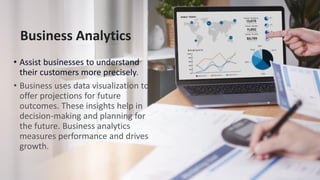
• Assist businesses to understand
their customers more precisely.
• Business uses data visualization to
offer projections for future
outcomes. These insights help in
decision-making and planning for
the future. Business analytics
measures performance and drives
growth.
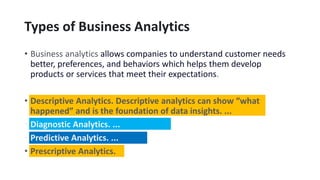
Types of Business Analytics
• Business analytics allows companies to understand customer needs
better, preferences, and behaviors which helps them develop
products or services that meet their expectations.
• Descriptive Analytics. Descriptive analytics can show “what
happened” and is the foundation of data insights. ...
• Diagnostic Analytics. ...
• Predictive Analytics. ...
• Prescriptive Analytics.
Why is
analytics
important?
• Data analytics is integral
to business because
it allows leadership to
create evidence-based
strategy, understand
customers to better
target marketing
initiatives, and increase
overall productivity.
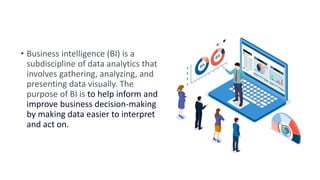
• Business intelligence (BI) is a
subdiscipline of data analytics that
involves gathering, analyzing, and
presenting data visually. The
purpose of BI is to help inform and
improve business decision-making
by making data easier to interpret
and act on.
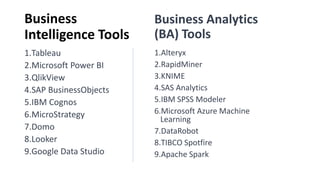
Business
Intelligence Tools
1.Tableau
2.Microsoft Power BI
3.QlikView
4.SAP BusinessObjects
5.IBM Cognos
6.MicroStrategy
7.Domo
8.Looker
9.Google Data Studio
Business Analytics
(BA) Tools
1.Alteryx
2.RapidMiner
3.KNIME
4.SAS Analytics
5.IBM SPSS Modeler
6.Microsoft Azure Machine
Learning
7.DataRobot
8.TIBCO Spotfire
9.Apache Spark
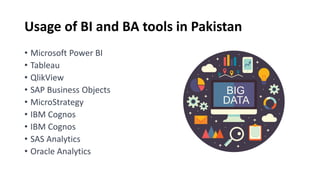
Usage of BI and BA tools in Pakistan
• Microsoft Power BI
• Tableau
• QlikView
• SAP Business Objects
• MicroStrategy
• IBM Cognos
• IBM Cognos
• SAS Analytics
• Oracle Analytics
Management And Information
Technology After Digital Transformation
Management And Information
Technology After Digital Transformation
Management And Information
Technology After Digital Transformation
Chapter
Overview
• The use of relevant data has become
essential for businesses in the current
data revolution. Extracting insights
from data through analytics is crucial
for survival and success in today's
business landscape. New technologies
and analytic solutions have made data
more accessible and have changed the
decision-making process in
organizations.
• Data, analytics, and artificial
intelligence (AI) are expected to play a
vital role in business success during
and after the COVID-19 crisis.
Analytic Solutions
• Extracting insights from data through analytics is essential for survival
and success in the modern business landscape.
• New technologies and analytic solutions have made data more accessible
and changed the decision-making process.
• Organizations aspire to become data-driven and use advanced techniques
and tools for decision-making.
• Data, analytics, and AI are expected to be imperative for business success
during and after the COVID-19 crisis.
• IT consultancy firms have opportunities to lead digital transformation
and develop solutions to help organizations overcome technical barriers.
• Inconsistent and confusing terminology in the
analytics field hinders communication and
limits the potential of the analytic
transformation.
• A common language and understanding are
needed for effective communication among
business students, researchers, and
professionals.
• This chapter focuses on the concepts of
business intelligence (BI) and business
analytics (BA), two terms frequently used
in relation to data-driven and evidence-
based decision-making.
• Business Intelligence (BI)
• Business Analytics (BA)
• Discuss these concepts in academia and
Practice
• For example, in a business context, we would use the term
“Analytics for Business”’, in more specified areas of use, Analytics
for marketing, Analytics for HRM, and so on.
• We believe that this change to the terminology would benefit firm
data-driven and evidence-based decision-making since (i) both BI and
BA are vague intermediary concepts and their exclusion would
eliminate one source of confusion, and (ii) the analytics etiquette is
more straightforward, less pretentious, more aligned to generic
skillsets and tools and simpler to integrate with organizational
capabilities.
• Our suggestion is in line, also,
with contemporary practice
implemented by leading global
consulting firms such as
McKinsey & Co., the Boston
Consulting Group, EY, and Bain
& Company.
• 17.1 Business
intelligence and
business analytics
– two concepts,
multiple
definitions:
• Business
intelligence
• Business Analytics
Difference between or relation of BI. And BA.
• Business intelligence
• Business Analytics
• It is not surprising that neither the Cambridge nor the Oxford
dictionaries define BA or BI; how could they without a common
understanding of the concepts?
• Although the use of the term ‘business
intelligence’ goes back to the late 1950s, it
became widespread only during the 1990s
(Pope 2014).
• BI is typically used as an ‘umbrella’ term to
describe a process, or concepts and
methods, that improve decision-making by
using fact-based support systems.
• Olszak (2016) summarizes definitions of BI as
• (1) Tools, technologies, and software
• (2) knowledge management
• (3) decision-support systems (DSS)
• (4) dashboards
• (5) culture of working with information
• (6) a process
• (7) analytics
• (8) competitive intelligence; and
• (9) Big data.
• BA sometimes is defined as a movement and at other times as a
collection of practices and technologies.
• Comparisons of BA and BI are equally confusing. Bayrak (2015) and
Chen et al. (2012) treat both concepts as synonymous.
• Mashingaidze and Backhouse’s (2017) work shows that BI can be
understood as part of BA or vice versa, and their academic references
show both that BI and BA are used interchangeably and that, in some
cases, BA is considered a subset of BI.
• There is a lack of consensus on the definition of Business Analytics (BA), including
whether it includes both quantitative and qualitative approaches and what its
specific ambitions are.
• The concept of BA is fuzzy and subject to confusion, with different interpretations
in business practice and academic research.
• BA and Business Intelligence (BI) are often treated as synonymous, but there is
an ongoing debate about whether BI is a subset of BA or vice versa.
• Harvard Business Analytics suggests that BI should be understood as a subset of
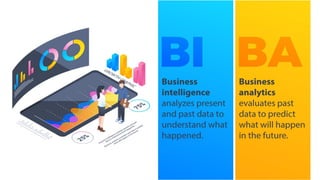
BA, with BI focusing on descriptive features and day-to-day operations, while
BA relates to prescriptive ambitions and strategic concerns.
• The conceptual confusion surrounding BA and BI persists, and the use of both
terms by practitioners and researchers may lead to further confusion.
• Surprisingly, there is a lack of debate and questioning about the conceptual
disarray in the analytics revolution and its implications.
• BA and BI – two fading concepts?
• The top consultancy firms have shifted away from using the terms
Business Analytics (BA) and Business Intelligence (BI) in their
marketing materials and service descriptions.
• Instead, they use terms like advanced analytics, Artificial
Intelligence (AI), and Big Data to describe their data-driven
offerings.
• While some consultancy firms, like Accenture and KPMG, still
include BA and BI as core concepts, others such as the Boston
Consulting Group, Bain & Company, McKinsey & Co, and EY avoid
using these terms altogether.
• This shift in terminology reflects a trend where BA and BI are no
longer the primary labels used to identify services in the management
consultancy industry.
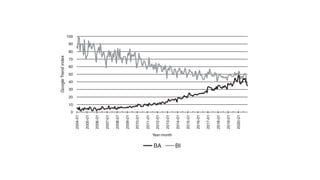
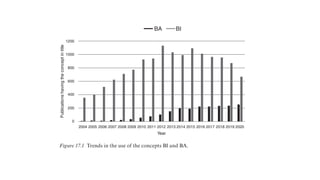
• Business Intelligence (BI) has been a core concept in the academic
research community for data-driven decision-making, but its
popularity has declined since 2012.
• The term BI is losing ground and fading in terms of usage, indicating a
decrease in hype surrounding the concept.
• Business Analytics (BA) is a relatively newer concept compared to
Business Intelligence (BI), originating in the late 1990s.
17.3 Breaking the conceptual divide
• The public sector and non-profit organizations can also benefit from
data-driven decision-making.
• The terms "intelligence" and "analytics" may be problematic.
• It is proposed to drop the notion of "intelligence" and prioritize a
more modest approach focused on "analytics."
17.4 Analytics at the expense of the BI and
the BA concepts
• Analytics refers to a structured procedure of generating insights out of data
• “Analytics is the scientific process of transforming data into insight for the
purpose of making a better decision”
• Analytics is a structured procedure that generates insights from data, involving a
thought process with the explicit purpose to address decision problems.
• The definition of analytics includes both qualitative and quantitative data and
analytic approaches as appropriate for the problem at hand.
• Terms like culture, mindset, application, craftsmanship, and technology are
excluded from the conceptualization of analytics to avoid confusion and should
be treated separately.
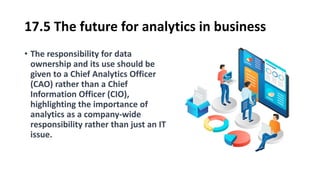
17.5 The future for analytics in business
• The responsibility for data
ownership and its use should be
given to a Chief Analytics Officer
(CAO) rather than a Chief
Information Officer (CIO),
highlighting the importance of
analytics as a company-wide
responsibility rather than just an IT
issue.
17.6 Takeaway
• Availability of more data will accelerate the
digital transformation and provide
opportunities for businesses and
organizations to create value from data.
• Being data-driven should be an
organizational effort rather than solely
relying on IT investments.
• The term "Analytics" aligns with the
developments in the broader field of
analytics and its powerful methods and
techniques.
Thanks!

Difference between Business Intelligence and Business Analytics_Mujeeb Riaz.pdf

  • 4.
    Business Analytics • Assistbusinesses to understand their customers more precisely. • Business uses data visualization to offer projections for future outcomes. These insights help in decision-making and planning for the future. Business analytics measures performance and drives growth.
  • 5.
    Types of BusinessAnalytics • Business analytics allows companies to understand customer needs better, preferences, and behaviors which helps them develop products or services that meet their expectations. • Descriptive Analytics. Descriptive analytics can show “what happened” and is the foundation of data insights. ... • Diagnostic Analytics. ... • Predictive Analytics. ... • Prescriptive Analytics.
  • 6.
    Why is analytics important? • Dataanalytics is integral to business because it allows leadership to create evidence-based strategy, understand customers to better target marketing initiatives, and increase overall productivity.
  • 8.
    • Business intelligence(BI) is a subdiscipline of data analytics that involves gathering, analyzing, and presenting data visually. The purpose of BI is to help inform and improve business decision-making by making data easier to interpret and act on.
  • 9.
    Business Intelligence Tools 1.Tableau 2.Microsoft PowerBI 3.QlikView 4.SAP BusinessObjects 5.IBM Cognos 6.MicroStrategy 7.Domo 8.Looker 9.Google Data Studio Business Analytics (BA) Tools 1.Alteryx 2.RapidMiner 3.KNIME 4.SAS Analytics 5.IBM SPSS Modeler 6.Microsoft Azure Machine Learning 7.DataRobot 8.TIBCO Spotfire 9.Apache Spark
  • 10.
    Usage of BIand BA tools in Pakistan • Microsoft Power BI • Tableau • QlikView • SAP Business Objects • MicroStrategy • IBM Cognos • IBM Cognos • SAS Analytics • Oracle Analytics
  • 11.
    Management And Information TechnologyAfter Digital Transformation Management And Information Technology After Digital Transformation Management And Information Technology After Digital Transformation Chapter Overview
  • 12.
    • The useof relevant data has become essential for businesses in the current data revolution. Extracting insights from data through analytics is crucial for survival and success in today's business landscape. New technologies and analytic solutions have made data more accessible and have changed the decision-making process in organizations. • Data, analytics, and artificial intelligence (AI) are expected to play a vital role in business success during and after the COVID-19 crisis. Analytic Solutions
  • 13.
    • Extracting insightsfrom data through analytics is essential for survival and success in the modern business landscape. • New technologies and analytic solutions have made data more accessible and changed the decision-making process. • Organizations aspire to become data-driven and use advanced techniques and tools for decision-making. • Data, analytics, and AI are expected to be imperative for business success during and after the COVID-19 crisis. • IT consultancy firms have opportunities to lead digital transformation and develop solutions to help organizations overcome technical barriers.
  • 14.
    • Inconsistent andconfusing terminology in the analytics field hinders communication and limits the potential of the analytic transformation. • A common language and understanding are needed for effective communication among business students, researchers, and professionals.
  • 15.
    • This chapterfocuses on the concepts of business intelligence (BI) and business analytics (BA), two terms frequently used in relation to data-driven and evidence- based decision-making. • Business Intelligence (BI) • Business Analytics (BA) • Discuss these concepts in academia and Practice
  • 16.
    • For example,in a business context, we would use the term “Analytics for Business”’, in more specified areas of use, Analytics for marketing, Analytics for HRM, and so on. • We believe that this change to the terminology would benefit firm data-driven and evidence-based decision-making since (i) both BI and BA are vague intermediary concepts and their exclusion would eliminate one source of confusion, and (ii) the analytics etiquette is more straightforward, less pretentious, more aligned to generic skillsets and tools and simpler to integrate with organizational capabilities.
  • 17.
    • Our suggestionis in line, also, with contemporary practice implemented by leading global consulting firms such as McKinsey & Co., the Boston Consulting Group, EY, and Bain & Company.
  • 18.
    • 17.1 Business intelligenceand business analytics – two concepts, multiple definitions: • Business intelligence • Business Analytics
  • 19.
    Difference between orrelation of BI. And BA. • Business intelligence • Business Analytics • It is not surprising that neither the Cambridge nor the Oxford dictionaries define BA or BI; how could they without a common understanding of the concepts?
  • 20.
    • Although theuse of the term ‘business intelligence’ goes back to the late 1950s, it became widespread only during the 1990s (Pope 2014). • BI is typically used as an ‘umbrella’ term to describe a process, or concepts and methods, that improve decision-making by using fact-based support systems.
  • 21.
    • Olszak (2016)summarizes definitions of BI as • (1) Tools, technologies, and software • (2) knowledge management • (3) decision-support systems (DSS) • (4) dashboards • (5) culture of working with information • (6) a process • (7) analytics • (8) competitive intelligence; and • (9) Big data.
  • 22.
    • BA sometimesis defined as a movement and at other times as a collection of practices and technologies. • Comparisons of BA and BI are equally confusing. Bayrak (2015) and Chen et al. (2012) treat both concepts as synonymous. • Mashingaidze and Backhouse’s (2017) work shows that BI can be understood as part of BA or vice versa, and their academic references show both that BI and BA are used interchangeably and that, in some cases, BA is considered a subset of BI.
  • 23.
    • There isa lack of consensus on the definition of Business Analytics (BA), including whether it includes both quantitative and qualitative approaches and what its specific ambitions are. • The concept of BA is fuzzy and subject to confusion, with different interpretations in business practice and academic research. • BA and Business Intelligence (BI) are often treated as synonymous, but there is an ongoing debate about whether BI is a subset of BA or vice versa. • Harvard Business Analytics suggests that BI should be understood as a subset of BA, with BI focusing on descriptive features and day-to-day operations, while BA relates to prescriptive ambitions and strategic concerns. • The conceptual confusion surrounding BA and BI persists, and the use of both terms by practitioners and researchers may lead to further confusion. • Surprisingly, there is a lack of debate and questioning about the conceptual disarray in the analytics revolution and its implications.
  • 24.
    • BA andBI – two fading concepts? • The top consultancy firms have shifted away from using the terms Business Analytics (BA) and Business Intelligence (BI) in their marketing materials and service descriptions. • Instead, they use terms like advanced analytics, Artificial Intelligence (AI), and Big Data to describe their data-driven offerings.
  • 25.
    • While someconsultancy firms, like Accenture and KPMG, still include BA and BI as core concepts, others such as the Boston Consulting Group, Bain & Company, McKinsey & Co, and EY avoid using these terms altogether. • This shift in terminology reflects a trend where BA and BI are no longer the primary labels used to identify services in the management consultancy industry.
  • 26.
    • Business Intelligence(BI) has been a core concept in the academic research community for data-driven decision-making, but its popularity has declined since 2012. • The term BI is losing ground and fading in terms of usage, indicating a decrease in hype surrounding the concept. • Business Analytics (BA) is a relatively newer concept compared to Business Intelligence (BI), originating in the late 1990s.
  • 29.
    17.3 Breaking theconceptual divide • The public sector and non-profit organizations can also benefit from data-driven decision-making. • The terms "intelligence" and "analytics" may be problematic. • It is proposed to drop the notion of "intelligence" and prioritize a more modest approach focused on "analytics."
  • 30.
    17.4 Analytics atthe expense of the BI and the BA concepts • Analytics refers to a structured procedure of generating insights out of data • “Analytics is the scientific process of transforming data into insight for the purpose of making a better decision” • Analytics is a structured procedure that generates insights from data, involving a thought process with the explicit purpose to address decision problems. • The definition of analytics includes both qualitative and quantitative data and analytic approaches as appropriate for the problem at hand. • Terms like culture, mindset, application, craftsmanship, and technology are excluded from the conceptualization of analytics to avoid confusion and should be treated separately.
  • 31.
    17.5 The futurefor analytics in business • The responsibility for data ownership and its use should be given to a Chief Analytics Officer (CAO) rather than a Chief Information Officer (CIO), highlighting the importance of analytics as a company-wide responsibility rather than just an IT issue.
  • 32.
    17.6 Takeaway • Availabilityof more data will accelerate the digital transformation and provide opportunities for businesses and organizations to create value from data. • Being data-driven should be an organizational effort rather than solely relying on IT investments. • The term "Analytics" aligns with the developments in the broader field of analytics and its powerful methods and techniques.
  • 33.