Social Identity Theory
Dulan Mahendra (B.Sc.)
Social Identity Theory (SIT)
 Henri Tajfel’s theory is all about becoming part of different groups, and how
membership to these groups helps construct our identities
 They suggested that people have an inbuilt tendency to categorize themselves
into one or more in-groups , building a part of their identity on the basis of
membership of that group and enforcing boundaries with other groups
Major foundational concepts
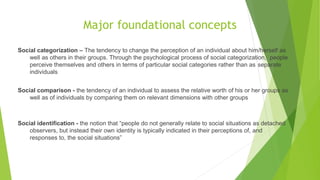
Social categorization – The tendency to change the perception of an individual about him/herself as
well as others in their groups. Through the psychological process of social categorization, people
perceive themselves and others in terms of particular social categories rather than as separate
individuals
Social comparison - the tendency of an individual to assess the relative worth of his or her groups as
well as of individuals by comparing them on relevant dimensions with other groups
Social identification - the notion that “people do not generally relate to social situations as detached
observers, but instead their own identity is typically indicated in their perceptions of, and
responses to, the social situations”
 Strength
 Shows that conflict between groups is not necessary to lead to discrimination.
 Explains how “positive distinctiveness” occurs for in-groups.
 Helps us understand in-group favoritism, conformity to group norms, and
stereotypes
 Weaknesses
 Tajfel’s research has been criticized for low ecological validity.
 Does not fully explain why in-group favoritism may result in violent behavior
towards out-groups
 Does not explain why constraints such as poverty could play a bigger role than SITs
Strength and weakness of SIT
Social Identity theory application in
leadership
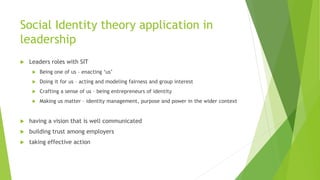
 Leaders roles with SIT
 Being one of us – enacting ‘us’
 Doing it for us – acting and modeling fairness and group interest
 Crafting a sense of us – being entrepreneurs of identity
 Making us matter – identity management, purpose and power in the wider context
 having a vision that is well communicated
 building trust among employers
 taking effective action
Traits of personality
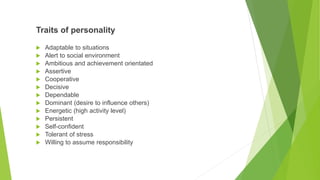
 Adaptable to situations
 Alert to social environment
 Ambitious and achievement orientated
 Assertive
 Cooperative
 Decisive
 Dependable
 Dominant (desire to influence others)
 Energetic (high activity level)
 Persistent
 Self-confident
 Tolerant of stress
 Willing to assume responsibility
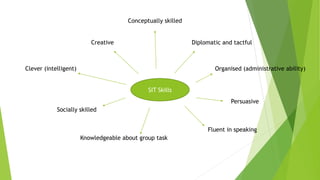
SIT Skills
Clever (intelligent)
Conceptually skilled
Creative
Organised (administrative ability)
Diplomatic and tactful
Fluent in speaking
Knowledgeable about group task
Persuasive
Socially skilled
 Accountability the state of being accountable, liable, or answerable
 Responsibility (for objects, tasks or people) can be delegated but accountability
cannot – buck stops with you!
 Accepts ultimate responsibility:
 will give credit to others when delegated responsibilities succeed
 will accept blame when delegated responsibilities fail
 Accountability cannot operate fairly without the leader being given full authority for
the responsibilities concerned
 Authority is the power to influence or command thought, opinion or behaviour
Accountability, Responsibility, and Authority
 Merrill accepts emphatically in a way of thinking of sharing his benefits and
his family riches with others less fortunate. Merrill accepts emphatically in a
way of thinking of sharing his benefits and his family riches with others less
blessed
 Charity is a significant part of his life and also permeates his business. For
example, Dilmah Tea supports the Ronald McDonald Houses, the Children’s
Leukemia and Cancer Research Foundation in Australia, as well as the hospice
movement in New Zealand
 strong emphasis on staff welfare - He provides free in-house staff medical
facilities and financial assistance for the education of their children. Merrill
concerns himself with the wellbeing of his followers, who he treats like
members of his family
Example
Mr. Merril J. Fernando – Founder of Dilmah
Teas
 Merrill J. Fernando, passion blended with "dedication". A man who dedicated
his life to tea and the tea drinker, his passion over the years has remained
unchanged
 Every decision and action he took was guided by his vision, to build a brand of
his At a time when many thought that building a brand for tea was not a
feasible proposition in fact used various means to discourage the work of
Fernando, he challenged this notion marched forward to make his dream a
reality
 Fernando to date tastes up to 5000 cup of tea a month and is one of the very
few makers of tea who develops his own tea
 a visionary who believes anything is possible if you commit yourself to it –
developing his brand to international

Social identity theory 1

  • 1.
  • 2.
    Social Identity Theory(SIT)  Henri Tajfel’s theory is all about becoming part of different groups, and how membership to these groups helps construct our identities  They suggested that people have an inbuilt tendency to categorize themselves into one or more in-groups , building a part of their identity on the basis of membership of that group and enforcing boundaries with other groups
  • 3.
    Major foundational concepts Socialcategorization – The tendency to change the perception of an individual about him/herself as well as others in their groups. Through the psychological process of social categorization, people perceive themselves and others in terms of particular social categories rather than as separate individuals Social comparison - the tendency of an individual to assess the relative worth of his or her groups as well as of individuals by comparing them on relevant dimensions with other groups Social identification - the notion that “people do not generally relate to social situations as detached observers, but instead their own identity is typically indicated in their perceptions of, and responses to, the social situations”
  • 4.
     Strength  Showsthat conflict between groups is not necessary to lead to discrimination.  Explains how “positive distinctiveness” occurs for in-groups.  Helps us understand in-group favoritism, conformity to group norms, and stereotypes  Weaknesses  Tajfel’s research has been criticized for low ecological validity.  Does not fully explain why in-group favoritism may result in violent behavior towards out-groups  Does not explain why constraints such as poverty could play a bigger role than SITs Strength and weakness of SIT
  • 5.
    Social Identity theoryapplication in leadership  Leaders roles with SIT  Being one of us – enacting ‘us’  Doing it for us – acting and modeling fairness and group interest  Crafting a sense of us – being entrepreneurs of identity  Making us matter – identity management, purpose and power in the wider context  having a vision that is well communicated  building trust among employers  taking effective action
  • 6.
    Traits of personality Adaptable to situations  Alert to social environment  Ambitious and achievement orientated  Assertive  Cooperative  Decisive  Dependable  Dominant (desire to influence others)  Energetic (high activity level)  Persistent  Self-confident  Tolerant of stress  Willing to assume responsibility
  • 7.
    SIT Skills Clever (intelligent) Conceptuallyskilled Creative Organised (administrative ability) Diplomatic and tactful Fluent in speaking Knowledgeable about group task Persuasive Socially skilled
  • 8.
     Accountability thestate of being accountable, liable, or answerable  Responsibility (for objects, tasks or people) can be delegated but accountability cannot – buck stops with you!  Accepts ultimate responsibility:  will give credit to others when delegated responsibilities succeed  will accept blame when delegated responsibilities fail  Accountability cannot operate fairly without the leader being given full authority for the responsibilities concerned  Authority is the power to influence or command thought, opinion or behaviour Accountability, Responsibility, and Authority
  • 9.
     Merrill acceptsemphatically in a way of thinking of sharing his benefits and his family riches with others less fortunate. Merrill accepts emphatically in a way of thinking of sharing his benefits and his family riches with others less blessed  Charity is a significant part of his life and also permeates his business. For example, Dilmah Tea supports the Ronald McDonald Houses, the Children’s Leukemia and Cancer Research Foundation in Australia, as well as the hospice movement in New Zealand  strong emphasis on staff welfare - He provides free in-house staff medical facilities and financial assistance for the education of their children. Merrill concerns himself with the wellbeing of his followers, who he treats like members of his family Example Mr. Merril J. Fernando – Founder of Dilmah Teas
  • 10.
     Merrill J.Fernando, passion blended with "dedication". A man who dedicated his life to tea and the tea drinker, his passion over the years has remained unchanged  Every decision and action he took was guided by his vision, to build a brand of his At a time when many thought that building a brand for tea was not a feasible proposition in fact used various means to discourage the work of Fernando, he challenged this notion marched forward to make his dream a reality  Fernando to date tastes up to 5000 cup of tea a month and is one of the very few makers of tea who develops his own tea  a visionary who believes anything is possible if you commit yourself to it – developing his brand to international