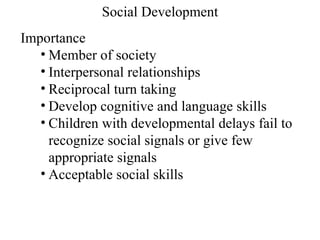
Social Development Importance Member of society Interpersonal relationships Reciprocal turn taking Develop cognitive and language skills Children with developmental delays fail to recognize social signals or give few appropriate signals Acceptable social skills
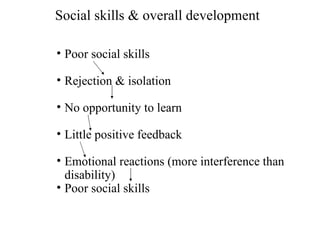
Social skills & overall development Poor social skills Rejection & isolation No opportunity to learn Little positive feedback Emotional reactions (more interference than disability) Poor social skills
Acquiring Appropriate Social skills Expectations of the group Variations/contradictions Unable to discriminate Acquiring social skills Temperament & emotions Social responsiveness Impact of developmental problems *Alternate signals and cues for      responsiveness *Overstimulation and overresponsiveness Social skills in sequence
Play Unoccupied behavior Onlooker behavior Solitary play Parallel play Associative play Cooperative play Teaching children to play Mastery through play/Fewer play skills Review choices several times Peer involvement geared to maximum success Gentle insistence
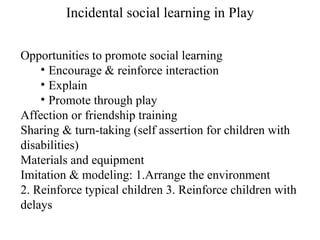
Incidental social learning in Play Opportunities to promote social learning Encourage & reinforce interaction Explain  Promote through play Affection or friendship training Sharing & turn-taking (self assertion for children with disabilities) Materials and equipment Imitation & modeling: 1.Arrange the environment  2. Reinforce typical children 3. Reinforce children with delays
Social Skills Needed Body basics Active listening Greeting Answering questions Saying goodbye Asking questions Introducing self Interrupting Making friends Thanks: saying & accepting Compliments Apologizing Accepting no Resisting peer pressure Responding to teasing Criticism
Following instructions Getting help Joining activities Asking for help Accepting responsibility
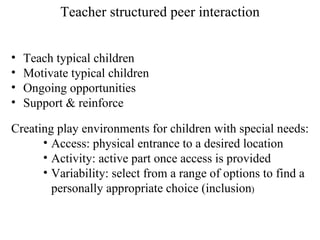
Teacher structured peer interaction Teach typical children Motivate typical children Ongoing opportunities Support & reinforce Creating play environments for children with special needs: Access: physical entrance to a desired location Activity: active part once access is provided Variability: select from a range of options to find a personally appropriate choice (inclusion )

Social development

  • 1.
    Social Development ImportanceMember of society Interpersonal relationships Reciprocal turn taking Develop cognitive and language skills Children with developmental delays fail to recognize social signals or give few appropriate signals Acceptable social skills
  • 2.
    Social skills &overall development Poor social skills Rejection & isolation No opportunity to learn Little positive feedback Emotional reactions (more interference than disability) Poor social skills
  • 3.
    Acquiring Appropriate Socialskills Expectations of the group Variations/contradictions Unable to discriminate Acquiring social skills Temperament & emotions Social responsiveness Impact of developmental problems *Alternate signals and cues for responsiveness *Overstimulation and overresponsiveness Social skills in sequence
  • 4.
    Play Unoccupied behaviorOnlooker behavior Solitary play Parallel play Associative play Cooperative play Teaching children to play Mastery through play/Fewer play skills Review choices several times Peer involvement geared to maximum success Gentle insistence
  • 5.
    Incidental social learningin Play Opportunities to promote social learning Encourage & reinforce interaction Explain Promote through play Affection or friendship training Sharing & turn-taking (self assertion for children with disabilities) Materials and equipment Imitation & modeling: 1.Arrange the environment 2. Reinforce typical children 3. Reinforce children with delays
  • 6.
    Social Skills NeededBody basics Active listening Greeting Answering questions Saying goodbye Asking questions Introducing self Interrupting Making friends Thanks: saying & accepting Compliments Apologizing Accepting no Resisting peer pressure Responding to teasing Criticism
  • 7.
    Following instructions Gettinghelp Joining activities Asking for help Accepting responsibility
  • 8.
    Teacher structured peerinteraction Teach typical children Motivate typical children Ongoing opportunities Support & reinforce Creating play environments for children with special needs: Access: physical entrance to a desired location Activity: active part once access is provided Variability: select from a range of options to find a personally appropriate choice (inclusion )