Social Skills
Development
Mayra DiBetta
University of Phoenix: AUT-503
Social Skill Development
Research
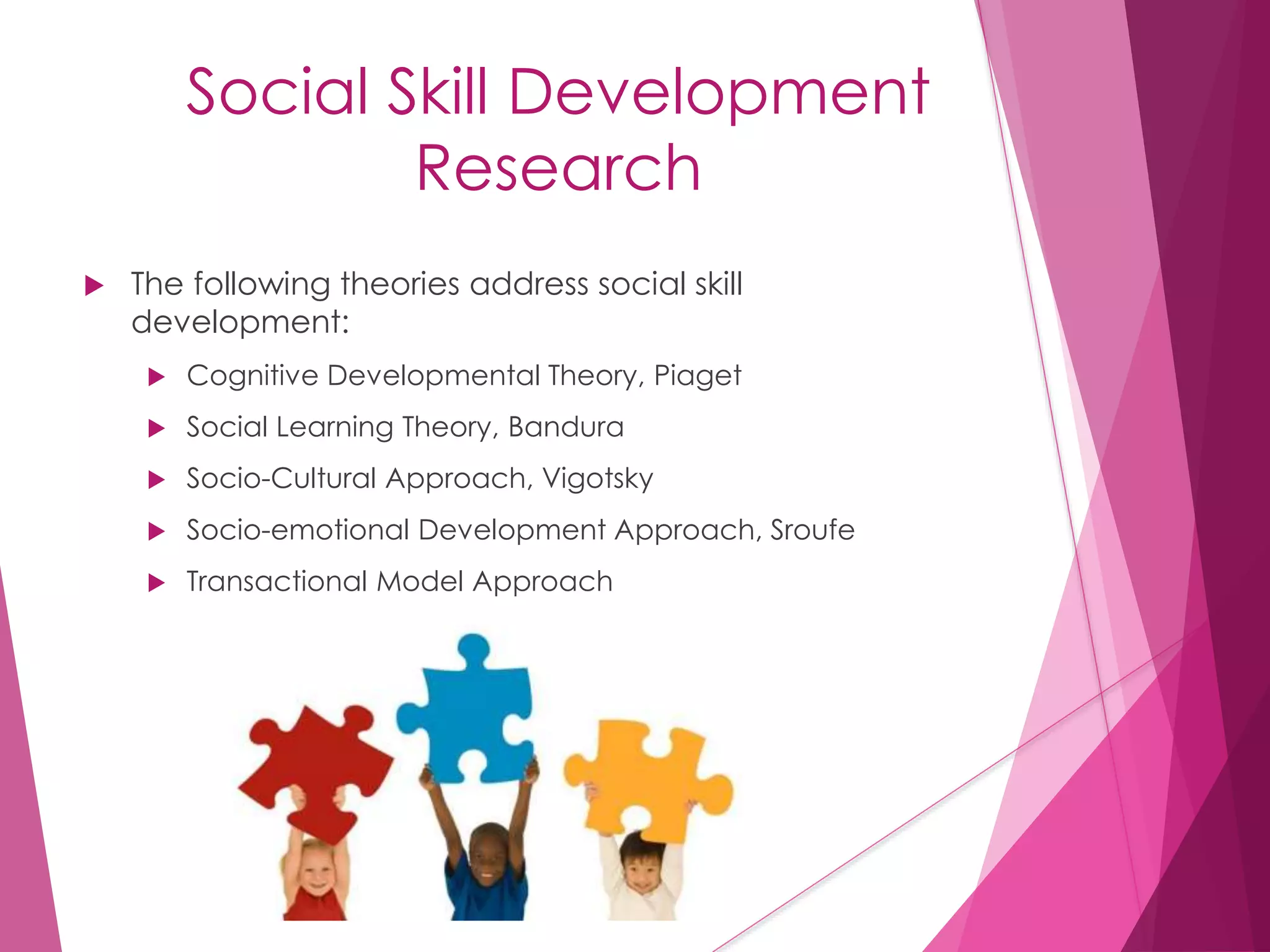
 The following theories address social skill
development:
 Cognitive Developmental Theory, Piaget
 Social Learning Theory, Bandura
 Socio-Cultural Approach, Vigotsky
 Socio-emotional Development Approach, Sroufe
 Transactional Model Approach
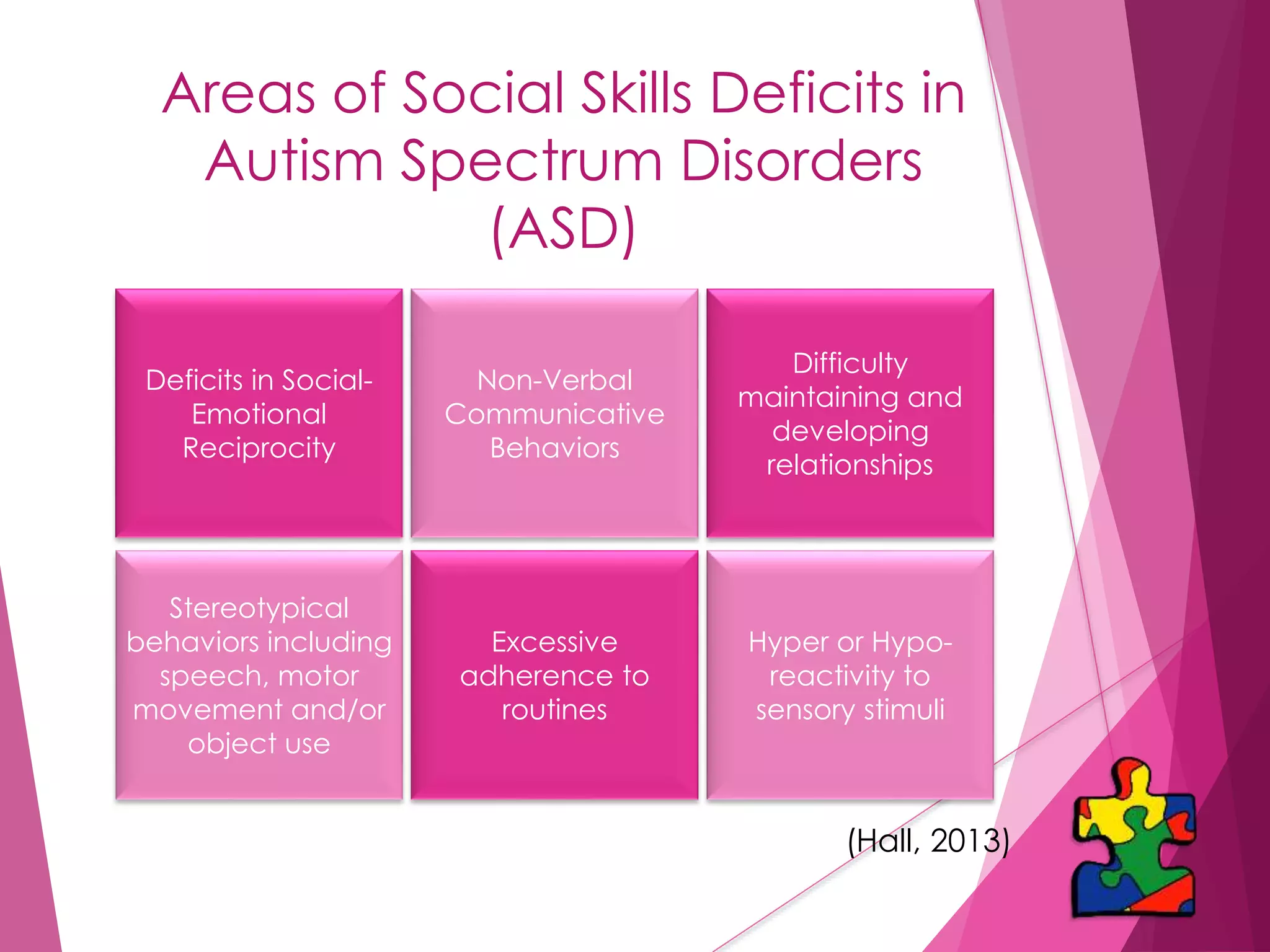
Areas of Social Skills Deficits in
Autism Spectrum Disorders
(ASD)
Deficits in Social-
Emotional
Reciprocity
Non-Verbal
Communicative
Behaviors
Difficulty
maintaining and
developing
relationships
Stereotypical
behaviors including
speech, motor
movement and/or
object use
Excessive
adherence to
routines
Hyper or Hypo-
reactivity to
sensory stimuli
(Hall, 2013)
Social Communication
Social Communication requires that individuals adapt how they
speak and otherwise communicate in a social situation.
Individuals with ASD struggle in engaging in effective conversations,
taking turns while speaking, adjusting speech to different situations
and places, etcetera. Here are two scenarios in which this is
illustrated:
Example #1: Johnny is a 9 year-old boy, he really enjoys Minecraft.
On the playground he goes up to an unknown boy who is talking
about a test he just finished, and says “Minecraft is my favorite,
when I go home I am going to play and then I will be watching
YouTube videos on how to build more stuff, and then I will see if my
mom will take me to the store to buy some more Minecraft toys”. The
boy walks away because he has no idea what Johnny is talking
about.
Example #2: Billy just arrived in the classroom while the class is
watching a video about the Independence of the U.S.
He blurts out that he is here and he needs to tell the class all about
his day at the doctor’s office. All the students in the class are
annoyed because he is interrupting their documentary.
Social Initiation
Social Initiation occurs when an individual initiates contact with
another individual or an object. Children with autism have a
difficult time entering conversations, initiating greetings of their
peers or adults around them, etcetera. This hinders their ability to
develop relationships and friendships with others.
Example #1: Carson arrives to school every day by bus, when he is
dropped off and retrieved from the bus by his teacher or
paraprofessional he never greets them. Upon joining his peers in
the classroom, he does not greet them either. He is able to
respond when greeted but he does not take the initiative to show
any interest in others.
Example #2: Mary really wants to play with other girls on the
playground. Instead of introducing herself, saying she really likes
the game and asking if she can join in; she simply bumps the girls
from what they are doing and takes over; all the girls walk away
mad at Mary for taking their spot.
Social Reciprocity
Social reciprocity is the back-and-forth flow of social interaction.
The term reciprocity refers to how the behavior of one person
influences and is influenced by the behavior of another person
and vice versa (Baltimore Autism Society, n.d.)
Example #1: Roxy is a 7 year-old girl, she has been diagnosed with
Asperger’s. She receives instruction in the general education
setting. She is having a difficult time because she only wants to talk
about My Little Pony. When other students are around her and try
to change the topic Roxy does not show any interest in the subject
and immediately returns to speaking about My Little Pony.
Example #2: Kingsley is a 12 year old boy with autism. During social
skills time, his teacher allows the students to chose one activity to
do as a group. As a class they select to play a game on the Smart
Board. Kingsley loses during his first attempt and takes over the
second player’s turn. He then takes over the next player’s turn and
when he is asked by his teacher to take turns he throws a temper
tantrum. His peers request that he no longer be allowed to play so
that they are able to finish the game.
Social Cognition
Social cognition involves how we think about all things social, how we
interpret other people’s actions and how we adjust our own actions
based on the reactions of others (Dunn Buron, 2009). Students with
autism have a difficult time understanding gestures, feelings and
demonstrating sympathy and empathy.
Example #1: Alice is a 4 year old girl, her mother has noticed that Alice
does not appropriately respond to other people’s body language. For
instance, she went to visit her friend Ashly and pulled her hair. After a
minute or so, Ashly cried in pain, however, Alice was unable to tell her
playmate was in pain from her expression or reaction.
Example #2: Joe is a fifth grade boy with autism, he attends some classes
in the general education setting and sits with his peers at lunch. During
lunch some of his peers were picking on Sam for having “farted” in class
that morning. Joe arrived to his general education class in the afternoon
and the first thing he said was “Ha! Sam farted!” Everyone glared at him
because it was no longer funny and it was irrelevant at that point. Sam’s
feelings were hurt and Joe was unable to realize this until the teacher
had a conversation with him about the occurrence.
References
 Baltimore Autism Society,
http://www.baltimoreautismsociety.org/glossary/term/social-
reciprocity/
 Kari Dunn Buron – April 3, 2009
http://www.education.com/reference/article/social-
cognition-teach-autism/
 Hall, L. J. (2013). Autism spectrum disorders: From theory to
practice (2nd ed.). Upper Saddle River, NJ: Pearson Education.

Social skills development

  • 1.
  • 2.
    Social Skill Development Research The following theories address social skill development:  Cognitive Developmental Theory, Piaget  Social Learning Theory, Bandura  Socio-Cultural Approach, Vigotsky  Socio-emotional Development Approach, Sroufe  Transactional Model Approach
  • 3.
    Areas of SocialSkills Deficits in Autism Spectrum Disorders (ASD) Deficits in Social- Emotional Reciprocity Non-Verbal Communicative Behaviors Difficulty maintaining and developing relationships Stereotypical behaviors including speech, motor movement and/or object use Excessive adherence to routines Hyper or Hypo- reactivity to sensory stimuli (Hall, 2013)
  • 4.
    Social Communication Social Communicationrequires that individuals adapt how they speak and otherwise communicate in a social situation. Individuals with ASD struggle in engaging in effective conversations, taking turns while speaking, adjusting speech to different situations and places, etcetera. Here are two scenarios in which this is illustrated: Example #1: Johnny is a 9 year-old boy, he really enjoys Minecraft. On the playground he goes up to an unknown boy who is talking about a test he just finished, and says “Minecraft is my favorite, when I go home I am going to play and then I will be watching YouTube videos on how to build more stuff, and then I will see if my mom will take me to the store to buy some more Minecraft toys”. The boy walks away because he has no idea what Johnny is talking about. Example #2: Billy just arrived in the classroom while the class is watching a video about the Independence of the U.S. He blurts out that he is here and he needs to tell the class all about his day at the doctor’s office. All the students in the class are annoyed because he is interrupting their documentary.
  • 5.
    Social Initiation Social Initiationoccurs when an individual initiates contact with another individual or an object. Children with autism have a difficult time entering conversations, initiating greetings of their peers or adults around them, etcetera. This hinders their ability to develop relationships and friendships with others. Example #1: Carson arrives to school every day by bus, when he is dropped off and retrieved from the bus by his teacher or paraprofessional he never greets them. Upon joining his peers in the classroom, he does not greet them either. He is able to respond when greeted but he does not take the initiative to show any interest in others. Example #2: Mary really wants to play with other girls on the playground. Instead of introducing herself, saying she really likes the game and asking if she can join in; she simply bumps the girls from what they are doing and takes over; all the girls walk away mad at Mary for taking their spot.
  • 6.
    Social Reciprocity Social reciprocityis the back-and-forth flow of social interaction. The term reciprocity refers to how the behavior of one person influences and is influenced by the behavior of another person and vice versa (Baltimore Autism Society, n.d.) Example #1: Roxy is a 7 year-old girl, she has been diagnosed with Asperger’s. She receives instruction in the general education setting. She is having a difficult time because she only wants to talk about My Little Pony. When other students are around her and try to change the topic Roxy does not show any interest in the subject and immediately returns to speaking about My Little Pony. Example #2: Kingsley is a 12 year old boy with autism. During social skills time, his teacher allows the students to chose one activity to do as a group. As a class they select to play a game on the Smart Board. Kingsley loses during his first attempt and takes over the second player’s turn. He then takes over the next player’s turn and when he is asked by his teacher to take turns he throws a temper tantrum. His peers request that he no longer be allowed to play so that they are able to finish the game.
  • 7.
    Social Cognition Social cognitioninvolves how we think about all things social, how we interpret other people’s actions and how we adjust our own actions based on the reactions of others (Dunn Buron, 2009). Students with autism have a difficult time understanding gestures, feelings and demonstrating sympathy and empathy. Example #1: Alice is a 4 year old girl, her mother has noticed that Alice does not appropriately respond to other people’s body language. For instance, she went to visit her friend Ashly and pulled her hair. After a minute or so, Ashly cried in pain, however, Alice was unable to tell her playmate was in pain from her expression or reaction. Example #2: Joe is a fifth grade boy with autism, he attends some classes in the general education setting and sits with his peers at lunch. During lunch some of his peers were picking on Sam for having “farted” in class that morning. Joe arrived to his general education class in the afternoon and the first thing he said was “Ha! Sam farted!” Everyone glared at him because it was no longer funny and it was irrelevant at that point. Sam’s feelings were hurt and Joe was unable to realize this until the teacher had a conversation with him about the occurrence.
  • 8.
    References  Baltimore AutismSociety, http://www.baltimoreautismsociety.org/glossary/term/social- reciprocity/  Kari Dunn Buron – April 3, 2009 http://www.education.com/reference/article/social- cognition-teach-autism/  Hall, L. J. (2013). Autism spectrum disorders: From theory to practice (2nd ed.). Upper Saddle River, NJ: Pearson Education.