


Social
Constructivism(SC)


Hasnain Zafar Baloch
    e-learning
Contents
•   Introduction
•   Zone of Proximal Development (ZPD)
•   Example of SC Pedagogy
•   Gaming Module in MOODLE
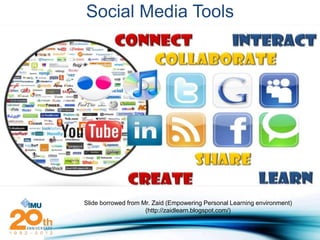
•   Social Media Tools
•   Q&A
Introduction
• A self-regulatory process of struggling with
  the conflict between existing personal
  models of the world and discrepant new
  insights. (Fosnot 1996)
• Constructing new representations and
  models through cooperative social activity,
  discourse, and debate. (Fosnot 1996)
• “large amount of adult learning is
  informal”. Knowles (1998, 67)
Introduction
• Active Role for Learner, Teacher as Facilitator
• Virtual Mobility
• Knowledge is Gain by Social
  Interaction(Flipped Classroom)
• Shared experience not individual experience.
• learn together to inquire and create
  knowledge on the basis of their experiences
  (Basu 2011)
• Feedback, Conversational Model (Diana
  Lauriallard 1994)
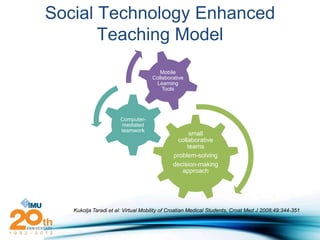
Social Technology Enhanced
       Teaching Model
                                       Mobile
                                    Collaborative
                                     Learning
                                        Tools


                      Computer-
                      mediated
                      teamwork
                                                   small
                                              collaborative
                                                  teams
                                             problem-solving
                                             decision-making
                                                approach


   Kukolja Taradi et al: Virtual Mobility of Croatian Medical Students, Croat Med J 2008;49:344-351
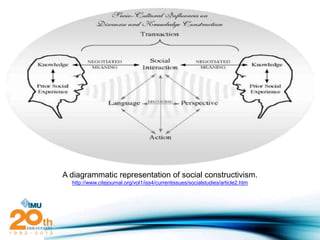
A diagrammatic representation of social constructivism.
  http://www.citejournal.org/vol1/iss4/currentissues/socialstudies/article2.htm
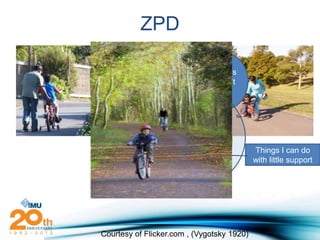
ZPD

                                Things
                                I can’t
                                  do


              Things I Can do
                                            Things I can do
                                            with little support


Courtesy of Flicker.com , (Vygotsky 1920)
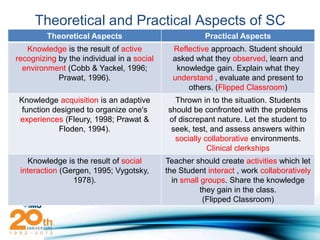
Theoretical and Practical Aspects of SC
         Theoretical Aspects                           Practical Aspects
   Knowledge is the result of active          Reflective approach. Student should
recognizing by the individual in a social     asked what they observed, learn and
  environment (Cobb & Yackel, 1996;            knowledge gain. Explain what they
            Prawat, 1996).                    understand , evaluate and present to
                                                  others. (Flipped Classroom)
 Knowledge acquisition is an adaptive         Thrown in to the situation. Students
  function designed to organize one's       should be confronted with the problems
 experiences (Fleury, 1998; Prawat &        of discrepant nature. Let the student to
             Floden, 1994).                  seek, test, and assess answers within
                                              socially collaborative environments.
                                                        Clinical clerkships
   Knowledge is the result of social        Teacher should create activities which let
 interaction (Gergen, 1995; Vygotsky,       the Student interact , work collaboratively
                1978).                        in small groups. Share the knowledge
                                                       they gain in the class.
                                                        (Flipped Classroom)
http://pkab.files.wordpress.com/2008/04/hmm_constructivism.gif
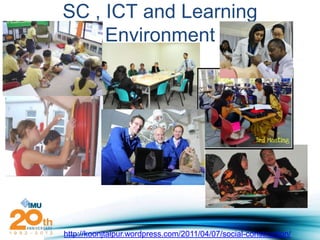
SC , ICT and Learning
     Environment


http://koonjtalpur.wordpress.com/2011/04/07/social-construction/
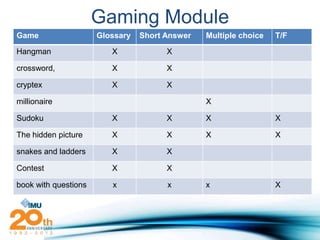
Gaming Module
Game                  Glossary   Short Answer   Multiple choice   T/F

Hangman                  X             X

crossword,               X             X

cryptex                  X             X

millionaire                                     X

Sudoku                   X             X        X                 X

The hidden picture       X             X        X                 X

snakes and ladders       X             X

Contest                  X             X

book with questions      x             x        x                 X
Moodle Examples
Live Moodle Demo


http://play2learn.gr/moodle/mod/game/index.php?id=18
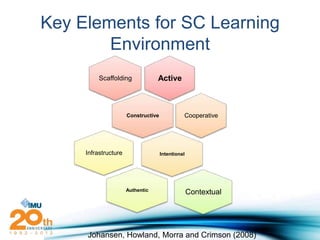
Key Elements for SC Learning
        Environment
          Scaffolding             Active


                      Constructive             Cooperative


     Infrastructure                  Intentional


                      Authentic
                                                   Contextual


     Johansen, Howland, Morra and Crimson (2008)
Social Media Tools


Slide borrowed from Mr. Zaid (Empowering Personal Learning environment)
                     (http://zaidlearn.blogspot.com/)
Interactive Web Technologies


            http://www.stixy.com/
Simulator Examples
References
•      Basu A. et al. (2011) Integrating Medical Education with Medical Practice: Role of Web 2.0 Tools, www.igi-
       global.com/chapter/integrating-medical-education-medicalpractice/49268
•      Doolottle, P.E. (2001). The need to leverage theory in the development of guidelines for using technology in social studies
       teacher preparation: A reply to Crocco and Mason et al. Contemporary Issues in Technology and Teacher Education
       [Online serial] , 1 (4) . Available: http://www.citejournal.org/vol1/iss4/currentissues/socialstudies/article2.htm
•      Doolottle, P.E. (2001). The need to leverage theory in the development of guidelines for using technology in social studies
       teacher preparation: A reply to Crocco and Mason et al. Contemporary Issues in Technology and Teacher Education
       [Online serial] , 1 (4) . Available: http://www.citejournal.org/vol1/iss4/currentissues/socialstudies/article2.htm
•      Fosnot, C. T. (1996). Constructivism: Theory, perspective, and practice. New York: Teachers College Press.
•      Laurillard, D. (1994) Multimedia and the changing experience of the learner, In Ryan, M. (ed.) Proceedings of Asia Pacific
       Information Technology in Training and Education Conference and Exhibition: APITITE 94. Brisbane. Australia. Vol. 1. pp.
       19-24
•      Knolwes, M.S. Holton, E.F. and Swanson, R.A. (1998) The Adult Learner: The Definitive Classic in Adult Education and
       Human Resource Development. 5th Edition. MA. Butterwirth-Heinemann.
•      University of Warwick’s Medical School , http://education.icnetwork.co.uk/midlands-education-
       news/2012/03/15/birmingham-student-designs-world-leading-3d-anatomy-model-65233-30537638/
•      Weill Cornell Medical College, Cornell University ,
       http://ezramagazine.cornell.edu/update/April11/EU.WCMC.anatomy.donors.html
•      http://www.perdanauniversity.edu.my/pugsom/
•      Ice Storm is a healthcare simulation training program. Demonstrated at the MT3 Conference in Orlando, Florida.
       http://www.youtube.com/watch?v=KPJz_evaQwk
    • http://www.uthsc.edu/allied/
    • http://www.rgbstock.com/download/melodi2/mjYxU8O.jpg
Social constructivism(sc)24v1

Social constructivism(sc)24v1

  • 1.
  • 2.
    Contents • Introduction • Zone of Proximal Development (ZPD) • Example of SC Pedagogy • Gaming Module in MOODLE • Social Media Tools • Q&A
  • 3.
    Introduction • A self-regulatoryprocess of struggling with the conflict between existing personal models of the world and discrepant new insights. (Fosnot 1996) • Constructing new representations and models through cooperative social activity, discourse, and debate. (Fosnot 1996) • “large amount of adult learning is informal”. Knowles (1998, 67)
  • 4.
    Introduction • Active Rolefor Learner, Teacher as Facilitator • Virtual Mobility • Knowledge is Gain by Social Interaction(Flipped Classroom) • Shared experience not individual experience. • learn together to inquire and create knowledge on the basis of their experiences (Basu 2011) • Feedback, Conversational Model (Diana Lauriallard 1994)
  • 5.
    Social Technology Enhanced Teaching Model Mobile Collaborative Learning Tools Computer- mediated teamwork small collaborative teams problem-solving decision-making approach Kukolja Taradi et al: Virtual Mobility of Croatian Medical Students, Croat Med J 2008;49:344-351
  • 6.
    A diagrammatic representationof social constructivism. http://www.citejournal.org/vol1/iss4/currentissues/socialstudies/article2.htm
  • 7.
    ZPD Things I can’t do Things I Can do Things I can do with little support Courtesy of Flicker.com , (Vygotsky 1920)
  • 8.
    Theoretical and PracticalAspects of SC Theoretical Aspects Practical Aspects Knowledge is the result of active Reflective approach. Student should recognizing by the individual in a social asked what they observed, learn and environment (Cobb & Yackel, 1996; knowledge gain. Explain what they Prawat, 1996). understand , evaluate and present to others. (Flipped Classroom) Knowledge acquisition is an adaptive Thrown in to the situation. Students function designed to organize one's should be confronted with the problems experiences (Fleury, 1998; Prawat & of discrepant nature. Let the student to Floden, 1994). seek, test, and assess answers within socially collaborative environments. Clinical clerkships Knowledge is the result of social Teacher should create activities which let interaction (Gergen, 1995; Vygotsky, the Student interact , work collaboratively 1978). in small groups. Share the knowledge they gain in the class. (Flipped Classroom)
  • 9.
  • 10.
    SC , ICTand Learning Environment http://koonjtalpur.wordpress.com/2011/04/07/social-construction/
  • 11.
    Gaming Module Game Glossary Short Answer Multiple choice T/F Hangman X X crossword, X X cryptex X X millionaire X Sudoku X X X X The hidden picture X X X X snakes and ladders X X Contest X X book with questions x x x X
  • 12.
  • 13.
  • 14.
    Key Elements forSC Learning Environment Scaffolding Active Constructive Cooperative Infrastructure Intentional Authentic Contextual Johansen, Howland, Morra and Crimson (2008)
  • 15.
    Social Media Tools Slideborrowed from Mr. Zaid (Empowering Personal Learning environment) (http://zaidlearn.blogspot.com/)
  • 16.
    Interactive Web Technologies http://www.stixy.com/
  • 17.
  • 18.
    References • Basu A. et al. (2011) Integrating Medical Education with Medical Practice: Role of Web 2.0 Tools, www.igi- global.com/chapter/integrating-medical-education-medicalpractice/49268 • Doolottle, P.E. (2001). The need to leverage theory in the development of guidelines for using technology in social studies teacher preparation: A reply to Crocco and Mason et al. Contemporary Issues in Technology and Teacher Education [Online serial] , 1 (4) . Available: http://www.citejournal.org/vol1/iss4/currentissues/socialstudies/article2.htm • Doolottle, P.E. (2001). The need to leverage theory in the development of guidelines for using technology in social studies teacher preparation: A reply to Crocco and Mason et al. Contemporary Issues in Technology and Teacher Education [Online serial] , 1 (4) . Available: http://www.citejournal.org/vol1/iss4/currentissues/socialstudies/article2.htm • Fosnot, C. T. (1996). Constructivism: Theory, perspective, and practice. New York: Teachers College Press. • Laurillard, D. (1994) Multimedia and the changing experience of the learner, In Ryan, M. (ed.) Proceedings of Asia Pacific Information Technology in Training and Education Conference and Exhibition: APITITE 94. Brisbane. Australia. Vol. 1. pp. 19-24 • Knolwes, M.S. Holton, E.F. and Swanson, R.A. (1998) The Adult Learner: The Definitive Classic in Adult Education and Human Resource Development. 5th Edition. MA. Butterwirth-Heinemann. • University of Warwick’s Medical School , http://education.icnetwork.co.uk/midlands-education- news/2012/03/15/birmingham-student-designs-world-leading-3d-anatomy-model-65233-30537638/ • Weill Cornell Medical College, Cornell University , http://ezramagazine.cornell.edu/update/April11/EU.WCMC.anatomy.donors.html • http://www.perdanauniversity.edu.my/pugsom/ • Ice Storm is a healthcare simulation training program. Demonstrated at the MT3 Conference in Orlando, Florida. http://www.youtube.com/watch?v=KPJz_evaQwk • http://www.uthsc.edu/allied/ • http://www.rgbstock.com/download/melodi2/mjYxU8O.jpg

Editor's Notes

  • #6 ID strategy: MCL, Theme : Computer mediated teamwork using Social media tools. Methodology: small collaborative teams; Problem solving , decision-making approachWe can achieve not only active learning but interactive also.
  • #9 discrepant confronting nature
  • #14 http://jcc.goto-school.com/course/
  • #15 Active – students should be actively involved in what they are doing and should be active participants who are free to manipulate their environment. For example, in mathematics students should be allowed to experiment and risk not immediately finding the correct solution in solving a problem.Constructive – students should be given the opportunity to reflect upon what they have learnt and construct their own mental model of what happened that led them to find the correct solution.Intentional – tasks should be goal directed with students striving towards cognitive goals.Authentic – tasks should be authentic, that is they should be based on real world problem solving and thereby meaningful to the student.Cooperative – students should work together in pairs or in small groups to achieve goals. This improves cooperation and communication.