1
Sociology Grad Student Prelim Experience Survey Report
Compiled and Analyzed by: Gina Spitz
This report summarizes the experiences of 54 UW Madison graduate students in Sociology who
have taken or are soon taking one or more of the required prelims. The results show a wide range of
experiences with the prelim process in terms of satisfaction, study methods, interactions with prelim
committees, relevance of prelims to grads’ own research agendas, and the availability of resources to
prepare for prelims. The data also show the presence of inequities between prelims in terms of their
difficulty level and the guidance provided to pass prelims. Finally, this report explores a number of
proposals to modify the prelim process, and finds some general support for changing some aspects of
the system.
Data highlights of the report include:
 Responses indicate that some of the biggest areas of dissatisfaction among grads regarding the
prelim are the clarity of grading and clarity of topics and/or readings to study.
 The level of guidance provided by different prelim committees definitely varies widely.
 Graduate students believe that there are significant inequities between prelims and the
guidance (level and type) provided from committees for different prelims. Respondents also
mostly do not agree with how the prelims are split into A and B levels.
 The most supported proposals for changes to the prelim prep and content/structure were as
follows:
o having committees provide the list or topics or readings to use for preparing for the
exam
o posting prelim expectations (e.g. rubrics for good answers, topics, reading lists) in a
public or semi-public space (such as on the web)
o adding qualitative methods to the methods prelim
o re-thinking the sequencing of prelims so that they could be taken with class work
o offering take-home exams options for all prelims
o making prelims more relevant to a student’s research trajectory – especially to the
dissertation.
Attached to the report (Pp.14-24), is a copy of the survey that the respondents filled out.
Complete data is available upon request to Gina Spitz (gspitz@ssc.wisc.edu).
2
Experience with Prelims Taken (or about to take)
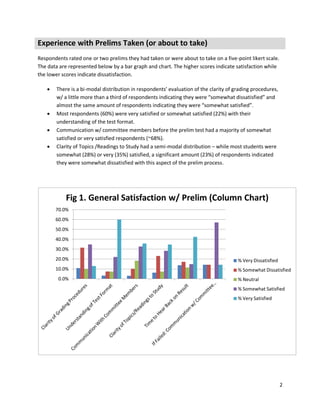
Respondents rated one or two prelims they had taken or were about to take on a five-point likert scale.
The data are represented below by a bar graph and chart. The higher scores indicate satisfaction while
the lower scores indicate dissatisfaction.
 There is a bi-modal distribution in respondents’ evaluation of the clarity of grading procedures,
w/ a little more than a third of respondents indicating they were “somewhat dissatisfied” and
almost the same amount of respondents indicating they were “somewhat satisfied”.
 Most respondents (60%) were very satisfied or somewhat satisfied (22%) with their
understanding of the test format.
 Communication w/ committee members before the prelim test had a majority of somewhat
satisfied or very satisfied respondents (~68%).
 Clarity of Topics /Readings to Study had a semi-modal distribution – while most students were
somewhat (28%) or very (35%) satisfied, a significant amount (23%) of respondents indicated
they were somewhat dissatisfied with this aspect of the prelim process.
0.0%
10.0%
20.0%
30.0%
40.0%
50.0%
60.0%
70.0%
Fig 1. General Satisfaction w/ Prelim (Column Chart)
% Very Dissatisfied
% Somewhat Dissatisfied
% Neutral
% Somewhat Satisfied
% Very Satisfied
3
Figure 2: General Satisfaction w/ Prelim (Table)
Question Very
Dissatisfied
(1)
Somewhat
Dissatisfied
(2)
Neutral
(3)
Somewhat
Satisfied
(4)
Very
Satisfied
(5)
EXAMS
EVALUATED
MEAN
Clarity of
Grading
Procedures (i.e.
what
constitutes a
passing
answer)
10.9% 31.5% 9.7% 34.7% 13%
92 3.1
Understanding
of Test Format
3.2% 7.3% 7.3% 22.1% 60% 95 4.3
Communication
With
Committee
Members
(Before the
test)
3.1% 10.2% 18.4% 32.6% 35.7% 98 3.9
Clarity of
Topics and/or
Readings to
Study
6.3% 23.2% 7.4% 28.4% 34.7% 95 3.6
Time to Hear
Back from
Committee
about Result
13.8% 17.2% 11.5% 14.9% 42.5% 87 3.5
If Failed only:
Communication
with
Committee
Members after
the test
14.3% 14.3% 0% 57.1% 14.3% 7 3.4
4
Study Methods for Passed Prelims (n=42)
The most common methods of studying and passing prelims were writing practice answers,
reading through books and articles, forming study groups, reading through past exams, utilizing
materials left behind by previous test-passers (such as notes, outlines, past answers), taking notes on
readings, and memorizing citations and concepts using flashcards or other techniques. This is important
to know partially because many faculty have different advice on how students should study and
different ideas about what students actually do to study.
 It is also notable that so many students mentioned reading through past exam answers or
outlines (provided by previous test-takers), because this implies that exams with fewer previous
test-takers are at a disadvantage.
 Also, since even more students mentioned reading through past exams (and implied that they
wrote practice answers based on those), this implies a disadvantage might be present for those
taking exams that vary in their content or format over time and/or have more “surprises.”
Paraphrased Responses (The number in parenthesis is the amount of respondents that mentioned the
concept, if more than once)
 Wrote practice answers( 24)
o -timed vs. untimed
o -whole test vs. individual practice answers
o -from memory vs. open-book
o -based on specific questions vs. broader topics
o -outlines vs. written-out answers
 Read through articles and books (24)
 Had meetings with other test-taker(s) (20)
o -“on an off” (2)
o -study group w/ regular meetings (18)
 Read through past exams (19)
 Read through past exam answers or outlines (16)
 Took notes on readings (15)
 Generated flash cards to memorize citations (11)
 Created a calendar of readings (8)
 Read syllabi for related core courses (7)
 Reviewed reading lists supplied by previous test-takers (6)
 Spoke with committee member(s) (6)
 Studied alone (4)
 Took courses to prepare for the exam (4)
 Spoke with previous test-passer (3)
 Spoke with the chair of the committee (2)
 Read up on current events related to topics on exam
 Read up on most recent relevant articles
 Reviewed readings lists posted at other Universities
5
Interactions with Committee(s)
The level and types of interaction with committee members produced one of the most varied
response sets. Some respondents said they met with the whole committee during meetings such as the
standing committee prelim meetings or also each individually. Others said they didn’t meet with any
committee members, either by their own choice (4) or because the committee members were
unreachable (6). In any case, the level of guidance provided by different prelim committees definitely
varies widely.
Paraphrased Responses (n=41) (Below, the number in parenthesis is the amount of respondents that
mentioned the concept, if more than once)
Type of Information Provided
-answered student questions (5)
-how to structure answers (5)
-possible questions on the exam (5)
- advice on literature about topic(s) (4)
-advice on how to study (3)
-feedback on student-generated reading-list (3)
-how to read books (2)
-areas/topics on exam
-syllabi that structured core readings
-help with particular problems
Helpfulness and Accessibility
-more guidance from one committee member than others (7)
-received no response to requests for help from a committee member(s)(6)
-vague in giving advice (4)
-could not articulate expectations (4)
-advice given didn’t match up with exam (3)
-negative interaction about explaining a fail (3)
-were accessible/supportive (2)
-areas/topics mentioned gave direction for study
-guidelines for passing answers were not set
-provided clear answers to students questions before exam
-reluctant to give advice on readings
-engaged
-explained how to improve
-uneven access to committee members by different students
-prompt responses
-positive interaction in discussing fail
-regular meetings with one committee member
-no members responded until a month before the exam
6
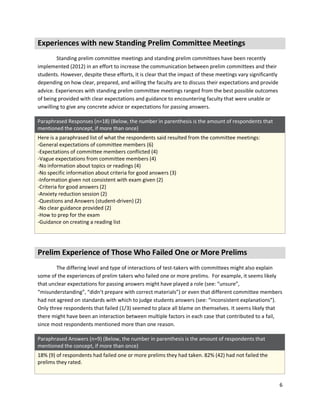
Experiences with new Standing Prelim Committee Meetings
Standing prelim committee meetings and standing prelim committees have been recently
implemented (2012) in an effort to increase the communication between prelim committees and their
students. However, despite these efforts, it is clear that the impact of these meetings vary significantly
depending on how clear, prepared, and willing the faculty are to discuss their expectations and provide
advice. Experiences with standing prelim committee meetings ranged from the best possible outcomes
of being provided with clear expectations and guidance to encountering faculty that were unable or
unwilling to give any concrete advice or expectations for passing answers.
Paraphrased Responses (n=18) (Below, the number in parenthesis is the amount of respondents that
mentioned the concept, if more than once)
Here is a paraphrased list of what the respondents said resulted from the committee meetings:
-General expectations of committee members (6)
-Expectations of committee members conflicted (4)
-Vague expectations from committee members (4)
-No information about topics or readings (4)
-No specific information about criteria for good answers (3)
-Information given not consistent with exam given (2)
-Criteria for good answers (2)
-Anxiety reduction session (2)
-Questions and Answers (student-driven) (2)
-No clear guidance provided (2)
-How to prep for the exam
-Guidance on creating a reading list
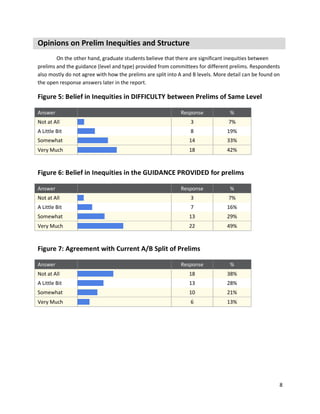
Prelim Experience of Those Who Failed One or More Prelims
The differing level and type of interactions of test-takers with committees might also explain
some of the experiences of prelim takers who failed one or more prelims. For example, it seems likely
that unclear expectations for passing answers might have played a role (see: “unsure”,
“misunderstanding”, “didn’t prepare with correct materials”) or even that different committee members
had not agreed on standards with which to judge students answers (see: “inconsistent explanations”).
Only three respondents that failed (1/3) seemed to place all blame on themselves. It seems likely that
there might have been an interaction between multiple factors in each case that contributed to a fail,
since most respondents mentioned more than one reason.
Paraphrased Answers (n=9) (Below, the number in parenthesis is the amount of respondents that
mentioned the concept, if more than once)
18% (9) of respondents had failed one or more prelims they had taken. 82% (42) had not failed the
prelims they rated.
7
Why Students Say They Failed
-Arguments didn’t have enough detail (2)
-Unsure (2)
-Inconsistent explanations by different committee members (2)
-Misunderstanding of (or lack of communication about) desired format or expectations of answers (2)
-Graded on a curve [explicitly stated by committee member (1) or the suspicion of the student (1)]
-Not sufficiently prepared
-Ran out of time
-Didn’t prepare with the correct materials
-Misunderstanding of a question
-Unrealistic expectations by committee members
Relevance of Prelims to Research and Coursework
Grad respondents mostly view prelims as somewhat or very related to their own graduate
research agendas and also to (though to a slightly lesser extent) to the courses provided in the
department. This result, combined with the common suggestion to increase the utilizability of the prelim
for dissertation work or the job market is interesting.
Figure 3: Relationship of Prelims to Individual Grad Research Agendas
Answer Response # %
Not at All 1 2%
A Little Bit 8 16%
Somewhat 17 33%
Very Much 25 49%
Figure 4: Relationship of Course Offerings to Prelims Taken (or planned)
Answer Response %
Not at All 6 6%
A Little Bit 23 23%
Somewhat 22 22%
Very Much 48 48%
8
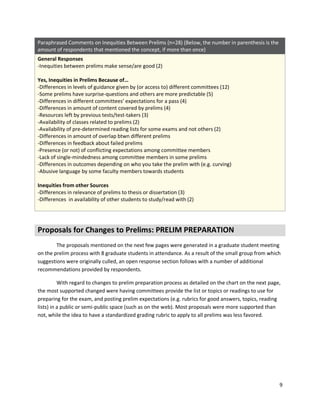
Opinions on Prelim Inequities and Structure
On the other hand, graduate students believe that there are significant inequities between
prelims and the guidance (level and type) provided from committees for different prelims. Respondents
also mostly do not agree with how the prelims are split into A and B levels. More detail can be found on
the open response answers later in the report.
Figure 5: Belief in Inequities in DIFFICULTY between Prelims of Same Level
Answer Response %
Not at All 3 7%
A Little Bit 8 19%
Somewhat 14 33%
Very Much 18 42%
Figure 6: Belief in Inequities in the GUIDANCE PROVIDED for prelims
Answer Response %
Not at All 3 7%
A Little Bit 7 16%
Somewhat 13 29%
Very Much 22 49%
Figure 7: Agreement with Current A/B Split of Prelims
Answer Response %
Not at All 18 38%
A Little Bit 13 28%
Somewhat 10 21%
Very Much 6 13%
9
Paraphrased Comments on Inequities Between Prelims (n=28) (Below, the number in parenthesis is the
amount of respondents that mentioned the concept, if more than once)
General Responses
-Inequities between prelims make sense/are good (2)
Yes, Inequities in Prelims Because of…
-Differences in levels of guidance given by (or access to) different committees (12)
-Some prelims have surprise-questions and others are more predictable (5)
-Differences in different committees’ expectations for a pass (4)
-Differences in amount of content covered by prelims (4)
-Resources left by previous tests/test-takers (3)
-Availability of classes related to prelims (2)
-Availability of pre-determined reading lists for some exams and not others (2)
-Differences in amount of overlap btwn different prelims
-Differences in feedback about failed prelims
-Presence (or not) of conflicting expectations among committee members
-Lack of single-mindedness among committee members in some prelims
-Differences in outcomes depending on who you take the prelim with (e.g. curving)
-Abusive language by some faculty members towards students
Inequities from other Sources
-Differences in relevance of prelims to thesis or dissertation (3)
-Differences in availability of other students to study/read with (2)
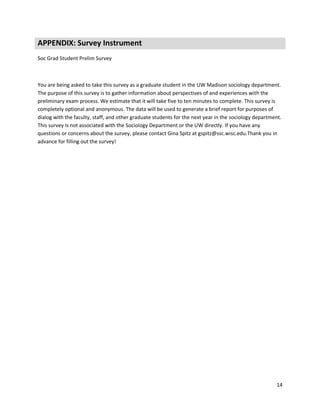
Proposals for Changes to Prelims: PRELIM PREPARATION
The proposals mentioned on the next few pages were generated in a graduate student meeting
on the prelim process with 8 graduate students in attendance. As a result of the small group from which
suggestions were originally culled, an open response section follows with a number of additional
recommendations provided by respondents.
With regard to changes to prelim preparation process as detailed on the chart on the next page,
the most supported changed were having committees provide the list or topics or readings to use for
preparing for the exam, and posting prelim expectations (e.g. rubrics for good answers, topics, reading
lists) in a public or semi-public space (such as on the web). Most proposals were more supported than
not, while the idea to have a standardized grading rubric to apply to all prelims was less favored.
10
Figure 8: Proposals for Changes to Changes to Prelim Prep Process
Question Completely
Against
Somewhat
Against
Neutral Somewhat
In-favor
Completely
In-favor
Responses Mean
Standardized
Grading Rubric for
Exam Agreed Upon
Among Committee
Members for Each
Prelim
4 5 9 18 13 49 3.63
Standardized
Grading Rubric To
Apply to All Prelims
(implies uniform
components of
passing answers
across subject
areas)
9 13 12 10 5 49 2.78
Committee
Provision of List of
Topics and/or
Readings that will
be Tested before
the Exam
4 3 3 12 28 50 4.14
Posting of Prelim
Expectations
Agreed Upon By
Committees In
Public or Semi-
Public Space
(Rubric, Topics, any
other guidance)
3 2 7 15 23 50 4.06
Support in Pro-
seminar for Prelims
(study skills,
guidelines for
passing responses,
pre-organized
study groups are
just some of the
forms this could
take)
5 6 9 17 13 50 3.54
Other workshop for
prelim preparation
2 4 11 18 12 47 3.72
11
Paraphrased Additional Proposals for Modifying the Prelim Prep Process (n=18) (Below, the number in
parenthesis is the amount of respondents that mentioned the concept, if more than once)
-First year or prosem is too early to introduce prelim prep (6)
-Faculty on the committee should set clear criteria for elements of passing answer will contain (2)
-Against changes/reform because it is like “faculty hand-holding”
-Creating "standards for passing" runs risk of being too narrow and not allowing new ideas/approaches
to emerge
-Maintain and improve X drive materials from previous test-takers (incl readings). Institutionalize a way
for students to do so.
-Level of resources (e.g. articles, past exams answers) should have a level of standardization across
prelims.
-Advanced seminars need to be offered in each of the prelim areas
-Create formal process for committee members to provide reasons for failing and make explicit how the
prelim would have to change to pass
-Continue semester meetings.
-Create prelim advisors (like dissertation advisors) to guide through process.
-Provide a reading list, focus the seminars around that, and then offer the prelims right after the course.
Proposals for Changes to Prelims: STRUCTURE/CONTENT
A number of the proposals received to modify the structure or content of the prelims received
moderately favorable votes – most notably to add qualitative methods to the methods prelim (though
the open response additions may suggest alternative ways of incorporating qualitative methods). Other
well-supported proposals were to re-think the sequencing of prelims so that they could be taken with
class work, and offering take-home exams options for all prelims. The proposal that received very little
support was to focus prelim question on current debates in the literature. In the open response
additions to changing structure/content, the most common proposal was to make prelims somehow
more relevant to a student’s research trajectory – especially to the dissertation.
12
Figure 9: Proposals for Changes to Prelim Structure/Content
Question Completel
y Against
Somewhat
Against
Neutral Somewhat
In-favor
Completely
In-favor
Responses Mean
Focus Prelim Questions
on Current Debates
(rather than all the
literature)
11 17 11 10 1 50 2.46
Add Qualitative
Methods to the Method
Prelim (It is currently
quantitatively focused)
4 2 9 12 23 50 3.96
Have A-and B-Level
Exams for Each Topic
Area (rather than
assigning, say, race to a
B-level, and Gender to
an A- level exam, the
difference would be
between an A-level
exam in Race or a B-
level exam in Race)
10 5 14 12 10 51 3.14
Re-Thinking Sequencing
of Prelims (Offering
them concurrent with
class work, during
Masters, or some other
time)
3 7 13 13 14 50 3.56
Offering Take-Home
Exams for All Prelims
7 5 10 12 17 51 3.53
13
Paraphrased Additional Proposals for Modifying Prelim Structure/Content (n=23) (Below, the number in
parenthesis is the amount of respondents that mentioned the concept, if more than once)
Relevance to Academic Research
-Format not helpful for training us to be career academics. Instead, (e.g. a take-home exam, syllabi, etc.)
(6).
-Have each student tailor their prelims and/or reading lists to their particular interests/research. (6)
-Make prelims more useful for training and/or completion of dissertation. (2)
-The Prelim should be comprised of one exam in a sub discipline, and one take-home or literature
review that can be used to for preparing one's dissertation proposal.
-Change system to an oral defense with questions tailored to your specific research interests.
Topics
-Have quantitative and qualitative methods prelims. (3)
-Make separate qualitative methods prelim.
-Rename methods prelim quant methods prelim.
-Add qualitative methods to the methods exam.
-Add Intersectionality and Critical Race and Gender Theory as prelim area
A/B Split
-Rather than an A and B system it could be a breadth and depth test.
-Eliminate A-level and B-level prelims (categorization into either is relative).
Other
-Discussions across different prelim committees to promote comparability over inequities in exams. (2)
-Create a category of "marginal fail”, and give the student a chance to write a “recovery essay" or
defend their answers orally.
-Split the prelim into two days.
14
APPENDIX: Survey Instrument
Soc Grad Student Prelim Survey
You are being asked to take this survey as a graduate student in the UW Madison sociology department.
The purpose of this survey is to gather information about perspectives of and experiences with the
preliminary exam process. We estimate that it will take five to ten minutes to complete. This survey is
completely optional and anonymous. The data will be used to generate a brief report for purposes of
dialog with the faculty, staff, and other graduate students for the next year in the sociology department.
This survey is not associated with the Sociology Department or the UW directly. If you have any
questions or concerns about the survey, please contact Gina Spitz at gspitz@ssc.wisc.edu.Thank you in
advance for filling out the survey!
15
Your Prelim Experience (Section 1/3)How would you rate your experience with the following for the
FIRST prelim you took or are going to take?
Very
Dissatisfied
(1)
Somewhat
Dissatisfied
(2)
Neutral (3) Somewhat
Satisfied (4)
Very
Satisfied (5)
Don't Have
Enough
Info/ Don't
Have an
Opinion (6)
Clarity of
Grading
Procedures (i.e.
what
constitutes a
passing
answer) (1)
     
Understanding
of Test Format
(2)
     
Communication
With
Committee
Members
(Before the
test) (3)
     
Clarity of
Topics and/or
Readings to
Study (4)
     
Time to Hear
Back from
Committee
about Result
(5)
     
If Failed only:
Communication
with
Committee
Members after
the test (6)
     
16
For the prelim you just rated, did you take it already?
 Yes and passed it. (1)
 Yes and didn't pass it. (2)
 No, I'm planning to take it in the future. (3)
Which prelim was it? (Optional)
17
How would you rate your experience with the following for the SECOND prelim you took or are going to
take?
Very
Dissatisfied
(1)
Somewhat
Dissatisfied
(2)
Neutral (3) Somewhat
Satisfied (4)
Very
Satisfied (5)
Don't Have
Enough
Info/ Don't
Have an
Opinion (6)
Clarity of
Grading
Procedures (i.e.
what
constitutes a
passing
answer) (1)
     
Understanding
of Test Format
(2)
     
Communication
With
Committee
Members
(Before the
test) (3)
     
Clarity of
Topics and/or
Readings to
Study (4)
     
Time to Hear
Back from
Committee
about Result
(5)
     
If Failed only:
Communication
with
Committee
Members after
the test (6)
     
18
For the prelim you just rated, did you take it already?
 Yes and passed it. (1)
 Yes and didn't pass it. (2)
 No, I am planning on taking it in the future. (3)
Which prelim was it? (optional)
If you have taken one or more prelims and passed them, please provide brief comments on your study
process.
If you have taken one or more prelims and passed them, please provide brief comments on your
interactions with your committee(s).
Have you ever failed a prelim exam?
 Yes (1)
 No (2)
If you have ever failed a prelim or prelims, will you please comment on why you think you failed the
exam or any feedback you received from your committee members about why you received a failing
grade? Please remember that this is anonymous.
If you attended one or more annual meetings orchestrated by your standing prelim committee members
this year, please provide comments on how the meeting went. Were the criteria for passing clearly laid
out? Was information about the topics and/or readings to study provided?
19
Your Opinions on Prelims (Section 2/3) To what extent do at least two topic areas of the preliminary
exams relate to your research interests and/or projects?
 Not at All (1)
 A Little Bit (2)
 Somewhat (3)
 Very Much (4)
To what extent do you agree with the way the main topics of the prelims are split into A- and B-level
examinations?
 Not at All (1)
 A Little Bit (2)
 Somewhat (3)
 Very Much (4)
To what extent do department course offerings relate to the FIRST prelim you plan to take or took?
 Not at All (1)
 A Little Bit (2)
 Somewhat (3)
 Very Much (4)
To what extent do department course offerings relate to the SECOND prelim you plan to take or took?
 Not at All (1)
 A Little Bit (2)
 Somewhat (3)
 Very Much (4)
To what extent do you feel that there are inequities in the DIFFICULTY LEVEL of prelims on the same
level (comparing A level to A level and B level to B level)?
 Not at All (1)
 A Little Bit (2)
 Somewhat (3)
 Very Much (4)
20
To what extent do you feel that there are inequities in the GUIDANCE PROVIDED for prelims (i.e. grading
criteria, topics/readings)?
 Not at All (1)
 A Little Bit (2)
 Somewhat (3)
 Very Much (4)
Please comment on any inequities between prelims in difficulty, guidance provided, or other criteria.
21
Proposals for Changes to Prelims (Section 3/3)Please rate you are in favor of the following proposals for
the sociology prelim system related to PRELIM PREPARATION:
Completely
Against (1)
Somewhat
Against (2)
Neutral (3) Somewhat In-
favor (4)
Completely In-
favor (5)
Standardized
Grading Rubric
for Exam
Agreed Upon
Among
Committee
Members for
Each Prelim (1)
    
Standardized
Grading Rubric
To Apply to All
Prelims
(implies
uniform
components of
passing
answers across
subject areas)
(2)
    
Committee
Provision of
List of Topics
and/or
Readings that
will be Tested
before the
Exam (3)
    
Posting of
Prelim
Expectations
Agreed Upon
By Committees
In Public or
Semi-Public
Space (Rubric,
Topics, any
other
guidance) (4)
    
Support in Pro-
seminar for
Prelims (study
    
22
skills,
guidelines for
passing
responses,
pre-organized
study groups
are just some
of the forms
this could
take) (5)
Other
workshop for
prelim
preparation (6)
    
Do you have any additional proposals for modifying the prelim preparation process, not listed above?
23
Please rate how much support you would give the following proposals for the sociology PRELIM
STRUCTURE/CONTENT:
Completely
Against (1)
Somewhat
Against (2)
Neutral (3) Somewhat In-
favor (4)
Completely In-
favor (5)
Focus Prelim
Questions on
Current
Debates
(rather than all
the literature)
(1)
    
Add
Qualitative
Methods to
the Method
Prelim (It is
currently
quantitatively
focused) (2)
    
Have A-and B-
Level Exams
for Each Topic
Area (rather
than assigning,
say, race to a
B-level, and
Gender to an
A- level exam,
the difference
would be
between an A-
level exam in
Race or a B-
level exam in
Race) (3)
    
Re-Thinking
Sequencing of
Prelims
(Offering them
concurrent
with
classwork,
during
Masters, or
some other
    
24
time) (4)
Offering Take-
Home Exams
for All Prelims
(5)
    
Do you have any additional proposals for modifying the prelim structure/content, not listed above?

SocGradPrelimExperiencesSurveyReport

  • 1.
    1 Sociology Grad StudentPrelim Experience Survey Report Compiled and Analyzed by: Gina Spitz This report summarizes the experiences of 54 UW Madison graduate students in Sociology who have taken or are soon taking one or more of the required prelims. The results show a wide range of experiences with the prelim process in terms of satisfaction, study methods, interactions with prelim committees, relevance of prelims to grads’ own research agendas, and the availability of resources to prepare for prelims. The data also show the presence of inequities between prelims in terms of their difficulty level and the guidance provided to pass prelims. Finally, this report explores a number of proposals to modify the prelim process, and finds some general support for changing some aspects of the system. Data highlights of the report include:  Responses indicate that some of the biggest areas of dissatisfaction among grads regarding the prelim are the clarity of grading and clarity of topics and/or readings to study.  The level of guidance provided by different prelim committees definitely varies widely.  Graduate students believe that there are significant inequities between prelims and the guidance (level and type) provided from committees for different prelims. Respondents also mostly do not agree with how the prelims are split into A and B levels.  The most supported proposals for changes to the prelim prep and content/structure were as follows: o having committees provide the list or topics or readings to use for preparing for the exam o posting prelim expectations (e.g. rubrics for good answers, topics, reading lists) in a public or semi-public space (such as on the web) o adding qualitative methods to the methods prelim o re-thinking the sequencing of prelims so that they could be taken with class work o offering take-home exams options for all prelims o making prelims more relevant to a student’s research trajectory – especially to the dissertation. Attached to the report (Pp.14-24), is a copy of the survey that the respondents filled out. Complete data is available upon request to Gina Spitz (gspitz@ssc.wisc.edu).
  • 2.
    2 Experience with PrelimsTaken (or about to take) Respondents rated one or two prelims they had taken or were about to take on a five-point likert scale. The data are represented below by a bar graph and chart. The higher scores indicate satisfaction while the lower scores indicate dissatisfaction.  There is a bi-modal distribution in respondents’ evaluation of the clarity of grading procedures, w/ a little more than a third of respondents indicating they were “somewhat dissatisfied” and almost the same amount of respondents indicating they were “somewhat satisfied”.  Most respondents (60%) were very satisfied or somewhat satisfied (22%) with their understanding of the test format.  Communication w/ committee members before the prelim test had a majority of somewhat satisfied or very satisfied respondents (~68%).  Clarity of Topics /Readings to Study had a semi-modal distribution – while most students were somewhat (28%) or very (35%) satisfied, a significant amount (23%) of respondents indicated they were somewhat dissatisfied with this aspect of the prelim process. 0.0% 10.0% 20.0% 30.0% 40.0% 50.0% 60.0% 70.0% Fig 1. General Satisfaction w/ Prelim (Column Chart) % Very Dissatisfied % Somewhat Dissatisfied % Neutral % Somewhat Satisfied % Very Satisfied
  • 3.
    3 Figure 2: GeneralSatisfaction w/ Prelim (Table) Question Very Dissatisfied (1) Somewhat Dissatisfied (2) Neutral (3) Somewhat Satisfied (4) Very Satisfied (5) EXAMS EVALUATED MEAN Clarity of Grading Procedures (i.e. what constitutes a passing answer) 10.9% 31.5% 9.7% 34.7% 13% 92 3.1 Understanding of Test Format 3.2% 7.3% 7.3% 22.1% 60% 95 4.3 Communication With Committee Members (Before the test) 3.1% 10.2% 18.4% 32.6% 35.7% 98 3.9 Clarity of Topics and/or Readings to Study 6.3% 23.2% 7.4% 28.4% 34.7% 95 3.6 Time to Hear Back from Committee about Result 13.8% 17.2% 11.5% 14.9% 42.5% 87 3.5 If Failed only: Communication with Committee Members after the test 14.3% 14.3% 0% 57.1% 14.3% 7 3.4
  • 4.
    4 Study Methods forPassed Prelims (n=42) The most common methods of studying and passing prelims were writing practice answers, reading through books and articles, forming study groups, reading through past exams, utilizing materials left behind by previous test-passers (such as notes, outlines, past answers), taking notes on readings, and memorizing citations and concepts using flashcards or other techniques. This is important to know partially because many faculty have different advice on how students should study and different ideas about what students actually do to study.  It is also notable that so many students mentioned reading through past exam answers or outlines (provided by previous test-takers), because this implies that exams with fewer previous test-takers are at a disadvantage.  Also, since even more students mentioned reading through past exams (and implied that they wrote practice answers based on those), this implies a disadvantage might be present for those taking exams that vary in their content or format over time and/or have more “surprises.” Paraphrased Responses (The number in parenthesis is the amount of respondents that mentioned the concept, if more than once)  Wrote practice answers( 24) o -timed vs. untimed o -whole test vs. individual practice answers o -from memory vs. open-book o -based on specific questions vs. broader topics o -outlines vs. written-out answers  Read through articles and books (24)  Had meetings with other test-taker(s) (20) o -“on an off” (2) o -study group w/ regular meetings (18)  Read through past exams (19)  Read through past exam answers or outlines (16)  Took notes on readings (15)  Generated flash cards to memorize citations (11)  Created a calendar of readings (8)  Read syllabi for related core courses (7)  Reviewed reading lists supplied by previous test-takers (6)  Spoke with committee member(s) (6)  Studied alone (4)  Took courses to prepare for the exam (4)  Spoke with previous test-passer (3)  Spoke with the chair of the committee (2)  Read up on current events related to topics on exam  Read up on most recent relevant articles  Reviewed readings lists posted at other Universities
  • 5.
    5 Interactions with Committee(s) Thelevel and types of interaction with committee members produced one of the most varied response sets. Some respondents said they met with the whole committee during meetings such as the standing committee prelim meetings or also each individually. Others said they didn’t meet with any committee members, either by their own choice (4) or because the committee members were unreachable (6). In any case, the level of guidance provided by different prelim committees definitely varies widely. Paraphrased Responses (n=41) (Below, the number in parenthesis is the amount of respondents that mentioned the concept, if more than once) Type of Information Provided -answered student questions (5) -how to structure answers (5) -possible questions on the exam (5) - advice on literature about topic(s) (4) -advice on how to study (3) -feedback on student-generated reading-list (3) -how to read books (2) -areas/topics on exam -syllabi that structured core readings -help with particular problems Helpfulness and Accessibility -more guidance from one committee member than others (7) -received no response to requests for help from a committee member(s)(6) -vague in giving advice (4) -could not articulate expectations (4) -advice given didn’t match up with exam (3) -negative interaction about explaining a fail (3) -were accessible/supportive (2) -areas/topics mentioned gave direction for study -guidelines for passing answers were not set -provided clear answers to students questions before exam -reluctant to give advice on readings -engaged -explained how to improve -uneven access to committee members by different students -prompt responses -positive interaction in discussing fail -regular meetings with one committee member -no members responded until a month before the exam
  • 6.
    6 Experiences with newStanding Prelim Committee Meetings Standing prelim committee meetings and standing prelim committees have been recently implemented (2012) in an effort to increase the communication between prelim committees and their students. However, despite these efforts, it is clear that the impact of these meetings vary significantly depending on how clear, prepared, and willing the faculty are to discuss their expectations and provide advice. Experiences with standing prelim committee meetings ranged from the best possible outcomes of being provided with clear expectations and guidance to encountering faculty that were unable or unwilling to give any concrete advice or expectations for passing answers. Paraphrased Responses (n=18) (Below, the number in parenthesis is the amount of respondents that mentioned the concept, if more than once) Here is a paraphrased list of what the respondents said resulted from the committee meetings: -General expectations of committee members (6) -Expectations of committee members conflicted (4) -Vague expectations from committee members (4) -No information about topics or readings (4) -No specific information about criteria for good answers (3) -Information given not consistent with exam given (2) -Criteria for good answers (2) -Anxiety reduction session (2) -Questions and Answers (student-driven) (2) -No clear guidance provided (2) -How to prep for the exam -Guidance on creating a reading list Prelim Experience of Those Who Failed One or More Prelims The differing level and type of interactions of test-takers with committees might also explain some of the experiences of prelim takers who failed one or more prelims. For example, it seems likely that unclear expectations for passing answers might have played a role (see: “unsure”, “misunderstanding”, “didn’t prepare with correct materials”) or even that different committee members had not agreed on standards with which to judge students answers (see: “inconsistent explanations”). Only three respondents that failed (1/3) seemed to place all blame on themselves. It seems likely that there might have been an interaction between multiple factors in each case that contributed to a fail, since most respondents mentioned more than one reason. Paraphrased Answers (n=9) (Below, the number in parenthesis is the amount of respondents that mentioned the concept, if more than once) 18% (9) of respondents had failed one or more prelims they had taken. 82% (42) had not failed the prelims they rated.
  • 7.
    7 Why Students SayThey Failed -Arguments didn’t have enough detail (2) -Unsure (2) -Inconsistent explanations by different committee members (2) -Misunderstanding of (or lack of communication about) desired format or expectations of answers (2) -Graded on a curve [explicitly stated by committee member (1) or the suspicion of the student (1)] -Not sufficiently prepared -Ran out of time -Didn’t prepare with the correct materials -Misunderstanding of a question -Unrealistic expectations by committee members Relevance of Prelims to Research and Coursework Grad respondents mostly view prelims as somewhat or very related to their own graduate research agendas and also to (though to a slightly lesser extent) to the courses provided in the department. This result, combined with the common suggestion to increase the utilizability of the prelim for dissertation work or the job market is interesting. Figure 3: Relationship of Prelims to Individual Grad Research Agendas Answer Response # % Not at All 1 2% A Little Bit 8 16% Somewhat 17 33% Very Much 25 49% Figure 4: Relationship of Course Offerings to Prelims Taken (or planned) Answer Response % Not at All 6 6% A Little Bit 23 23% Somewhat 22 22% Very Much 48 48%
  • 8.
    8 Opinions on PrelimInequities and Structure On the other hand, graduate students believe that there are significant inequities between prelims and the guidance (level and type) provided from committees for different prelims. Respondents also mostly do not agree with how the prelims are split into A and B levels. More detail can be found on the open response answers later in the report. Figure 5: Belief in Inequities in DIFFICULTY between Prelims of Same Level Answer Response % Not at All 3 7% A Little Bit 8 19% Somewhat 14 33% Very Much 18 42% Figure 6: Belief in Inequities in the GUIDANCE PROVIDED for prelims Answer Response % Not at All 3 7% A Little Bit 7 16% Somewhat 13 29% Very Much 22 49% Figure 7: Agreement with Current A/B Split of Prelims Answer Response % Not at All 18 38% A Little Bit 13 28% Somewhat 10 21% Very Much 6 13%
  • 9.
    9 Paraphrased Comments onInequities Between Prelims (n=28) (Below, the number in parenthesis is the amount of respondents that mentioned the concept, if more than once) General Responses -Inequities between prelims make sense/are good (2) Yes, Inequities in Prelims Because of… -Differences in levels of guidance given by (or access to) different committees (12) -Some prelims have surprise-questions and others are more predictable (5) -Differences in different committees’ expectations for a pass (4) -Differences in amount of content covered by prelims (4) -Resources left by previous tests/test-takers (3) -Availability of classes related to prelims (2) -Availability of pre-determined reading lists for some exams and not others (2) -Differences in amount of overlap btwn different prelims -Differences in feedback about failed prelims -Presence (or not) of conflicting expectations among committee members -Lack of single-mindedness among committee members in some prelims -Differences in outcomes depending on who you take the prelim with (e.g. curving) -Abusive language by some faculty members towards students Inequities from other Sources -Differences in relevance of prelims to thesis or dissertation (3) -Differences in availability of other students to study/read with (2) Proposals for Changes to Prelims: PRELIM PREPARATION The proposals mentioned on the next few pages were generated in a graduate student meeting on the prelim process with 8 graduate students in attendance. As a result of the small group from which suggestions were originally culled, an open response section follows with a number of additional recommendations provided by respondents. With regard to changes to prelim preparation process as detailed on the chart on the next page, the most supported changed were having committees provide the list or topics or readings to use for preparing for the exam, and posting prelim expectations (e.g. rubrics for good answers, topics, reading lists) in a public or semi-public space (such as on the web). Most proposals were more supported than not, while the idea to have a standardized grading rubric to apply to all prelims was less favored.
  • 10.
    10 Figure 8: Proposalsfor Changes to Changes to Prelim Prep Process Question Completely Against Somewhat Against Neutral Somewhat In-favor Completely In-favor Responses Mean Standardized Grading Rubric for Exam Agreed Upon Among Committee Members for Each Prelim 4 5 9 18 13 49 3.63 Standardized Grading Rubric To Apply to All Prelims (implies uniform components of passing answers across subject areas) 9 13 12 10 5 49 2.78 Committee Provision of List of Topics and/or Readings that will be Tested before the Exam 4 3 3 12 28 50 4.14 Posting of Prelim Expectations Agreed Upon By Committees In Public or Semi- Public Space (Rubric, Topics, any other guidance) 3 2 7 15 23 50 4.06 Support in Pro- seminar for Prelims (study skills, guidelines for passing responses, pre-organized study groups are just some of the forms this could take) 5 6 9 17 13 50 3.54 Other workshop for prelim preparation 2 4 11 18 12 47 3.72
  • 11.
    11 Paraphrased Additional Proposalsfor Modifying the Prelim Prep Process (n=18) (Below, the number in parenthesis is the amount of respondents that mentioned the concept, if more than once) -First year or prosem is too early to introduce prelim prep (6) -Faculty on the committee should set clear criteria for elements of passing answer will contain (2) -Against changes/reform because it is like “faculty hand-holding” -Creating "standards for passing" runs risk of being too narrow and not allowing new ideas/approaches to emerge -Maintain and improve X drive materials from previous test-takers (incl readings). Institutionalize a way for students to do so. -Level of resources (e.g. articles, past exams answers) should have a level of standardization across prelims. -Advanced seminars need to be offered in each of the prelim areas -Create formal process for committee members to provide reasons for failing and make explicit how the prelim would have to change to pass -Continue semester meetings. -Create prelim advisors (like dissertation advisors) to guide through process. -Provide a reading list, focus the seminars around that, and then offer the prelims right after the course. Proposals for Changes to Prelims: STRUCTURE/CONTENT A number of the proposals received to modify the structure or content of the prelims received moderately favorable votes – most notably to add qualitative methods to the methods prelim (though the open response additions may suggest alternative ways of incorporating qualitative methods). Other well-supported proposals were to re-think the sequencing of prelims so that they could be taken with class work, and offering take-home exams options for all prelims. The proposal that received very little support was to focus prelim question on current debates in the literature. In the open response additions to changing structure/content, the most common proposal was to make prelims somehow more relevant to a student’s research trajectory – especially to the dissertation.
  • 12.
    12 Figure 9: Proposalsfor Changes to Prelim Structure/Content Question Completel y Against Somewhat Against Neutral Somewhat In-favor Completely In-favor Responses Mean Focus Prelim Questions on Current Debates (rather than all the literature) 11 17 11 10 1 50 2.46 Add Qualitative Methods to the Method Prelim (It is currently quantitatively focused) 4 2 9 12 23 50 3.96 Have A-and B-Level Exams for Each Topic Area (rather than assigning, say, race to a B-level, and Gender to an A- level exam, the difference would be between an A-level exam in Race or a B- level exam in Race) 10 5 14 12 10 51 3.14 Re-Thinking Sequencing of Prelims (Offering them concurrent with class work, during Masters, or some other time) 3 7 13 13 14 50 3.56 Offering Take-Home Exams for All Prelims 7 5 10 12 17 51 3.53
  • 13.
    13 Paraphrased Additional Proposalsfor Modifying Prelim Structure/Content (n=23) (Below, the number in parenthesis is the amount of respondents that mentioned the concept, if more than once) Relevance to Academic Research -Format not helpful for training us to be career academics. Instead, (e.g. a take-home exam, syllabi, etc.) (6). -Have each student tailor their prelims and/or reading lists to their particular interests/research. (6) -Make prelims more useful for training and/or completion of dissertation. (2) -The Prelim should be comprised of one exam in a sub discipline, and one take-home or literature review that can be used to for preparing one's dissertation proposal. -Change system to an oral defense with questions tailored to your specific research interests. Topics -Have quantitative and qualitative methods prelims. (3) -Make separate qualitative methods prelim. -Rename methods prelim quant methods prelim. -Add qualitative methods to the methods exam. -Add Intersectionality and Critical Race and Gender Theory as prelim area A/B Split -Rather than an A and B system it could be a breadth and depth test. -Eliminate A-level and B-level prelims (categorization into either is relative). Other -Discussions across different prelim committees to promote comparability over inequities in exams. (2) -Create a category of "marginal fail”, and give the student a chance to write a “recovery essay" or defend their answers orally. -Split the prelim into two days.
  • 14.
    14 APPENDIX: Survey Instrument SocGrad Student Prelim Survey You are being asked to take this survey as a graduate student in the UW Madison sociology department. The purpose of this survey is to gather information about perspectives of and experiences with the preliminary exam process. We estimate that it will take five to ten minutes to complete. This survey is completely optional and anonymous. The data will be used to generate a brief report for purposes of dialog with the faculty, staff, and other graduate students for the next year in the sociology department. This survey is not associated with the Sociology Department or the UW directly. If you have any questions or concerns about the survey, please contact Gina Spitz at gspitz@ssc.wisc.edu.Thank you in advance for filling out the survey!
  • 15.
    15 Your Prelim Experience(Section 1/3)How would you rate your experience with the following for the FIRST prelim you took or are going to take? Very Dissatisfied (1) Somewhat Dissatisfied (2) Neutral (3) Somewhat Satisfied (4) Very Satisfied (5) Don't Have Enough Info/ Don't Have an Opinion (6) Clarity of Grading Procedures (i.e. what constitutes a passing answer) (1)       Understanding of Test Format (2)       Communication With Committee Members (Before the test) (3)       Clarity of Topics and/or Readings to Study (4)       Time to Hear Back from Committee about Result (5)       If Failed only: Communication with Committee Members after the test (6)      
  • 16.
    16 For the prelimyou just rated, did you take it already?  Yes and passed it. (1)  Yes and didn't pass it. (2)  No, I'm planning to take it in the future. (3) Which prelim was it? (Optional)
  • 17.
    17 How would yourate your experience with the following for the SECOND prelim you took or are going to take? Very Dissatisfied (1) Somewhat Dissatisfied (2) Neutral (3) Somewhat Satisfied (4) Very Satisfied (5) Don't Have Enough Info/ Don't Have an Opinion (6) Clarity of Grading Procedures (i.e. what constitutes a passing answer) (1)       Understanding of Test Format (2)       Communication With Committee Members (Before the test) (3)       Clarity of Topics and/or Readings to Study (4)       Time to Hear Back from Committee about Result (5)       If Failed only: Communication with Committee Members after the test (6)      
  • 18.
    18 For the prelimyou just rated, did you take it already?  Yes and passed it. (1)  Yes and didn't pass it. (2)  No, I am planning on taking it in the future. (3) Which prelim was it? (optional) If you have taken one or more prelims and passed them, please provide brief comments on your study process. If you have taken one or more prelims and passed them, please provide brief comments on your interactions with your committee(s). Have you ever failed a prelim exam?  Yes (1)  No (2) If you have ever failed a prelim or prelims, will you please comment on why you think you failed the exam or any feedback you received from your committee members about why you received a failing grade? Please remember that this is anonymous. If you attended one or more annual meetings orchestrated by your standing prelim committee members this year, please provide comments on how the meeting went. Were the criteria for passing clearly laid out? Was information about the topics and/or readings to study provided?
  • 19.
    19 Your Opinions onPrelims (Section 2/3) To what extent do at least two topic areas of the preliminary exams relate to your research interests and/or projects?  Not at All (1)  A Little Bit (2)  Somewhat (3)  Very Much (4) To what extent do you agree with the way the main topics of the prelims are split into A- and B-level examinations?  Not at All (1)  A Little Bit (2)  Somewhat (3)  Very Much (4) To what extent do department course offerings relate to the FIRST prelim you plan to take or took?  Not at All (1)  A Little Bit (2)  Somewhat (3)  Very Much (4) To what extent do department course offerings relate to the SECOND prelim you plan to take or took?  Not at All (1)  A Little Bit (2)  Somewhat (3)  Very Much (4) To what extent do you feel that there are inequities in the DIFFICULTY LEVEL of prelims on the same level (comparing A level to A level and B level to B level)?  Not at All (1)  A Little Bit (2)  Somewhat (3)  Very Much (4)
  • 20.
    20 To what extentdo you feel that there are inequities in the GUIDANCE PROVIDED for prelims (i.e. grading criteria, topics/readings)?  Not at All (1)  A Little Bit (2)  Somewhat (3)  Very Much (4) Please comment on any inequities between prelims in difficulty, guidance provided, or other criteria.
  • 21.
    21 Proposals for Changesto Prelims (Section 3/3)Please rate you are in favor of the following proposals for the sociology prelim system related to PRELIM PREPARATION: Completely Against (1) Somewhat Against (2) Neutral (3) Somewhat In- favor (4) Completely In- favor (5) Standardized Grading Rubric for Exam Agreed Upon Among Committee Members for Each Prelim (1)      Standardized Grading Rubric To Apply to All Prelims (implies uniform components of passing answers across subject areas) (2)      Committee Provision of List of Topics and/or Readings that will be Tested before the Exam (3)      Posting of Prelim Expectations Agreed Upon By Committees In Public or Semi-Public Space (Rubric, Topics, any other guidance) (4)      Support in Pro- seminar for Prelims (study     
  • 22.
    22 skills, guidelines for passing responses, pre-organized study groups arejust some of the forms this could take) (5) Other workshop for prelim preparation (6)      Do you have any additional proposals for modifying the prelim preparation process, not listed above?
  • 23.
    23 Please rate howmuch support you would give the following proposals for the sociology PRELIM STRUCTURE/CONTENT: Completely Against (1) Somewhat Against (2) Neutral (3) Somewhat In- favor (4) Completely In- favor (5) Focus Prelim Questions on Current Debates (rather than all the literature) (1)      Add Qualitative Methods to the Method Prelim (It is currently quantitatively focused) (2)      Have A-and B- Level Exams for Each Topic Area (rather than assigning, say, race to a B-level, and Gender to an A- level exam, the difference would be between an A- level exam in Race or a B- level exam in Race) (3)      Re-Thinking Sequencing of Prelims (Offering them concurrent with classwork, during Masters, or some other     
  • 24.
    24 time) (4) Offering Take- HomeExams for All Prelims (5)      Do you have any additional proposals for modifying the prelim structure/content, not listed above?