















Khadeeja Al-Shidhani  61344 Amal Al-Balushi  66755 COMPARATIVE AND NON-COMPARATIVE STUDY
Outline Comparative Study Research  Title Research Purpose Research Questions Participants Evaluation Instruments Advantages & Disadvantages Research results Non-comparative Study Study  title The  Aim of  The  Study Research Methodology Disadvantages Study results
COMPARATIVE STUDY Perception and performance study
Research  Title “ Comparative Analysis of Learner Satisfaction and Learning Outcomes in Online and Face-to-Face Learning Environments” Scottd. Johnson, Steven R. Aragon, Najmuddin Shaik, & Nilda Palma-Rivas University of Illinois at Urbana-Champaign
Research Purpose Comparing an  online  course with an equivalent course taught in a traditional  face-to-face  format. Comparisons included student ratings of instructor and course quality; assessment of course interaction, structure, and support; and learning outcomes such as course projects, grades, and student self-assessment of their ability to perform various ISD tasks.
Research Questions What differences exist in satisfaction with the learning experience of students enrolled in online versus face-to-face learning environments? What differences exist in student perceptions of student/instructor interaction, course structure, and course support between students enrolled in online versus face-to-face learning environments? What differences exist in the learning outcomes (i.e., perceived content knowledge, quality of course projects, and final course grades) of students enrolled in online versus face-to-face learning environments?
Participants The subject of this study includes  38  students enrolled in an instructional design course.  19  students were taught face-to-face while the other  19  students were taught online.
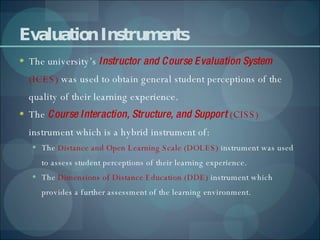
Evaluation Instruments The university’s  Instructor and Course Evaluation System  (ICES)  was used to obtain general student perceptions of the quality of their learning experience. The  Course Interaction, Structure, and Support  (CISS)  instrument which is a hybrid instrument of: The  Distance and Open Learning Scale (DOLES)  instrument was used to assess student perceptions of their learning experience. The  Dimensions of Distance Education (DDE)  instrument which provides a further assessment of the learning environment.
Advantages & Disadvantages Advantages: More than one instrument was used to collect data. Disadvantages: Only tools for quantitative analysis were used without using of any type of qualitative analysis tools.
Research Results Student Satisfaction:  On the student satisfaction indicators, instructor quality and course quality, both groups provided positive ratings, although the face-to-face group displayed more positive views than the online group. Perceptions of course interaction, structure & support:  Overall, both groups of students had positive perceptions, with the face-to-face students having significantly more positive views for interaction and support.
Research Results (Cont’d) Learning Outcomes (Course Grades): Course Format n Course Grade A % B % C % I % Face-to-Face 19 13 68% 2 11% 2 11% 2 11% Online 19 13 68% 1 6% 2 11% 3 16% Total 38 26 68% 3 8% 4 11% 5 13%
NON-COMPARATIVE STUDY
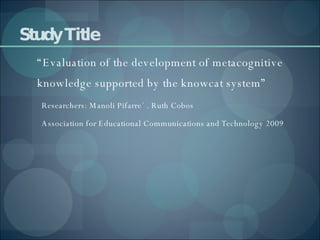
Study Title “ Evaluation of the development of metacognitive knowledge supported by the knowcat system” Researchers: Manoli Pifarre´ . Ruth Cobos Association for Educational Communications and Technology 2009
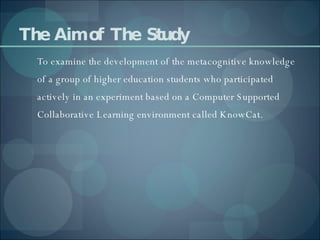
The  Aim of  The  Study To examine the development of the metacognitive knowledge of a group of higher education students who participated actively in an experiment based on a Computer Supported Collaborative Learning environment called KnowCat.
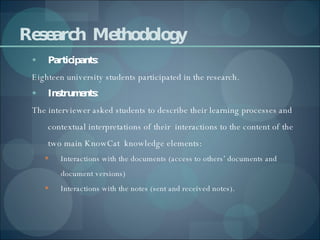
Research  Methodology Participants: Eighteen university students participated in the research. Instruments: The interviewer asked students to describe their learning processes and contextual interpretations of their  interactions to the content of the two main KnowCat  knowledge elements:  Interactions with the documents (access to others’ documents and document versions)  Interactions with the notes (sent and received notes).
Disadvantages The researchers have used interviews as the only tool for qualitative evaluation, without any quantitative evaluation tool.
Research  Results Interactions of students with their classmates’ documents encourage them to compare their own cognitive strategies to solve the task with the others’. Students are aware of how the characteristics of the KnowCat educational process had a strong incidence in their cognition-metacognitive knowledge of task and context category.
Research  Results cont.. Results revealed a high level of awareness that students received through note contribution as it proved to be a unique opportunity to monitor and regulate their cognitive strategies to solve the task. These results show evidence that the KnowCat note knowledge element was helpful in assisting students develop constituent components of metacognition i.e., planning, monitoring, evaluating and revising their learning activities to solve the tasks efficiently.
References http://www.editlib.org/index.cfm?fuseaction=Reader.ViewFullText&paper_id=8371   http://www.springerlink.com/content/87v06t9523380k72/

Comparartive and non-Comparative study

  • 1.
    Khadeeja Al-Shidhani 61344 Amal Al-Balushi 66755 COMPARATIVE AND NON-COMPARATIVE STUDY
  • 2.
    Outline Comparative StudyResearch Title Research Purpose Research Questions Participants Evaluation Instruments Advantages & Disadvantages Research results Non-comparative Study Study title The Aim of The Study Research Methodology Disadvantages Study results
  • 3.
    COMPARATIVE STUDY Perceptionand performance study
  • 4.
    Research Title“ Comparative Analysis of Learner Satisfaction and Learning Outcomes in Online and Face-to-Face Learning Environments” Scottd. Johnson, Steven R. Aragon, Najmuddin Shaik, & Nilda Palma-Rivas University of Illinois at Urbana-Champaign
  • 5.
    Research Purpose Comparingan online course with an equivalent course taught in a traditional face-to-face format. Comparisons included student ratings of instructor and course quality; assessment of course interaction, structure, and support; and learning outcomes such as course projects, grades, and student self-assessment of their ability to perform various ISD tasks.
  • 6.
    Research Questions Whatdifferences exist in satisfaction with the learning experience of students enrolled in online versus face-to-face learning environments? What differences exist in student perceptions of student/instructor interaction, course structure, and course support between students enrolled in online versus face-to-face learning environments? What differences exist in the learning outcomes (i.e., perceived content knowledge, quality of course projects, and final course grades) of students enrolled in online versus face-to-face learning environments?
  • 7.
    Participants The subjectof this study includes 38 students enrolled in an instructional design course. 19 students were taught face-to-face while the other 19 students were taught online.
  • 8.
    Evaluation Instruments Theuniversity’s Instructor and Course Evaluation System (ICES) was used to obtain general student perceptions of the quality of their learning experience. The Course Interaction, Structure, and Support (CISS) instrument which is a hybrid instrument of: The Distance and Open Learning Scale (DOLES) instrument was used to assess student perceptions of their learning experience. The Dimensions of Distance Education (DDE) instrument which provides a further assessment of the learning environment.
  • 9.
    Advantages & DisadvantagesAdvantages: More than one instrument was used to collect data. Disadvantages: Only tools for quantitative analysis were used without using of any type of qualitative analysis tools.
  • 10.
    Research Results StudentSatisfaction: On the student satisfaction indicators, instructor quality and course quality, both groups provided positive ratings, although the face-to-face group displayed more positive views than the online group. Perceptions of course interaction, structure & support: Overall, both groups of students had positive perceptions, with the face-to-face students having significantly more positive views for interaction and support.
  • 11.
    Research Results (Cont’d)Learning Outcomes (Course Grades): Course Format n Course Grade A % B % C % I % Face-to-Face 19 13 68% 2 11% 2 11% 2 11% Online 19 13 68% 1 6% 2 11% 3 16% Total 38 26 68% 3 8% 4 11% 5 13%
  • 12.
  • 13.
    Study Title “Evaluation of the development of metacognitive knowledge supported by the knowcat system” Researchers: Manoli Pifarre´ . Ruth Cobos Association for Educational Communications and Technology 2009
  • 14.
    The Aimof The Study To examine the development of the metacognitive knowledge of a group of higher education students who participated actively in an experiment based on a Computer Supported Collaborative Learning environment called KnowCat.
  • 15.
    Research MethodologyParticipants: Eighteen university students participated in the research. Instruments: The interviewer asked students to describe their learning processes and contextual interpretations of their interactions to the content of the two main KnowCat knowledge elements: Interactions with the documents (access to others’ documents and document versions) Interactions with the notes (sent and received notes).
  • 16.
    Disadvantages The researchershave used interviews as the only tool for qualitative evaluation, without any quantitative evaluation tool.
  • 17.
    Research ResultsInteractions of students with their classmates’ documents encourage them to compare their own cognitive strategies to solve the task with the others’. Students are aware of how the characteristics of the KnowCat educational process had a strong incidence in their cognition-metacognitive knowledge of task and context category.
  • 18.
    Research Resultscont.. Results revealed a high level of awareness that students received through note contribution as it proved to be a unique opportunity to monitor and regulate their cognitive strategies to solve the task. These results show evidence that the KnowCat note knowledge element was helpful in assisting students develop constituent components of metacognition i.e., planning, monitoring, evaluating and revising their learning activities to solve the tasks efficiently.
  • 19.