SNORT
,,_
O“ )~
‘’’’
The Networked Family
ICM
P
TCP
IP
UDP
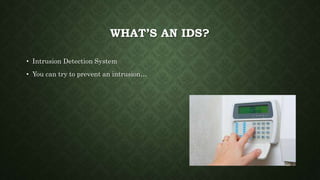
WHAT’S AN IDS?
• Intrusion Detection System
• You can try to prevent an intrusion…
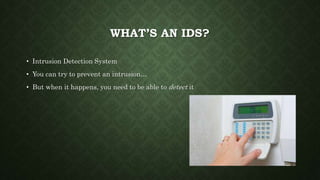
WHAT’S AN IDS?
• Intrusion Detection System
• You can try to prevent an intrusion…
• But when it happens, you need to be able to detect it
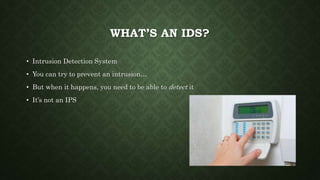
WHAT’S AN IDS?
• Intrusion Detection System
• You can try to prevent an intrusion…
• But when it happens, you need to be able to detect it
• It’s not an IPS
HOW DOES IT WORK?
• What would you look for?
• What can you look for?
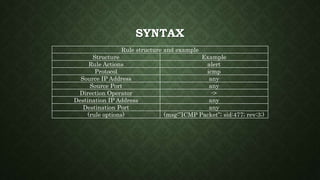
SYNTAX
Rule structure and example
Structure Example
Rule Actions alert
Protocol icmp
Source IP Address any
Source Port any
Direction Operator ->
Destination IP Address any
Destination Port any
(rule options) (msg:”ICMP Packet”; sid:477; rev:3;)
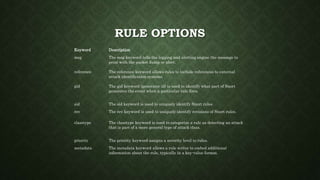
RULE OPTIONS
Keyword Description
msg The msg keyword tells the logging and alerting engine the message to
print with the packet dump or alert.
reference The reference keyword allows rules to include references to external
attack identification systems.
gid The gid keyword (generator id) is used to identify what part of Snort
generates the event when a particular rule fires.
sid The sid keyword is used to uniquely identify Snort rules.
rev The rev keyword is used to uniquely identify revisions of Snort rules.
classtype The classtype keyword is used to categorize a rule as detecting an attack
that is part of a more general type of attack class.
priority The priority keyword assigns a severity level to rules.
metadata The metadata keyword allows a rule writer to embed additional
information about the rule, typically in a key-value format.
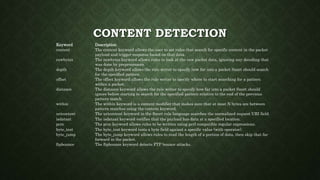
CONTENT DETECTION
Keyword Description
content The content keyword allows the user to set rules that search for specific content in the packet
payload and trigger response based on that data.
rawbytes The rawbytes keyword allows rules to look at the raw packet data, ignoring any decoding that
was done by preprocessors.
depth The depth keyword allows the rule writer to specify how far into a packet Snort should search
for the specified pattern.
offset The offset keyword allows the rule writer to specify where to start searching for a pattern
within a packet.
distance The distance keyword allows the rule writer to specify how far into a packet Snort should
ignore before starting to search for the specified pattern relative to the end of the previous
pattern match.
within The within keyword is a content modifier that makes sure that at most N bytes are between
pattern matches using the content keyword.
uricontent The uricontent keyword in the Snort rule language searches the normalized request URI field.
isdataat The isdataat keyword verifies that the payload has data at a specified location.
pcre The pcre keyword allows rules to be written using perl compatible regular expressions.
byte_test The byte_test keyword tests a byte field against a specific value (with operator).
byte_jump The byte_jump keyword allows rules to read the length of a portion of data, then skip that far
forward in the packet.
ftpbounce The ftpbounce keyword detects FTP bounce attacks.
CAN YOU DETECT A REVERSE SHELL
EXPLOIT?
• How would you start?
CAN YOU DETECT A REVERSE SHELL
EXPLOIT?
• How would you start?
• What would examine?
CAN YOU DETECT A REVERSE SHELL
EXPLOIT?
• How would you start?
• What would examine?
• How would you test?
$SNORT -R
• Replay a pcap file captured from tcpdump to test your ruleset
SYNTAX
• <Rule Actions> <Protocol> <Source IP Address> <Source Port>
• <Direction Operator> <Destination IP Address> <Destination > (rule options)
• ----------------------------------------------------------------------------------------------------------
• Becomes this:
• alert icmp any any -> any any (msg:"ICMP Packet"; sid:477; rev:3;)
WHAT HAPPENS?
• Rules trigger alerts into the snort logs
• To automatically be alerted use a shell script to monitor
• Pseudo code is something like this:
• #grep for something in the log
• #if the output isn’t blank, email someone
• #do that again forever and clear the log once you’ve seen the message
SUMMARY
• An IDS is an intelligent packet sniffer
• Snort is an open sourced implementation
• Rules have a standard format
• Rules are configured to look at packet headers and/or content

Snort IDS

  • 1.
  • 2.
  • 3.
  • 4.
    WHAT’S AN IDS? •Intrusion Detection System • You can try to prevent an intrusion…
  • 5.
    WHAT’S AN IDS? •Intrusion Detection System • You can try to prevent an intrusion… • But when it happens, you need to be able to detect it
  • 6.
    WHAT’S AN IDS? •Intrusion Detection System • You can try to prevent an intrusion… • But when it happens, you need to be able to detect it • It’s not an IPS
  • 7.
    HOW DOES ITWORK? • What would you look for? • What can you look for?
  • 8.
    SYNTAX Rule structure andexample Structure Example Rule Actions alert Protocol icmp Source IP Address any Source Port any Direction Operator -> Destination IP Address any Destination Port any (rule options) (msg:”ICMP Packet”; sid:477; rev:3;)
  • 9.
    RULE OPTIONS Keyword Description msgThe msg keyword tells the logging and alerting engine the message to print with the packet dump or alert. reference The reference keyword allows rules to include references to external attack identification systems. gid The gid keyword (generator id) is used to identify what part of Snort generates the event when a particular rule fires. sid The sid keyword is used to uniquely identify Snort rules. rev The rev keyword is used to uniquely identify revisions of Snort rules. classtype The classtype keyword is used to categorize a rule as detecting an attack that is part of a more general type of attack class. priority The priority keyword assigns a severity level to rules. metadata The metadata keyword allows a rule writer to embed additional information about the rule, typically in a key-value format.
  • 10.
    CONTENT DETECTION Keyword Description contentThe content keyword allows the user to set rules that search for specific content in the packet payload and trigger response based on that data. rawbytes The rawbytes keyword allows rules to look at the raw packet data, ignoring any decoding that was done by preprocessors. depth The depth keyword allows the rule writer to specify how far into a packet Snort should search for the specified pattern. offset The offset keyword allows the rule writer to specify where to start searching for a pattern within a packet. distance The distance keyword allows the rule writer to specify how far into a packet Snort should ignore before starting to search for the specified pattern relative to the end of the previous pattern match. within The within keyword is a content modifier that makes sure that at most N bytes are between pattern matches using the content keyword. uricontent The uricontent keyword in the Snort rule language searches the normalized request URI field. isdataat The isdataat keyword verifies that the payload has data at a specified location. pcre The pcre keyword allows rules to be written using perl compatible regular expressions. byte_test The byte_test keyword tests a byte field against a specific value (with operator). byte_jump The byte_jump keyword allows rules to read the length of a portion of data, then skip that far forward in the packet. ftpbounce The ftpbounce keyword detects FTP bounce attacks.
  • 11.
    CAN YOU DETECTA REVERSE SHELL EXPLOIT? • How would you start?
  • 12.
    CAN YOU DETECTA REVERSE SHELL EXPLOIT? • How would you start? • What would examine?
  • 13.
    CAN YOU DETECTA REVERSE SHELL EXPLOIT? • How would you start? • What would examine? • How would you test?
  • 14.
    $SNORT -R • Replaya pcap file captured from tcpdump to test your ruleset
  • 15.
    SYNTAX • <Rule Actions><Protocol> <Source IP Address> <Source Port> • <Direction Operator> <Destination IP Address> <Destination > (rule options) • ---------------------------------------------------------------------------------------------------------- • Becomes this: • alert icmp any any -> any any (msg:"ICMP Packet"; sid:477; rev:3;)
  • 16.
    WHAT HAPPENS? • Rulestrigger alerts into the snort logs • To automatically be alerted use a shell script to monitor • Pseudo code is something like this: • #grep for something in the log • #if the output isn’t blank, email someone • #do that again forever and clear the log once you’ve seen the message
  • 17.
    SUMMARY • An IDSis an intelligent packet sniffer • Snort is an open sourced implementation • Rules have a standard format • Rules are configured to look at packet headers and/or content