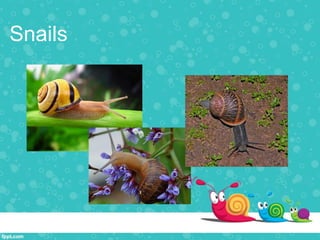
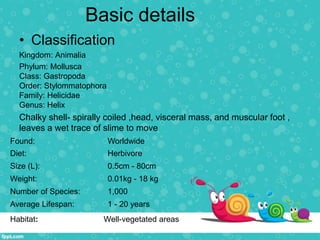
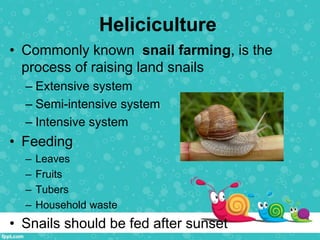
Snails
Basic details
• Classification
Kingdom: Animalia
Phylum: Mollusca
Class: Gastropoda
Order: Stylommatophora
Family: Helicidae
Genus: Helix
Chalky shell- spirally coiled ,head, visceral mass, and muscular foot ,
leaves a wet trace of slime to move
Found: Worldwide
Diet: Herbivore
Size (L): 0.5cm - 80cm
Weight: 0.01kg - 18 kg
Number of Species: 1,000
Average Lifespan: 1 - 20 years
Habitat: Well-vegetated areas
• Breeding
Hermaphrodites animal
have to mate with another snail in order to
fertilize their eggs
Average Litter Size - 200
Predators
Rats, Human, Birds, Caraboid beetle and larva, Lizards
Heliciculture
• Commonly known snail farming, is the
process of raising land snails
– Extensive system
– Semi-intensive system
– Intensive system
• Feeding
– Leaves
– Fruits
– Tubers
– Household waste
• Snails should be fed after sunset
Suitable tropical snail species for
farming
Helix pomatia - Apple snail Otala lactea - Milk snail
Achatina fulica -The city girl Cepaea nemoralis - grove snail
Cepaea hortensis - white-lipped snail
Human relevance
• In agriculture biological pest control agent, manure
• As food Land snails, freshwater snails and sea snails
• Cosmetic Skin creams-Helix agent
• Cultural depictions
• Textiles as natural dye
• Land snails, freshwater snails and sea snails are
eaten
• European countries (Spain,France,Italy…)
• Asian countries (Philippines, China, India,Nepal…)
• African countries (Morocco,Nigeria, Ghana, Malta)
• Belgium, United States, Cyprus
• Freshly gathered snails have just eaten
– Washing Boiling Dressing
Snails as a food (escargot)
• Rats, Human, Birds, Caraboid beetle and larva, Lizards
• Irregular growth of the shell, operculum
• Thin and fragile shell
• Deterioration of shell and operculum
Predators, parasites and diseases
Snail

Snail

  • 1.
  • 2.
    Basic details • Classification Kingdom:Animalia Phylum: Mollusca Class: Gastropoda Order: Stylommatophora Family: Helicidae Genus: Helix Chalky shell- spirally coiled ,head, visceral mass, and muscular foot , leaves a wet trace of slime to move Found: Worldwide Diet: Herbivore Size (L): 0.5cm - 80cm Weight: 0.01kg - 18 kg Number of Species: 1,000 Average Lifespan: 1 - 20 years Habitat: Well-vegetated areas
  • 3.
    • Breeding Hermaphrodites animal haveto mate with another snail in order to fertilize their eggs Average Litter Size - 200 Predators Rats, Human, Birds, Caraboid beetle and larva, Lizards
  • 4.
    Heliciculture • Commonly knownsnail farming, is the process of raising land snails – Extensive system – Semi-intensive system – Intensive system • Feeding – Leaves – Fruits – Tubers – Household waste • Snails should be fed after sunset
  • 5.
    Suitable tropical snailspecies for farming Helix pomatia - Apple snail Otala lactea - Milk snail Achatina fulica -The city girl Cepaea nemoralis - grove snail Cepaea hortensis - white-lipped snail
  • 6.
    Human relevance • Inagriculture biological pest control agent, manure • As food Land snails, freshwater snails and sea snails • Cosmetic Skin creams-Helix agent • Cultural depictions • Textiles as natural dye
  • 7.
    • Land snails,freshwater snails and sea snails are eaten • European countries (Spain,France,Italy…) • Asian countries (Philippines, China, India,Nepal…) • African countries (Morocco,Nigeria, Ghana, Malta) • Belgium, United States, Cyprus • Freshly gathered snails have just eaten – Washing Boiling Dressing Snails as a food (escargot)
  • 8.
    • Rats, Human,Birds, Caraboid beetle and larva, Lizards • Irregular growth of the shell, operculum • Thin and fragile shell • Deterioration of shell and operculum Predators, parasites and diseases