SUBMITTED BY:-
NARAIN DHAR
[M.Sc.(Ag) 1st yr]
2016-17
SUBMITTED TO:-
Dr.D.PRATAP (SIR)
Dept- Genetics & Plant
Breeding
CONTENT
 INTRODUCTION
 HISTORY OF DISEASE
 DAMAGE CAPACITY OF DISEASE
 SYMPTOMS OF DISEASE
 ETIOLOGY
 DISEASE CYCLE
 DISEASE MANAGEMENT
 IDM APPROCHES
INTRODUCTION
IMPORTANCE OF SUGARCANE
 The importance of sugar in human diet needs no introduction; it
has become a part and parcel of daily life. Sugar is produced
mainly from sugarcane and sugarbeet and more than 75 percent
of the world sugar comes from sugarcane.
Sugarcane is a native of India and has been in use for
‘gur’making since prehistoric times. ‘Gur’ was known as early as
3000 BC
Use as a Gasohol
HISTORY OF DISEASE
Red rot of sugarcane was first reported in 1893 from java
(indonesia)
The accepted name,‘Red rot’ was given to this cane
disease in 1906 by Sir E. J. Butler, the celebrated Imperial
Mycologist of India,who was then working at Pusa,Bihar.
The disease was first seen in India in 1901 near Godavari
Delata of Andhra Pradesh, India.
Epidemic in 1939 – 40 in east UP & Bihar
In 1950 It has always damage a lot of sucrose content
variety,coj 312, of sugarcane.
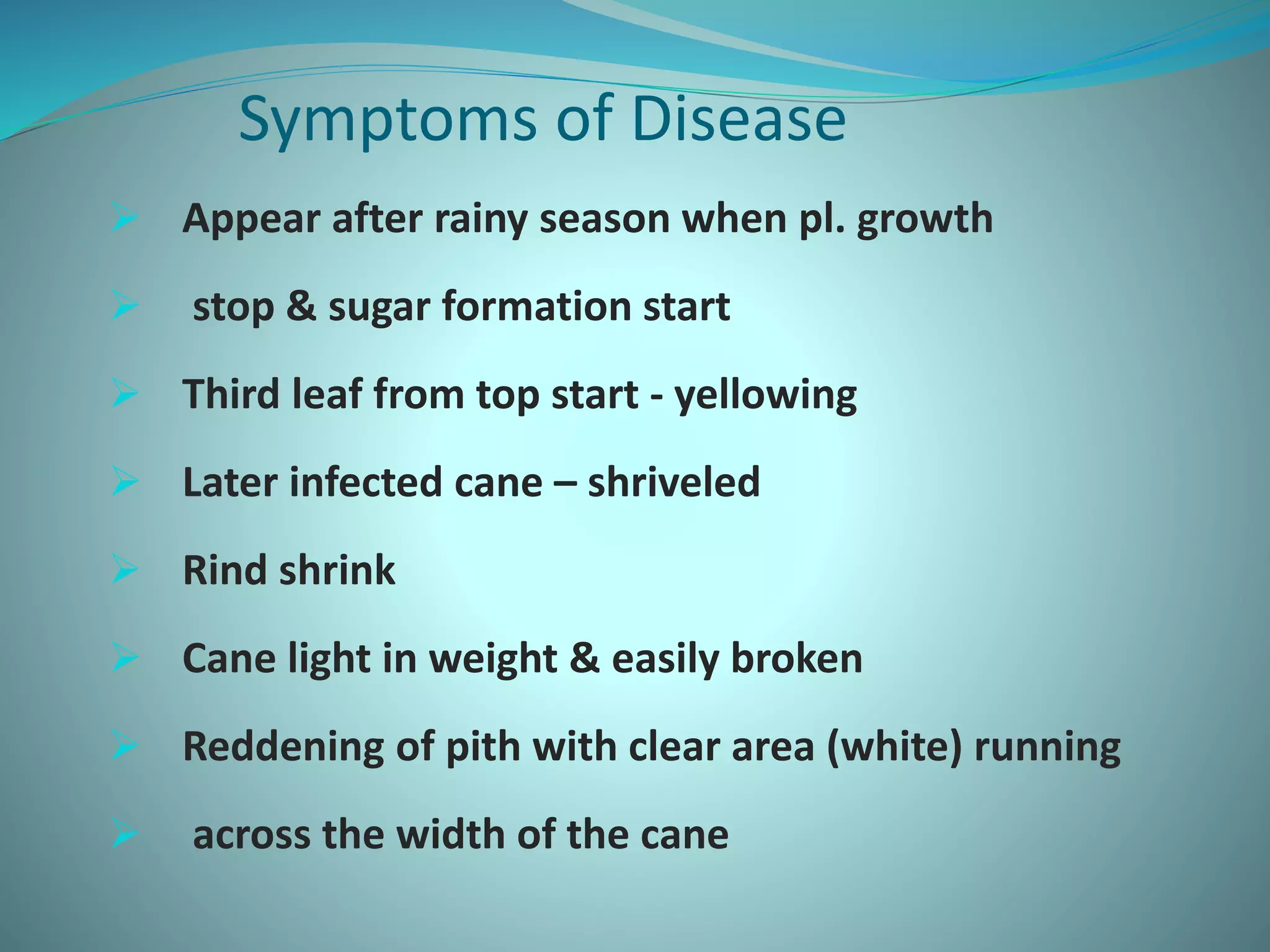
Symptoms of Disease
 Appear after rainy season when pl. growth
 stop & sugar formation start
 Third leaf from top start - yellowing
 Later infected cane – shriveled
 Rind shrink
 Cane light in weight & easily broken
 Reddening of pith with clear area (white) running
 across the width of the cane
ETIOLOGY
 Causal Organism :- Colletrotrichum falcatum
 Perfect stage:- Glomerella tucumanensis
The fungi causing the disease occur in two stages.
 These are the asexual stage, which is called anamorph
or imperfect stage .
 Perfect stage :-which is called teleomorph or the
Sexual stage. Perfect stage of fungus means When it
reproduces sexually.
Soil born disease
Systemic Position
Kingdom – Mycota/ Fungi
Division – Eumycota
Sub division – Deuteromycotina
Class – Coeleomycetes
Order – Melanconiales
Family – Melanconaceae
Genus _ Colletotrichum
Species - falcatum
Disease cycle
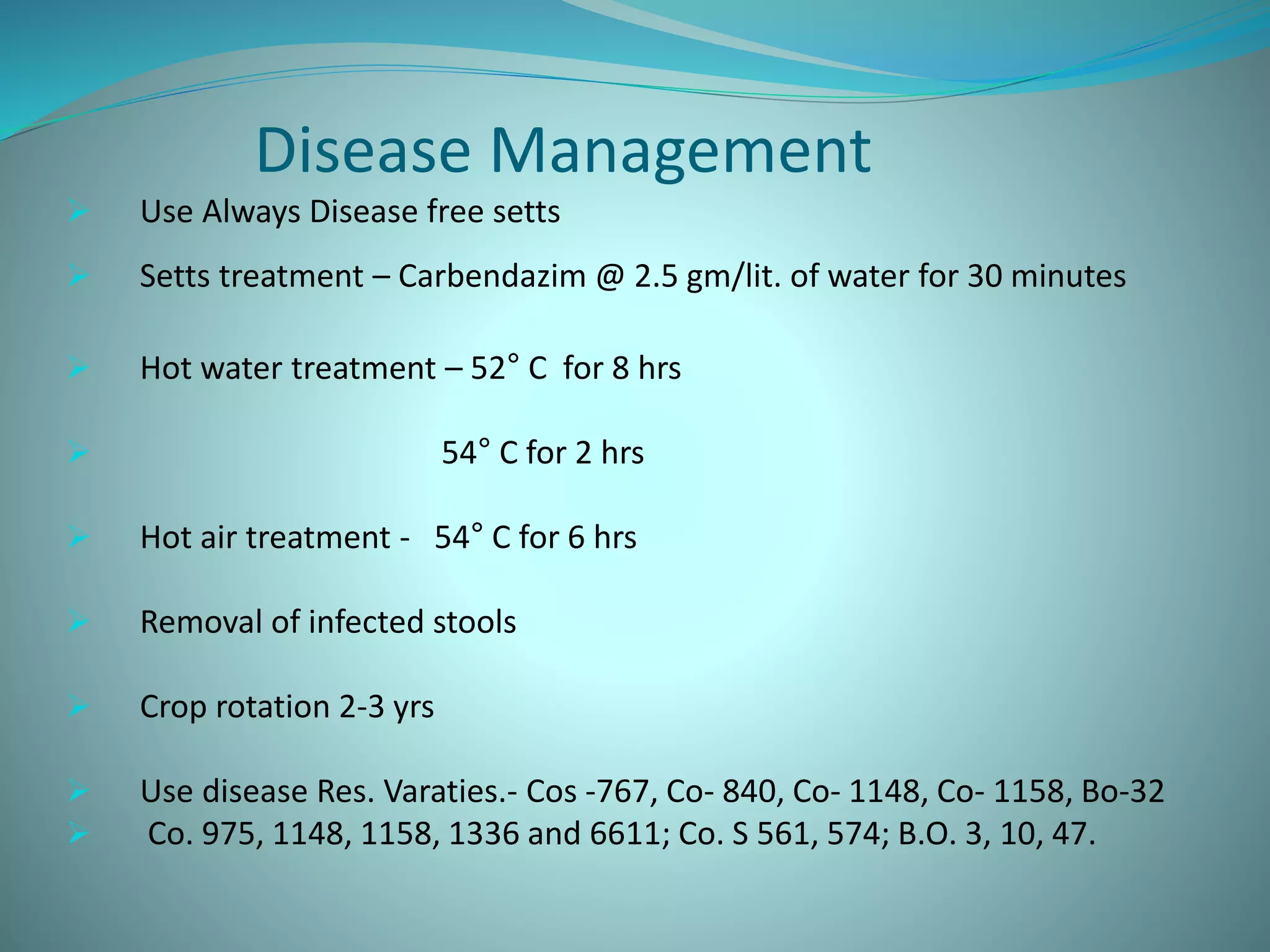
Disease Management
 Use Always Disease free setts
 Setts treatment – Carbendazim @ 2.5 gm/lit. of water for 30 minutes
 Hot water treatment – 52° C for 8 hrs
 54° C for 2 hrs
 Hot air treatment - 54° C for 6 hrs
 Removal of infected stools
 Crop rotation 2-3 yrs
 Use disease Res. Varaties.- Cos -767, Co- 840, Co- 1148, Co- 1158, Bo-32
 Co. 975, 1148, 1158, 1336 and 6611; Co. S 561, 574; B.O. 3, 10, 47.
INTEGRATED DISEASE MANAGEMENT
RED ROT OF SUGARCAE

RED ROT OF SUGARCAE

  • 2.
    SUBMITTED BY:- NARAIN DHAR [M.Sc.(Ag)1st yr] 2016-17 SUBMITTED TO:- Dr.D.PRATAP (SIR) Dept- Genetics & Plant Breeding
  • 3.
    CONTENT  INTRODUCTION  HISTORYOF DISEASE  DAMAGE CAPACITY OF DISEASE  SYMPTOMS OF DISEASE  ETIOLOGY  DISEASE CYCLE  DISEASE MANAGEMENT  IDM APPROCHES
  • 4.
    INTRODUCTION IMPORTANCE OF SUGARCANE The importance of sugar in human diet needs no introduction; it has become a part and parcel of daily life. Sugar is produced mainly from sugarcane and sugarbeet and more than 75 percent of the world sugar comes from sugarcane. Sugarcane is a native of India and has been in use for ‘gur’making since prehistoric times. ‘Gur’ was known as early as 3000 BC Use as a Gasohol
  • 5.
    HISTORY OF DISEASE Redrot of sugarcane was first reported in 1893 from java (indonesia) The accepted name,‘Red rot’ was given to this cane disease in 1906 by Sir E. J. Butler, the celebrated Imperial Mycologist of India,who was then working at Pusa,Bihar. The disease was first seen in India in 1901 near Godavari Delata of Andhra Pradesh, India. Epidemic in 1939 – 40 in east UP & Bihar In 1950 It has always damage a lot of sucrose content variety,coj 312, of sugarcane.
  • 6.
    Symptoms of Disease Appear after rainy season when pl. growth  stop & sugar formation start  Third leaf from top start - yellowing  Later infected cane – shriveled  Rind shrink  Cane light in weight & easily broken  Reddening of pith with clear area (white) running  across the width of the cane
  • 9.
    ETIOLOGY  Causal Organism:- Colletrotrichum falcatum  Perfect stage:- Glomerella tucumanensis The fungi causing the disease occur in two stages.  These are the asexual stage, which is called anamorph or imperfect stage .  Perfect stage :-which is called teleomorph or the Sexual stage. Perfect stage of fungus means When it reproduces sexually. Soil born disease
  • 10.
    Systemic Position Kingdom –Mycota/ Fungi Division – Eumycota Sub division – Deuteromycotina Class – Coeleomycetes Order – Melanconiales Family – Melanconaceae Genus _ Colletotrichum Species - falcatum
  • 11.
  • 12.
    Disease Management  UseAlways Disease free setts  Setts treatment – Carbendazim @ 2.5 gm/lit. of water for 30 minutes  Hot water treatment – 52° C for 8 hrs  54° C for 2 hrs  Hot air treatment - 54° C for 6 hrs  Removal of infected stools  Crop rotation 2-3 yrs  Use disease Res. Varaties.- Cos -767, Co- 840, Co- 1148, Co- 1158, Bo-32  Co. 975, 1148, 1158, 1336 and 6611; Co. S 561, 574; B.O. 3, 10, 47.
  • 13.