HR 
TRANSFORMATION 
FOR 
SMALL & MEDIUM 
ENTERPRISSES 
(SME) IN 
UAE 
© Browne & Mohan, 2014
Few Facts & Figures 
Small and Medium enterprises (SME) 
represent 95% of all the 
establishments. 
Micro, small and medium sized firms 
contribute 72%, 18% and 5% 
respectively. 
SME businesses account for 42% of 
the work force of Dubai. 
The annual growth rate of GDP of 
Dubai is around 4.9%. 
© Browne & Mohan, 2014
SMEs HR Orientation 
INSIGHTS 
Lower productivity levels are 
prevalent due to lack for a 
strategic HR unit. 
Lack of description of the 
KRA/KPIs and effective 
performance management system. 
Absence of identification of the 
training needs and actual skill 
development training provided to 
employees. 
According to a survey done by Dubai 
SME agency, appointed by 
Department of Economic 
Development, Dubai:- 
 75% of the survey respondents 
indicated that they do not have a 
separate HR unit. 
 83% of the SMEs do not have well 
defined KRA/KPIs and PMS. 
 74% of the SMEs indicated that 
they do not provide need based or 
comprehensive training. 
© Browne & Mohan, 2014
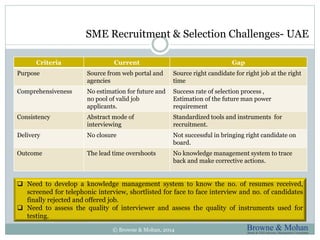
SME Recruitment & Selection Challenges- UAE 
Criteria Current Gap 
Purpose Source from web portal and 
agencies 
Source right candidate for right job at the right 
time 
Comprehensiveness No estimation for future and 
no pool of valid job 
applicants. 
Success rate of selection process , 
Estimation of the future man power 
requirement 
Consistency Abstract mode of 
interviewing 
Standardized tools and instruments for 
recruitment. 
Delivery No closure Not successful in bringing right candidate on 
board. 
Outcome The lead time overshoots No knowledge management system to trace 
back and make corrective actions. 
 Need to develop a knowledge management system to know the no. of resumes received, 
screened for telephonic interview, shortlisted for face to face interview and no. of candidates 
finally rejected and offered job. 
 Need to assess the quality of interviewer and assess the quality of instruments used for 
© Browne & Mohan, 2014 
testing.
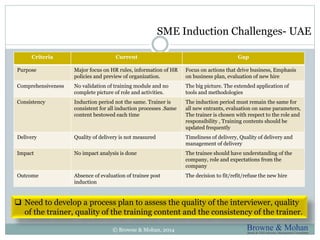
SME Induction Challenges- UAE 
Criteria Current Gap 
Purpose Major focus on HR rules, information of HR 
policies and preview of organization. 
Focus on actions that drive business, Emphasis 
on business plan, evaluation of new hire 
Comprehensiveness No validation of training module and no 
complete picture of role and activities. 
The big picture. The extended application of 
tools and methodologies 
Consistency Induction period not the same. Trainer is 
consistent for all induction processes .Same 
content bestowed each time 
The induction period must remain the same for 
all new entrants, evaluation on same parameters, 
The trainer is chosen with respect to the role and 
responsibility , Training contents should be 
updated frequently 
Delivery Quality of delivery is not measured Timeliness of delivery, Quality of delivery and 
management of delivery 
Impact No impact analysis is done The trainee should have understanding of the 
company, role and expectations from the 
company 
Outcome Absence of evaluation of trainee post 
induction 
The decision to fit/refit/refuse the new hire 
 Need to develop a process plan to assess the quality of the interviewer, quality 
of the trainer, quality of the training content and the consistency of the trainer. 
© Browne & Mohan, 2014
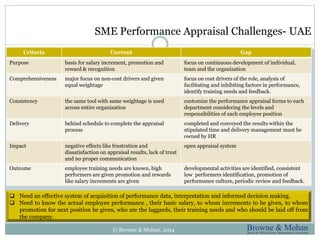
SME Performance Appraisal Challenges- UAE 
Criteria Current Gap 
Purpose basis for salary increment, promotion and 
reward & recognition 
focus on continuous development of individual, 
team and the organization 
Comprehensiveness major focus on non-cost drivers and given 
equal weightage 
focus on cost drivers of the role, analysis of 
facilitating and inhibiting factors in performance, 
identify training needs and feedback. 
Consistency the same tool with same weightage is used 
across entire organization 
customize the performance appraisal forms to each 
department considering the levels and 
responsibilities of each employee position 
Delivery behind schedule to complete the appraisal 
process 
completed and conveyed the results within the 
stipulated time and delivery management must be 
owned by HR 
Impact negative effects like frustration and 
dissatisfaction on appraisal results, lack of trust 
and no proper communication 
open appraisal system 
Outcome employee training needs are known, high 
performers are given promotion and rewards 
like salary increments are given 
developmental activities are identified, consistent 
low performers identification, promotion of 
performance culture, periodic review and feedback. 
 Need an effective system of acquisition of performance data, interpretation and informed decision making. 
 Need to know the actual employee performance , their basic salary, to whom increments to be given, to whom 
promotion for next position be given, who are the laggards, their training needs and who should be laid off from 
the company. 
© Browne & Mohan, 2014
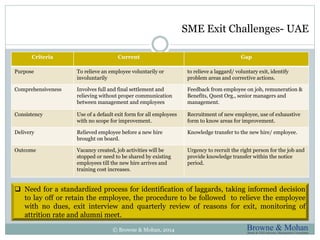
SME Exit Challenges- UAE 
Criteria Current Gap 
Purpose To relieve an employee voluntarily or 
involuntarily 
to relieve a laggard/ voluntary exit, identify 
problem areas and corrective actions. 
Comprehensiveness Involves full and final settlement and 
relieving without proper communication 
between management and employees 
Feedback from employee on job, remuneration & 
Benefits, Quest Org., senior managers and 
management. 
Consistency Use of a default exit form for all employees 
with no scope for improvement. 
Recruitment of new employee, use of exhaustive 
form to know areas for improvement. 
Delivery Relieved employee before a new hire 
brought on board. 
Knowledge transfer to the new hire/ employee. 
Outcome Vacancy created, job activities will be 
stopped or need to be shared by existing 
employees till the new hire arrives and 
training cost increases. 
Urgency to recruit the right person for the job and 
provide knowledge transfer within the notice 
period. 
 Need for a standardized process for identification of laggards, taking informed decision 
to lay off or retain the employee, the procedure to be followed to relieve the employee 
with no dues, exit interview and quarterly review of reasons for exit, monitoring of 
attrition rate and alumni meet. 
© Browne & Mohan, 2014
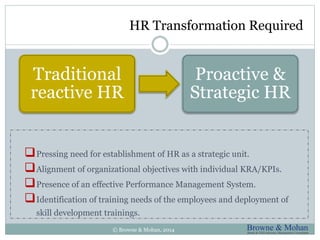
HR Transformation Required 
Traditional 
reactive HR 
Pressing need for establishment of HR as a strategic unit. 
Alignment of organizational objectives with individual KRA/KPIs. 
Presence of an effective Performance Management System. 
Identification of training needs of the employees and deployment of 
skill development trainings. 
Proactive & 
Strategic HR 
© Browne & Mohan, 2014
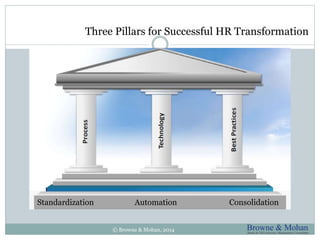
Three Pillars for Successful HR Transformation 
Standardization Automation Consolidation 
© Browne & Mohan, 2014
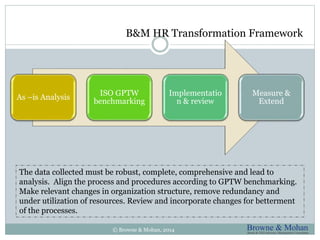
B&M HR Transformation Framework 
As –is Analysis 
ISO GPTW 
benchmarking 
Implementatio 
n & review 
Measure & 
Extend 
The data collected must be robust, complete, comprehensive and lead to 
analysis. Align the process and procedures according to GPTW benchmarking. 
Make relevant changes in organization structure, remove redundancy and 
under utilization of resources. Review and incorporate changes for betterment 
of the processes. 
© Browne & Mohan, 2014
Organizational Analysis: B&M Approach 
Organizational analysis is a process where we understand organization's systems, 
capacity and functionality. The information is used to increase efficiency, performance and 
output. The objective is to collect data and highlight opportunities for improvement. 
The first step in consulting is the as-is analysis. 
As is analysis- 
 Detailed presentation of the process as it is currently being performed. When doing an as-is 
analysis, information regarding all the processes that are currently followed are 
documented. 
 As in analysis would give an idea to understand which are the areas that have to catered to 
immediately. The objective being improvement of methods to reach the goals, measure 
outcomes and keep improving further on. 
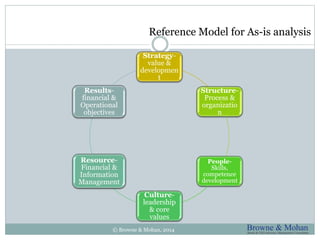
 To conduct an As is analysis, we use ‘Reference Model’ 
 There are 6 elements based on which details are collected: 
© Browne & Mohan, 2014
Reference Model for As-is analysis 
Strategy-value 
& 
developmen 
t 
Results-financial 
& 
Operational 
objectives 
© Browne & Mohan, 2014 
Structure- 
Process & 
organizatio 
n 
People- 
Skills, 
competence 
development 
Culture-leadership 
& core 
values 
Resource- 
Financial & 
Information 
Management
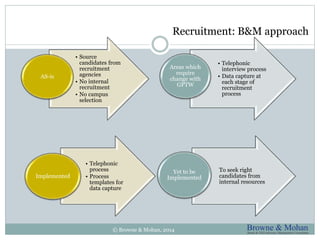
Recruitment: B&M approach 
• Source 
candidates from 
recruitment 
agencies 
• No internal 
recruitment 
• No campus 
selection 
© Browne & Mohan, 2014 
AS-is 
• Telephonic 
interview process 
• Data capture at 
each stage of 
recruitment 
process 
Areas which 
require 
change with 
GPTW 
• Telephonic 
process 
• Process 
templates for 
data capture 
Implemented 
To seek right 
candidates from 
internal resources 
Yet to be 
Implemented
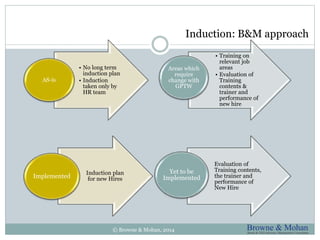
Induction: B&M approach 
• No long term 
induction plan 
• Induction 
taken only by 
HR team 
© Browne & Mohan, 2014 
AS-is 
• Training on 
relevant job 
areas 
• Evaluation of 
Training 
contents & 
trainer and 
performance of 
new hire 
Areas which 
require 
change with 
GPTW 
Induction plan 
Implemented for new Hires 
Evaluation of 
Training contents, 
the trainer and 
performance of 
New Hire 
Yet to be 
Implemented
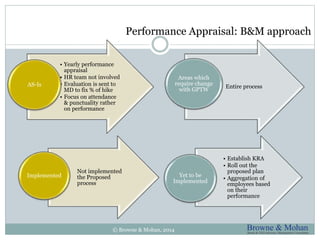
Performance Appraisal: B&M approach 
• Yearly performance 
appraisal 
• HR team not involved 
• Evaluation is sent to 
MD to fix % of hike 
• Focus on attendance 
& punctuality rather 
on performance 
AS-Is Entire process 
© Browne & Mohan, 2014 
Areas which 
require change 
with GPTW 
Not implemented 
the Proposed 
process 
Implemented 
• Establish KRA 
• Roll out the 
proposed plan 
• Aggregation of 
employees based 
on their 
performance 
Yet to be 
Implemented
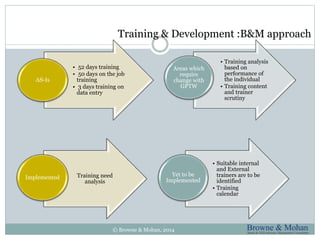
Training & Development :B&M approach 
• 52 days training 
• 50 days on the job 
training 
• 3 days training on 
data entry 
© Browne & Mohan, 2014 
AS-Is 
• Training analysis 
based on 
performance of 
the individual 
• Training content 
and trainer 
scrutiny 
Areas which 
require 
change with 
GPTW 
Training need 
analysis 
Implemented 
• Suitable internal 
and External 
trainers are to be 
identified 
• Training 
calendar 
Yet to be 
Implemented
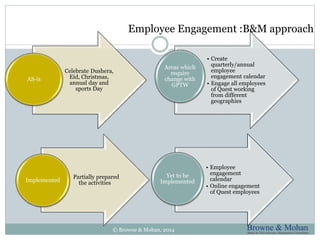
Employee Engagement :B&M approach 
Celebrate Dushera, 
Eid, Christmas, 
annual day and 
sports Day 
AS-is 
• Create 
quarterly/annual 
employee 
engagement calendar 
• Engage all employees 
of Quest working 
from different 
geographies 
Areas which 
require 
change with 
GPTW 
Partially prepared 
Implemented the activities 
• Employee 
engagement 
calendar 
• Online engagement 
of Quest employees 
Yet to be 
Implemented 
© Browne & Mohan, 2014
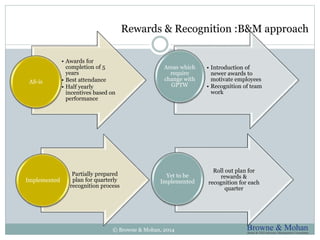
Rewards & Recognition :B&M approach 
• Awards for 
completion of 5 
years 
• Best attendance 
• Half yearly 
incentives based on 
performance 
AS-is 
• Introduction of 
newer awards to 
motivate employees 
• Recognition of team 
work 
Areas which 
require 
change with 
GPTW 
Partially prepared 
plan for quarterly 
recognition process 
Implemented 
Roll out plan for 
rewards & 
recognition for each 
quarter 
Yet to be 
Implemented 
© Browne & Mohan, 2014
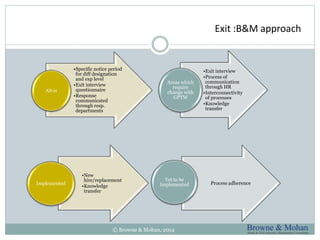
Exit :B&M approach 
•Specific notice period 
for diff designation 
and exp level 
•Exit interview 
questionnaire 
•Response 
communicated 
through resp. 
departments 
Yet to be 
© Browne & Mohan, 2014 
AS-is 
•Exit interview 
•Process of 
communication 
through HR 
•Interconnectivity 
of processes 
•Knowledge 
transfer 
Areas which 
require 
change with 
GPTW 
•New 
hire/replacement 
•Knowledge 
transfer 
Implemented Process adherence 
Implemented
Inter- connectivity of processes 
 Multi stage linkage of the processes 
 Smooth Data flow to yield meaningful decisions 
 Managers do not take decisions based on intuition 
 The company as a whole carries an effective knowledge management system. 
© Browne & Mohan, 2014
Benefits for the clients by B&M HR transformation process 
 Cost saving 
 Better business alignment 
 Deeper professional expertise 
 More consistent processes 
 Improved customer service 
 Greater line engagement 
 Repositioning of HR/people management on the map 
© Browne & Mohan, 2014
Thank You 
Browne & Mohan 
Board & CEO Advisors, 
Management Consultants 
157/A, 2nd Floor, 10th 'A' Main, 
Jayanagar 1st Block 
Bangalore-560 011 
Ph: +91-80-26565164/40951170 
www.browneandmohan.com 
© Browne & Mohan, 2014

HR TRANSFORMATION FOR SMALL & MEDIUM ENTERPRISSES in UAE

  • 1.
    HR TRANSFORMATION FOR SMALL & MEDIUM ENTERPRISSES (SME) IN UAE © Browne & Mohan, 2014
  • 2.
    Few Facts &Figures Small and Medium enterprises (SME) represent 95% of all the establishments. Micro, small and medium sized firms contribute 72%, 18% and 5% respectively. SME businesses account for 42% of the work force of Dubai. The annual growth rate of GDP of Dubai is around 4.9%. © Browne & Mohan, 2014
  • 3.
    SMEs HR Orientation INSIGHTS Lower productivity levels are prevalent due to lack for a strategic HR unit. Lack of description of the KRA/KPIs and effective performance management system. Absence of identification of the training needs and actual skill development training provided to employees. According to a survey done by Dubai SME agency, appointed by Department of Economic Development, Dubai:-  75% of the survey respondents indicated that they do not have a separate HR unit.  83% of the SMEs do not have well defined KRA/KPIs and PMS.  74% of the SMEs indicated that they do not provide need based or comprehensive training. © Browne & Mohan, 2014
  • 4.
    SME Recruitment &Selection Challenges- UAE Criteria Current Gap Purpose Source from web portal and agencies Source right candidate for right job at the right time Comprehensiveness No estimation for future and no pool of valid job applicants. Success rate of selection process , Estimation of the future man power requirement Consistency Abstract mode of interviewing Standardized tools and instruments for recruitment. Delivery No closure Not successful in bringing right candidate on board. Outcome The lead time overshoots No knowledge management system to trace back and make corrective actions.  Need to develop a knowledge management system to know the no. of resumes received, screened for telephonic interview, shortlisted for face to face interview and no. of candidates finally rejected and offered job.  Need to assess the quality of interviewer and assess the quality of instruments used for © Browne & Mohan, 2014 testing.
  • 5.
    SME Induction Challenges-UAE Criteria Current Gap Purpose Major focus on HR rules, information of HR policies and preview of organization. Focus on actions that drive business, Emphasis on business plan, evaluation of new hire Comprehensiveness No validation of training module and no complete picture of role and activities. The big picture. The extended application of tools and methodologies Consistency Induction period not the same. Trainer is consistent for all induction processes .Same content bestowed each time The induction period must remain the same for all new entrants, evaluation on same parameters, The trainer is chosen with respect to the role and responsibility , Training contents should be updated frequently Delivery Quality of delivery is not measured Timeliness of delivery, Quality of delivery and management of delivery Impact No impact analysis is done The trainee should have understanding of the company, role and expectations from the company Outcome Absence of evaluation of trainee post induction The decision to fit/refit/refuse the new hire  Need to develop a process plan to assess the quality of the interviewer, quality of the trainer, quality of the training content and the consistency of the trainer. © Browne & Mohan, 2014
  • 6.
    SME Performance AppraisalChallenges- UAE Criteria Current Gap Purpose basis for salary increment, promotion and reward & recognition focus on continuous development of individual, team and the organization Comprehensiveness major focus on non-cost drivers and given equal weightage focus on cost drivers of the role, analysis of facilitating and inhibiting factors in performance, identify training needs and feedback. Consistency the same tool with same weightage is used across entire organization customize the performance appraisal forms to each department considering the levels and responsibilities of each employee position Delivery behind schedule to complete the appraisal process completed and conveyed the results within the stipulated time and delivery management must be owned by HR Impact negative effects like frustration and dissatisfaction on appraisal results, lack of trust and no proper communication open appraisal system Outcome employee training needs are known, high performers are given promotion and rewards like salary increments are given developmental activities are identified, consistent low performers identification, promotion of performance culture, periodic review and feedback.  Need an effective system of acquisition of performance data, interpretation and informed decision making.  Need to know the actual employee performance , their basic salary, to whom increments to be given, to whom promotion for next position be given, who are the laggards, their training needs and who should be laid off from the company. © Browne & Mohan, 2014
  • 7.
    SME Exit Challenges-UAE Criteria Current Gap Purpose To relieve an employee voluntarily or involuntarily to relieve a laggard/ voluntary exit, identify problem areas and corrective actions. Comprehensiveness Involves full and final settlement and relieving without proper communication between management and employees Feedback from employee on job, remuneration & Benefits, Quest Org., senior managers and management. Consistency Use of a default exit form for all employees with no scope for improvement. Recruitment of new employee, use of exhaustive form to know areas for improvement. Delivery Relieved employee before a new hire brought on board. Knowledge transfer to the new hire/ employee. Outcome Vacancy created, job activities will be stopped or need to be shared by existing employees till the new hire arrives and training cost increases. Urgency to recruit the right person for the job and provide knowledge transfer within the notice period.  Need for a standardized process for identification of laggards, taking informed decision to lay off or retain the employee, the procedure to be followed to relieve the employee with no dues, exit interview and quarterly review of reasons for exit, monitoring of attrition rate and alumni meet. © Browne & Mohan, 2014
  • 8.
    HR Transformation Required Traditional reactive HR Pressing need for establishment of HR as a strategic unit. Alignment of organizational objectives with individual KRA/KPIs. Presence of an effective Performance Management System. Identification of training needs of the employees and deployment of skill development trainings. Proactive & Strategic HR © Browne & Mohan, 2014
  • 9.
    Three Pillars forSuccessful HR Transformation Standardization Automation Consolidation © Browne & Mohan, 2014
  • 10.
    B&M HR TransformationFramework As –is Analysis ISO GPTW benchmarking Implementatio n & review Measure & Extend The data collected must be robust, complete, comprehensive and lead to analysis. Align the process and procedures according to GPTW benchmarking. Make relevant changes in organization structure, remove redundancy and under utilization of resources. Review and incorporate changes for betterment of the processes. © Browne & Mohan, 2014
  • 11.
    Organizational Analysis: B&MApproach Organizational analysis is a process where we understand organization's systems, capacity and functionality. The information is used to increase efficiency, performance and output. The objective is to collect data and highlight opportunities for improvement. The first step in consulting is the as-is analysis. As is analysis-  Detailed presentation of the process as it is currently being performed. When doing an as-is analysis, information regarding all the processes that are currently followed are documented.  As in analysis would give an idea to understand which are the areas that have to catered to immediately. The objective being improvement of methods to reach the goals, measure outcomes and keep improving further on.  To conduct an As is analysis, we use ‘Reference Model’  There are 6 elements based on which details are collected: © Browne & Mohan, 2014
  • 12.
    Reference Model forAs-is analysis Strategy-value & developmen t Results-financial & Operational objectives © Browne & Mohan, 2014 Structure- Process & organizatio n People- Skills, competence development Culture-leadership & core values Resource- Financial & Information Management
  • 13.
    Recruitment: B&M approach • Source candidates from recruitment agencies • No internal recruitment • No campus selection © Browne & Mohan, 2014 AS-is • Telephonic interview process • Data capture at each stage of recruitment process Areas which require change with GPTW • Telephonic process • Process templates for data capture Implemented To seek right candidates from internal resources Yet to be Implemented
  • 14.
    Induction: B&M approach • No long term induction plan • Induction taken only by HR team © Browne & Mohan, 2014 AS-is • Training on relevant job areas • Evaluation of Training contents & trainer and performance of new hire Areas which require change with GPTW Induction plan Implemented for new Hires Evaluation of Training contents, the trainer and performance of New Hire Yet to be Implemented
  • 15.
    Performance Appraisal: B&Mapproach • Yearly performance appraisal • HR team not involved • Evaluation is sent to MD to fix % of hike • Focus on attendance & punctuality rather on performance AS-Is Entire process © Browne & Mohan, 2014 Areas which require change with GPTW Not implemented the Proposed process Implemented • Establish KRA • Roll out the proposed plan • Aggregation of employees based on their performance Yet to be Implemented
  • 16.
    Training & Development:B&M approach • 52 days training • 50 days on the job training • 3 days training on data entry © Browne & Mohan, 2014 AS-Is • Training analysis based on performance of the individual • Training content and trainer scrutiny Areas which require change with GPTW Training need analysis Implemented • Suitable internal and External trainers are to be identified • Training calendar Yet to be Implemented
  • 17.
    Employee Engagement :B&Mapproach Celebrate Dushera, Eid, Christmas, annual day and sports Day AS-is • Create quarterly/annual employee engagement calendar • Engage all employees of Quest working from different geographies Areas which require change with GPTW Partially prepared Implemented the activities • Employee engagement calendar • Online engagement of Quest employees Yet to be Implemented © Browne & Mohan, 2014
  • 18.
    Rewards & Recognition:B&M approach • Awards for completion of 5 years • Best attendance • Half yearly incentives based on performance AS-is • Introduction of newer awards to motivate employees • Recognition of team work Areas which require change with GPTW Partially prepared plan for quarterly recognition process Implemented Roll out plan for rewards & recognition for each quarter Yet to be Implemented © Browne & Mohan, 2014
  • 19.
    Exit :B&M approach •Specific notice period for diff designation and exp level •Exit interview questionnaire •Response communicated through resp. departments Yet to be © Browne & Mohan, 2014 AS-is •Exit interview •Process of communication through HR •Interconnectivity of processes •Knowledge transfer Areas which require change with GPTW •New hire/replacement •Knowledge transfer Implemented Process adherence Implemented
  • 20.
    Inter- connectivity ofprocesses  Multi stage linkage of the processes  Smooth Data flow to yield meaningful decisions  Managers do not take decisions based on intuition  The company as a whole carries an effective knowledge management system. © Browne & Mohan, 2014
  • 21.
    Benefits for theclients by B&M HR transformation process  Cost saving  Better business alignment  Deeper professional expertise  More consistent processes  Improved customer service  Greater line engagement  Repositioning of HR/people management on the map © Browne & Mohan, 2014
  • 22.
    Thank You Browne& Mohan Board & CEO Advisors, Management Consultants 157/A, 2nd Floor, 10th 'A' Main, Jayanagar 1st Block Bangalore-560 011 Ph: +91-80-26565164/40951170 www.browneandmohan.com © Browne & Mohan, 2014