Regional Funding Profiles
MIAMI -DADE TPO GOVERNING BOARD MEETING
SEPTEMBER 26, 2017
TEXT
2
Los Angeles Region , CA
3
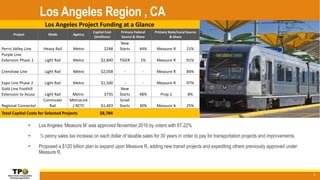
 Los Angeles ‘Measure M’ was approved November 2016 by voters with 67.22%
 ½ penny sales tax increase on each dollar of taxable sales for 30 years in order to pay for transportation projects and improvements.
 Proposed a $120 billion plan to expand upon Measure R, adding new transit projects and expediting others previously approved under
Measure R.
Los Angeles Project Funding at a Glance
Project Mode Agency
Capital Cost
($millions)
Primary Federal
Source & Share
Primary State/Local Source
& Share
Perris Valley Line Heavy Rail Metro $248
New
Starts 44% Measure R 21%
Purple Line
Extension Phase 1 Light Rail Metro $2,840 TIGER 1% Measure R 91%
Crenshaw Line Light Rail Metro $2,058 - - Measure R 84%
Expo Line Phase 2 Light Rail Metro $1,500 - - Measure R 97%
Gold Line Foothill
Extension to Azusa Light Rail Metro $735
New
Starts 48% Prop 1 8%
Regional Connector
Commuter
Rail
MetroLink
/ RCTC $1,403
Small
Starts 30% Measure A 25%
Total Capital Costs for Selected Projects $8,784
San Francisco Bay Area Region, CA
4
Project Mode Agency
Capital Cost
($millions)
Primary Federal
Source & Share
Primary State/Local Source
& Share
East Bay BRT
Bus Rapid
Transit AC Transit $152 Small Starts 42%
Regional
Measure 2 32%
Santa Clara-Alum
Rock BRT
Bus Rapid
Transit VTA $148 - -
State
Proposition 1B 61%
Van Ness Avenue BRT
Bus Rapid
Transit SFCTA $163 Small Starts 46%
Proposition K
Sales Tax 22%
eBART
Commuter
Rail DMU BART $462 - -
Regional
Measure 2 19%
SMART Train Phase I
Commuter
Rail DMU SMART $473 - - Measure Q 29%
BART Silicon Valley
Berryessa Extension Heavy Rail VTA $2,300 New Starts 40% 2000 Measure A 51%
BART Warm Springs
Extension Heavy Rail BART $890 - -
ACTIA Measure B
Tier 1 24%
Central Subway Light Rail SFMTA $1,578 New Starts 60%
State
Proposition 1B 20%
Transbay Center
Phase I Station SFCTA $1,899 ARRA 30% Land Sales 27%
Total Capital Costs for Selected Projects $ 8,065
 Voters in the Bay Area approved a bridge toll increase to fund transportation improvements along the toll bridge corridors
 Capital program provides $1.5 billion to fund over 140 construction projects totaling over $10 billion.
San Francisco Bay Area Region, CA con’t
5
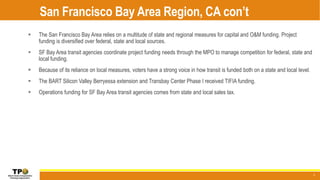
 The San Francisco Bay Area relies on a multitude of state and regional measures for capital and O&M funding. Project
funding is diversified over federal, state and local sources.
 SF Bay Area transit agencies coordinate project funding needs through the MPO to manage competition for federal, state and
local funding.
 Because of its reliance on local measures, voters have a strong voice in how transit is funded both on a state and local level.
 The BART Silicon Valley Berryessa extension and Transbay Center Phase I received TIFIA funding.
 Operations funding for SF Bay Area transit agencies comes from state and local sales tax.
Seattle Region, WA
6
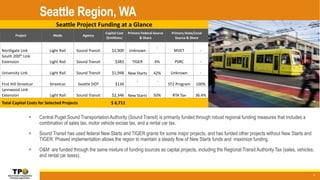
 Central Puget Sound Transportation Authority (Sound Transit) is primarily funded through robust regional funding measures that includes a
combination of sales tax, motor vehicle excise tax, and a rental car tax.
 Sound Transit has used federal New Starts and TIGER grants for some major projects, and has funded other projects without New Starts and
TIGER. Phased implementation allows the region to maintain a steady flow of New Starts funds and maximize funding.
 O&M are funded through the same mixture of funding sources as capital projects, including the Regional Transit Authority Tax (sales, vehicles,
and rental car taxes).
Seattle Project Funding at a Glance
Project Mode Agency
Capital Cost
($millions)
Primary Federal Source
& Share
Primary State/Local
Source & Share
Northgate Link Light Rail Sound Transit $1,900 Unknown
-
MVET -
South 200th Link
Extension Light Rail Sound Transit $383 TIGER 4% PSRC -
University Link Light Rail Sound Transit $1,948 New Starts 42% Unknown -
First Hill Streetcar Streetcar Seattle DOT $134
- -
ST2 Program 100%
Lynnwood Link
Extension Light Rail Sound Transit $2,346 New Starts 50% RTA Tax 36.4%
Total Capital Costs for Selected Projects $ 6,711
Denver Region, CO
7
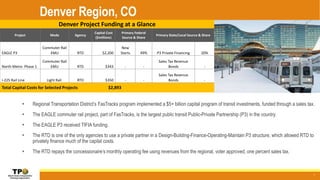
 Regional Transportation District’s FasTracks program implemented a $5+ billion capital program of transit investments, funded through a sales tax.
 The EAGLE commuter rail project, part of FasTracks, is the largest public transit Public-Private Partnership (P3) in the country.
 The EAGLE P3 received TIFIA funding.
 The RTD is one of the only agencies to use a private partner in a Design-Building-Finance-Operating-Maintain P3 structure, which allowed RTD to
privately finance much of the capital costs.
 The RTD repays the concessionaire’s monthly operating fee using revenues from the regional, voter approved, one percent sales tax.
Denver Project Funding at a Glance
Project Mode Agency
Capital Cost
($millions)
Primary Federal
Source & Share
Primary State/Local Source & Share
EAGLE P3
Commuter Rail
EMU RTD $2,200
New
Starts 49% P3 Private Financing 20%
North Metro Phase 1
Commuter Rail
EMU RTD $343 - -
Sales Tax Revenue
Bonds -
I‐225 Rail Line Light Rail RTD $350 - -
Sales Tax Revenue
Bonds -
Total Capital Costs for Selected Projects $2,893
Houston Region, TX
8
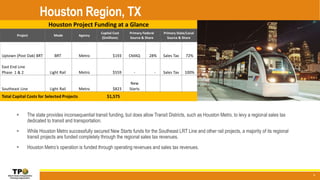
 The state provides inconsequential transit funding, but does allow Transit Districts, such as Houston Metro, to levy a regional sales tax
dedicated to transit and transportation.
 While Houston Metro successfully secured New Starts funds for the Southeast LRT Line and other rail projects, a majority of its regional
transit projects are funded completely through the regional sales tax revenues.
 Houston Metro’s operation is funded through operating revenues and sales tax revenues.
Houston Project Funding at a Glance
Project Mode Agency
Capital Cost
($millions)
Primary Federal
Source & Share
Primary State/Local
Source & Share
Uptown (Post Oak) BRT BRT Metro $193 CMAQ 28% Sales Tax 72%
East End Line
Phase 1 & 2 Light Rail Metro $559 - - Sales Tax 100%
Southeast Line Light Rail Metro $823
New
Starts
Total Capital Costs for Selected Projects $1,575
San Diego, CA
9
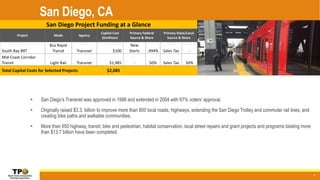
 San Diego’s Transnet was approved in 1988 and extended in 2004 with 67% voters’ approval.
 Originally raised $3.3. billion to improve more than 800 local roads, highways, extending the San Diego Trolley and commuter rail lines, and
creating bike paths and walkable communities.
 More than 650 highway, transit, bike and pedestrian, habitat conservation, local street repairs and grant projects and programs totaling more
than $13.7 billion have been completed.
San Diego Project Funding at a Glance
Project Mode Agency
Capital Cost
($millions)
Primary Federal
Source & Share
Primary State/Local
Source & Share
South Bay BRT
Bus Rapid
Transit Transnet $100
New
Starts .494% Sales Tax -
Mid-Coast Corridor
Transit Light Rail Transnet $1,985 - 50% Sales Tax 50%
Total Capital Costs for Selected Projects $2,085
www.miamidadetpo.org
AILEEN BOUCLÉ, EXECUTIVE DIRECTOR

SMART Plan Regional Funding Profiles

  • 1.
    Regional Funding Profiles MIAMI-DADE TPO GOVERNING BOARD MEETING SEPTEMBER 26, 2017
  • 2.
  • 3.
    Los Angeles Region, CA 3  Los Angeles ‘Measure M’ was approved November 2016 by voters with 67.22%  ½ penny sales tax increase on each dollar of taxable sales for 30 years in order to pay for transportation projects and improvements.  Proposed a $120 billion plan to expand upon Measure R, adding new transit projects and expediting others previously approved under Measure R. Los Angeles Project Funding at a Glance Project Mode Agency Capital Cost ($millions) Primary Federal Source & Share Primary State/Local Source & Share Perris Valley Line Heavy Rail Metro $248 New Starts 44% Measure R 21% Purple Line Extension Phase 1 Light Rail Metro $2,840 TIGER 1% Measure R 91% Crenshaw Line Light Rail Metro $2,058 - - Measure R 84% Expo Line Phase 2 Light Rail Metro $1,500 - - Measure R 97% Gold Line Foothill Extension to Azusa Light Rail Metro $735 New Starts 48% Prop 1 8% Regional Connector Commuter Rail MetroLink / RCTC $1,403 Small Starts 30% Measure A 25% Total Capital Costs for Selected Projects $8,784
  • 4.
    San Francisco BayArea Region, CA 4 Project Mode Agency Capital Cost ($millions) Primary Federal Source & Share Primary State/Local Source & Share East Bay BRT Bus Rapid Transit AC Transit $152 Small Starts 42% Regional Measure 2 32% Santa Clara-Alum Rock BRT Bus Rapid Transit VTA $148 - - State Proposition 1B 61% Van Ness Avenue BRT Bus Rapid Transit SFCTA $163 Small Starts 46% Proposition K Sales Tax 22% eBART Commuter Rail DMU BART $462 - - Regional Measure 2 19% SMART Train Phase I Commuter Rail DMU SMART $473 - - Measure Q 29% BART Silicon Valley Berryessa Extension Heavy Rail VTA $2,300 New Starts 40% 2000 Measure A 51% BART Warm Springs Extension Heavy Rail BART $890 - - ACTIA Measure B Tier 1 24% Central Subway Light Rail SFMTA $1,578 New Starts 60% State Proposition 1B 20% Transbay Center Phase I Station SFCTA $1,899 ARRA 30% Land Sales 27% Total Capital Costs for Selected Projects $ 8,065  Voters in the Bay Area approved a bridge toll increase to fund transportation improvements along the toll bridge corridors  Capital program provides $1.5 billion to fund over 140 construction projects totaling over $10 billion.
  • 5.
    San Francisco BayArea Region, CA con’t 5  The San Francisco Bay Area relies on a multitude of state and regional measures for capital and O&M funding. Project funding is diversified over federal, state and local sources.  SF Bay Area transit agencies coordinate project funding needs through the MPO to manage competition for federal, state and local funding.  Because of its reliance on local measures, voters have a strong voice in how transit is funded both on a state and local level.  The BART Silicon Valley Berryessa extension and Transbay Center Phase I received TIFIA funding.  Operations funding for SF Bay Area transit agencies comes from state and local sales tax.
  • 6.
    Seattle Region, WA 6 Central Puget Sound Transportation Authority (Sound Transit) is primarily funded through robust regional funding measures that includes a combination of sales tax, motor vehicle excise tax, and a rental car tax.  Sound Transit has used federal New Starts and TIGER grants for some major projects, and has funded other projects without New Starts and TIGER. Phased implementation allows the region to maintain a steady flow of New Starts funds and maximize funding.  O&M are funded through the same mixture of funding sources as capital projects, including the Regional Transit Authority Tax (sales, vehicles, and rental car taxes). Seattle Project Funding at a Glance Project Mode Agency Capital Cost ($millions) Primary Federal Source & Share Primary State/Local Source & Share Northgate Link Light Rail Sound Transit $1,900 Unknown - MVET - South 200th Link Extension Light Rail Sound Transit $383 TIGER 4% PSRC - University Link Light Rail Sound Transit $1,948 New Starts 42% Unknown - First Hill Streetcar Streetcar Seattle DOT $134 - - ST2 Program 100% Lynnwood Link Extension Light Rail Sound Transit $2,346 New Starts 50% RTA Tax 36.4% Total Capital Costs for Selected Projects $ 6,711
  • 7.
    Denver Region, CO 7 Regional Transportation District’s FasTracks program implemented a $5+ billion capital program of transit investments, funded through a sales tax.  The EAGLE commuter rail project, part of FasTracks, is the largest public transit Public-Private Partnership (P3) in the country.  The EAGLE P3 received TIFIA funding.  The RTD is one of the only agencies to use a private partner in a Design-Building-Finance-Operating-Maintain P3 structure, which allowed RTD to privately finance much of the capital costs.  The RTD repays the concessionaire’s monthly operating fee using revenues from the regional, voter approved, one percent sales tax. Denver Project Funding at a Glance Project Mode Agency Capital Cost ($millions) Primary Federal Source & Share Primary State/Local Source & Share EAGLE P3 Commuter Rail EMU RTD $2,200 New Starts 49% P3 Private Financing 20% North Metro Phase 1 Commuter Rail EMU RTD $343 - - Sales Tax Revenue Bonds - I‐225 Rail Line Light Rail RTD $350 - - Sales Tax Revenue Bonds - Total Capital Costs for Selected Projects $2,893
  • 8.
    Houston Region, TX 8 The state provides inconsequential transit funding, but does allow Transit Districts, such as Houston Metro, to levy a regional sales tax dedicated to transit and transportation.  While Houston Metro successfully secured New Starts funds for the Southeast LRT Line and other rail projects, a majority of its regional transit projects are funded completely through the regional sales tax revenues.  Houston Metro’s operation is funded through operating revenues and sales tax revenues. Houston Project Funding at a Glance Project Mode Agency Capital Cost ($millions) Primary Federal Source & Share Primary State/Local Source & Share Uptown (Post Oak) BRT BRT Metro $193 CMAQ 28% Sales Tax 72% East End Line Phase 1 & 2 Light Rail Metro $559 - - Sales Tax 100% Southeast Line Light Rail Metro $823 New Starts Total Capital Costs for Selected Projects $1,575
  • 9.
    San Diego, CA 9 San Diego’s Transnet was approved in 1988 and extended in 2004 with 67% voters’ approval.  Originally raised $3.3. billion to improve more than 800 local roads, highways, extending the San Diego Trolley and commuter rail lines, and creating bike paths and walkable communities.  More than 650 highway, transit, bike and pedestrian, habitat conservation, local street repairs and grant projects and programs totaling more than $13.7 billion have been completed. San Diego Project Funding at a Glance Project Mode Agency Capital Cost ($millions) Primary Federal Source & Share Primary State/Local Source & Share South Bay BRT Bus Rapid Transit Transnet $100 New Starts .494% Sales Tax - Mid-Coast Corridor Transit Light Rail Transnet $1,985 - 50% Sales Tax 50% Total Capital Costs for Selected Projects $2,085
  • 10.