Smart Grid – An Outline Shyam Penubolu
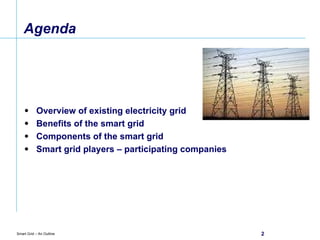
Agenda Overview of existing electricity grid Benefits of the smart grid Components of the smart grid Smart grid players – participating companies
Overview of existing electricity grid Benefits of the smart grid Components of the smart grid Smart grid players – participating companies
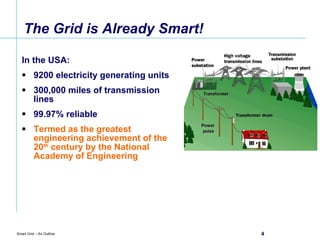
The Grid is Already Smart! In the USA: 9200 electricity generating units 300,000 miles of transmission lines 99.97% reliable Termed as the greatest engineering achievement of the 20 th  century by the National Academy of Engineering
So, what are the issues? Does not address modern concerns such as: Reliability: increasing number of black-outs  Slow mechanical switches No automated analytics No situational awareness Energy Efficiency National Economy increasingly dependent on electronic equipment. Affordability:  Rising fossil fuel costs triggering increase in energy costs Grid not prepared to easily accommodate renewable sources Climate Change: Electricity accounts for 40% of GHG emissions.  If Alexander Graham Bell were somehow transported to the 21st century, he would not begin to recognize the components of modern telephony – cell phones, texting, cell towers, PDAs, etc. – while Thomas Edison, one of the grid’s key early architects, would be totally familiar with the grid.   - From DOE's Smart Grid: An Introduction
Some Startling Numbers Power outages cost  $180 billion  per year Growth in peak demand exceeds growth in transmission by almost 25% every year If the grid were just 5% more efficient, the energy savings would equate to  eliminating 53 million cars Sun Microsystems estimates that a blackout costs the company  $1 million every minute . Load from chip technologies and automated manufacturing is about  40%  currently. Expected to reach  60% by 2012 . In 2000, the one-hour outage that hit the Chicago Board of Trade resulted in  $20 trillion in trades delayed . Average efficiency of legacy grids is 33% whereas the efficiency of those using modern technologies is 60%
Overview of existing electricity grid Benefits of the smart grid Components of the smart grid Smart grid players – participating companies
Benefits to Consumers Can monitor their energy consumption in real-time. Can control their consumption based on real-time pricing information the control can be automated  even possible via the web. Can power electric and plug-in/hybrid vehicles and  feed locally generated energy back to the grid.
Benefits to Utilities Monitor load in real-time, anticipate demand and automatically adjust energy flows Peak Load Balancing – interact with customers to reduce demand at peak load Enable integration of external renewable energy sources to pump electricity back into the grid Fault Isolation – advanced sensors allow quick isolation of faults in the network and speedy recovery Power Plant Growth – better management of demand and supply allows utilities to reduce need for additional power plants
Overview of existing electricity grid Benefits of the smart grid Components of the smart grid Smart grid players – participating companies
Components of the Smart Grid The Smart Grid is a widely distributed electricity delivery network, characterized by  2-way flow of electricity and information  and is  capable of monitoring  everything from power plants to customer appliances.
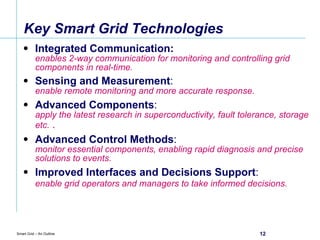
Key Smart Grid Technologies Integrated Communication: enables 2-way communication for monitoring and controlling grid components in real-time. Sensing and Measurement :  enable remote monitoring and more accurate response. Advanced Components :  apply the latest research in superconductivity, fault tolerance, storage etc.  .   Advanced Control Methods :  monitor essential components, enabling rapid diagnosis and precise solutions to events. Improved Interfaces and Decisions Support :  enable grid operators and managers to take informed decisions.
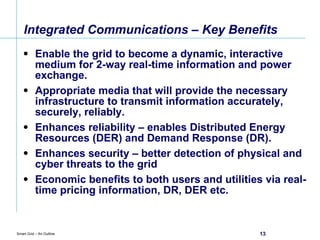
Integrated Communications – Key Benefits Enable the grid to become a dynamic, interactive medium for 2-way real-time information and power exchange. Appropriate media that will provide the necessary infrastructure to transmit information accurately, securely, reliably. Enhances reliability – enables Distributed Energy Resources (DER) and Demand Response (DR). Enhances security – better detection of physical and cyber threats to the grid Economic benefits to both users and utilities via real-time pricing information, DR, DER etc.
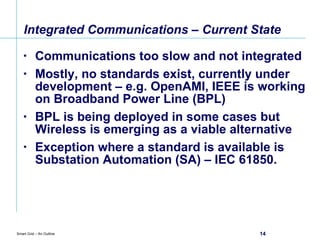
Integrated Communications – Current State Communications too slow and not integrated Mostly, no standards exist, currently under development – e.g. OpenAMI, IEEE is working on Broadband Power Line (BPL) BPL is being deployed in some cases but Wireless is emerging as a viable alternative Exception where a standard is available is Substation Automation (SA) – IEC 61850.
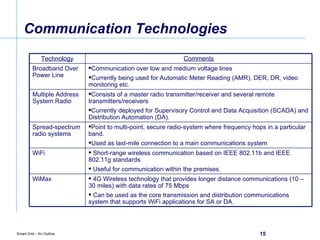
Communication Technologies 4G Wireless technology that provides longer distance communications (10 – 30 miles) with data rates of 75 Mbps Can be used as the core transmission and distribution communications system that supports WiFi applications for SA or DA.  WiMax Point to multi-point, secure radio-system where frequency hops in a particular band. Used as last-mile connection to a main communications system Spread-spectrum radio systems Short-range wireless communication based on IEEE 802.11b and IEEE 802.11g standards. Useful for communication within the premises. WiFi Communication over low and medium voltage lines Currently being used for Automatic Meter Reading (AMR), DER, DR, video monitoring etc. Broadband Over Power Line Consists of a master radio transmitter/receiver and several remote transmitters/receivers Currently deployed for Supervisory Control and Data Acquisition (SCADA) and Distribution Automation (DA).  Multiple Address System Radio Comments Technology
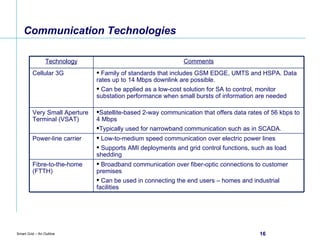
Communication Technologies Family of standards that includes GSM EDGE, UMTS and HSPA. Data rates up to 14 Mbps downlink are possible. Can be applied as a low-cost solution for SA to control, monitor substation performance when small bursts of information are needed Cellular 3G Broadband communication over fiber-optic connections to customer premises Can be used in connecting the end users – homes and industrial facilities Fibre-to-the-home (FTTH) Low-to-medium speed communication over electric power lines Supports AMI deployments and grid control functions, such as load shedding Power-line carrier Satellite-based 2-way communication that offers data rates of 56 kbps to 4 Mbps Typically used for narrowband communication such as in SCADA. Very Small Aperture Terminal (VSAT) Comments Technology
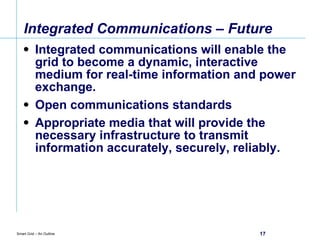
Integrated Communications – Future Integrated communications will enable the grid to become a dynamic, interactive medium for real-time information and power exchange. Open communications standards  Appropriate media that will provide the necessary infrastructure to transmit information accurately, securely, reliably.
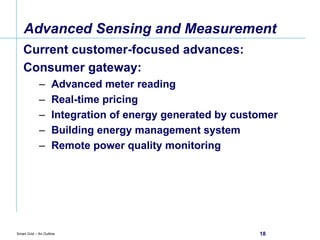
Advanced Sensing and Measurement Current customer-focused advances: Consumer gateway: Advanced meter reading Real-time pricing Integration of energy generated by customer Building energy management system Remote power quality monitoring
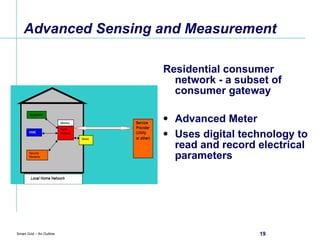
Advanced Sensing and Measurement Residential consumer network - a subset of consumer gateway Advanced Meter Uses digital technology to read and record electrical parameters
Utility focused advances Wide-area Monitoring System (WAMS):  GPS based PMUs measure voltage and current at various  locations on the grid Provides global view of the grid, automatically monitors it and alerts the operator in case of (possible) issues Combines phasor data with SCADA for enhanced state estimation Most promising of all the technologies Dynamic line rating technology Measures the ampacity (current carrying capability) of lines in real-time
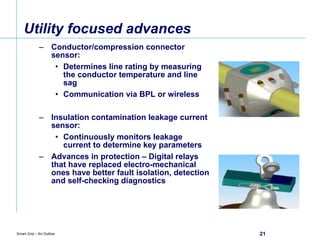
Utility focused advances Conductor/compression connector sensor: Determines line rating by measuring the conductor temperature and line sag Communication via BPL or wireless Insulation contamination leakage current sensor: Continuously monitors leakage current to determine key parameters Advances in protection – Digital relays that have replaced electro-mechanical ones have better fault isolation, detection and self-checking diagnostics
Advanced Sensing and Measurement - Future Customer focused: Solid-state meters are the future Will record usage at different times of day Will listen to real-time pricing signals sent by the provider and display to user May be capable of controlling loads based on customer profile May even provide non-utility services such as fire and burglar alarms
Advanced Sensing and Measurement - Future Utility focused: Tools that will provide info on: Power factor Power quality throughout the grid Phasor relationships (WAMS) Equipment health and capacity Meter tampering Vegetation intrusion Fault location Transformer and line loading New host software systems will collect, store, analyze, and process the abundance of data that flows from these modern tools Future digital relays that employ computer agents will further enhance reliability
Advanced Components – Current State Both AC and HVDC transmission equipment requiring power electronics. These devices aid in: Voltage control at various load conditions Power quality enhancement Reactive power balance Stability problems in long-distance transmission Examples of devices using power electronics (FACTS – Flexible AC Transmission System): Universal Power Flow Contoller: does reactive power compensation and flow control DVAR (Dynamic VAr): Mobile device. Provides voltage support and improves power quality MV SVR: Boosts load voltage during source voltage sags caused by faults in the utility distribution grid or in the transmission system Static VAr Compensator: Most important and most prevalent device. Improves  transmission line efficiency by resolving dynamic voltage problems
Advanced Components – Current Research Superconductivity First Generation Wire High-temperature Superconductor (HTS) Cable 2G Wire (5-10 years development required) DER – small capacity – 3 to 10000 KW power generation, located close to where energy is used. Distributed Generation– Wind, Solar PV, Fuel Cells and Microturbines. DER: Distributed Storage: NaS battery Vanadium Redox battery Ultra-capacitors Composite conductors: allows doubling of amperage limits without modifications to line support or towers. Aluminum conductor composite core cable Aluminum conductor composite reinforced cable Annealed aluminum, steel supported, trapezoid cross section conductor wire Grid-friendly appliances – that can be switched off or on to modulate load during system disturbances.
Advanced Components – Role of Plug-in Hybrid EVs (PHEV) According to NREL’s research, the following are the benefits of PHEVs: Significant reduction in oil consumption Utilities can control the time at which PHEVs are recharged. Say, overnight when the demand is low PHEVs can be used to store energy that can be used in periods of extreme demand or system emergencies.
Advanced Control Methods (ACM) ACM refers to the devices and algorithms that analyze the current state of the grid and predict fault conditions. ACM may also take automatic corrective actions to prevent outages and power quality disturbances Currently deployed ACM have a local scope and do not have a system-wide perspective ACM relies on three areas: Distributed Intelligent Agents – semi-autonomous entities that respond to local conditions rapidly. E.g. Energy Management Systems Analytical Tools  such as Phasor Measurement Analyzer, System Performance Monitoring, Simulation and Prediction Operational Applications such as SA, DA and DR
Advanced Control Methods - Future ACM will process real-time information received from Low cost Intelligent Electronic Devices (IEDs) PMUs integrated with GPS time signals will be deployed to provide the grid status, and will enable prediction of grid instabilities System diagnosis at local, regional and system-wide levels Advanced Data Analysis will help in load forecasting, risk analysis, planning and maintenance Take autonomous actions when appropriate or present data to human operators
Integrated Interfaces and Decision Support (IIDS) IIDS helps present complex smart grid data in a simple manner and not let operators feel swamped by data overload. IIDS enables operators to analyze the state of the grid and predict issues rapidly Techniques include animation, colour contouring and virtual reality Currently, the required amount and quality of data is not available Research being done in the area of visualization Progress mostly happening in the area of transmission
Integrated Interfaces and Decision Support - Future IIDS will enable operators at generation, distribution, transmission levels to get a better understanding of the state of the grid. Improved information sharing among uses via integration with enterprise-wide technologies such as: GIS  Weather forecasting Work management system and  Asset management processes
Overview of existing electricity grid Benefits of the smart grid Components of the smart grid Smart grid players – participating companies
Cisco  Aiming to be a one-stop shop for end-to-end distribution and transmission secure communication infrastructure Offer Cisco’s data center portfolio to enable data collection and storage for smart grid data analysis and optimization Software for centralized management and control – distribution management, automated metering infrastructure, GIS, asset management etc.  Partnering with smart meters and other smart grid device vendors to create an ecosystem that utilities have multiple options Has announced a building energy management software product called EnergyWise: integrated platform for monitoring and controlling energy usage of computers, phones, HVAC, lighting etc. leverages capabilities of products from partner companies: Computer power management from Verdiem Network management software from SolarWinds Building controls from Schneider Electric.
IBM  Aims to be the system integrator for smart grid infrastructure Formed the Global Intelligent Utility Network – an alliance of innovative utilities Goals of the alliance – optimize usage of wind energy, energy efficiency and reliability. The alliance helps share experiences and best practices. The alliance has also created a Smart Grid maturity model
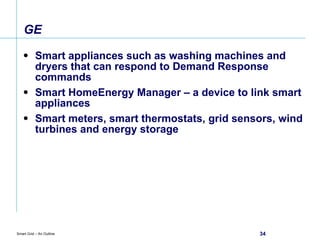
GE  Smart appliances such as washing machines and dryers that can respond to Demand Response commands Smart HomeEnergy Manager – a device to link smart appliances Smart meters, smart thermostats, grid sensors, wind turbines and energy storage
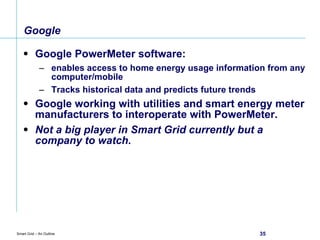
Google  Google PowerMeter software:  enables access to home energy usage information from any computer/mobile Tracks historical data and predicts future trends Google working with utilities and smart energy meter manufacturers to interoperate with PowerMeter. Not a big player in Smart Grid currently but a company to watch.
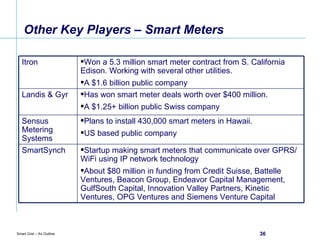
Other Key Players – Smart Meters Plans to install 430,000 smart meters in Hawaii. US based public company Sensus Metering Systems Startup making smart meters that communicate over GPRS/WiFi using IP network technology About $80 million in funding from Credit Suisse, Battelle Ventures, Beacon Group, Endeavor Capital Management, GulfSouth Capital, Innovation Valley Partners, Kinetic Ventures, OPG Ventures and Siemens Venture Capital  SmartSynch Has won smart meter deals worth over $400 million. A $1.25+ billion public Swiss company Landis & Gyr Won a 5.3 million smart meter contract from S. California Edison. Working with several other utilities. A $1.6 billion public company Itron
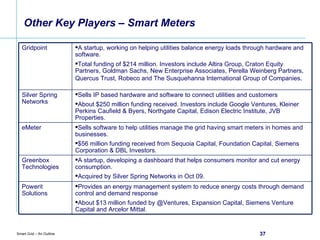
Other Key Players – Smart Meters A startup, developing a dashboard that helps consumers monitor and cut energy consumption. Acquired by Silver Spring Networks in Oct 09. Greenbox Technologies Sells IP based hardware and software to connect utilities and customers About $250 million funding received. Investors include Google Ventures, Kleiner Perkins Caufield & Byers, Northgate Capital, Edison Electric Institute, JVB Properties. Silver Spring Networks Sells software to help utilities manage the grid having smart meters in homes and businesses. $56 million funding received from Sequoia Capital, Foundation Capital, Siemens Corporation & DBL Investors. eMeter Provides an energy management system to reduce energy costs through demand control and demand response About $13 million funded by @Ventures, Expansion Capital, Siemens Venture Capital and Arcelor Mittal. Powerit Solutions A startup, working on helping utilities balance energy loads through hardware and software. Total funding of $214 million. Investors include Altira Group, Craton Equity Partners, Goldman Sachs, New Enterprise Associates, Perella Weinberg Partners, Quercus Trust, Robeco and The Susquehanna International Group of Companies . Gridpoint
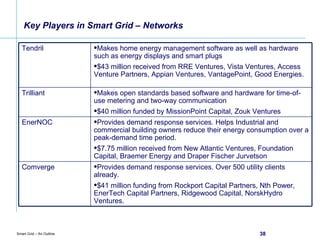
Key Players in Smart Grid – Networks Provides demand response services. Over 500 utility clients already. $41 million funding from Rockport Capital Partners, Nth Power, EnerTech Capital Partners, Ridgewood Capital, NorskHydro Ventures. Comverge Makes open standards based software and hardware for time-of-use metering and two-way communication $40 million funded by MissionPoint Capital, Zouk Ventures Trilliant Provides demand response services. Helps Industrial and commercial building owners reduce their energy consumption over a peak-demand time period. $7.75 million received from New Atlantic Ventures, Foundation Capital, Braemer Energy and Draper Fischer Jurvetson EnerNOC Makes home energy management software as well as hardware such as energy displays and smart plugs $43 million received from RRE Ventures, Vista Ventures, Access Venture Partners, Appian Ventures, VantagePoint, Good Energies. Tendril
Other Key Players - Utilities Southern California Edison –  installing computerized systems to ensure a more rapid, accurate, automated response to grid problems  Replacing legacy electro-mechanical devices with digital ones for increased efficiency and reliability Installing advanced sensors and control systems to respond to stress rapidly. SmartConnect program to install 5 million smart meters. The smart meters  PG&E  Over 5 million smart meters installed XCel Energy  SmartGridCity initiative in Boulder, CO.  Adding green energy to the mix Deploying smart meters and smart devices in homes Digitally enhanced and resilient energy grid
Other Key Players - Utilities Austin Energy Smart Grid intiative called Pecan Street Project Involves deployment of 500,000 smart devices and 410,000 smart meters On the network side, 3000 computers and network devices and 2500 sensors Sempra Energy 1.4 smart meters in San Diego region by 2011 Smart Grid demonstration funded by the Dept of Energy and California Energy Commission: Incorporated solar power generators on homes and small businesses.  Coordinated new peak load management technology.  Improve overall power quality.  Leveraged smart meters.  Integrated and remotely control distributed generation storage devices to allow access to electricity in emergencies.  Oncor Won a $7.3 million Federal grant for demonstrating Dynamic Line Rating (DLR). The DLR demo will showcase monitoring technology to reduce transmission-line congestion and increase the carrying capacity of the transmission lines.
Thank You!

Smart Grid - An Outline

  • 1.
    Smart Grid –An Outline Shyam Penubolu
  • 2.
    Agenda Overview ofexisting electricity grid Benefits of the smart grid Components of the smart grid Smart grid players – participating companies
  • 3.
    Overview of existingelectricity grid Benefits of the smart grid Components of the smart grid Smart grid players – participating companies
  • 4.
    The Grid isAlready Smart! In the USA: 9200 electricity generating units 300,000 miles of transmission lines 99.97% reliable Termed as the greatest engineering achievement of the 20 th century by the National Academy of Engineering
  • 5.
    So, what arethe issues? Does not address modern concerns such as: Reliability: increasing number of black-outs Slow mechanical switches No automated analytics No situational awareness Energy Efficiency National Economy increasingly dependent on electronic equipment. Affordability: Rising fossil fuel costs triggering increase in energy costs Grid not prepared to easily accommodate renewable sources Climate Change: Electricity accounts for 40% of GHG emissions. If Alexander Graham Bell were somehow transported to the 21st century, he would not begin to recognize the components of modern telephony – cell phones, texting, cell towers, PDAs, etc. – while Thomas Edison, one of the grid’s key early architects, would be totally familiar with the grid. - From DOE's Smart Grid: An Introduction
  • 6.
    Some Startling NumbersPower outages cost $180 billion per year Growth in peak demand exceeds growth in transmission by almost 25% every year If the grid were just 5% more efficient, the energy savings would equate to eliminating 53 million cars Sun Microsystems estimates that a blackout costs the company $1 million every minute . Load from chip technologies and automated manufacturing is about 40% currently. Expected to reach 60% by 2012 . In 2000, the one-hour outage that hit the Chicago Board of Trade resulted in $20 trillion in trades delayed . Average efficiency of legacy grids is 33% whereas the efficiency of those using modern technologies is 60%
  • 7.
    Overview of existingelectricity grid Benefits of the smart grid Components of the smart grid Smart grid players – participating companies
  • 8.
    Benefits to ConsumersCan monitor their energy consumption in real-time. Can control their consumption based on real-time pricing information the control can be automated even possible via the web. Can power electric and plug-in/hybrid vehicles and feed locally generated energy back to the grid.
  • 9.
    Benefits to UtilitiesMonitor load in real-time, anticipate demand and automatically adjust energy flows Peak Load Balancing – interact with customers to reduce demand at peak load Enable integration of external renewable energy sources to pump electricity back into the grid Fault Isolation – advanced sensors allow quick isolation of faults in the network and speedy recovery Power Plant Growth – better management of demand and supply allows utilities to reduce need for additional power plants
  • 10.
    Overview of existingelectricity grid Benefits of the smart grid Components of the smart grid Smart grid players – participating companies
  • 11.
    Components of theSmart Grid The Smart Grid is a widely distributed electricity delivery network, characterized by 2-way flow of electricity and information and is capable of monitoring everything from power plants to customer appliances.
  • 12.
    Key Smart GridTechnologies Integrated Communication: enables 2-way communication for monitoring and controlling grid components in real-time. Sensing and Measurement : enable remote monitoring and more accurate response. Advanced Components : apply the latest research in superconductivity, fault tolerance, storage etc. . Advanced Control Methods : monitor essential components, enabling rapid diagnosis and precise solutions to events. Improved Interfaces and Decisions Support : enable grid operators and managers to take informed decisions.
  • 13.
    Integrated Communications –Key Benefits Enable the grid to become a dynamic, interactive medium for 2-way real-time information and power exchange. Appropriate media that will provide the necessary infrastructure to transmit information accurately, securely, reliably. Enhances reliability – enables Distributed Energy Resources (DER) and Demand Response (DR). Enhances security – better detection of physical and cyber threats to the grid Economic benefits to both users and utilities via real-time pricing information, DR, DER etc.
  • 14.
    Integrated Communications –Current State Communications too slow and not integrated Mostly, no standards exist, currently under development – e.g. OpenAMI, IEEE is working on Broadband Power Line (BPL) BPL is being deployed in some cases but Wireless is emerging as a viable alternative Exception where a standard is available is Substation Automation (SA) – IEC 61850.
  • 15.
    Communication Technologies 4GWireless technology that provides longer distance communications (10 – 30 miles) with data rates of 75 Mbps Can be used as the core transmission and distribution communications system that supports WiFi applications for SA or DA. WiMax Point to multi-point, secure radio-system where frequency hops in a particular band. Used as last-mile connection to a main communications system Spread-spectrum radio systems Short-range wireless communication based on IEEE 802.11b and IEEE 802.11g standards. Useful for communication within the premises. WiFi Communication over low and medium voltage lines Currently being used for Automatic Meter Reading (AMR), DER, DR, video monitoring etc. Broadband Over Power Line Consists of a master radio transmitter/receiver and several remote transmitters/receivers Currently deployed for Supervisory Control and Data Acquisition (SCADA) and Distribution Automation (DA). Multiple Address System Radio Comments Technology
  • 16.
    Communication Technologies Familyof standards that includes GSM EDGE, UMTS and HSPA. Data rates up to 14 Mbps downlink are possible. Can be applied as a low-cost solution for SA to control, monitor substation performance when small bursts of information are needed Cellular 3G Broadband communication over fiber-optic connections to customer premises Can be used in connecting the end users – homes and industrial facilities Fibre-to-the-home (FTTH) Low-to-medium speed communication over electric power lines Supports AMI deployments and grid control functions, such as load shedding Power-line carrier Satellite-based 2-way communication that offers data rates of 56 kbps to 4 Mbps Typically used for narrowband communication such as in SCADA. Very Small Aperture Terminal (VSAT) Comments Technology
  • 17.
    Integrated Communications –Future Integrated communications will enable the grid to become a dynamic, interactive medium for real-time information and power exchange. Open communications standards Appropriate media that will provide the necessary infrastructure to transmit information accurately, securely, reliably.
  • 18.
    Advanced Sensing andMeasurement Current customer-focused advances: Consumer gateway: Advanced meter reading Real-time pricing Integration of energy generated by customer Building energy management system Remote power quality monitoring
  • 19.
    Advanced Sensing andMeasurement Residential consumer network - a subset of consumer gateway Advanced Meter Uses digital technology to read and record electrical parameters
  • 20.
    Utility focused advancesWide-area Monitoring System (WAMS): GPS based PMUs measure voltage and current at various locations on the grid Provides global view of the grid, automatically monitors it and alerts the operator in case of (possible) issues Combines phasor data with SCADA for enhanced state estimation Most promising of all the technologies Dynamic line rating technology Measures the ampacity (current carrying capability) of lines in real-time
  • 21.
    Utility focused advancesConductor/compression connector sensor: Determines line rating by measuring the conductor temperature and line sag Communication via BPL or wireless Insulation contamination leakage current sensor: Continuously monitors leakage current to determine key parameters Advances in protection – Digital relays that have replaced electro-mechanical ones have better fault isolation, detection and self-checking diagnostics
  • 22.
    Advanced Sensing andMeasurement - Future Customer focused: Solid-state meters are the future Will record usage at different times of day Will listen to real-time pricing signals sent by the provider and display to user May be capable of controlling loads based on customer profile May even provide non-utility services such as fire and burglar alarms
  • 23.
    Advanced Sensing andMeasurement - Future Utility focused: Tools that will provide info on: Power factor Power quality throughout the grid Phasor relationships (WAMS) Equipment health and capacity Meter tampering Vegetation intrusion Fault location Transformer and line loading New host software systems will collect, store, analyze, and process the abundance of data that flows from these modern tools Future digital relays that employ computer agents will further enhance reliability
  • 24.
    Advanced Components –Current State Both AC and HVDC transmission equipment requiring power electronics. These devices aid in: Voltage control at various load conditions Power quality enhancement Reactive power balance Stability problems in long-distance transmission Examples of devices using power electronics (FACTS – Flexible AC Transmission System): Universal Power Flow Contoller: does reactive power compensation and flow control DVAR (Dynamic VAr): Mobile device. Provides voltage support and improves power quality MV SVR: Boosts load voltage during source voltage sags caused by faults in the utility distribution grid or in the transmission system Static VAr Compensator: Most important and most prevalent device. Improves transmission line efficiency by resolving dynamic voltage problems
  • 25.
    Advanced Components –Current Research Superconductivity First Generation Wire High-temperature Superconductor (HTS) Cable 2G Wire (5-10 years development required) DER – small capacity – 3 to 10000 KW power generation, located close to where energy is used. Distributed Generation– Wind, Solar PV, Fuel Cells and Microturbines. DER: Distributed Storage: NaS battery Vanadium Redox battery Ultra-capacitors Composite conductors: allows doubling of amperage limits without modifications to line support or towers. Aluminum conductor composite core cable Aluminum conductor composite reinforced cable Annealed aluminum, steel supported, trapezoid cross section conductor wire Grid-friendly appliances – that can be switched off or on to modulate load during system disturbances.
  • 26.
    Advanced Components –Role of Plug-in Hybrid EVs (PHEV) According to NREL’s research, the following are the benefits of PHEVs: Significant reduction in oil consumption Utilities can control the time at which PHEVs are recharged. Say, overnight when the demand is low PHEVs can be used to store energy that can be used in periods of extreme demand or system emergencies.
  • 27.
    Advanced Control Methods(ACM) ACM refers to the devices and algorithms that analyze the current state of the grid and predict fault conditions. ACM may also take automatic corrective actions to prevent outages and power quality disturbances Currently deployed ACM have a local scope and do not have a system-wide perspective ACM relies on three areas: Distributed Intelligent Agents – semi-autonomous entities that respond to local conditions rapidly. E.g. Energy Management Systems Analytical Tools such as Phasor Measurement Analyzer, System Performance Monitoring, Simulation and Prediction Operational Applications such as SA, DA and DR
  • 28.
    Advanced Control Methods- Future ACM will process real-time information received from Low cost Intelligent Electronic Devices (IEDs) PMUs integrated with GPS time signals will be deployed to provide the grid status, and will enable prediction of grid instabilities System diagnosis at local, regional and system-wide levels Advanced Data Analysis will help in load forecasting, risk analysis, planning and maintenance Take autonomous actions when appropriate or present data to human operators
  • 29.
    Integrated Interfaces andDecision Support (IIDS) IIDS helps present complex smart grid data in a simple manner and not let operators feel swamped by data overload. IIDS enables operators to analyze the state of the grid and predict issues rapidly Techniques include animation, colour contouring and virtual reality Currently, the required amount and quality of data is not available Research being done in the area of visualization Progress mostly happening in the area of transmission
  • 30.
    Integrated Interfaces andDecision Support - Future IIDS will enable operators at generation, distribution, transmission levels to get a better understanding of the state of the grid. Improved information sharing among uses via integration with enterprise-wide technologies such as: GIS Weather forecasting Work management system and Asset management processes
  • 31.
    Overview of existingelectricity grid Benefits of the smart grid Components of the smart grid Smart grid players – participating companies
  • 32.
    Cisco Aimingto be a one-stop shop for end-to-end distribution and transmission secure communication infrastructure Offer Cisco’s data center portfolio to enable data collection and storage for smart grid data analysis and optimization Software for centralized management and control – distribution management, automated metering infrastructure, GIS, asset management etc. Partnering with smart meters and other smart grid device vendors to create an ecosystem that utilities have multiple options Has announced a building energy management software product called EnergyWise: integrated platform for monitoring and controlling energy usage of computers, phones, HVAC, lighting etc. leverages capabilities of products from partner companies: Computer power management from Verdiem Network management software from SolarWinds Building controls from Schneider Electric.
  • 33.
    IBM Aimsto be the system integrator for smart grid infrastructure Formed the Global Intelligent Utility Network – an alliance of innovative utilities Goals of the alliance – optimize usage of wind energy, energy efficiency and reliability. The alliance helps share experiences and best practices. The alliance has also created a Smart Grid maturity model
  • 34.
    GE Smartappliances such as washing machines and dryers that can respond to Demand Response commands Smart HomeEnergy Manager – a device to link smart appliances Smart meters, smart thermostats, grid sensors, wind turbines and energy storage
  • 35.
    Google GooglePowerMeter software: enables access to home energy usage information from any computer/mobile Tracks historical data and predicts future trends Google working with utilities and smart energy meter manufacturers to interoperate with PowerMeter. Not a big player in Smart Grid currently but a company to watch.
  • 36.
    Other Key Players– Smart Meters Plans to install 430,000 smart meters in Hawaii. US based public company Sensus Metering Systems Startup making smart meters that communicate over GPRS/WiFi using IP network technology About $80 million in funding from Credit Suisse, Battelle Ventures, Beacon Group, Endeavor Capital Management, GulfSouth Capital, Innovation Valley Partners, Kinetic Ventures, OPG Ventures and Siemens Venture Capital SmartSynch Has won smart meter deals worth over $400 million. A $1.25+ billion public Swiss company Landis & Gyr Won a 5.3 million smart meter contract from S. California Edison. Working with several other utilities. A $1.6 billion public company Itron
  • 37.
    Other Key Players– Smart Meters A startup, developing a dashboard that helps consumers monitor and cut energy consumption. Acquired by Silver Spring Networks in Oct 09. Greenbox Technologies Sells IP based hardware and software to connect utilities and customers About $250 million funding received. Investors include Google Ventures, Kleiner Perkins Caufield & Byers, Northgate Capital, Edison Electric Institute, JVB Properties. Silver Spring Networks Sells software to help utilities manage the grid having smart meters in homes and businesses. $56 million funding received from Sequoia Capital, Foundation Capital, Siemens Corporation & DBL Investors. eMeter Provides an energy management system to reduce energy costs through demand control and demand response About $13 million funded by @Ventures, Expansion Capital, Siemens Venture Capital and Arcelor Mittal. Powerit Solutions A startup, working on helping utilities balance energy loads through hardware and software. Total funding of $214 million. Investors include Altira Group, Craton Equity Partners, Goldman Sachs, New Enterprise Associates, Perella Weinberg Partners, Quercus Trust, Robeco and The Susquehanna International Group of Companies . Gridpoint
  • 38.
    Key Players inSmart Grid – Networks Provides demand response services. Over 500 utility clients already. $41 million funding from Rockport Capital Partners, Nth Power, EnerTech Capital Partners, Ridgewood Capital, NorskHydro Ventures. Comverge Makes open standards based software and hardware for time-of-use metering and two-way communication $40 million funded by MissionPoint Capital, Zouk Ventures Trilliant Provides demand response services. Helps Industrial and commercial building owners reduce their energy consumption over a peak-demand time period. $7.75 million received from New Atlantic Ventures, Foundation Capital, Braemer Energy and Draper Fischer Jurvetson EnerNOC Makes home energy management software as well as hardware such as energy displays and smart plugs $43 million received from RRE Ventures, Vista Ventures, Access Venture Partners, Appian Ventures, VantagePoint, Good Energies. Tendril
  • 39.
    Other Key Players- Utilities Southern California Edison – installing computerized systems to ensure a more rapid, accurate, automated response to grid problems Replacing legacy electro-mechanical devices with digital ones for increased efficiency and reliability Installing advanced sensors and control systems to respond to stress rapidly. SmartConnect program to install 5 million smart meters. The smart meters PG&E Over 5 million smart meters installed XCel Energy SmartGridCity initiative in Boulder, CO. Adding green energy to the mix Deploying smart meters and smart devices in homes Digitally enhanced and resilient energy grid
  • 40.
    Other Key Players- Utilities Austin Energy Smart Grid intiative called Pecan Street Project Involves deployment of 500,000 smart devices and 410,000 smart meters On the network side, 3000 computers and network devices and 2500 sensors Sempra Energy 1.4 smart meters in San Diego region by 2011 Smart Grid demonstration funded by the Dept of Energy and California Energy Commission: Incorporated solar power generators on homes and small businesses. Coordinated new peak load management technology. Improve overall power quality. Leveraged smart meters. Integrated and remotely control distributed generation storage devices to allow access to electricity in emergencies. Oncor Won a $7.3 million Federal grant for demonstrating Dynamic Line Rating (DLR). The DLR demo will showcase monitoring technology to reduce transmission-line congestion and increase the carrying capacity of the transmission lines.
  • 41.

Editor's Notes