TEACHING STRATEGIES
IN MATH
Strategies to be discussed are:
Lecture-Discussion Method
Cooperative and Collaborative learning
Jigsaw Method
Think-Pair-Share
Lecture-Discussion Method
It is based on three sources which makes it an
effective tool to teaching:
Schemata Theory- It uses what students already
know by building on their existing background.
Meaningful Verbal Learning-Presents information
in a systematic way.
Active Learner Involvement- Uses teacher
questioning to involve students actively in the
learning process.
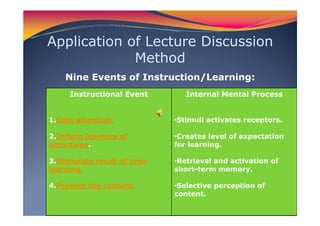
Application of Lecture Discussion
Method
Nine Events of Instruction/Learning:
Instructional Event
1.Gain attention.
2.Inform learners of
objectives.
3.Stimulate recall of prior
learning.
4.Present the content.
Internal Mental Process
•Stimuli activates receptors.
•Creates level of expectation
for learning.
•Retrieval and activation of
short-term memory.
•Selective perception of
content.
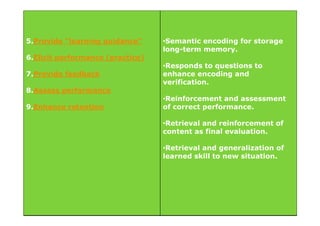
5.Provide "learning guidance"
6.Elicit performance (practice)
7.Provide feedback
8.Assess performance
9.Enhance retention
•Semantic encoding for storage
long-term memory.
•Responds to questions to
enhance encoding and
verification.
•Reinforcement and assessment
of correct performance.
•Retrieval and reinforcement of
content as final evaluation.
•Retrieval and generalization of
learned skill to new situation.
Cooperative and Collaborative
Learning
Collaborative learning is a method
of teaching and learning in which
students team together to explore
a significant question or create a
meaningful Knowledge.
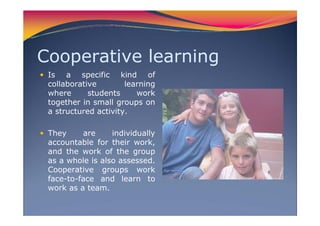
Cooperative learning
Is a specific kind of
collaborative learning
where students work
together in small groups on
a structured activity.
They are individually
accountable for their work,
and the work of the group
as a whole is also assessed.
Cooperative groups work
face-to-face and learn to
work as a team.
Why cooperative and collaborative
learning?
Paradigm shift of
education CALLS for the
departure from the
traditional teaching
methods which are
primarily Teacher
Centered into a
Student-Centered
Learning Environment.
Model for cooperative and
collaborative Learning
There are plenty of
models for
cooperative and
collaborative
teaching strategies
such as JIGSAW
PUZZLE and THINK-
PAIR SHARE which
will be discussed
later on…
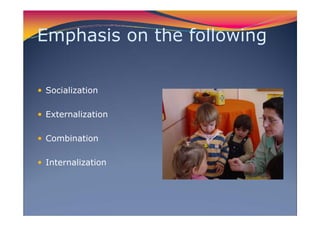
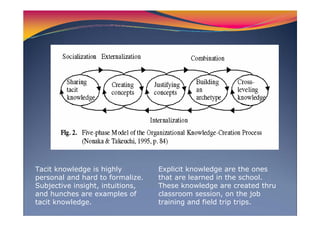
Emphasis on the following
Socialization
Externalization
Combination
Internalization
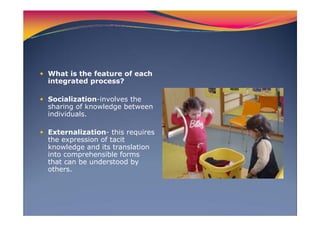
What is the feature of each
integrated process?
Socialization-involves the
sharing of knowledge between
individuals.
Externalization- this requires
the expression of tacit
knowledge and its translation
into comprehensible forms
that can be understood by
others.
Combination
Involves the
conversion of
explicit knowledge
into more complex
sets of explicit
knowledge. This is
fitting the elements
of knowledge
together.
Internalization
Where newly
created knowledge
is converted from
explicit knowledge
into the
organization’s tacit
knowledge.
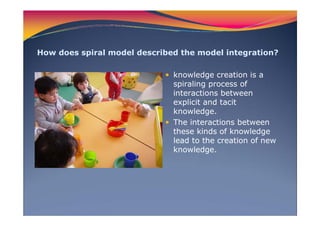
How does spiral model described the model integration?
knowledge creation is a
spiraling process of
interactions between
explicit and tacit
knowledge.
The interactions between
these kinds of knowledge
lead to the creation of new
knowledge.
Tacit knowledge is highly
personal and hard to formalize.
Subjective insight, intuitions,
and hunches are examples of
tacit knowledge.
Explicit knowledge are the ones
that are learned in the school.
These knowledge are created thru
classroom session, on the job
training and field trip trips.
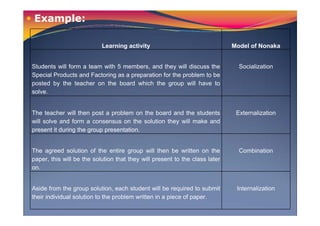
Example:
Learning activity Model of Nonaka
Students will form a team with 5 members, and they will discuss the
Special Products and Factoring as a preparation for the problem to be
posted by the teacher on the board which the group will have to
solve.
Socialization
The teacher will then post a problem on the board and the students
will solve and form a consensus on the solution they will make and
present it during the group presentation.
Externalization
The agreed solution of the entire group will then be written on the
paper, this will be the solution that they will present to the class later
on.
Combination
Aside from the group solution, each student will be required to submit
their individual solution to the problem written in a piece of paper.
Internalization
Jigsaw Method
The Jigsaw method is a cooperative learning technique
in which students work in small groups. Jigsaw can be
used in a variety of ways for a variety of goals, but it
is primarily used for the acquisition and presentation
of new material, review, or informed debate.
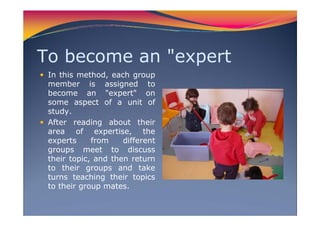
To become an "expert
In this method, each group
member is assigned to
become an "expert" on
some aspect of a unit of
study.
After reading about their
area of expertise, the
experts from different
groups meet to discuss
their topic, and then return
to their groups and take
turns teaching their topics
to their group mates.
This Strategy allows for:
An efficient way to learn
content.
Development of
listening, engagement,
and empathy skills.
A way for students to
work independently.
Interaction among all
students.
Classroom application of
the Jigsaw Puzzle Model.
EDUCATIONAL GOAL:
The students will be able to solve 2 problems that would
require them to find the mean, median, mode and range of
range from the given data.
Learning Objective:
To be able to solve 2 problems that would
require them to find the mean, median,
mode and range from the given data.
Divide students into 5- or 6-
person jigsaw groups. The groups
should be diverse in terms of
gender, ethnicity, race, and
ability.
Appoint one student from each
group as the leader. Initially, this
person should be the most mature
student in the group.
Divide the lesson into 4 segments:
(1) Solving for the mean from
grouped, ungrouped data
(2) solving for median from the given
grouped, ungrouped data
(3) solving for the mode of the given
grouped, ungrouped data
(4) finding the range of the given
data.
Assign each student to learn one
segment, making sure students have
direct access only to their own
segment.
Give students time to read over their
segment at least twice and become
familiar with it. There is no need for
them to memorize it.
Form temporary "expert groups" by having
one student from each jigsaw group join
other students assigned to the same
segment.
Give students in these expert groups time to
discuss the main points of their segment and
to rehearse the presentations they will make
to their jigsaw group.
Bring the students back into their jigsaw
groups.
Ask each student to present her or his
segment to the group. Encourage others in
the group to ask questions for clarification.
Observing the process.
Float from group to group, observing the process.
If any group is having trouble (e.g., a member is
dominating or disruptive), make an appropriate
intervention.
Eventually, it's best for the group leader to handle
this task. Leaders can be trained by whispering an
instruction on how to intervene, until the leader
gets the hang of it.
Not just fun and games
At the end of the session, give a quiz
on the material so that students
quickly come to realize that these
sessions are not just fun and games
but really count.
Think-Pair-Share
It is a cooperative discussion
strategy developed by Frank
Lyman and his colleagues in
Maryland.
It gets its name from the three
stages of student action, with
emphasis on what students are to
be DOING at each of those stages
How Does It Work?
1) Think.
The teacher provokes students'
thinking with a question or prompt
or observation.
The students should take a few
moments (probably not minutes)
just to THINK about the question.
2) Pair. Using designated partners, nearby neighbors, or a
desk mate, students PAIR up to talk about the answer each
came up with. They compare their mental or written notes
and identify the answers they think are best, most
convincing, or most unique.
.
3) Share.
After students talk in pairs for a few moments,
the teacher calls for pairs to SHARE their
thinking with the rest of the class.
The can do this by going around in round-robin
fashion, calling on each pair; or the can take
answers as they are called out (or as hands
are raised).
Often, the teacher or a designated helper will
record these responses on the board or on the
overhead
Example:
Learning Task:
The teacher will provide a worded problem involving an area.
Think:
The teacher will allow the students to individually solve the
problem first.
Pair:
After 5 minutes, the teacher will ask
the students to find a partner, and
discuss their solutions to each other.
They should come up with a single
solution for the given problem.
While partners are discussing their
solutions, the teacher will roam
around to see which partnered
students were able to make it
correctly and which are not.
Share:
The teacher will
randomly select a
partner to share
their solutions to
the class by
explaining it in
front and solving it
using the
blackboard.

32 teaching strategies in math

  • 1.
  • 2.
    Strategies to bediscussed are: Lecture-Discussion Method Cooperative and Collaborative learning Jigsaw Method Think-Pair-Share
  • 3.
    Lecture-Discussion Method It isbased on three sources which makes it an effective tool to teaching: Schemata Theory- It uses what students already know by building on their existing background. Meaningful Verbal Learning-Presents information in a systematic way. Active Learner Involvement- Uses teacher questioning to involve students actively in the learning process.
  • 4.
    Application of LectureDiscussion Method Nine Events of Instruction/Learning: Instructional Event 1.Gain attention. 2.Inform learners of objectives. 3.Stimulate recall of prior learning. 4.Present the content. Internal Mental Process •Stimuli activates receptors. •Creates level of expectation for learning. •Retrieval and activation of short-term memory. •Selective perception of content.
  • 5.
    5.Provide "learning guidance" 6.Elicitperformance (practice) 7.Provide feedback 8.Assess performance 9.Enhance retention •Semantic encoding for storage long-term memory. •Responds to questions to enhance encoding and verification. •Reinforcement and assessment of correct performance. •Retrieval and reinforcement of content as final evaluation. •Retrieval and generalization of learned skill to new situation.
  • 6.
    Cooperative and Collaborative Learning Collaborativelearning is a method of teaching and learning in which students team together to explore a significant question or create a meaningful Knowledge.
  • 7.
    Cooperative learning Is aspecific kind of collaborative learning where students work together in small groups on a structured activity. They are individually accountable for their work, and the work of the group as a whole is also assessed. Cooperative groups work face-to-face and learn to work as a team.
  • 8.
    Why cooperative andcollaborative learning? Paradigm shift of education CALLS for the departure from the traditional teaching methods which are primarily Teacher Centered into a Student-Centered Learning Environment.
  • 9.
    Model for cooperativeand collaborative Learning There are plenty of models for cooperative and collaborative teaching strategies such as JIGSAW PUZZLE and THINK- PAIR SHARE which will be discussed later on…
  • 10.
    Emphasis on thefollowing Socialization Externalization Combination Internalization
  • 11.
    What is thefeature of each integrated process? Socialization-involves the sharing of knowledge between individuals. Externalization- this requires the expression of tacit knowledge and its translation into comprehensible forms that can be understood by others.
  • 12.
    Combination Involves the conversion of explicitknowledge into more complex sets of explicit knowledge. This is fitting the elements of knowledge together.
  • 13.
    Internalization Where newly created knowledge isconverted from explicit knowledge into the organization’s tacit knowledge.
  • 14.
    How does spiralmodel described the model integration? knowledge creation is a spiraling process of interactions between explicit and tacit knowledge. The interactions between these kinds of knowledge lead to the creation of new knowledge.
  • 15.
    Tacit knowledge ishighly personal and hard to formalize. Subjective insight, intuitions, and hunches are examples of tacit knowledge. Explicit knowledge are the ones that are learned in the school. These knowledge are created thru classroom session, on the job training and field trip trips.
  • 16.
    Example: Learning activity Modelof Nonaka Students will form a team with 5 members, and they will discuss the Special Products and Factoring as a preparation for the problem to be posted by the teacher on the board which the group will have to solve. Socialization The teacher will then post a problem on the board and the students will solve and form a consensus on the solution they will make and present it during the group presentation. Externalization The agreed solution of the entire group will then be written on the paper, this will be the solution that they will present to the class later on. Combination Aside from the group solution, each student will be required to submit their individual solution to the problem written in a piece of paper. Internalization
  • 17.
    Jigsaw Method The Jigsawmethod is a cooperative learning technique in which students work in small groups. Jigsaw can be used in a variety of ways for a variety of goals, but it is primarily used for the acquisition and presentation of new material, review, or informed debate.
  • 18.
    To become an"expert In this method, each group member is assigned to become an "expert" on some aspect of a unit of study. After reading about their area of expertise, the experts from different groups meet to discuss their topic, and then return to their groups and take turns teaching their topics to their group mates.
  • 19.
    This Strategy allowsfor: An efficient way to learn content. Development of listening, engagement, and empathy skills. A way for students to work independently. Interaction among all students.
  • 20.
    Classroom application of theJigsaw Puzzle Model. EDUCATIONAL GOAL: The students will be able to solve 2 problems that would require them to find the mean, median, mode and range of range from the given data.
  • 21.
    Learning Objective: To beable to solve 2 problems that would require them to find the mean, median, mode and range from the given data.
  • 22.
    Divide students into5- or 6- person jigsaw groups. The groups should be diverse in terms of gender, ethnicity, race, and ability. Appoint one student from each group as the leader. Initially, this person should be the most mature student in the group.
  • 23.
    Divide the lessoninto 4 segments: (1) Solving for the mean from grouped, ungrouped data (2) solving for median from the given grouped, ungrouped data (3) solving for the mode of the given grouped, ungrouped data (4) finding the range of the given data.
  • 24.
    Assign each studentto learn one segment, making sure students have direct access only to their own segment. Give students time to read over their segment at least twice and become familiar with it. There is no need for them to memorize it.
  • 25.
    Form temporary "expertgroups" by having one student from each jigsaw group join other students assigned to the same segment. Give students in these expert groups time to discuss the main points of their segment and to rehearse the presentations they will make to their jigsaw group.
  • 26.
    Bring the studentsback into their jigsaw groups. Ask each student to present her or his segment to the group. Encourage others in the group to ask questions for clarification.
  • 27.
    Observing the process. Floatfrom group to group, observing the process. If any group is having trouble (e.g., a member is dominating or disruptive), make an appropriate intervention. Eventually, it's best for the group leader to handle this task. Leaders can be trained by whispering an instruction on how to intervene, until the leader gets the hang of it.
  • 28.
    Not just funand games At the end of the session, give a quiz on the material so that students quickly come to realize that these sessions are not just fun and games but really count.
  • 29.
    Think-Pair-Share It is acooperative discussion strategy developed by Frank Lyman and his colleagues in Maryland. It gets its name from the three stages of student action, with emphasis on what students are to be DOING at each of those stages
  • 30.
    How Does ItWork? 1) Think. The teacher provokes students' thinking with a question or prompt or observation. The students should take a few moments (probably not minutes) just to THINK about the question.
  • 31.
    2) Pair. Usingdesignated partners, nearby neighbors, or a desk mate, students PAIR up to talk about the answer each came up with. They compare their mental or written notes and identify the answers they think are best, most convincing, or most unique. .
  • 32.
    3) Share. After studentstalk in pairs for a few moments, the teacher calls for pairs to SHARE their thinking with the rest of the class. The can do this by going around in round-robin fashion, calling on each pair; or the can take answers as they are called out (or as hands are raised). Often, the teacher or a designated helper will record these responses on the board or on the overhead
  • 33.
    Example: Learning Task: The teacherwill provide a worded problem involving an area. Think: The teacher will allow the students to individually solve the problem first.
  • 34.
    Pair: After 5 minutes,the teacher will ask the students to find a partner, and discuss their solutions to each other. They should come up with a single solution for the given problem. While partners are discussing their solutions, the teacher will roam around to see which partnered students were able to make it correctly and which are not.
  • 35.
    Share: The teacher will randomlyselect a partner to share their solutions to the class by explaining it in front and solving it using the blackboard.