Small bowel vs. Large bowel
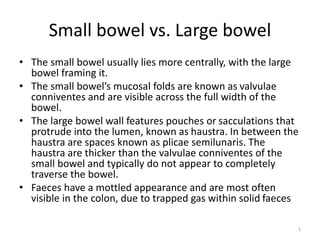
• The small bowel usually lies more centrally, with the large
bowel framing it.
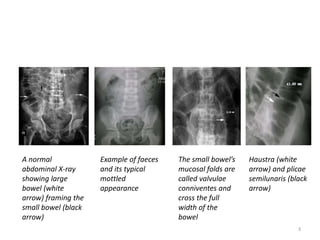
• The small bowel’s mucosal folds are known as valvulae
conniventes and are visible across the full width of the
bowel.
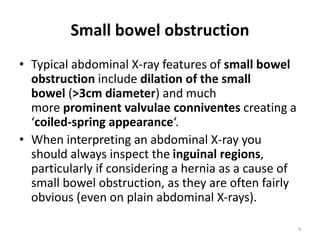
• The large bowel wall features pouches or sacculations that
protrude into the lumen, known as haustra. In between the
haustra are spaces known as plicae semilunaris. The
haustra are thicker than the valvulae conniventes of the
small bowel and typically do not appear to completely
traverse the bowel.
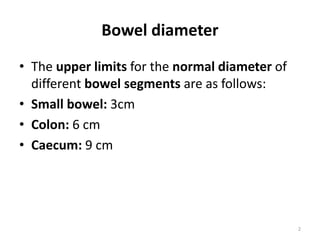
• Faeces have a mottled appearance and are most often
visible in the colon, due to trapped gas within solid faeces
1
Bowel diameter
• The upper limits for the normal diameter of
different bowel segments are as follows:
• Small bowel: 3cm
• Colon: 6 cm
• Caecum: 9 cm
2
A normal
abdominal X-ray
showing large
bowel (white
arrow) framing the
small bowel (black
arrow)
Example of faeces
and its typical
mottled
appearance
The small bowel’s
mucosal folds are
called valvulae
conniventes and
cross the full
width of the
bowel
Haustra (white
arrow) and plicae
semilunaris (black
arrow)
3
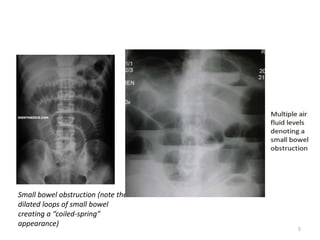
Small bowel obstruction
• Typical abdominal X-ray features of small bowel
obstruction include dilation of the small
bowel (>3cm diameter) and much
more prominent valvulae conniventes creating a
‘coiled-spring appearance‘.
• When interpreting an abdominal X-ray you
should always inspect the inguinal regions,
particularly if considering a hernia as a cause of
small bowel obstruction, as they are often fairly
obvious (even on plain abdominal X-rays).
4
Small bowel obstruction (note the
dilated loops of small bowel
creating a “coiled-spring”
appearance)
5
Large bowel obstruction
• Characterised by colonic distension proximal
to the obstruction, with collapse distally.
• Considered dilated if it is over 6 cm in
diameter, with the caecum having an upper
limit of 9 cm.
• Very few or no air-fluid levels are found in the
large bowel because water is reabsorbed.
• rectum has little or no air.
6
Large bowel obstruction
7

Small bowel vs large.pptx

  • 1.
    Small bowel vs.Large bowel • The small bowel usually lies more centrally, with the large bowel framing it. • The small bowel’s mucosal folds are known as valvulae conniventes and are visible across the full width of the bowel. • The large bowel wall features pouches or sacculations that protrude into the lumen, known as haustra. In between the haustra are spaces known as plicae semilunaris. The haustra are thicker than the valvulae conniventes of the small bowel and typically do not appear to completely traverse the bowel. • Faeces have a mottled appearance and are most often visible in the colon, due to trapped gas within solid faeces 1
  • 2.
    Bowel diameter • Theupper limits for the normal diameter of different bowel segments are as follows: • Small bowel: 3cm • Colon: 6 cm • Caecum: 9 cm 2
  • 3.
    A normal abdominal X-ray showinglarge bowel (white arrow) framing the small bowel (black arrow) Example of faeces and its typical mottled appearance The small bowel’s mucosal folds are called valvulae conniventes and cross the full width of the bowel Haustra (white arrow) and plicae semilunaris (black arrow) 3
  • 4.
    Small bowel obstruction •Typical abdominal X-ray features of small bowel obstruction include dilation of the small bowel (>3cm diameter) and much more prominent valvulae conniventes creating a ‘coiled-spring appearance‘. • When interpreting an abdominal X-ray you should always inspect the inguinal regions, particularly if considering a hernia as a cause of small bowel obstruction, as they are often fairly obvious (even on plain abdominal X-rays). 4
  • 5.
    Small bowel obstruction(note the dilated loops of small bowel creating a “coiled-spring” appearance) 5
  • 6.
    Large bowel obstruction •Characterised by colonic distension proximal to the obstruction, with collapse distally. • Considered dilated if it is over 6 cm in diameter, with the caecum having an upper limit of 9 cm. • Very few or no air-fluid levels are found in the large bowel because water is reabsorbed. • rectum has little or no air. 6
  • 7.