BUSINESS INCUBATORS
ROLL NO. – 19163015
SUBJECT - ENTERPRENUERSHIP
SUBMITTED BY – KAJAL DAHIYA
SUBMITTED TO – MS. MEGHA SAINI
BUSINESS INCUBATORS
 Business incubator is an organization
that helps startup companies and
individual entrepreneurs to develop
their businesses by providing a
full-scale range of services
starting with management
training and office space and ending
with venture capital financing.
HISTORY OF BUSINESS
INCUBATORS -
 The formal concept of business incubation began in the
US in 1959 when Joseph L. Mancuso opened the
Batavia Industrial Center in a Batavia, New York,
warehouse. Incubation expanded in the U.S. in the
1980s and spread to the UK and Europe through
various related forms . The U.S.-based International
Business Innovation Association estimates that there
are about 7,000 incubators worldwide.
DEFINITIONS OF
BUSINESS INCUBATORS
 The National Business Incubation Association
(NBIA) defines business incubators as a catalyst
tool for either regional ornational economic
development.
 According to Allen and Rahman, “The universal
purpose of a business incubator is toincrease the
chances of a firm surviving its formative years, but
the business incubator also adds value by
maximizing the firms’ growth potential
TYPES OF BUSINESS
INCUBATORS -
 (i) Virtual Business Incubators:
 These are also known as online business
incubators.
 Business incubators began in the 1950s and
took off in the late 1990s as support for
startup companies who need advice and
venture capital to get their ideas off the
ground. As the dot-com bubble burst, many
high-tech business incubators did so too. Now
the model of a business incubator is
changing.
(ii) Medical Incubator
This is a business incubator focused onmedical devices & biomaterials. For
encouraging innovation and entrepreneurship in medical technologies, through
technology, business incubation support is giventoinnovators, start-ups and
industry.
(iii) Kitchen Incubator
It is a business incubator focused onthe food industry. Specialty foods aretypically
high-value and, at least in the beginning, low production. Starting a commercial
kitchen from scratch can cost a huge amount of investment. Theaverage food
entrepreneur has to spend plenty before even making their first batch of food item.
(iv) Public/SocialIncubator
This isabusiness incubatorfocusedonthe publicgood.Socialincubatorsaimto providesocial
entrepreneurswiththe toolstoexpandtheir business.Thechallenging economic environment is
changing thelandscapeofhowwedo business.Atone end, somebusinessesavoidtheir social
responsibilityand,atthe other,charitieshavetofindwaystobemorebusinesssavvy tosurvive. India
hasembracedthe concept,with atwist,creatingthe idea of“socialbusiness”.
(v)Seed Accelerator
This isabusiness incubatorfocusedonearlystartups.Seedaccelerators,alsoknownas startup
accelerators,arefixed-term,cohort-basedprograms,thatincludementorshipandeducational
componentsandculminate in apublic pitchevent ordemo day.Whiletraditionalbusiness
incubatorsareoftengovernment-funded,generally takenoequity,andfocusonbiotech,financial
technology(“FinTech”), medical technology(“MedTech”), clean tech orproduct-centric
companies,acceleratorscanbeeitherprivatelyorpubliclyfundedandfocusona wide rangeof
industries.
(vi) Corporate Accelerator
It is aprogramofalargercompanythatactsakintoa seedaccelerator.A corporateacceleratoris a
specific formofseed acceleratorwhich is sponsoredbyan establishedfor-profitcorporation.Similar to
seedacceleratorstheysupportearly-stagestartupcompaniesthroughmentorshipandoftencapitaland
officespace.In contrasttoregularprograms,though,corporateacceleratorsderive theirobjectives from
the sponsoringorganization.Theseobjectives caninclude thewish tostaycloseto emerging trendsor
toestablisha funnelforcorporateventurecapitalinvestments
(vii) Startup Studio
This isabusiness incubatorwithinteractingportfoliocompanies.Startupstudio,alsoknownas a
startupfactory,orastartupfoundry,ora venturebuilder,is astudio-likecompanythataimsat
building several companiesin succession. Thisstyle ofbusiness building isreferredtoas “parallel
entrepreneurship.Thestartupstudiotrendhadreally begun togain momentumaround2008. Beta
worksis oneof thepioneersofthis model. Today,thereareover 65startupstudiosacrossthe
world,ofwhich 17havebeen built since2013.
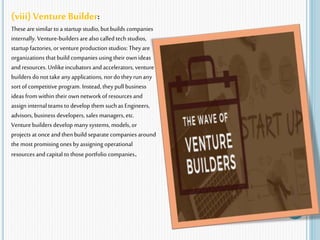
(viii) Venture Builder:
Thesearesimilar to a startup studio, but builds companies
internally.Venture-builders arealso called tech studios,
startup factories, orventureproduction studios: Theyare
organizations that build companies using theirown ideas
and resources. Unlikeincubators and accelerators, venture
builders do not take anyapplications, nor do they runany
sort of competitive program. Instead, they pull business
ideas fromwithin their own networkof resources and
assign internal teams to develop them suchas Engineers,
advisors, business developers, sales managers, etc.
Venturebuilders develop manysystems, models, or
projects at once and then build separate companies around
the most promising onesby assigning operational
resources andcapital to those portfolio companies.
THREE STAGES OF
BUSINESS INCUBATION
DEVELOPMENT
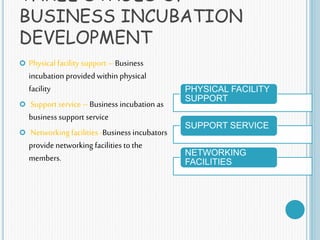
 Physical facility support – Business
incubation provided within physical
facility
 Support service – Business incubation as
business support service
 Networking facilities -Business incubators
providenetworking facilities to the
members.
PHYSICAL FACILITY
SUPPORT
SUPPORT SERVICE
NETWORKING
FACILITIES
Types of Incubation
Services
Since startup companies lack many resources, experience and networks,
incubators provide services which helps them get through initial hurdles in
starting up a business. These hurdles include space, funding, legal,
accounting, computer services and other prerequisites to running the
business.
Following are the mostcommonincubator services:
(i) Theyhelp with business basics
( ii) Theyprovide Networkingactivities
(iii) Theyprovide Marketingassistance
(iv) Incubators help inMarketResearch
(v) Theyprovide High-speed Internetaccess
(vi) IncubatorsHelp with accounting/financial management
(vii) Theyhelp in providing Access to bank loans, loan funds and guaranteeprograms
(viii) Incubators help with presentation skills
(ix) Theylink to highereducation resources
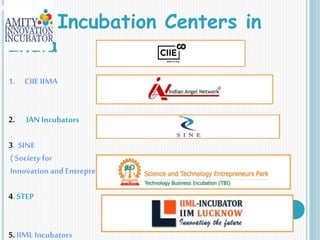
Incubation Centers in
India
1. CIIE IIMA
2. IAN Incubators
3. SINE
( Society for
Innovation and Entrepreneurship)
4. STEP
5. IIML Incubators
business incubators and its types ppt

business incubators and its types ppt

  • 1.
    BUSINESS INCUBATORS ROLL NO.– 19163015 SUBJECT - ENTERPRENUERSHIP SUBMITTED BY – KAJAL DAHIYA SUBMITTED TO – MS. MEGHA SAINI
  • 2.
    BUSINESS INCUBATORS  Businessincubator is an organization that helps startup companies and individual entrepreneurs to develop their businesses by providing a full-scale range of services starting with management training and office space and ending with venture capital financing.
  • 3.
    HISTORY OF BUSINESS INCUBATORS-  The formal concept of business incubation began in the US in 1959 when Joseph L. Mancuso opened the Batavia Industrial Center in a Batavia, New York, warehouse. Incubation expanded in the U.S. in the 1980s and spread to the UK and Europe through various related forms . The U.S.-based International Business Innovation Association estimates that there are about 7,000 incubators worldwide.
  • 4.
    DEFINITIONS OF BUSINESS INCUBATORS The National Business Incubation Association (NBIA) defines business incubators as a catalyst tool for either regional ornational economic development.  According to Allen and Rahman, “The universal purpose of a business incubator is toincrease the chances of a firm surviving its formative years, but the business incubator also adds value by maximizing the firms’ growth potential
  • 5.
    TYPES OF BUSINESS INCUBATORS-  (i) Virtual Business Incubators:  These are also known as online business incubators.  Business incubators began in the 1950s and took off in the late 1990s as support for startup companies who need advice and venture capital to get their ideas off the ground. As the dot-com bubble burst, many high-tech business incubators did so too. Now the model of a business incubator is changing.
  • 6.
    (ii) Medical Incubator Thisis a business incubator focused onmedical devices & biomaterials. For encouraging innovation and entrepreneurship in medical technologies, through technology, business incubation support is giventoinnovators, start-ups and industry. (iii) Kitchen Incubator It is a business incubator focused onthe food industry. Specialty foods aretypically high-value and, at least in the beginning, low production. Starting a commercial kitchen from scratch can cost a huge amount of investment. Theaverage food entrepreneur has to spend plenty before even making their first batch of food item.
  • 7.
    (iv) Public/SocialIncubator This isabusinessincubatorfocusedonthe publicgood.Socialincubatorsaimto providesocial entrepreneurswiththe toolstoexpandtheir business.Thechallenging economic environment is changing thelandscapeofhowwedo business.Atone end, somebusinessesavoidtheir social responsibilityand,atthe other,charitieshavetofindwaystobemorebusinesssavvy tosurvive. India hasembracedthe concept,with atwist,creatingthe idea of“socialbusiness”. (v)Seed Accelerator This isabusiness incubatorfocusedonearlystartups.Seedaccelerators,alsoknownas startup accelerators,arefixed-term,cohort-basedprograms,thatincludementorshipandeducational componentsandculminate in apublic pitchevent ordemo day.Whiletraditionalbusiness incubatorsareoftengovernment-funded,generally takenoequity,andfocusonbiotech,financial technology(“FinTech”), medical technology(“MedTech”), clean tech orproduct-centric companies,acceleratorscanbeeitherprivatelyorpubliclyfundedandfocusona wide rangeof industries.
  • 8.
    (vi) Corporate Accelerator Itis aprogramofalargercompanythatactsakintoa seedaccelerator.A corporateacceleratoris a specific formofseed acceleratorwhich is sponsoredbyan establishedfor-profitcorporation.Similar to seedacceleratorstheysupportearly-stagestartupcompaniesthroughmentorshipandoftencapitaland officespace.In contrasttoregularprograms,though,corporateacceleratorsderive theirobjectives from the sponsoringorganization.Theseobjectives caninclude thewish tostaycloseto emerging trendsor toestablisha funnelforcorporateventurecapitalinvestments (vii) Startup Studio This isabusiness incubatorwithinteractingportfoliocompanies.Startupstudio,alsoknownas a startupfactory,orastartupfoundry,ora venturebuilder,is astudio-likecompanythataimsat building several companiesin succession. Thisstyle ofbusiness building isreferredtoas “parallel entrepreneurship.Thestartupstudiotrendhadreally begun togain momentumaround2008. Beta worksis oneof thepioneersofthis model. Today,thereareover 65startupstudiosacrossthe world,ofwhich 17havebeen built since2013.
  • 9.
    (viii) Venture Builder: Thesearesimilarto a startup studio, but builds companies internally.Venture-builders arealso called tech studios, startup factories, orventureproduction studios: Theyare organizations that build companies using theirown ideas and resources. Unlikeincubators and accelerators, venture builders do not take anyapplications, nor do they runany sort of competitive program. Instead, they pull business ideas fromwithin their own networkof resources and assign internal teams to develop them suchas Engineers, advisors, business developers, sales managers, etc. Venturebuilders develop manysystems, models, or projects at once and then build separate companies around the most promising onesby assigning operational resources andcapital to those portfolio companies.
  • 10.
    THREE STAGES OF BUSINESSINCUBATION DEVELOPMENT  Physical facility support – Business incubation provided within physical facility  Support service – Business incubation as business support service  Networking facilities -Business incubators providenetworking facilities to the members. PHYSICAL FACILITY SUPPORT SUPPORT SERVICE NETWORKING FACILITIES
  • 11.
    Types of Incubation Services Sincestartup companies lack many resources, experience and networks, incubators provide services which helps them get through initial hurdles in starting up a business. These hurdles include space, funding, legal, accounting, computer services and other prerequisites to running the business. Following are the mostcommonincubator services: (i) Theyhelp with business basics ( ii) Theyprovide Networkingactivities (iii) Theyprovide Marketingassistance (iv) Incubators help inMarketResearch (v) Theyprovide High-speed Internetaccess (vi) IncubatorsHelp with accounting/financial management (vii) Theyhelp in providing Access to bank loans, loan funds and guaranteeprograms (viii) Incubators help with presentation skills (ix) Theylink to highereducation resources
  • 12.
    Incubation Centers in India 1.CIIE IIMA 2. IAN Incubators 3. SINE ( Society for Innovation and Entrepreneurship) 4. STEP 5. IIML Incubators