Small and
medium
enterprises
INTRODUCTION
 By the enactment of small and medium
enterprises development act, 2006 the small
and medium sector has been defined as small
and medium enterprises with effect from
OCTOBER 2006
 The classification has been done on the basis
on investment in plant ad machinery in case
of manufacturing enterprises and investment
equipment's in case of service
SMALL ENTERPRISES
 These are those enterprises where the
investment in plant and machinery in more
than Rs. 25 lakhs But does not exceed Rs. 5
crores
 Where the investment in equipment is more
than Rs. 10 lakh but not exceed Rs. 2 crore.
MEDIUM ENTERPRISES
 These are those where the investment in
plant and machinery is more than Rs. 5 crore
but does not exceed 10 crore
 Where the investment in equipment is more
than Rs. 2crore but does not exceed 5 crore
OBJECTIVES
 To create permanent employment opportunities to
public at large at relatively small costs
 To meet a major part of the increased demand for
consumer good and simple producer goods
 To ensure more equitable distribution of national
income to society at large scale
 To facilitate the mobilization of resources which
might remain inadequately utilized,
IMPORTANCE
 SMe’s are much labour intensive than large
scale industry. They provide more scope from
the employments of worker
 SSI also sustainable as they are essential
from combating poverty and employment
 The social cost of development small unit
specially handicraft and village industry is
lower
Cont..
 Elasticity in technical and economic
organization in SSI is high as compared to
large sector concern
 SSI are expected to earn more quick returns
on capital invested in such industries where;
gestation period is quite short is comparison
to large scale industries
SMALL AND MEDIUM
ENTERPRISES DEVELPOMENT
ACT, 2006
This act was passed on october2, 2006 the main
features:
 Setting up of a national board for MSMEs
 Classification of enterprises
 Advisory committees to support MSMEs
 Measures for promotion, development and
enhanced MSMEs
 Schemes to control delayed payments of
MSMEs
MERGER AND
ACQUISITION
MERGER
 Merger is an transaction that result in the transfer
of ownership and control of a corporation
 When one company purchases another company
of an approximately similar size. The two
company come together to become one
 Two company usually agree to merge when they
feel that they can do something together that they
can not do one their own.
Acquisition
 An acquisition may be an act of acquiring effective
control by one company over assets or
management of another company without any
combination of companies
 Companies may remain Independent, separate
but there may be change is control of companies
 It is also known as takeover and or a buyout
TYPES OF MERGER&
ACQUISITION
 Horizontal merger
 Vertical merger
 Market- extension merger
 Product- extension merger
 conglomeration
DIFFERENCE BITWEEN
MERGER AND ACQUISITION
MERGER
 Merging of two organization in to one
 It is the mutual decision
 Merger is expensive than acquisition
 Through merger shareholder can increase
their net worth
 It is time consuming and the company has to
maintain so much legal issue
 Dilution of ownership occurs in merger
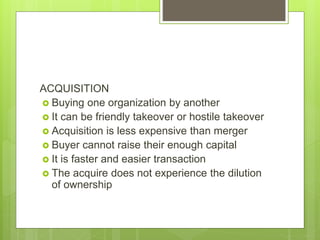
ACQUISITION
 Buying one organization by another
 It can be friendly takeover or hostile takeover
 Acquisition is less expensive than merger
 Buyer cannot raise their enough capital
 It is faster and easier transaction
 The acquire does not experience the dilution
of ownership
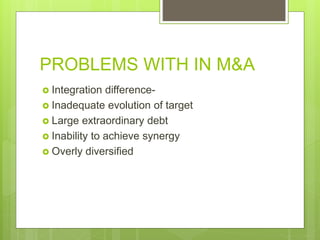
PROBLEMS WITH IN M&A
 Integration difference-
 Inadequate evolution of target
 Large extraordinary debt
 Inability to achieve synergy
 Overly diversified
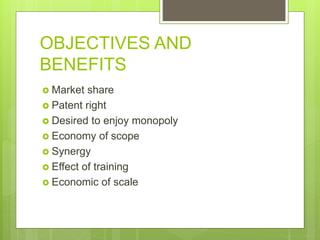
OBJECTIVES AND
BENEFITS
 Market share
 Patent right
 Desired to enjoy monopoly
 Economy of scope
 Synergy
 Effect of training
 Economic of scale
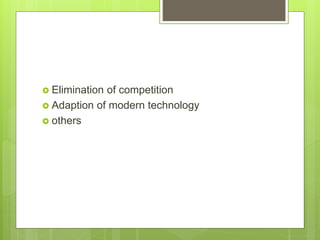
 Elimination of competition
 Adaption of modern technology
 others
THANK YOU

Small and medium enterprises ppt

  • 1.
  • 2.
    INTRODUCTION  By theenactment of small and medium enterprises development act, 2006 the small and medium sector has been defined as small and medium enterprises with effect from OCTOBER 2006  The classification has been done on the basis on investment in plant ad machinery in case of manufacturing enterprises and investment equipment's in case of service
  • 3.
    SMALL ENTERPRISES  Theseare those enterprises where the investment in plant and machinery in more than Rs. 25 lakhs But does not exceed Rs. 5 crores  Where the investment in equipment is more than Rs. 10 lakh but not exceed Rs. 2 crore.
  • 4.
    MEDIUM ENTERPRISES  Theseare those where the investment in plant and machinery is more than Rs. 5 crore but does not exceed 10 crore  Where the investment in equipment is more than Rs. 2crore but does not exceed 5 crore
  • 5.
    OBJECTIVES  To createpermanent employment opportunities to public at large at relatively small costs  To meet a major part of the increased demand for consumer good and simple producer goods  To ensure more equitable distribution of national income to society at large scale  To facilitate the mobilization of resources which might remain inadequately utilized,
  • 6.
    IMPORTANCE  SMe’s aremuch labour intensive than large scale industry. They provide more scope from the employments of worker  SSI also sustainable as they are essential from combating poverty and employment  The social cost of development small unit specially handicraft and village industry is lower
  • 7.
    Cont..  Elasticity intechnical and economic organization in SSI is high as compared to large sector concern  SSI are expected to earn more quick returns on capital invested in such industries where; gestation period is quite short is comparison to large scale industries
  • 8.
    SMALL AND MEDIUM ENTERPRISESDEVELPOMENT ACT, 2006 This act was passed on october2, 2006 the main features:  Setting up of a national board for MSMEs  Classification of enterprises  Advisory committees to support MSMEs  Measures for promotion, development and enhanced MSMEs  Schemes to control delayed payments of MSMEs
  • 9.
  • 10.
    MERGER  Merger isan transaction that result in the transfer of ownership and control of a corporation  When one company purchases another company of an approximately similar size. The two company come together to become one  Two company usually agree to merge when they feel that they can do something together that they can not do one their own.
  • 11.
    Acquisition  An acquisitionmay be an act of acquiring effective control by one company over assets or management of another company without any combination of companies  Companies may remain Independent, separate but there may be change is control of companies  It is also known as takeover and or a buyout
  • 12.
    TYPES OF MERGER& ACQUISITION Horizontal merger  Vertical merger  Market- extension merger  Product- extension merger  conglomeration
  • 13.
    DIFFERENCE BITWEEN MERGER ANDACQUISITION MERGER  Merging of two organization in to one  It is the mutual decision  Merger is expensive than acquisition  Through merger shareholder can increase their net worth  It is time consuming and the company has to maintain so much legal issue  Dilution of ownership occurs in merger
  • 14.
    ACQUISITION  Buying oneorganization by another  It can be friendly takeover or hostile takeover  Acquisition is less expensive than merger  Buyer cannot raise their enough capital  It is faster and easier transaction  The acquire does not experience the dilution of ownership
  • 15.
    PROBLEMS WITH INM&A  Integration difference-  Inadequate evolution of target  Large extraordinary debt  Inability to achieve synergy  Overly diversified
  • 16.
    OBJECTIVES AND BENEFITS  Marketshare  Patent right  Desired to enjoy monopoly  Economy of scope  Synergy  Effect of training  Economic of scale
  • 17.
     Elimination ofcompetition  Adaption of modern technology  others
  • 18.