Copyright © 2011 Pearson Education, Inc.
Publishing as Prentice Hall
Ch 8 -1
Chapter 8
Implementing Strategies: Marketing,
Finance/Accounting, R&D, and MIS Issues
Strategic Management:
Concepts & Cases
13th Edition
Fred David
Copyright © 2011 Pearson Education, Inc.
Publishing as Prentice Hall
Ch 8 -2
Copyright © 2011 Pearson Education, Inc.
Publishing as Prentice Hall
Ch 8 -3
“The greatest strategy is doomed
if it’s implemented badly.”
– Bernard Reimann
Implementing Strategies
Copyright © 2011 Pearson Education, Inc.
Publishing as Prentice Hall
Ch 8 -4
Less than 10% of strategies formulated
are successfully implemented!
The Nature of Strategy
Implementation
Copyright © 2011 Pearson Education, Inc.
Publishing as Prentice Hall
Ch 8 -5
The Nature of Strategy
Implementation
There are many reasons for the low success rate
of Strategy Implementation. These include:
 Failing to segment markets appropriately
 Paying too much for a new acquisition
 Falling behind competitors in R&D
 Not recognizing benefit of computers in
managing information
Copyright © 2011 Pearson Education, Inc.
Publishing as Prentice Hall
Ch 8 -6
Countless marketing variables affect
the success or failure of Strategy
Implementation (SI). Two variables
are of central importance to SI:
 Market segmentation
 Product positioning
Marketing Issues
Copyright © 2011 Pearson Education, Inc.
Publishing as Prentice Hall
Ch 8 -7
 Subdividing of a market into
distinct subsets of customers
according to needs and buying
habits
Marketing Issues
Market Segmentation
Copyright © 2011 Pearson Education, Inc.
Publishing as Prentice Hall
Ch 8 -8
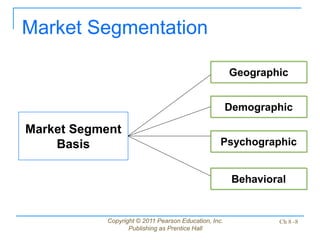
Market Segmentation
Market Segment
Basis Psychographic
Behavioral
Geographic
Demographic
Copyright © 2011 Pearson Education, Inc.
Publishing as Prentice Hall
Ch 8 -9
Market Segmentation is an important variable
in strategy implementation for three major
reasons:
 It is required to successfully implement market
development, product development, market
penetration, and diversification strategies.
 It allows a firm to operate with limited
resources because mass production,
distribution, and advertising are not required.
 It enables small firms to compete successfully
with large firms by maximizing per-unit profits
and per-segment sales.
Market Segmentation
Copyright © 2011 Pearson Education, Inc.
Publishing as Prentice Hall
Ch 8 -10
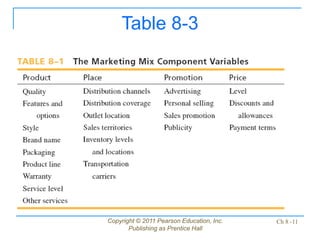
Market Segmentation decisions directly
affect marketing mix variables, as
indicated in Table 8-3:
 Product
 Place
 Promotion
 Price
Marketing Mix Variables
Copyright © 2011 Pearson Education, Inc.
Publishing as Prentice Hall
Ch 8 -11
Table 8-3
Copyright © 2011 Pearson Education, Inc.
Publishing as Prentice Hall
Ch 8 -12
Product Positioning
After markets have been segmented, the next step
is to find out what customers in each segment
need and want. Product Positioning is widely
used for this purpose.
 Product Positioning entails developing
schematic representations that reflect how a
firm’s products or services compare to
competitors’ on dimensions most important to
success in the industry.
Copyright © 2011 Pearson Education, Inc.
Publishing as Prentice Hall
Ch 8 -13
Product Positioning Steps
1. Select key criteria
2. Diagram map
3. Plot competitors’ products
4. Look for niches
5. Develop marketing plan
Copyright © 2011 Pearson Education, Inc.
Publishing as Prentice Hall
Ch 8 -14
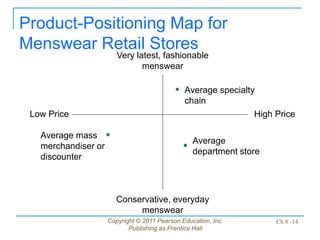
Product-Positioning Map for
Menswear Retail Stores
Very latest, fashionable
menswear
Conservative, everyday
menswear
Low Price High Price
Average
department store
Average specialty
chain
Average mass
merchandiser or
discounter
Copyright © 2011 Pearson Education, Inc.
Publishing as Prentice Hall
Ch 8 -15
Finance/Accounting Issues
There are several finance/accounting
concepts that are central to strategy
implementation. Some of the concepts
essential for Strategy Implementation are:
 Acquiring needed capital
 Developing projected financial statements
 Preparing financial budgets
 Evaluating the worth of a business
Copyright © 2011 Pearson Education, Inc.
Publishing as Prentice Hall
Ch 8 -16
Acquiring Needed Capital:
 Equity – common stock
 Debt - bonds
 Debt - borrow from lenders
Finance/Accounting Issues
Copyright © 2011 Pearson Education, Inc.
Publishing as Prentice Hall
Ch 8 -17
Finance/Accounting Issues
 Debt vs. Equity Decisions
EPS/EBIT analysis
 An Earnings Per Share/Earnings Before Interest and
Taxes analysis is the most widely used method for
determining whether debt, stock, or a combination of
debt and stock is the best alternative for raising capital
to implement strategies.
 This method involves an examination of the impact
that debt versus stock financing has on earnings per
share under various assumptions as to EBIT.
Copyright © 2011 Pearson Education, Inc.
Publishing as Prentice Hall
Ch 8 -18
 Allows an organization to examine the
expected results of various actions and
approaches
Finance/Accounting Issues
Projected Financial Statement Analysis
Copyright © 2011 Pearson Education, Inc.
Publishing as Prentice Hall
Ch 8 -19
1. Prepare income statement before
balance sheet (forecast sales)
2. Use percentage of sales method to
project CGS & expenses
3. Calculate projected net income
Finance/Accounting Issues
Steps in Preparing Projected Financial
Statements
Copyright © 2011 Pearson Education, Inc.
Publishing as Prentice Hall
Ch 8 -20
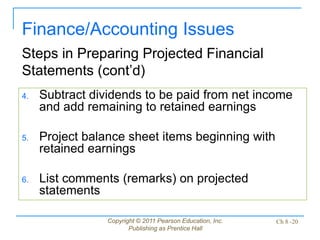
4. Subtract dividends to be paid from net income
and add remaining to retained earnings
5. Project balance sheet items beginning with
retained earnings
6. List comments (remarks) on projected
statements
Finance/Accounting Issues
Steps in Preparing Projected Financial
Statements (cont’d)
Copyright © 2011 Pearson Education, Inc.
Publishing as Prentice Hall
Ch 8 -21
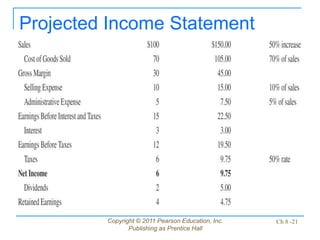
Projected Income Statement
Copyright © 2011 Pearson Education, Inc.
Publishing as Prentice Hall
Ch 8 -22
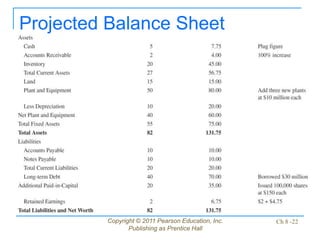
Projected Balance Sheet
Copyright © 2011 Pearson Education, Inc.
Publishing as Prentice Hall
Ch 8 -23
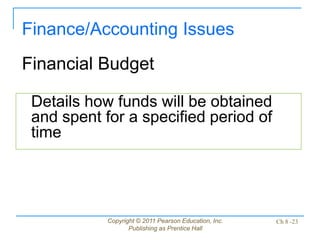
Details how funds will be obtained
and spent for a specified period of
time
Finance/Accounting Issues
Financial Budget
Copyright © 2011 Pearson Education, Inc.
Publishing as Prentice Hall
Ch 8 -24
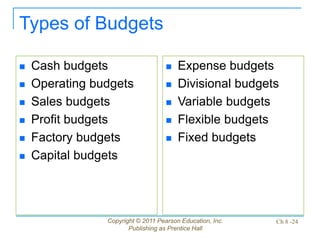
Types of Budgets
 Cash budgets
 Operating budgets
 Sales budgets
 Profit budgets
 Factory budgets
 Capital budgets
 Expense budgets
 Divisional budgets
 Variable budgets
 Flexible budgets
 Fixed budgets
Copyright © 2011 Pearson Education, Inc.
Publishing as Prentice Hall
Ch 8 -25
 Central to strategy implementation –
integrative, intensive, and
diversification strategies often
implemented through acquisitions of
other firms
Finance/Accounting Issues
Evaluating the Worth of a Business
Copyright © 2011 Pearson Education, Inc.
Publishing as Prentice Hall
Ch 8 -26
1. What a firm owns
2. What a firm earns
3. What a firm will bring in the market
Evaluating the Worth of a Business
There are three basic approaches
Copyright © 2011 Pearson Education, Inc.
Publishing as Prentice Hall
Ch 8 -27
Research & Development Issues
New products and improvement of
existing products that allow for effective
strategy implementation
Copyright © 2011 Pearson Education, Inc.
Publishing as Prentice Hall
Ch 8 -28
 Level of support constrained by resource
availability
 Technological improvements shorten
product life cycles
Research & Development Issues
Constraints
Copyright © 2011 Pearson Education, Inc.
Publishing as Prentice Hall
Ch 8 -29
1. Be the first firm to market new technological
products.
2. Be an innovative imitator of successful
products.
3. Be a low-cost producer by mass-producing
products similar to but less expensive than
products recently introduced.
Research & Development Issues
There are three major R&D approaches
to implementing strategies:
Copyright © 2011 Pearson Education, Inc.
Publishing as Prentice Hall
Ch 8 -30
Management Information
Systems (MIS) Issues
Having an effective management
information system (MIS) may be the
most important factor in differentiating
successful from unsuccessful firms.
Copyright © 2011 Pearson Education, Inc.
Publishing as Prentice Hall
Ch 8 -31
 Information collection, retrieval, and
storage
 Keeping managers informed
 Coordination of activities among divisions
 Allows firm to reduce costs
MIS Issues
Functions of MIS

david_sm13_ppt_08.ppt

  • 1.
    Copyright © 2011Pearson Education, Inc. Publishing as Prentice Hall Ch 8 -1 Chapter 8 Implementing Strategies: Marketing, Finance/Accounting, R&D, and MIS Issues Strategic Management: Concepts & Cases 13th Edition Fred David
  • 2.
    Copyright © 2011Pearson Education, Inc. Publishing as Prentice Hall Ch 8 -2
  • 3.
    Copyright © 2011Pearson Education, Inc. Publishing as Prentice Hall Ch 8 -3 “The greatest strategy is doomed if it’s implemented badly.” – Bernard Reimann Implementing Strategies
  • 4.
    Copyright © 2011Pearson Education, Inc. Publishing as Prentice Hall Ch 8 -4 Less than 10% of strategies formulated are successfully implemented! The Nature of Strategy Implementation
  • 5.
    Copyright © 2011Pearson Education, Inc. Publishing as Prentice Hall Ch 8 -5 The Nature of Strategy Implementation There are many reasons for the low success rate of Strategy Implementation. These include:  Failing to segment markets appropriately  Paying too much for a new acquisition  Falling behind competitors in R&D  Not recognizing benefit of computers in managing information
  • 6.
    Copyright © 2011Pearson Education, Inc. Publishing as Prentice Hall Ch 8 -6 Countless marketing variables affect the success or failure of Strategy Implementation (SI). Two variables are of central importance to SI:  Market segmentation  Product positioning Marketing Issues
  • 7.
    Copyright © 2011Pearson Education, Inc. Publishing as Prentice Hall Ch 8 -7  Subdividing of a market into distinct subsets of customers according to needs and buying habits Marketing Issues Market Segmentation
  • 8.
    Copyright © 2011Pearson Education, Inc. Publishing as Prentice Hall Ch 8 -8 Market Segmentation Market Segment Basis Psychographic Behavioral Geographic Demographic
  • 9.
    Copyright © 2011Pearson Education, Inc. Publishing as Prentice Hall Ch 8 -9 Market Segmentation is an important variable in strategy implementation for three major reasons:  It is required to successfully implement market development, product development, market penetration, and diversification strategies.  It allows a firm to operate with limited resources because mass production, distribution, and advertising are not required.  It enables small firms to compete successfully with large firms by maximizing per-unit profits and per-segment sales. Market Segmentation
  • 10.
    Copyright © 2011Pearson Education, Inc. Publishing as Prentice Hall Ch 8 -10 Market Segmentation decisions directly affect marketing mix variables, as indicated in Table 8-3:  Product  Place  Promotion  Price Marketing Mix Variables
  • 11.
    Copyright © 2011Pearson Education, Inc. Publishing as Prentice Hall Ch 8 -11 Table 8-3
  • 12.
    Copyright © 2011Pearson Education, Inc. Publishing as Prentice Hall Ch 8 -12 Product Positioning After markets have been segmented, the next step is to find out what customers in each segment need and want. Product Positioning is widely used for this purpose.  Product Positioning entails developing schematic representations that reflect how a firm’s products or services compare to competitors’ on dimensions most important to success in the industry.
  • 13.
    Copyright © 2011Pearson Education, Inc. Publishing as Prentice Hall Ch 8 -13 Product Positioning Steps 1. Select key criteria 2. Diagram map 3. Plot competitors’ products 4. Look for niches 5. Develop marketing plan
  • 14.
    Copyright © 2011Pearson Education, Inc. Publishing as Prentice Hall Ch 8 -14 Product-Positioning Map for Menswear Retail Stores Very latest, fashionable menswear Conservative, everyday menswear Low Price High Price Average department store Average specialty chain Average mass merchandiser or discounter
  • 15.
    Copyright © 2011Pearson Education, Inc. Publishing as Prentice Hall Ch 8 -15 Finance/Accounting Issues There are several finance/accounting concepts that are central to strategy implementation. Some of the concepts essential for Strategy Implementation are:  Acquiring needed capital  Developing projected financial statements  Preparing financial budgets  Evaluating the worth of a business
  • 16.
    Copyright © 2011Pearson Education, Inc. Publishing as Prentice Hall Ch 8 -16 Acquiring Needed Capital:  Equity – common stock  Debt - bonds  Debt - borrow from lenders Finance/Accounting Issues
  • 17.
    Copyright © 2011Pearson Education, Inc. Publishing as Prentice Hall Ch 8 -17 Finance/Accounting Issues  Debt vs. Equity Decisions EPS/EBIT analysis  An Earnings Per Share/Earnings Before Interest and Taxes analysis is the most widely used method for determining whether debt, stock, or a combination of debt and stock is the best alternative for raising capital to implement strategies.  This method involves an examination of the impact that debt versus stock financing has on earnings per share under various assumptions as to EBIT.
  • 18.
    Copyright © 2011Pearson Education, Inc. Publishing as Prentice Hall Ch 8 -18  Allows an organization to examine the expected results of various actions and approaches Finance/Accounting Issues Projected Financial Statement Analysis
  • 19.
    Copyright © 2011Pearson Education, Inc. Publishing as Prentice Hall Ch 8 -19 1. Prepare income statement before balance sheet (forecast sales) 2. Use percentage of sales method to project CGS & expenses 3. Calculate projected net income Finance/Accounting Issues Steps in Preparing Projected Financial Statements
  • 20.
    Copyright © 2011Pearson Education, Inc. Publishing as Prentice Hall Ch 8 -20 4. Subtract dividends to be paid from net income and add remaining to retained earnings 5. Project balance sheet items beginning with retained earnings 6. List comments (remarks) on projected statements Finance/Accounting Issues Steps in Preparing Projected Financial Statements (cont’d)
  • 21.
    Copyright © 2011Pearson Education, Inc. Publishing as Prentice Hall Ch 8 -21 Projected Income Statement
  • 22.
    Copyright © 2011Pearson Education, Inc. Publishing as Prentice Hall Ch 8 -22 Projected Balance Sheet
  • 23.
    Copyright © 2011Pearson Education, Inc. Publishing as Prentice Hall Ch 8 -23 Details how funds will be obtained and spent for a specified period of time Finance/Accounting Issues Financial Budget
  • 24.
    Copyright © 2011Pearson Education, Inc. Publishing as Prentice Hall Ch 8 -24 Types of Budgets  Cash budgets  Operating budgets  Sales budgets  Profit budgets  Factory budgets  Capital budgets  Expense budgets  Divisional budgets  Variable budgets  Flexible budgets  Fixed budgets
  • 25.
    Copyright © 2011Pearson Education, Inc. Publishing as Prentice Hall Ch 8 -25  Central to strategy implementation – integrative, intensive, and diversification strategies often implemented through acquisitions of other firms Finance/Accounting Issues Evaluating the Worth of a Business
  • 26.
    Copyright © 2011Pearson Education, Inc. Publishing as Prentice Hall Ch 8 -26 1. What a firm owns 2. What a firm earns 3. What a firm will bring in the market Evaluating the Worth of a Business There are three basic approaches
  • 27.
    Copyright © 2011Pearson Education, Inc. Publishing as Prentice Hall Ch 8 -27 Research & Development Issues New products and improvement of existing products that allow for effective strategy implementation
  • 28.
    Copyright © 2011Pearson Education, Inc. Publishing as Prentice Hall Ch 8 -28  Level of support constrained by resource availability  Technological improvements shorten product life cycles Research & Development Issues Constraints
  • 29.
    Copyright © 2011Pearson Education, Inc. Publishing as Prentice Hall Ch 8 -29 1. Be the first firm to market new technological products. 2. Be an innovative imitator of successful products. 3. Be a low-cost producer by mass-producing products similar to but less expensive than products recently introduced. Research & Development Issues There are three major R&D approaches to implementing strategies:
  • 30.
    Copyright © 2011Pearson Education, Inc. Publishing as Prentice Hall Ch 8 -30 Management Information Systems (MIS) Issues Having an effective management information system (MIS) may be the most important factor in differentiating successful from unsuccessful firms.
  • 31.
    Copyright © 2011Pearson Education, Inc. Publishing as Prentice Hall Ch 8 -31  Information collection, retrieval, and storage  Keeping managers informed  Coordination of activities among divisions  Allows firm to reduce costs MIS Issues Functions of MIS