CHAPTER 8:
Implementing Strategies:
Marketing,
Finance/Accounting, R&D,
and MIS Issues
Presented by:
INIKE APRILIA L.
(1511011009)
SILVIA
(1511011010)
THE NATURE OF STRATEGY
IMPLEMENTATION
Strategies have no chance of being implemented
successfully in organizations that do not market
goods and services well, in firms that cannot raise
needed working capital, in firms that produce
technologically inferior products, or in firms that
have a weak information system.
CURRENT MARKETING ISSUES
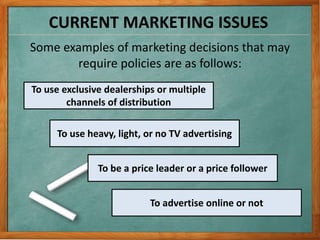
Some examples of marketing decisions that may
require policies are as follows:
To use exclusive dealerships or multiple
channels of distribution
To use heavy, light, or no TV advertising
To be a price leader or a price follower
To advertise online or not
Today a business or organization’s Web site
must provide clear and simple instructions
for customers to set up a blog and/or
contribute to a wiki.
New Principles of Marketing
Customers trust each others’
opinions more than a company’s
marketing pitch, and the more they
talk freely, the more the firm can
learn how to improve its product,
service, and marketing.
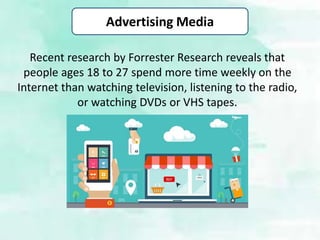
Recent research by Forrester Research reveals that
people ages 18 to 27 spend more time weekly on the
Internet than watching television, listening to the radio,
or watching DVDs or VHS tapes.
Advertising Media
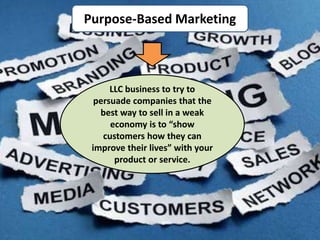
Purpose-Based Marketing
LLC business to try to
persuade companies that the
best way to sell in a weak
economy is to “show
customers how they can
improve their lives” with your
product or service.
MARKET SEGMENTATION
Market segmentation can be defined as the subdividing
of a market into distinct subsets of customers according
to needs and buying habits.
Segmentation is a
key to matching
supply and
demand, which is
one of the
thorniest problems
in customer
service.
Segmentation
often reveals that
large, random
fluctuations in
demand actually
consist of several
small, predictable,
and manageable
patterns.
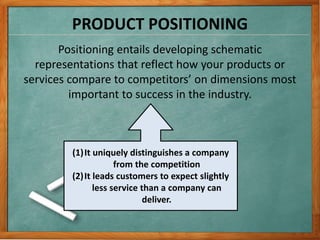
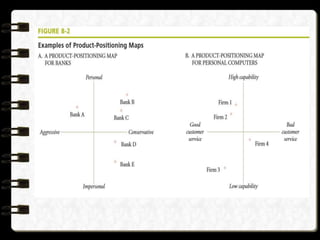
PRODUCT POSITIONING
Positioning entails developing schematic
representations that reflect how your products or
services compare to competitors’ on dimensions most
important to success in the industry.
(1)It uniquely distinguishes a company
from the competition
(2)It leads customers to expect slightly
less service than a company can
deliver.
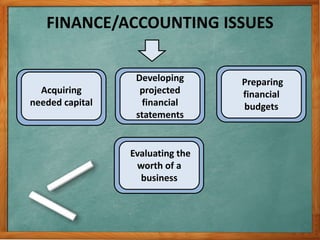
FINANCE/ACCOUNTING ISSUES
Acquiring
needed capital
Developing
projected
financial
statements
Preparing
financial
budgets
Evaluating the
worth of a
business
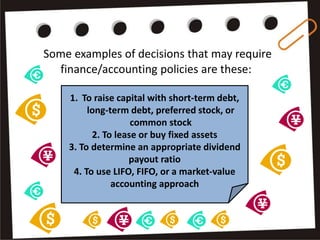
Some examples of decisions that may require
finance/accounting policies are these:
1. To raise capital with short-term debt,
long-term debt, preferred stock, or
common stock
2. To lease or buy fixed assets
3. To determine an appropriate dividend
payout ratio
4. To use LIFO, FIFO, or a market-value
accounting approach
Determining an appropriate mix of
debt and equity in a firm’s capital
structure can be vital to successful
strategy implementation.
An Earnings Per Share/Earnings
Before Interest and Taxes (EPS/EBIT)
analysis is the most widely used
technique for determining whether
debt, stock, or a combination of debt
and stock is the best alternative for
raising capital to implement
strategies.
Acquiring Needed Capital
Brown Company’s Case
• Brown Company needs to raise $1 million to finance
implementation of a market-development strategy.
• The company’s common stock currently sells for $50
per share, and 100,000 shares are outstanding.
• The prime interest rate is 10 percent, and the
company’s tax rate is 50 percent.
• The company’s earnings before interest and taxes next
year are expected to be $2 million if a recession occurs,
$4 million if the economy stays as is, and $8 million if
the economy significantly improves.
HOW ABOUT THE EPS/EBIT ANALYSIS ?
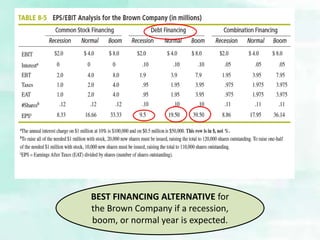
BEST FINANCING ALTERNATIVE for
the Brown Company if a recession,
boom, or normal year is expected.
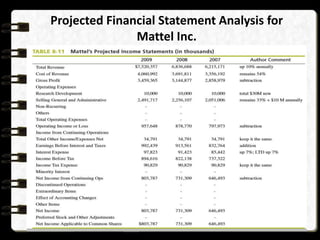
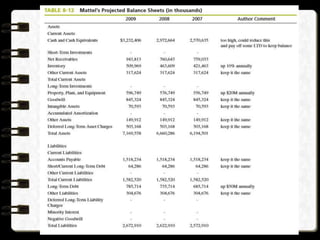
Projected Financial Statements
Projected financial statement
analysis is a central strategy-
implementation technique because it
allows an organization to examine
the expected results of various
actions and approaches.
This type of
analysis can be
used to forecast the
impact of various
implementation
decisions
There are six steps in performing projected
financial analysis:
1. Prepare the projected income statement before
the balance sheet.
2. Use the percentage-of-sales method to project
cost of goods sold (CGS) and the expense items in
the income statement.
3. Calculate the projected net income.
4. Subtract from the net income any dividends to be
paid for that year.
5. Project the balance sheet items, beginning with
retained earnings and then forecasting
stockholders’ equity, long-term, current & total
liabilities, total assets, fixed & current assets.
6. List comments (remarks) on the projected
statements.
Projected Financial Statement Analysis for
Mattel Inc.
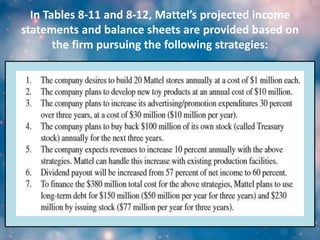
In Tables 8-11 and 8-12, Mattel’s projected income
statements and balance sheets are provided based on
the firm pursuing the following strategies:
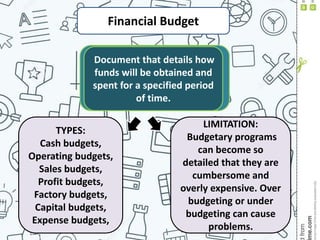
Financial Budget
Document that details how
funds will be obtained and
spent for a specified period
of time.
TYPES:
Cash budgets,
Operating budgets,
Sales budgets,
Profit budgets,
Factory budgets,
Capital budgets,
Expense budgets,
LIMITATION:
Budgetary programs
can become so
detailed that they are
cumbersome and
overly expensive. Over
budgeting or under
budgeting can cause
problems.
All the various methods for determining a business’s
worth can be grouped into three main approaches: What
a firm owns, What a firm earns, or What a firm will
bring in the market.
Evaluating the Worth of a Business
Business evaluations are
becoming routine in many
situations. Businesses have many
strategy-implementation reasons
for determining their worth in
addition to preparing to be sold or
to buy other companies.
R&D ISSUES
Research and development (R&D) personnel can play
an integral part in strategy implementation. These
individuals are generally charged with developing new
products and improving old products in a way that will
allow effective strategy implementation.
R&D policies can enhance strategy implementation
efforts to:
Emphasize product or process improvements.
Stress basic or applied research.
Be leaders or followers in R&D.
Develop robotics or manual-type processes.
Spend a high, average, or low amount of money on
R&D.
Perform R&D within the firm or to contract R&D to
outside firms.
Use university researchers or private-sector
researchers.
MANAGEMENT INFORMATION
SYSTEM ISSUES
Firms that gather, assimilate, and evaluate external and
internal information most effectively are gaining
competitive advantages over other firms. Having an
effective management information system (MIS) may be
the most important factor in differentiating successful
from unsuccessful firms.
Information collection,
retrieval, and storage can be
used to create competitive
advantages in ways such as
cross-selling to customers,
monitoring suppliers,
keeping managers and
employees informed,
coordinating activities
among divisions, and
managing funds.

Chapter 8 Strategic Management

  • 1.
  • 2.
    Presented by: INIKE APRILIAL. (1511011009) SILVIA (1511011010)
  • 4.
    THE NATURE OFSTRATEGY IMPLEMENTATION Strategies have no chance of being implemented successfully in organizations that do not market goods and services well, in firms that cannot raise needed working capital, in firms that produce technologically inferior products, or in firms that have a weak information system.
  • 5.
    CURRENT MARKETING ISSUES Someexamples of marketing decisions that may require policies are as follows: To use exclusive dealerships or multiple channels of distribution To use heavy, light, or no TV advertising To be a price leader or a price follower To advertise online or not
  • 6.
    Today a businessor organization’s Web site must provide clear and simple instructions for customers to set up a blog and/or contribute to a wiki. New Principles of Marketing Customers trust each others’ opinions more than a company’s marketing pitch, and the more they talk freely, the more the firm can learn how to improve its product, service, and marketing.
  • 7.
    Recent research byForrester Research reveals that people ages 18 to 27 spend more time weekly on the Internet than watching television, listening to the radio, or watching DVDs or VHS tapes. Advertising Media
  • 8.
    Purpose-Based Marketing LLC businessto try to persuade companies that the best way to sell in a weak economy is to “show customers how they can improve their lives” with your product or service.
  • 9.
    MARKET SEGMENTATION Market segmentationcan be defined as the subdividing of a market into distinct subsets of customers according to needs and buying habits. Segmentation is a key to matching supply and demand, which is one of the thorniest problems in customer service. Segmentation often reveals that large, random fluctuations in demand actually consist of several small, predictable, and manageable patterns.
  • 10.
    PRODUCT POSITIONING Positioning entailsdeveloping schematic representations that reflect how your products or services compare to competitors’ on dimensions most important to success in the industry. (1)It uniquely distinguishes a company from the competition (2)It leads customers to expect slightly less service than a company can deliver.
  • 12.
  • 13.
    Some examples ofdecisions that may require finance/accounting policies are these: 1. To raise capital with short-term debt, long-term debt, preferred stock, or common stock 2. To lease or buy fixed assets 3. To determine an appropriate dividend payout ratio 4. To use LIFO, FIFO, or a market-value accounting approach
  • 14.
    Determining an appropriatemix of debt and equity in a firm’s capital structure can be vital to successful strategy implementation. An Earnings Per Share/Earnings Before Interest and Taxes (EPS/EBIT) analysis is the most widely used technique for determining whether debt, stock, or a combination of debt and stock is the best alternative for raising capital to implement strategies. Acquiring Needed Capital
  • 15.
    Brown Company’s Case •Brown Company needs to raise $1 million to finance implementation of a market-development strategy. • The company’s common stock currently sells for $50 per share, and 100,000 shares are outstanding. • The prime interest rate is 10 percent, and the company’s tax rate is 50 percent. • The company’s earnings before interest and taxes next year are expected to be $2 million if a recession occurs, $4 million if the economy stays as is, and $8 million if the economy significantly improves. HOW ABOUT THE EPS/EBIT ANALYSIS ?
  • 16.
    BEST FINANCING ALTERNATIVEfor the Brown Company if a recession, boom, or normal year is expected.
  • 17.
    Projected Financial Statements Projectedfinancial statement analysis is a central strategy- implementation technique because it allows an organization to examine the expected results of various actions and approaches. This type of analysis can be used to forecast the impact of various implementation decisions
  • 18.
    There are sixsteps in performing projected financial analysis: 1. Prepare the projected income statement before the balance sheet. 2. Use the percentage-of-sales method to project cost of goods sold (CGS) and the expense items in the income statement. 3. Calculate the projected net income. 4. Subtract from the net income any dividends to be paid for that year. 5. Project the balance sheet items, beginning with retained earnings and then forecasting stockholders’ equity, long-term, current & total liabilities, total assets, fixed & current assets. 6. List comments (remarks) on the projected statements.
  • 19.
    Projected Financial StatementAnalysis for Mattel Inc.
  • 21.
    In Tables 8-11and 8-12, Mattel’s projected income statements and balance sheets are provided based on the firm pursuing the following strategies:
  • 22.
    Financial Budget Document thatdetails how funds will be obtained and spent for a specified period of time. TYPES: Cash budgets, Operating budgets, Sales budgets, Profit budgets, Factory budgets, Capital budgets, Expense budgets, LIMITATION: Budgetary programs can become so detailed that they are cumbersome and overly expensive. Over budgeting or under budgeting can cause problems.
  • 23.
    All the variousmethods for determining a business’s worth can be grouped into three main approaches: What a firm owns, What a firm earns, or What a firm will bring in the market. Evaluating the Worth of a Business Business evaluations are becoming routine in many situations. Businesses have many strategy-implementation reasons for determining their worth in addition to preparing to be sold or to buy other companies.
  • 24.
    R&D ISSUES Research anddevelopment (R&D) personnel can play an integral part in strategy implementation. These individuals are generally charged with developing new products and improving old products in a way that will allow effective strategy implementation.
  • 25.
    R&D policies canenhance strategy implementation efforts to: Emphasize product or process improvements. Stress basic or applied research. Be leaders or followers in R&D. Develop robotics or manual-type processes. Spend a high, average, or low amount of money on R&D. Perform R&D within the firm or to contract R&D to outside firms. Use university researchers or private-sector researchers.
  • 26.
    MANAGEMENT INFORMATION SYSTEM ISSUES Firmsthat gather, assimilate, and evaluate external and internal information most effectively are gaining competitive advantages over other firms. Having an effective management information system (MIS) may be the most important factor in differentiating successful from unsuccessful firms.
  • 27.
    Information collection, retrieval, andstorage can be used to create competitive advantages in ways such as cross-selling to customers, monitoring suppliers, keeping managers and employees informed, coordinating activities among divisions, and managing funds.