Portfolio
Product
Management
2
New Product Development
Performance Evaluation
Risk Management ROI Maximization
Portfolio Prioritization
Product Consistency
Resource Optimization
Agenda
3
New Product
Development
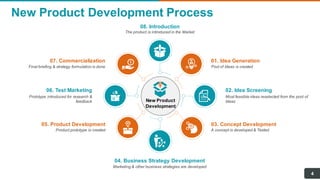
New Product Development Process
08. Introduction
The product is introduced in the Market
01. Idea Generation
Pool of Ideas is created
02. Idea Screening
Most feasible ideas reselected from the pool of
Ideas
03. Concept Development
A concept is developed & Tested
04. Business Strategy Development
Marketing & other business strategies are developed
05. Product Development
Product prototype is created
06. Test Marketing
Prototype introduced for research &
feedback
07. Commercialization
Final briefing & strategy formulation is done
New Product
Development
4
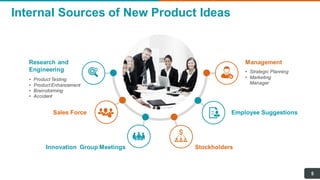
Internal Sources of New Product Ideas
Sales Force
Innovation Group Meetings Stockholders
Employee Suggestions
Research and
Engineering
• ProductTesting
• ProductEnhancement
• Brainstorming
• Accident
Management
• Strategic Planning
• Marketing
Manager
5
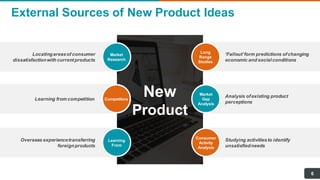
External Sources of New Product Ideas
‘Fallout’form predictions ofchanging
economic and socialconditions
Analysis ofexisting product
perceptions
Studying activitiesto identify
unsatisfiedneeds
Locatingareasof consumer
dissatisfactionwith currentproducts
Learning from competition
Overseas experiencetransferring
foreignproducts
New
Product
Long
Range
Studies
Market
Gap
Analysis
Consumer
Activity
Analysis
Learning
From
Competitors
Market
Research
6
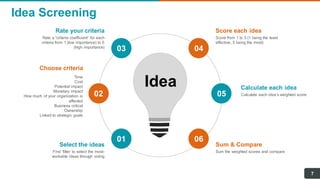
Idea Screening
Idea
05
02
04
03
01 06
Rate a “criteria coefficient” for each
criteria from 1 (low importance) to 5
(high importance)
Rate your criteria
Time
Cost
Potential impact
Monetary impact
How much of your organization is
affected
Business critical
Ownership
Linked to strategic goals
Choose criteria
First ’filter’ to select the most-
workable ideas through voting
Select the ideas
Score from 1 to 5 (1 being the least
effective, 5 being the most)
Score each idea
Calculate each idea’s weighted score
Calculate each idea
Sum the weighted scores and compare
Sum & Compare
7
01
02
03
04
05
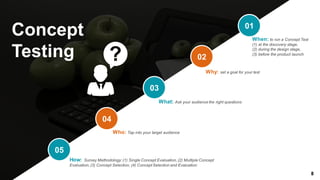
Why: set a goal for your test
When: to run a Concept Test
(1) at the discovery stage,
(2) during the design stage,
(3) before the product launch
What: Ask your audience the right questions
How: Survey Methodology: (1) Single Concept Evaluation, (2) Multiple Concept
Evaluation, (3) Concept Selection, (4) Concept Selection and Evaluation
Who: Tap into your target audience
Concept
Testing
8
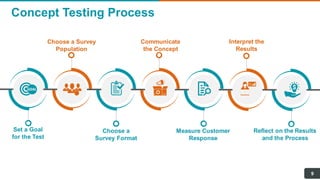
Concept Testing Process
9
Set a Goal
for the Test
Choose a Survey
Population
Choose a
Survey Format
Communicate
the Concept
Measure Customer
Response
Interpret the
Results
Reflect on the Results
and the Process
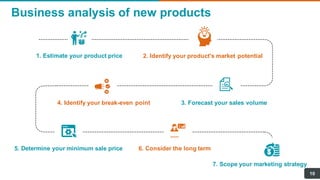
Business analysis of new products
4. Identify your break-even point
7. Scope your marketing strategy
1. Estimate your product price 2. Identify your product's market potential
3. Forecast your sales volume
6. Consider the long term
5. Determine your minimum sale price
10
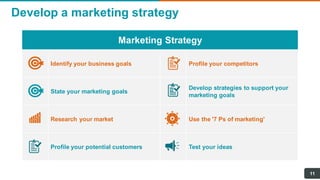
Develop a marketing strategy
11
Marketing Strategy
Identify your business goals Profile your competitors
State your marketing goals
Develop strategies to support your
marketing goals
Research your market Use the '7 Ps of marketing'
Profile your potential customers Test your ideas
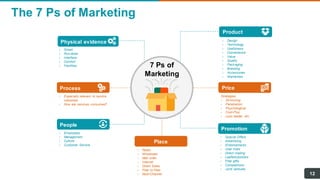
People
› Employees
› Management
› Culture
› Customer Service
The 7 Ps of Marketing
12
Place
› Retail
› Wholesale
› Mail order
› Internet
› Direct Sales
› Peer to Peer
› Multi-Channel
› Smart
› Run-down
› Interface
› Comfort
› Facilities
Physical evidence
Price
Strategies:
› Skimming
› Penetration
› Psychological
› Cost-Plus
› Loss leader, etc
Promotion
› Special Offers
› Advertising
› Endorsements
› User trials
› Direct mailing
› Leaflets/posters
› Free gifts
› Competitions
› Joint ventures
Process
› Especially relevant to service
industries
› How are services consumed?
7 Ps of
Marketing
› Design
› Technology
› Usefulness
› Convenience
› Value
› Quality
› Packaging
› Branding
› Accessories
› Warranties
Product
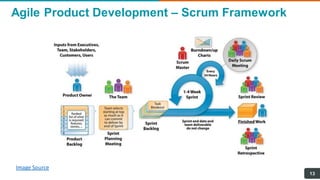
Agile Product Development – Scrum Framework
13
Image Source
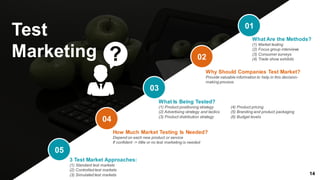
01
02
03
04
05
Why Should Companies Test Market?
Provide valuable information to help in this decision-
making process
What Are the Methods?
(1) Market testing
(2) Focus group interviews
(3) Consumer surveys
(4) Trade show exhibits
What Is Being Tested?
(1) Product positioning strategy (4) Product pricing
(2) Advertising strategy and tactics (5) Branding and product packaging
(3) Product distribution strategy (6) Budget levels
3 Test Market Approaches:
(1) Standard test markets
(2) Controlled test markets
(3) Simulated test markets
How Much Market Testing Is Needed?
Depend on each new product or service
If confident -> little or no test marketing is needed
Test
Marketing
14
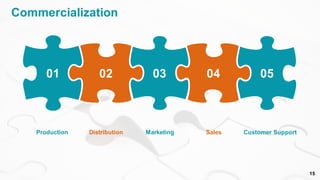
01 02 03 04 05
Production Distribution Marketing Sales Customer Support
Commercialization
15
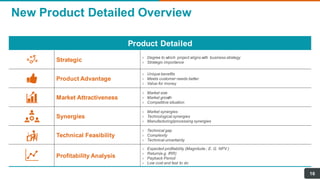
New Product Detailed Overview
Product Detailed
Strategic › Degree to which project aligns with business strategy
› Strategic importance
Product Advantage
› Unique benefits
› Meets customer needs better
› Value for money
Market Attractiveness
› Market size
› Market growth
› Competitive situation
Synergies
› Market synergies
› Technological synergies
› Manufacturing/processing synergies
Technical Feasibility
› Technical gap
› Complexity
› Technical uncertainty
Profitability Analysis
› Expected profitability (Magnitude ; E. G. NPV )
› Return(e.g. IRR)
› Payback Period
› Low cost and fast to do
16
17
Performance
Evaluation
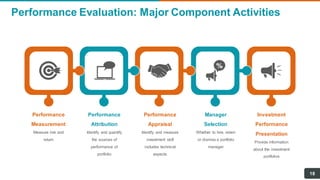
Performance Evaluation: Major Component Activities
18
Performance
Measurement
Measure risk and
return
Performance
Attribution
Identify and quantify
the sources of
performance of
portfolio
Performance
Appraisal
Identify and measure
investment skill
includes technical
aspects
Manager
Selection
Whether to hire, retain
or dismiss a portfolio
manager
Investment
Performance
Presentation
Provide information
about the investment
portfolios
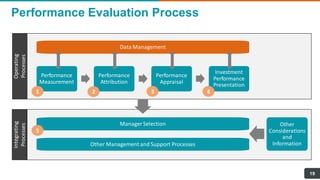
Performance Evaluation Process
19
Performance
Measurement
Performance
Attribution
Performance
Appraisal
Investment
Performance
Presentation
Data Management
Manager Selection
Other Management and Support Processes
Other
Considerations
and
Information
Operating
Processes
Integrating
Processes
1 2 3 4
5
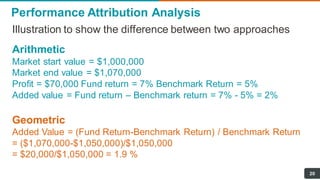
Performance Attribution Analysis
20
Illustration to show the difference between two approaches
Arithmetic
Market start value = $1,000,000
Market end value = $1,070,000
Profit = $70,000 Fund return = 7% Benchmark Return = 5%
Added value = Fund return – Benchmark return = 7% - 5% = 2%
Geometric
Added Value = (Fund Return-Benchmark Return) / Benchmark Return
= ($1,070,000-$1,050,000)/$1,050,000
= $20,000/$1,050,000 = 1.9 %
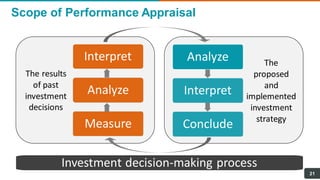
Scope of Performance Appraisal
21
Analyze
Interpret
Conclude
The
proposed
and
implemented
investment
strategy
Interpret
Analyze
Measure
The results
of past
investment
decisions
Investment decision-making process
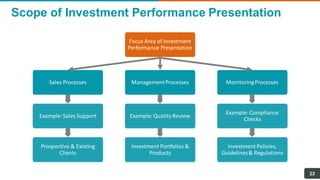
Scope of Investment Performance Presentation
22
Sales Processes
Example:Sales Support
Prospective & Existing
Clients
ManagementProcesses
Example:Quality Review
Investment Portfolios &
Products
MonitoringProcesses
Example:Compliance
Checks
Investment Policies,
Guidelines& Regulations
Focus Area of Investment
Performance Presentation
23
Risk
Management
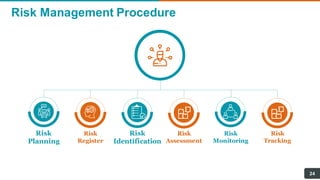
Risk Management Procedure
24
Risk
Planning
Risk
Register
Risk
Identification
Risk
Assessment
Risk
Monitoring
Risk
Tracking
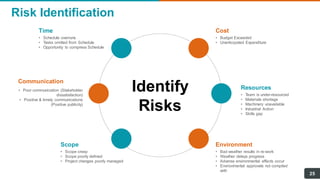
Risk Identification
Identify
Risks
• Schedule overruns
• Tasks omitted from Schedule
• Opportunity to compress Schedule
Time
• Poor communication (Stakeholder
dissatisfaction)
• Positive & timely communications
(Positive publicity)
Communication
• Scope creep
• Scope poorly defined
• Project changes poorly managed
Scope
• Budget Exceeded
• Unanticipated Expenditure
Cost
• Team is under-resourced
• Materials shortage
• Machinery unavailable
• Industrial Action
• Skills gap
Resources
• Bad weather results in re-work
• Weather delays progress
• Adverse environmental effects occur
• Environmental approvals not compiled
with
Environment
25
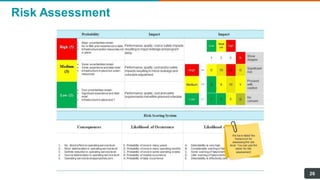
Risk Assessment
26
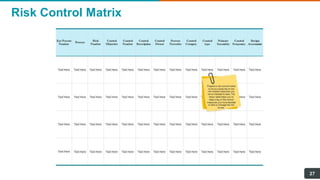
Risk Control Matrix
27
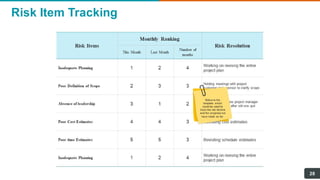
Risk Item Tracking
28
29
Portfolio
Prioritization
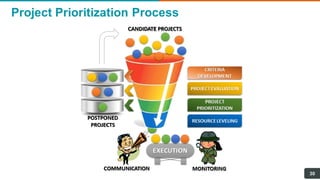
Project Prioritization Process
30
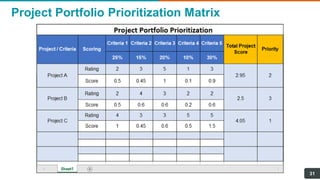
Project Portfolio Prioritization Matrix
31
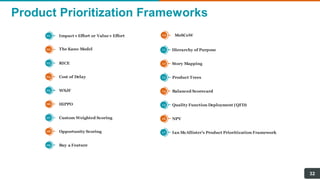
Product Prioritization Frameworks
32
Impact v Effort or Value v Effort
01
The Kano Model
02
RICE
03
Cost of Delay
04
WSJF
05
HiPPO
06
Custom Weighted Scoring
07
Opportunity Scoring
08
Buy a Feature
09
MoSCoW
10
Hierarchy of Purpose
11
Story Mapping
12
Product Trees
13
Balanced Scorecard
14
Quality Function Deployment (QFD)
15
NPV
16
Ian McAllister’s Product Prioritization Framework
17
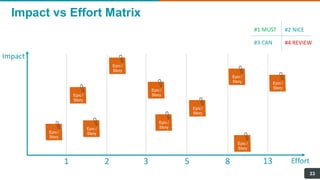
Impact vs Effort Matrix
33
1 2 3 5 8 13 Effort
Impact
#1 MUST #2 NICE
#3 CAN #4 REVIEW
Epic /
Story
Epic /
Story
Epic /
Story
Epic /
Story
Epic /
Story
Epic /
Story
Epic /
Story
Epic /
Story
Epic /
Story
Epic /
Story
34
Resource
Optimization
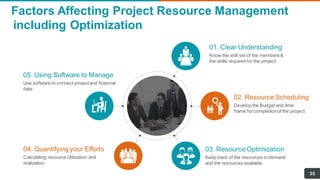
Factors Affecting Project Resource Management
including Optimization
35
01. Clear Understanding
Know the skill set of the members&
the skills required for the project
02. Resource Scheduling
Develop the Budget and time
frame forcompletionof the project
03. Resource Optimization
Keep track of the resources indemand
and the resources available
04. Quantifying your Efforts
Calculating resource Utilization and
realization
05. Using Software to Manage
Use software to connect projectand financial
data
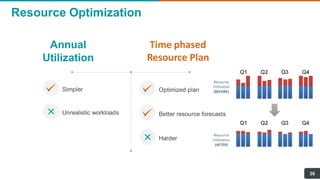
Resource Optimization
36
Annual
Utilization
Time phased
Resource Plan
Simpler
Unrealistic workloads
Optimized plan
Harder
Better resource forecasts
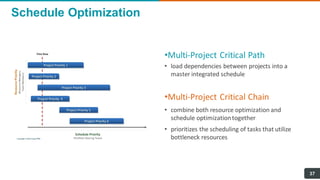
Schedule Optimization
•Multi-Project Critical Path
• load dependencies between projects into a
master integrated schedule
•Multi-Project Critical Chain
• combine both resource optimization and
schedule optimizationtogether
• prioritizes the scheduling of tasks that utilize
bottleneck resources
37
38
ROI
Maximization
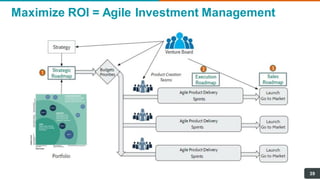
Maximize ROI = Agile Investment Management
39
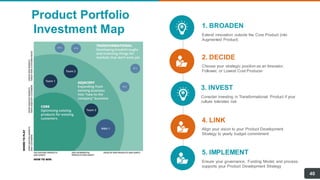
Product Portfolio
Investment Map
40
1. BROADEN
Extend innovation outside the Core Product (into
Augmented Product)
2. DECIDE
Choose your strategic position as an Innovator,
Follower, or Lowest Cost Producer
3. INVEST
Consider investing in Transformational Product if your
culture tolerates risk
4. LINK
Align your vision to your Product Development
Strategy to yearly budget commitment
5. IMPLEMENT
Ensure your governance, Funding Model, and process
supports your Product Development Strategy
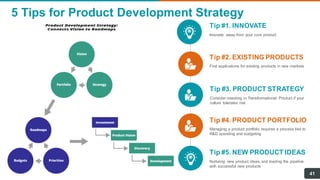
5 Tips for Product Development Strategy
41
Tip #1. INNOVATE
Innovate away from your core product
Tip #2. EXISTING PRODUCTS
Find applications for existing products in new markets
Tip #3. PRODUCT STRATEGY
Consider investing in Transformational Product if your
culture tolerates risk
Tip #4. PRODUCT PORTFOLIO
Managing a product portfolio requires a process tied to
R&D spending and budgeting
Tip #5. NEW PRODUCT IDEAS
Nurturing new product ideas, and loading the pipeline
with successful new products
42
Product
Consistency
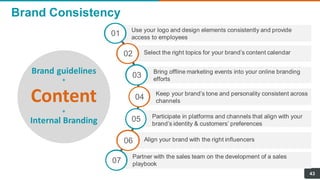
Brand Consistency
43
Use your logo and design elements consistently and provide
access to employees
01
Select the right topics for your brand’s content calendar
02
Bring offline marketing events into your online branding
efforts
03
Keep your brand’s tone and personality consistent across
channels
04
Partner with the sales team on the development of a sales
playbook
07
Align your brand with the right influencers
06
Participate in platforms and channels that align with your
brand’s identity & customers’ preferences
05
Brand guidelines
+
Content
+
Internal Branding
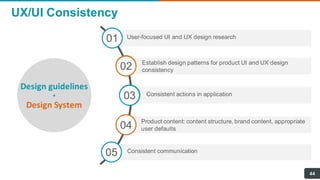
UX/UI Consistency
44
Consistent communication
05
Product content: content structure, brand content, appropriate
user defaults
04
Consistent actions in application
03
Establish design patterns for product UI and UX design
consistency
02
User-focused UI and UX design research
01
Design guidelines
+
Design System
45
TRANG NGUYEN PRESENTATION
Thanks

Portfolio product management - Trang Nguyen

  • 1.
  • 2.
    2 New Product Development PerformanceEvaluation Risk Management ROI Maximization Portfolio Prioritization Product Consistency Resource Optimization Agenda
  • 3.
  • 4.
    New Product DevelopmentProcess 08. Introduction The product is introduced in the Market 01. Idea Generation Pool of Ideas is created 02. Idea Screening Most feasible ideas reselected from the pool of Ideas 03. Concept Development A concept is developed & Tested 04. Business Strategy Development Marketing & other business strategies are developed 05. Product Development Product prototype is created 06. Test Marketing Prototype introduced for research & feedback 07. Commercialization Final briefing & strategy formulation is done New Product Development 4
  • 5.
    Internal Sources ofNew Product Ideas Sales Force Innovation Group Meetings Stockholders Employee Suggestions Research and Engineering • ProductTesting • ProductEnhancement • Brainstorming • Accident Management • Strategic Planning • Marketing Manager 5
  • 6.
    External Sources ofNew Product Ideas ‘Fallout’form predictions ofchanging economic and socialconditions Analysis ofexisting product perceptions Studying activitiesto identify unsatisfiedneeds Locatingareasof consumer dissatisfactionwith currentproducts Learning from competition Overseas experiencetransferring foreignproducts New Product Long Range Studies Market Gap Analysis Consumer Activity Analysis Learning From Competitors Market Research 6
  • 7.
    Idea Screening Idea 05 02 04 03 01 06 Ratea “criteria coefficient” for each criteria from 1 (low importance) to 5 (high importance) Rate your criteria Time Cost Potential impact Monetary impact How much of your organization is affected Business critical Ownership Linked to strategic goals Choose criteria First ’filter’ to select the most- workable ideas through voting Select the ideas Score from 1 to 5 (1 being the least effective, 5 being the most) Score each idea Calculate each idea’s weighted score Calculate each idea Sum the weighted scores and compare Sum & Compare 7
  • 8.
    01 02 03 04 05 Why: set agoal for your test When: to run a Concept Test (1) at the discovery stage, (2) during the design stage, (3) before the product launch What: Ask your audience the right questions How: Survey Methodology: (1) Single Concept Evaluation, (2) Multiple Concept Evaluation, (3) Concept Selection, (4) Concept Selection and Evaluation Who: Tap into your target audience Concept Testing 8
  • 9.
    Concept Testing Process 9 Seta Goal for the Test Choose a Survey Population Choose a Survey Format Communicate the Concept Measure Customer Response Interpret the Results Reflect on the Results and the Process
  • 10.
    Business analysis ofnew products 4. Identify your break-even point 7. Scope your marketing strategy 1. Estimate your product price 2. Identify your product's market potential 3. Forecast your sales volume 6. Consider the long term 5. Determine your minimum sale price 10
  • 11.
    Develop a marketingstrategy 11 Marketing Strategy Identify your business goals Profile your competitors State your marketing goals Develop strategies to support your marketing goals Research your market Use the '7 Ps of marketing' Profile your potential customers Test your ideas
  • 12.
    People › Employees › Management ›Culture › Customer Service The 7 Ps of Marketing 12 Place › Retail › Wholesale › Mail order › Internet › Direct Sales › Peer to Peer › Multi-Channel › Smart › Run-down › Interface › Comfort › Facilities Physical evidence Price Strategies: › Skimming › Penetration › Psychological › Cost-Plus › Loss leader, etc Promotion › Special Offers › Advertising › Endorsements › User trials › Direct mailing › Leaflets/posters › Free gifts › Competitions › Joint ventures Process › Especially relevant to service industries › How are services consumed? 7 Ps of Marketing › Design › Technology › Usefulness › Convenience › Value › Quality › Packaging › Branding › Accessories › Warranties Product
  • 13.
    Agile Product Development– Scrum Framework 13 Image Source
  • 14.
    01 02 03 04 05 Why Should CompaniesTest Market? Provide valuable information to help in this decision- making process What Are the Methods? (1) Market testing (2) Focus group interviews (3) Consumer surveys (4) Trade show exhibits What Is Being Tested? (1) Product positioning strategy (4) Product pricing (2) Advertising strategy and tactics (5) Branding and product packaging (3) Product distribution strategy (6) Budget levels 3 Test Market Approaches: (1) Standard test markets (2) Controlled test markets (3) Simulated test markets How Much Market Testing Is Needed? Depend on each new product or service If confident -> little or no test marketing is needed Test Marketing 14
  • 15.
    01 02 0304 05 Production Distribution Marketing Sales Customer Support Commercialization 15
  • 16.
    New Product DetailedOverview Product Detailed Strategic › Degree to which project aligns with business strategy › Strategic importance Product Advantage › Unique benefits › Meets customer needs better › Value for money Market Attractiveness › Market size › Market growth › Competitive situation Synergies › Market synergies › Technological synergies › Manufacturing/processing synergies Technical Feasibility › Technical gap › Complexity › Technical uncertainty Profitability Analysis › Expected profitability (Magnitude ; E. G. NPV ) › Return(e.g. IRR) › Payback Period › Low cost and fast to do 16
  • 17.
  • 18.
    Performance Evaluation: MajorComponent Activities 18 Performance Measurement Measure risk and return Performance Attribution Identify and quantify the sources of performance of portfolio Performance Appraisal Identify and measure investment skill includes technical aspects Manager Selection Whether to hire, retain or dismiss a portfolio manager Investment Performance Presentation Provide information about the investment portfolios
  • 19.
    Performance Evaluation Process 19 Performance Measurement Performance Attribution Performance Appraisal Investment Performance Presentation DataManagement Manager Selection Other Management and Support Processes Other Considerations and Information Operating Processes Integrating Processes 1 2 3 4 5
  • 20.
    Performance Attribution Analysis 20 Illustrationto show the difference between two approaches Arithmetic Market start value = $1,000,000 Market end value = $1,070,000 Profit = $70,000 Fund return = 7% Benchmark Return = 5% Added value = Fund return – Benchmark return = 7% - 5% = 2% Geometric Added Value = (Fund Return-Benchmark Return) / Benchmark Return = ($1,070,000-$1,050,000)/$1,050,000 = $20,000/$1,050,000 = 1.9 %
  • 21.
    Scope of PerformanceAppraisal 21 Analyze Interpret Conclude The proposed and implemented investment strategy Interpret Analyze Measure The results of past investment decisions Investment decision-making process
  • 22.
    Scope of InvestmentPerformance Presentation 22 Sales Processes Example:Sales Support Prospective & Existing Clients ManagementProcesses Example:Quality Review Investment Portfolios & Products MonitoringProcesses Example:Compliance Checks Investment Policies, Guidelines& Regulations Focus Area of Investment Performance Presentation
  • 23.
  • 24.
  • 25.
    Risk Identification Identify Risks • Scheduleoverruns • Tasks omitted from Schedule • Opportunity to compress Schedule Time • Poor communication (Stakeholder dissatisfaction) • Positive & timely communications (Positive publicity) Communication • Scope creep • Scope poorly defined • Project changes poorly managed Scope • Budget Exceeded • Unanticipated Expenditure Cost • Team is under-resourced • Materials shortage • Machinery unavailable • Industrial Action • Skills gap Resources • Bad weather results in re-work • Weather delays progress • Adverse environmental effects occur • Environmental approvals not compiled with Environment 25
  • 26.
  • 27.
  • 28.
  • 29.
  • 30.
  • 31.
  • 32.
    Product Prioritization Frameworks 32 Impactv Effort or Value v Effort 01 The Kano Model 02 RICE 03 Cost of Delay 04 WSJF 05 HiPPO 06 Custom Weighted Scoring 07 Opportunity Scoring 08 Buy a Feature 09 MoSCoW 10 Hierarchy of Purpose 11 Story Mapping 12 Product Trees 13 Balanced Scorecard 14 Quality Function Deployment (QFD) 15 NPV 16 Ian McAllister’s Product Prioritization Framework 17
  • 33.
    Impact vs EffortMatrix 33 1 2 3 5 8 13 Effort Impact #1 MUST #2 NICE #3 CAN #4 REVIEW Epic / Story Epic / Story Epic / Story Epic / Story Epic / Story Epic / Story Epic / Story Epic / Story Epic / Story Epic / Story
  • 34.
  • 35.
    Factors Affecting ProjectResource Management including Optimization 35 01. Clear Understanding Know the skill set of the members& the skills required for the project 02. Resource Scheduling Develop the Budget and time frame forcompletionof the project 03. Resource Optimization Keep track of the resources indemand and the resources available 04. Quantifying your Efforts Calculating resource Utilization and realization 05. Using Software to Manage Use software to connect projectand financial data
  • 36.
    Resource Optimization 36 Annual Utilization Time phased ResourcePlan Simpler Unrealistic workloads Optimized plan Harder Better resource forecasts
  • 37.
    Schedule Optimization •Multi-Project CriticalPath • load dependencies between projects into a master integrated schedule •Multi-Project Critical Chain • combine both resource optimization and schedule optimizationtogether • prioritizes the scheduling of tasks that utilize bottleneck resources 37
  • 38.
  • 39.
    Maximize ROI =Agile Investment Management 39
  • 40.
    Product Portfolio Investment Map 40 1.BROADEN Extend innovation outside the Core Product (into Augmented Product) 2. DECIDE Choose your strategic position as an Innovator, Follower, or Lowest Cost Producer 3. INVEST Consider investing in Transformational Product if your culture tolerates risk 4. LINK Align your vision to your Product Development Strategy to yearly budget commitment 5. IMPLEMENT Ensure your governance, Funding Model, and process supports your Product Development Strategy
  • 41.
    5 Tips forProduct Development Strategy 41 Tip #1. INNOVATE Innovate away from your core product Tip #2. EXISTING PRODUCTS Find applications for existing products in new markets Tip #3. PRODUCT STRATEGY Consider investing in Transformational Product if your culture tolerates risk Tip #4. PRODUCT PORTFOLIO Managing a product portfolio requires a process tied to R&D spending and budgeting Tip #5. NEW PRODUCT IDEAS Nurturing new product ideas, and loading the pipeline with successful new products
  • 42.
  • 43.
    Brand Consistency 43 Use yourlogo and design elements consistently and provide access to employees 01 Select the right topics for your brand’s content calendar 02 Bring offline marketing events into your online branding efforts 03 Keep your brand’s tone and personality consistent across channels 04 Partner with the sales team on the development of a sales playbook 07 Align your brand with the right influencers 06 Participate in platforms and channels that align with your brand’s identity & customers’ preferences 05 Brand guidelines + Content + Internal Branding
  • 44.
    UX/UI Consistency 44 Consistent communication 05 Productcontent: content structure, brand content, appropriate user defaults 04 Consistent actions in application 03 Establish design patterns for product UI and UX design consistency 02 User-focused UI and UX design research 01 Design guidelines + Design System
  • 45.