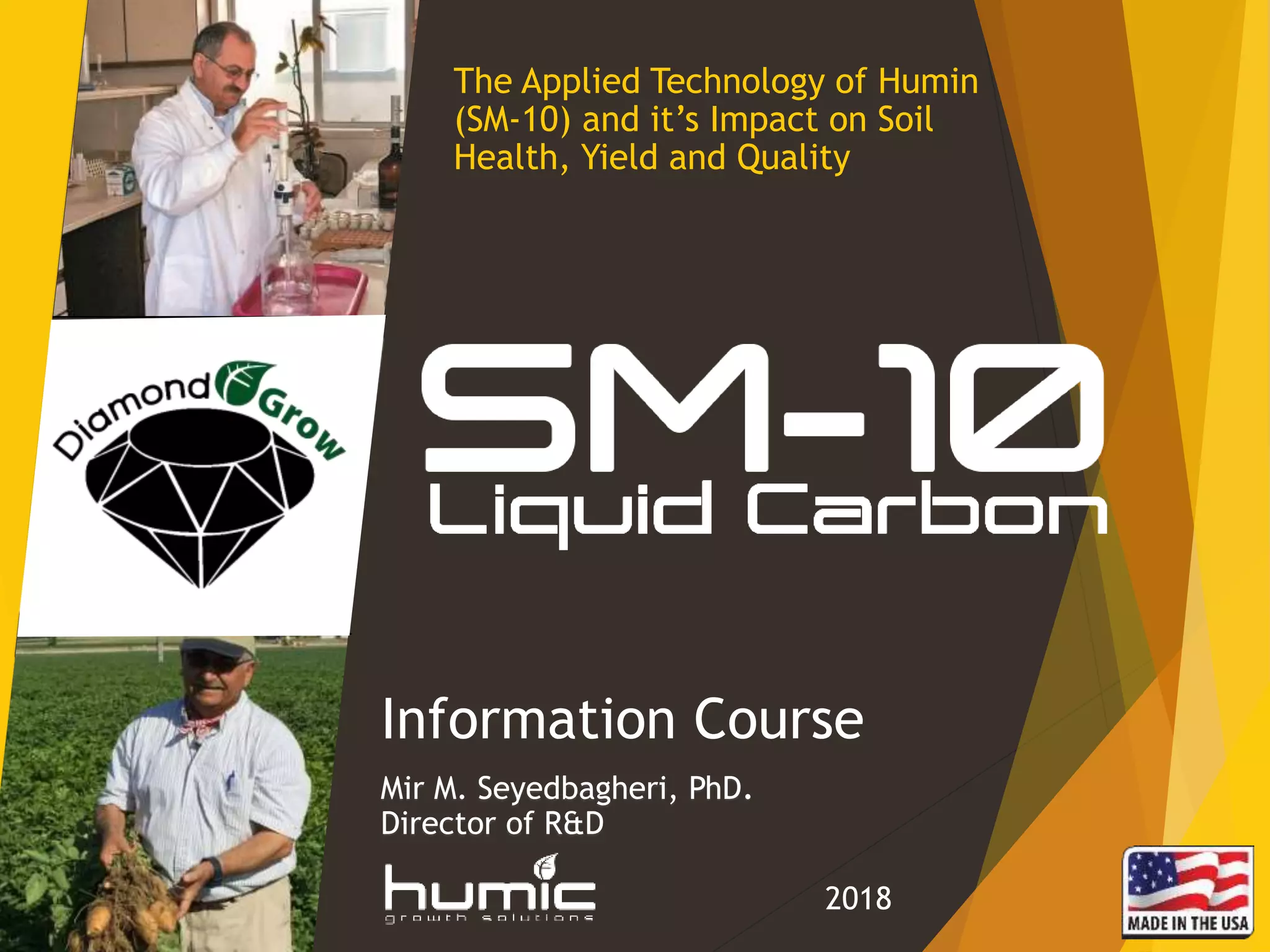
The Applied Technology of Humin
(SM-10) and it’s Impact on Soil
Health, Yield and Quality
Information Course
Mir M. Seyedbagheri, PhD.
Director of R&D
2018
Lack of HS in the soil of
conventional farms in the USA
A research report analyzing soil samples
from over 700 conventional farms in 48
states shows the alarming discovery that
these samples contained little to no Humic
Substances.
2017 Drs Ghabbour, Davies et al
2
 On the most basic level, humin is
defined as the “fraction of the humic
substances insoluble in an aqueous
solution at any pH value.”
 Humin comprises just over 50% of the
organic carbon C in soils, more than
70% of organic C in unlithified
sediments, and therefore occupies an
important pantheon in natural
systems
 However, humin has also been labeled
a high molecular weight polymer, a
lingoprotein or plant and fungal
residues in differing stages of
decomposition.
Humic Acids, Fulvic Acids and
Humin
HA, FA and Humin are the most
active fraction of Humus
They have the presence of free
and bound phenolic OH groups,
quinones, oxygen and N as bridge
units, and –COOH groups variously
placed on the molecule.
Humin Influence on
Soil & Plant Metabolism
Three processes of humin formation assessed using
molecular, isotopic & microscopic tools
 Selective preservation of microbial, straight-chained biopolymers
 Physical encapsulation of plant wax fingerprints by weak forces
 Chemical binding by covalent bonds
Lichtfouse
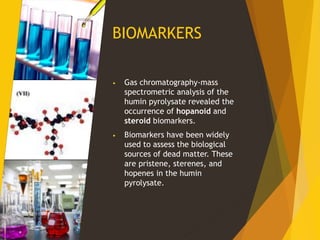
BIOMARKERS
• Gas chromatography-mass
spectrometric analysis of the
humin pyrolysate revealed the
occurrence of hopanoid and
steroid biomarkers.
• Biomarkers have been widely
used to assess the biological
sources of dead matter. These
are pristene, sterenes, and
hopenes in the humin
pyrolysate.
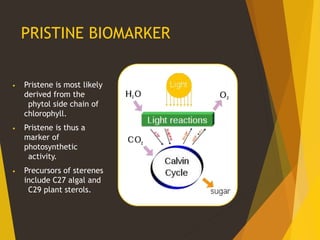
PRISTINE BIOMARKER
• Pristene is most likely
derived from the
phytol side chain of
chlorophyll.
• Pristene is thus a
marker of
photosynthetic
activity.
• Precursors of sterenes
include C27 algal and
C29 plant sterols.
HUMIN AND ITS
FUNCTIONALITY
Theoretically, humin is the non-
soluble fraction of soil humus
which breaks down slowly by soil
microbial activity and affects the
soil by regulating its water
holding capacity, ion exchange
rate, EC, pH and soil crumble
(micro aggregates).
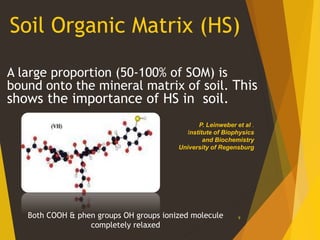
Soil Organic Matrix (HS)
A large proportion (50-100% of SOM) is
bound onto the mineral matrix of soil. This
shows the importance of HS in soil.
9
P. Leinweber et al .
Institute of Biophysics
and Biochemistry
University of Regensburg
Both COOH & phen groups OH groups ionized molecule
completely relaxed
HGS® has the Perfect
Fusion of Chemistry
and Biology
10
The 5-R’s of Nutrient Stewardship
1. Right Fertilizer
2. Right Rate
3. Right Time
4. Right Place
11
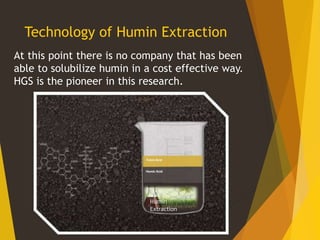
Technology of Humin Extraction
At this point there is no company that has been
able to solubilize humin in a cost effective way.
HGS is the pioneer in this research.
Humin
Extraction
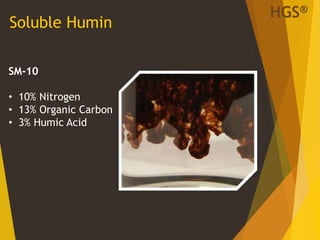
Soluble Humin
SM-10
• 10% Nitrogen
• 13% Organic Carbon
• 3% Humic Acid
HGS®
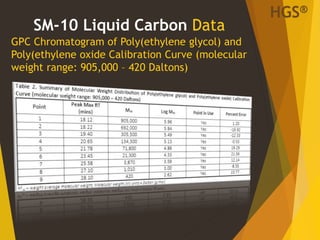
GPC Chromatogram of Poly(ethylene glycol) and
Poly(ethylene oxide Calibration Curve (molecular
weight range: 905,000 – 420 Daltons)
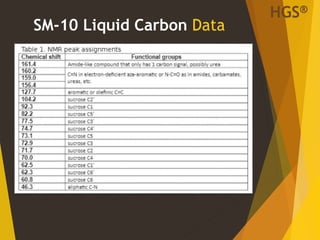
SM-10 Liquid Carbon Data
HGS®
SM-10 Liquid Carbon Data
HGS®
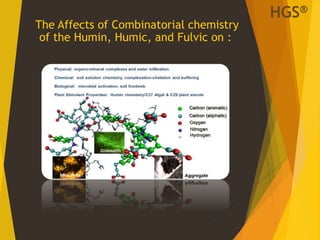
The Affects of Combinatorial chemistry
of the Humin, Humic, and Fulvic on :
HGS®
Combinatorial Chemistry and Their
Influence on Soil and Plant Health
17
Humic Substance
•Source
•Concentration
•Size (molecular wt.)
Plant
•Species
•Age
*Root Initiation and
Development
*Enhanced adsorption of
macro- and micro-
nutrients
(e.g. NO3
-)
*Seedling growth
*Shoot Development
*Seed Germination
*Enhanced Metabolic
Activity
Biostimulant activities
HGS®
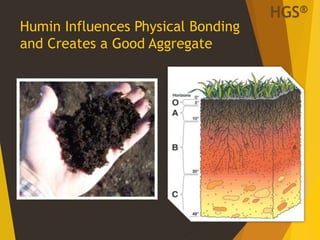
Humin Influences Physical Bonding
and Creates a Good Aggregate
18
HGS®
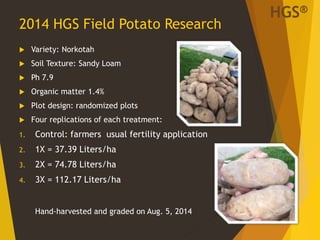
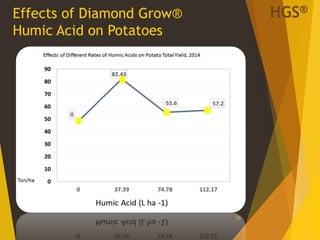
2014 HGS Field Potato Research
 Variety: Norkotah
 Soil Texture: Sandy Loam
 Ph 7.9
 Organic matter 1.4%
 Plot design: randomized plots
 Four replications of each treatment:
1. Control: farmers usual fertility application
2. 1X = 37.39 Liters/ha
3. 2X = 74.78 Liters/ha
4. 3X = 112.17 Liters/ha
Hand-harvested and graded on Aug. 5, 2014
19
HGS®
Effects of Diamond Grow®
Humic Acid on Potatoes
20
HGS®
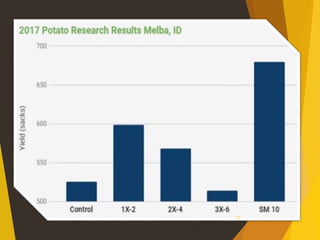
2017 Potato Humic
Research
Melba, Idaho
Randomized Complete Block Design
pH 8.06
OM 1.70
Lime 3.9%
*Very high fertilizer inputs
Carbon P Fusion 270 lbs/acre
Previous crop: sweet corn
Treatment Humic-K
1X = 2 gal
2X = 4 gal
3X = 6 gal
SM-10 = 4 gal
21
HGS®
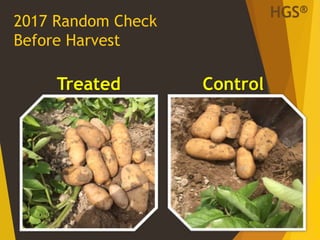
2017 Random Check
Before Harvest
22
Treated Control
HGS®
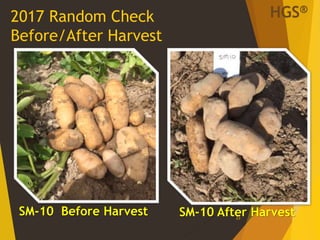
2017 Random Check
Before/After Harvest
23
SM-10 Before Harvest SM-10 After Harvest
HGS®
2017 Grading After Harvest
24
HGS®
HGS®
2017 SM-10 Potato Research:
Randomize Complete Block Design
26
HGS®
27
Humi[K] Treated Corn on
Different Fields in Utah
28
Brazil & Utah Field Trials
HA/Quality & Yield Increase
Seyedbagheri 2017
29
Conventional With Humic
780 ears/ha difference
7 ½ ton difference
per acre in silage corn
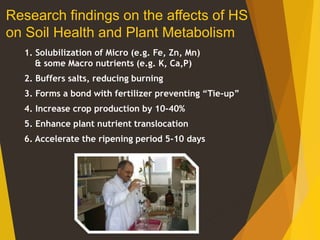
Research findings on the affects of HS
on Soil Health and Plant Metabolism
1. Solubilization of Micro (e.g. Fe, Zn, Mn)
& some Macro nutrients (e.g. K, Ca,P)
2. Buffers salts, reducing burning
3. Forms a bond with fertilizer preventing “Tie-up”
4. Increase crop production by 10-40%
5. Enhance plant nutrient translocation
6. Accelerate the ripening period 5-10 days
30
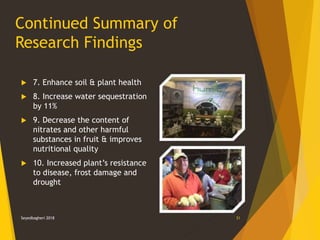
 7. Enhance soil & plant health
 8. Increase water sequestration
by 11%
 9. Decrease the content of
nitrates and other harmful
substances in fruit & improves
nutritional quality
 10. Increased plant’s resistance
to disease, frost damage and
drought
Seyedbagheri 2018 31
Continued Summary of
Research Findings
Seyedbagheri 2017 32
THE END

Diamond Grow® SM-10 Liquid Carbon

  • 1.
    The Applied Technologyof Humin (SM-10) and it’s Impact on Soil Health, Yield and Quality Information Course Mir M. Seyedbagheri, PhD. Director of R&D 2018
  • 2.
    Lack of HSin the soil of conventional farms in the USA A research report analyzing soil samples from over 700 conventional farms in 48 states shows the alarming discovery that these samples contained little to no Humic Substances. 2017 Drs Ghabbour, Davies et al 2
  • 3.
     On themost basic level, humin is defined as the “fraction of the humic substances insoluble in an aqueous solution at any pH value.”  Humin comprises just over 50% of the organic carbon C in soils, more than 70% of organic C in unlithified sediments, and therefore occupies an important pantheon in natural systems  However, humin has also been labeled a high molecular weight polymer, a lingoprotein or plant and fungal residues in differing stages of decomposition.
  • 4.
    Humic Acids, FulvicAcids and Humin HA, FA and Humin are the most active fraction of Humus They have the presence of free and bound phenolic OH groups, quinones, oxygen and N as bridge units, and –COOH groups variously placed on the molecule.
  • 5.
    Humin Influence on Soil& Plant Metabolism Three processes of humin formation assessed using molecular, isotopic & microscopic tools  Selective preservation of microbial, straight-chained biopolymers  Physical encapsulation of plant wax fingerprints by weak forces  Chemical binding by covalent bonds Lichtfouse
  • 6.
    BIOMARKERS • Gas chromatography-mass spectrometricanalysis of the humin pyrolysate revealed the occurrence of hopanoid and steroid biomarkers. • Biomarkers have been widely used to assess the biological sources of dead matter. These are pristene, sterenes, and hopenes in the humin pyrolysate.
  • 7.
    PRISTINE BIOMARKER • Pristeneis most likely derived from the phytol side chain of chlorophyll. • Pristene is thus a marker of photosynthetic activity. • Precursors of sterenes include C27 algal and C29 plant sterols.
  • 8.
    HUMIN AND ITS FUNCTIONALITY Theoretically,humin is the non- soluble fraction of soil humus which breaks down slowly by soil microbial activity and affects the soil by regulating its water holding capacity, ion exchange rate, EC, pH and soil crumble (micro aggregates).
  • 9.
    Soil Organic Matrix(HS) A large proportion (50-100% of SOM) is bound onto the mineral matrix of soil. This shows the importance of HS in soil. 9 P. Leinweber et al . Institute of Biophysics and Biochemistry University of Regensburg Both COOH & phen groups OH groups ionized molecule completely relaxed
  • 10.
    HGS® has thePerfect Fusion of Chemistry and Biology 10
  • 11.
    The 5-R’s ofNutrient Stewardship 1. Right Fertilizer 2. Right Rate 3. Right Time 4. Right Place 11
  • 12.
    Technology of HuminExtraction At this point there is no company that has been able to solubilize humin in a cost effective way. HGS is the pioneer in this research. Humin Extraction
  • 13.
    Soluble Humin SM-10 • 10%Nitrogen • 13% Organic Carbon • 3% Humic Acid HGS®
  • 14.
    GPC Chromatogram ofPoly(ethylene glycol) and Poly(ethylene oxide Calibration Curve (molecular weight range: 905,000 – 420 Daltons) SM-10 Liquid Carbon Data HGS®
  • 15.
  • 16.
    The Affects ofCombinatorial chemistry of the Humin, Humic, and Fulvic on : HGS®
  • 17.
    Combinatorial Chemistry andTheir Influence on Soil and Plant Health 17 Humic Substance •Source •Concentration •Size (molecular wt.) Plant •Species •Age *Root Initiation and Development *Enhanced adsorption of macro- and micro- nutrients (e.g. NO3 -) *Seedling growth *Shoot Development *Seed Germination *Enhanced Metabolic Activity Biostimulant activities HGS®
  • 18.
    Humin Influences PhysicalBonding and Creates a Good Aggregate 18 HGS®
  • 19.
    2014 HGS FieldPotato Research  Variety: Norkotah  Soil Texture: Sandy Loam  Ph 7.9  Organic matter 1.4%  Plot design: randomized plots  Four replications of each treatment: 1. Control: farmers usual fertility application 2. 1X = 37.39 Liters/ha 3. 2X = 74.78 Liters/ha 4. 3X = 112.17 Liters/ha Hand-harvested and graded on Aug. 5, 2014 19 HGS®
  • 20.
    Effects of DiamondGrow® Humic Acid on Potatoes 20 HGS®
  • 21.
    2017 Potato Humic Research Melba,Idaho Randomized Complete Block Design pH 8.06 OM 1.70 Lime 3.9% *Very high fertilizer inputs Carbon P Fusion 270 lbs/acre Previous crop: sweet corn Treatment Humic-K 1X = 2 gal 2X = 4 gal 3X = 6 gal SM-10 = 4 gal 21 HGS®
  • 22.
    2017 Random Check BeforeHarvest 22 Treated Control HGS®
  • 23.
    2017 Random Check Before/AfterHarvest 23 SM-10 Before Harvest SM-10 After Harvest HGS®
  • 24.
    2017 Grading AfterHarvest 24 HGS®
  • 25.
  • 26.
    2017 SM-10 PotatoResearch: Randomize Complete Block Design 26 HGS®
  • 27.
  • 28.
    Humi[K] Treated Cornon Different Fields in Utah 28
  • 29.
    Brazil & UtahField Trials HA/Quality & Yield Increase Seyedbagheri 2017 29 Conventional With Humic 780 ears/ha difference 7 ½ ton difference per acre in silage corn
  • 30.
    Research findings onthe affects of HS on Soil Health and Plant Metabolism 1. Solubilization of Micro (e.g. Fe, Zn, Mn) & some Macro nutrients (e.g. K, Ca,P) 2. Buffers salts, reducing burning 3. Forms a bond with fertilizer preventing “Tie-up” 4. Increase crop production by 10-40% 5. Enhance plant nutrient translocation 6. Accelerate the ripening period 5-10 days 30
  • 31.
     7. Enhancesoil & plant health  8. Increase water sequestration by 11%  9. Decrease the content of nitrates and other harmful substances in fruit & improves nutritional quality  10. Increased plant’s resistance to disease, frost damage and drought Seyedbagheri 2018 31 Continued Summary of Research Findings
  • 32.