SLIT LAMP BIOMICROSCOPE
By – Mushahid Raza
B.Optom
Indroduction
• SLIT lamp are used in the examination of the anterior segment of the
eye .
• Slit lamp is most important piece of equipment in the present day
ophthalmologist’s armamenterium .
• slit lamp biomicroscope was invented by Gullstrand in 1911.
Optics of slit lamp
• It works on the same principle as a compound microscope .
• The objective lens is towards the patient , whose eyes form the
object.
• The eyepiece is +10 to +14 D and it towards the examiner .
• The objective lens constis of two plano – convex lenses with their
convexities put together providing a composite power of + 22 D.
Principle
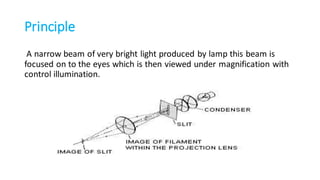
A narrow beam of very bright light produced by lamp this beam is
focused on to the eyes which is then viewed under magnification with
control illumination.
Types of slit lamp
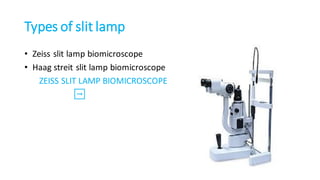
• Zeiss slit lamp biomicroscope
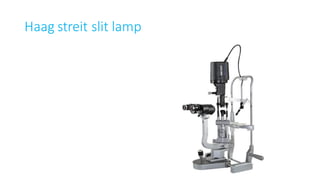
• Haag streit slit lamp biomicroscope
ZEISS SLIT LAMP BIOMICROSCOPE
➡️
Haag streit slit lamp
Parts of slit lamp
INSTRUMENTATION
1- observation system [ microscope ]
2- illumination system [ Slit lamp ]
3- mechanical system [ Engineering support ]
Observation system–
• Binocular eyepiece
• camera and vedio adapter
• Observation tube
Machenical system –
• forehead rest
• Chin rest
• Fixation target
• Power supply unit
• Locking unit
Illuminationsystem –
• lamp nousing unit
• Slit width and high control
• Neutral density filter
• Cobalt Blue filter
• Red free filter
• Field size control
• Diffusion
• Prism
Slit lamp routine
• Patient adjustment
• Instrument adjustment
• Beginning slit lamp examination
Patient adjustment–
Patient should be positioned comfortably in front of the slit lamp and his /
her chin resting on the chin rest and forehead opposed to headrest.
Instrument adjustment –
• the Hight of table housing the slit lamp should be adjust according to
patient’s Hight.
• The microscope illumination systemshould be aligned to the pt.eye to be
examined.
• Fixation target should be placed at the required position.
Beginning slit lamp examination –
• Examination should be carried out in semi dark room so that the
examiner’s eyes are partially dark adapted to ensure sensitivity to low
intensities of light .
• Medication like ointments and anesthetics eye drops produce
corneal surface disturbance.
• There should be a minimum exposure of retina to light .
Methods of illumination
1> Diffuse illumination
2> Direct illumination
3> Indirect illumination
4> Retro illumination
5> Specular reflection
6> Sclerotic scatter
7> Oscillatory illumination of koeppe
Diffuse illumination–
• A diffuse board beam of light is used and a general view of
the anterior segment of the eye is observed.
• Approximately 30-45° between light and microscope.
Direct illumination –
• Observation and illumination system are focused at the
same time .
• Medium to high illuminationis used here .
Indirect illumination –
• Observation and illumination system are not focused at the
same point.
• Low , Medium and high illumination is used
• 30°-45° angle between light and illumination.
Retro- illumination –
• The objectiv of interest is illumination by a light reflected from
the structure behind it.
• Vary angle between light and microscope
• Moderate beam used .
Specular illumination –
• Angle of incidence is equal to angle of reflection
• 60° angle between light & microscope.
Sclerotic scatter –
• Illumination of cornea by total internal reflection of a wide angle light
source.
• The light beam is directed at the limbal region.
Use of slit lamp biomicroscopy –
DIAGNOSTIC –
• Anterior & posterior segment disease
• Dry eye
Procedure –
• Applanation
• Tear evaluation
• Gonioscopy
• Contact lens fitting
Therapeutic –
• Foreign body removal
• Epilation
Slit lamp

Slit lamp

  • 1.
    SLIT LAMP BIOMICROSCOPE By– Mushahid Raza B.Optom
  • 2.
    Indroduction • SLIT lampare used in the examination of the anterior segment of the eye . • Slit lamp is most important piece of equipment in the present day ophthalmologist’s armamenterium . • slit lamp biomicroscope was invented by Gullstrand in 1911.
  • 3.
    Optics of slitlamp • It works on the same principle as a compound microscope . • The objective lens is towards the patient , whose eyes form the object. • The eyepiece is +10 to +14 D and it towards the examiner . • The objective lens constis of two plano – convex lenses with their convexities put together providing a composite power of + 22 D.
  • 4.
    Principle A narrow beamof very bright light produced by lamp this beam is focused on to the eyes which is then viewed under magnification with control illumination.
  • 5.
    Types of slitlamp • Zeiss slit lamp biomicroscope • Haag streit slit lamp biomicroscope ZEISS SLIT LAMP BIOMICROSCOPE ➡️
  • 6.
  • 7.
    Parts of slitlamp INSTRUMENTATION 1- observation system [ microscope ] 2- illumination system [ Slit lamp ] 3- mechanical system [ Engineering support ]
  • 8.
    Observation system– • Binoculareyepiece • camera and vedio adapter • Observation tube Machenical system – • forehead rest • Chin rest • Fixation target • Power supply unit • Locking unit
  • 9.
    Illuminationsystem – • lampnousing unit • Slit width and high control • Neutral density filter • Cobalt Blue filter • Red free filter • Field size control • Diffusion • Prism
  • 10.
    Slit lamp routine •Patient adjustment • Instrument adjustment • Beginning slit lamp examination
  • 11.
    Patient adjustment– Patient shouldbe positioned comfortably in front of the slit lamp and his / her chin resting on the chin rest and forehead opposed to headrest. Instrument adjustment – • the Hight of table housing the slit lamp should be adjust according to patient’s Hight. • The microscope illumination systemshould be aligned to the pt.eye to be examined. • Fixation target should be placed at the required position.
  • 12.
    Beginning slit lampexamination – • Examination should be carried out in semi dark room so that the examiner’s eyes are partially dark adapted to ensure sensitivity to low intensities of light . • Medication like ointments and anesthetics eye drops produce corneal surface disturbance. • There should be a minimum exposure of retina to light .
  • 13.
    Methods of illumination 1>Diffuse illumination 2> Direct illumination 3> Indirect illumination 4> Retro illumination 5> Specular reflection 6> Sclerotic scatter 7> Oscillatory illumination of koeppe
  • 14.
    Diffuse illumination– • Adiffuse board beam of light is used and a general view of the anterior segment of the eye is observed. • Approximately 30-45° between light and microscope. Direct illumination – • Observation and illumination system are focused at the same time . • Medium to high illuminationis used here .
  • 15.
    Indirect illumination – •Observation and illumination system are not focused at the same point. • Low , Medium and high illumination is used • 30°-45° angle between light and illumination. Retro- illumination – • The objectiv of interest is illumination by a light reflected from the structure behind it. • Vary angle between light and microscope • Moderate beam used .
  • 16.
    Specular illumination – •Angle of incidence is equal to angle of reflection • 60° angle between light & microscope. Sclerotic scatter – • Illumination of cornea by total internal reflection of a wide angle light source. • The light beam is directed at the limbal region.
  • 17.
    Use of slitlamp biomicroscopy – DIAGNOSTIC – • Anterior & posterior segment disease • Dry eye Procedure – • Applanation • Tear evaluation • Gonioscopy • Contact lens fitting
  • 18.
    Therapeutic – • Foreignbody removal • Epilation