Centre for Development of Advanced Computing
OpenMP
Samir Shaikh
C-DAC Pune
Centre for Development of Advanced Computing
Contents
➢ Basic Architecture
➢ Sequential Program Execution
➢ Introduction to OpenMP
➢ OpenMP Programming Model
➢ OpenMP Syntax and Execution
➢ OpenMP Directives and Clauses
➢ Race Condition
➢ Environment variables
➢ OpenMP examples
➢ Good things and Limitation of OpenMP
➢ References
Centre for Development of Advanced Computing
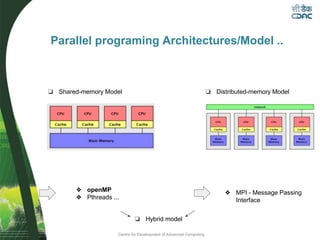
Parallel programing Architectures/Model ..
❏ Shared-memory Model ❏ Distributed-memory Model
❖ openMP
❖ Pthreads ...
❖ MPI - Message Passing
Interface
❏ Hybrid model
Centre for Development of Advanced Computing
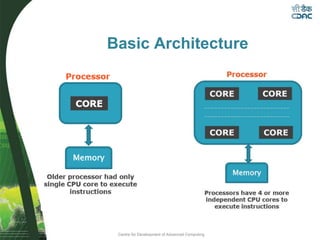
Basic Architecture
Centre for Development of Advanced Computing
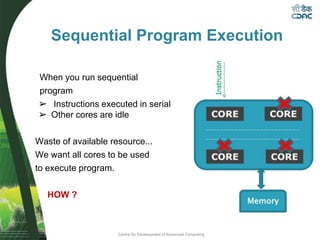
Sequential Program Execution
When you run sequential
program
➢ Instructions executed in serial
➢ Other cores are idle
Waste of available resource...
We want all cores to be used
to execute program.
HOW ?
Centre for Development of Advanced Computing
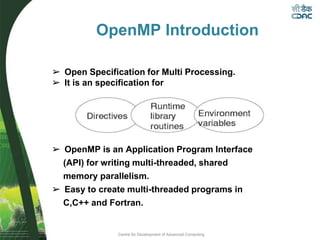
OpenMP Introduction
➢ Open Specification for Multi Processing.
➢ It is an specification for
➢ OpenMP is an Application Program Interface
(API) for writing multi-threaded, shared
memory parallelism.
➢ Easy to create multi-threaded programs in
C,C++ and Fortran.
Centre for Development of Advanced Computing
OpenMP Versions
➢ Fortran 1.0 was released in October 1997
○ C/C++ 1.0 was approved in November 1998
○ version 2.5 joint specification in May 2005
○ OpenMP 3.0 API released May 2008
○ Version 4.0 released in July 2013
○ Version 4.5 released in Nov 2015
Centre for Development of Advanced Computing
Why Choose OpenMP ?
➢ Portable
○ standardized for shared memory architectures
➢ Simple and Quick
○ Relatively easy to do parallelization for small parts of
an application at a time
○ Incremental parallelization
○ Supports both fine grained and coarse grained
parallelism
➢ Compact API
○ Simple and limited set of directives
○ Not automatic parallelization
Centre for Development of Advanced Computing
Execution Model
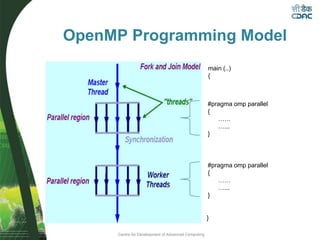
➢ OpenMP program starts single threaded
➢ To create additional threads, user starts a parallel region
○ additional threads are launched to create a team
○ original (master) thread is part of the team
○ threads “go away” at the end of the parallel region:
usually sleep or spin
➢ Repeat parallel regions as necessary
Fork-join model
Centre for Development of Advanced Computing
OpenMP Programming Model
#pragma omp parallel
{
……
…...
}
main (..)
{
#pragma omp parallel
{
……
…...
}
}
Centre for Development of Advanced Computing
Communication Between Threads
➢ Shared Memory Model
○ threads read and write shared variable no need for explicit
message passing
○ use synchronization to protect against race conditions
○ change storage attributes for minimizing synchronization and
improving cache reuse
Centre for Development of Advanced Computing
When to use openMP ?
➢ Target platform is multi core or
multiprocessor.
➢ Application is cross-platform
➢ Parallelizable loop
➢ Last-minute optimization
Centre for Development of Advanced Computing
OpenMP Basic Syntax
➢ Header file
#include <omp.h>
➢ Parallel region:
#pragma omp construct_name [clause, clause...]
{
// .. Do some work here
}
// end of parallel region/block
Environment variables and functions
➢ In Fortran:
!$OMP construct [clause [clause] .. ]
C$OMP construct [clause [clause] ..]
*$OMP construct [clause [clause] ..]
Centre for Development of Advanced Computing
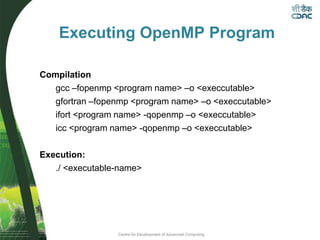
Executing OpenMP Program
Compilation
gcc –fopenmp <program name> –o <execcutable>
gfortran –fopenmp <program name> –o <execcutable>
ifort <program name> -qopenmp –o <execcutable>
icc <program name> -qopenmp –o <execcutable>
Execution:
./ <executable-name>
Centre for Development of Advanced Computing
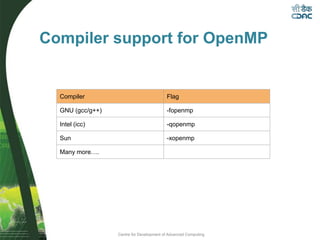
Compiler support for OpenMP
Compiler Flag
GNU (gcc/g++) -fopenmp
Intel (icc) -qopenmp
Sun -xopenmp
Many more….
Centre for Development of Advanced Computing
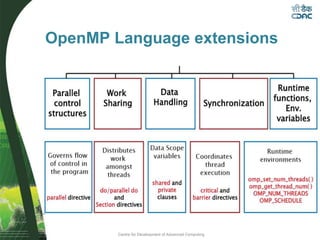
OpenMP Language extensions
Centre for Development of Advanced Computing
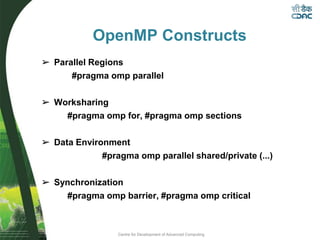
OpenMP Constructs
➢ Parallel Regions
#pragma omp parallel
➢ Worksharing
#pragma omp for, #pragma omp sections
➢ Data Environment
#pragma omp parallel shared/private (...)
➢ Synchronization
#pragma omp barrier, #pragma omp critical
Centre for Development of Advanced Computing
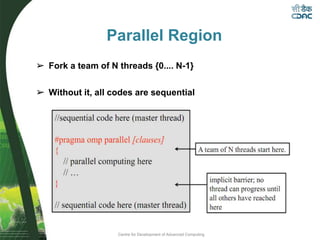
Parallel Region
➢ Fork a team of N threads {0.... N-1}
➢ Without it, all codes are sequential
Centre for Development of Advanced Computing
Loop Constructs: Parallel do/for
In C:
#pragma omp parallel for
for(i=0; i<n; i++)
a[i] = b[i] + c[i]
In Fortran:
!$omp parallel do
Do i=1, n
a(i) = b(i) +c(i)
enddo
Centre for Development of Advanced Computing
Clauses for Parallel constructs
➢ shared
➢ private
➢ firstprivate
➢ lastprivate
➢ nowait
#pragma omp parallel [clause, clause, ...]
➢ if
➢ reduction
➢ Schedule
➢ default
Centre for Development of Advanced Computing
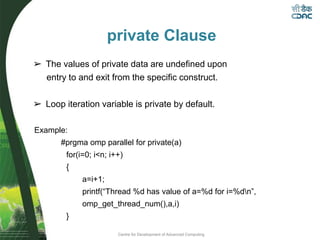
private Clause
➢ The values of private data are undefined upon
entry to and exit from the specific construct.
➢ Loop iteration variable is private by default.
Example:
#prgma omp parallel for private(a)
for(i=0; i<n; i++)
{
a=i+1;
printf(“Thread %d has value of a=%d for i=%dn”,
omp_get_thread_num(),a,i)
}
Centre for Development of Advanced Computing
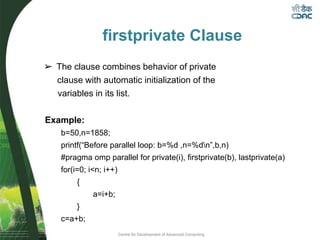
firstprivate Clause
➢ The clause combines behavior of private
clause with automatic initialization of the
variables in its list.
Example:
b=50,n=1858;
printf(“Before parallel loop: b=%d ,n=%dn”,b,n)
#pragma omp parallel for private(i), firstprivate(b), lastprivate(a)
for(i=0; i<n; i++)
{
a=i+b;
}
c=a+b;
Centre for Development of Advanced Computing
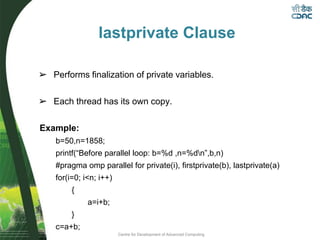
lastprivate Clause
➢ Performs finalization of private variables.
➢ Each thread has its own copy.
Example:
b=50,n=1858;
printf(“Before parallel loop: b=%d ,n=%dn”,b,n)
#pragma omp parallel for private(i), firstprivate(b), lastprivate(a)
for(i=0; i<n; i++)
{
a=i+b;
}
c=a+b;
Centre for Development of Advanced Computing
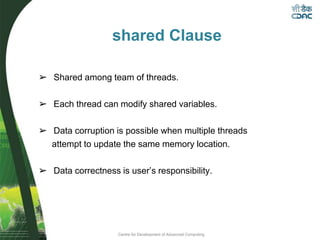
shared Clause
➢ Shared among team of threads.
➢ Each thread can modify shared variables.
➢ Data corruption is possible when multiple threads
attempt to update the same memory location.
➢ Data correctness is user’s responsibility.
Centre for Development of Advanced Computing
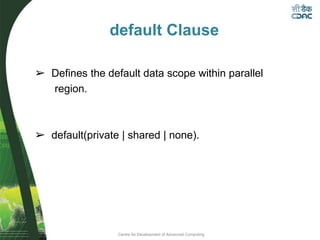
default Clause
➢ Defines the default data scope within parallel
region.
➢ default(private | shared | none).
Centre for Development of Advanced Computing
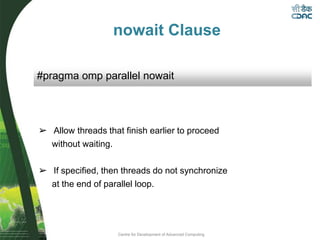
nowait Clause
➢ Allow threads that finish earlier to proceed
without waiting.
➢ If specified, then threads do not synchronize
at the end of parallel loop.
#pragma omp parallel nowait
Centre for Development of Advanced Computing
reduction Clause
➢ Performs a reduction on variables subject to
given operator.
#pragma omp parallel for reduction(+ : result)
for (unsigned i = 0; i < v.size(); i++)
{
result += v[i];
...
Centre for Development of Advanced Computing
schedule Clause
➢ Specifies how loop iteration are divided
among team of threads.
➢ Supported Scheduling Classes:
○ Static
○ Dynamic
○ Guided
○ runtime
#pragma omp parallel for schedule (type,[chunk size])
{
// ...some stuff
}
Centre for Development of Advanced Computing
schedule Clause.. cont
schedule(static, [n])
➢ Each thread is assigned chunks in “round robin” fashion, known as
block cyclic scheduling.
➢ If n has not been specified, it will contain
CEILING(number_of_iterations / number_of_threads) iterations.
○ Example: loop of length 16, 3 threads, chunk size 2:
Centre for Development of Advanced Computing
schedule Clause.. cont
schedule(dynamic, [n])
➢ Iteration of loop are divided into chunks containing n iterations
each.
➢ Default chunk size is 1.
!$omp do schedule (dynamic)
do i=1,8
… (loop body)
end do
!$omp end do
Centre for Development of Advanced Computing
schedule(guided, [n])
➢ If you specify n, that is the minimum chunk size that each thread
should posses.
➢ Size of each successive chunks is exponentially decreasing.
➢ initial chunk size
max((num_of_iterations/num_of_threads),n)
Subsequent chunks consist of
max(remaining_iterations/number_of_threads,n) iterations.
Schedule(runtime): export OMP_SCHEDULE “STATIC, 4”
➢ Determine the scheduling type at run time by the
OMP_SCHEDULE environment variable.
schedule Clause.. cont
Centre for Development of Advanced Computing
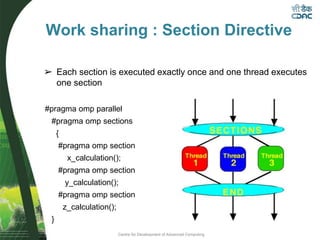
Work sharing : Section Directive
➢ Each section is executed exactly once and one thread executes
one section
#pragma omp parallel
#pragma omp sections
{
#pragma omp section
x_calculation();
#pragma omp section
y_calculation();
#pragma omp section
z_calculation();
}
Centre for Development of Advanced Computing
Designated section is executed by single thread only.
#pragma omp single
{
a =10;
}
#pragma omp for
{
for (i=0;i<N;i++)
b[i] = a;
}
Work sharing : Single Directive
Centre for Development of Advanced Computing
➢ Similar to single, but code block will be executed by the master
thread only.
#pragma omp master
{
a =10;
}
#pragma omp for
{
for (i=0;i<N;i++)
b[i] = a;
}
Work sharing : Master
C/C++:
#pragma omp master
----- block of code--
Centre for Development of Advanced Computing
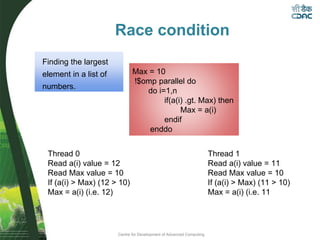
Race condition
Finding the largest
element in a list of
numbers.
Max = 10
!$omp parallel do
do i=1,n
if(a(i) .gt. Max) then
Max = a(i)
endif
enddo
Thread 0
Read a(i) value = 12
Read Max value = 10
If (a(i) > Max) (12 > 10)
Max = a(i) (i.e. 12)
Thread 1
Read a(i) value = 11
Read Max value = 10
If (a(i) > Max) (11 > 10)
Max = a(i) (i.e. 11
Centre for Development of Advanced Computing
Synchronization: Critical Section
Directive restrict access to the enclosed code to only one thread at a
time. cnt = 0, f=7;
#pragma omp parallel
{
#pragma omp for
for(i=0;i<20;i++)
{
if(b[i] == 0)
{
#pragma omp
critical
cnt++;
}
a[i] = b[i] + f*(i+1);
}
}
Centre for Development of Advanced Computing
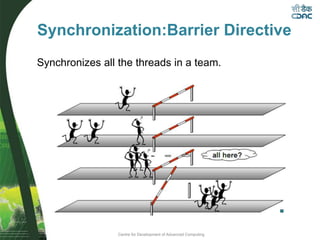
Synchronization:Barrier Directive
Synchronizes all the threads in a team.
Centre for Development of Advanced Computing
int x=2;
#pragma omp parallel shared(x)
{
int tid = omp_get_thread_num();
if(tid == 0)
x=5;
else
printf(“[1] thread %2d:
x=%dn”,tid,x);
#pragma omp barrier
printf(“[2] thread %2d:
x=%dn”,tid,x);
}
Synchronization:Barrier Directive
Some threads may still have
x=2 here
Cache flush + thread
synchronization
All threads have x=5 here
Centre for Development of Advanced Computing
➢ Mini Critical section.
➢ Specific memory location must be updated atomically.
Synchronization:Atomic Directive
C:
#pragma omp atomic
----- Single line code--
Centre for Development of Advanced Computing
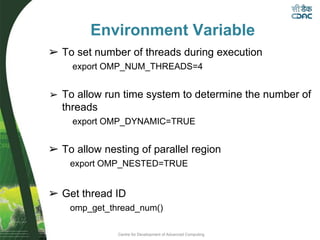
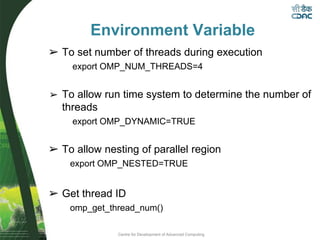
Environment Variable
➢ To set number of threads during execution
export OMP_NUM_THREADS=4
➢ To allow run time system to determine the number of
threads
export OMP_DYNAMIC=TRUE
➢ To allow nesting of parallel region
export OMP_NESTED=TRUE
➢ Get thread ID
omp_get_thread_num()
Centre for Development of Advanced Computing
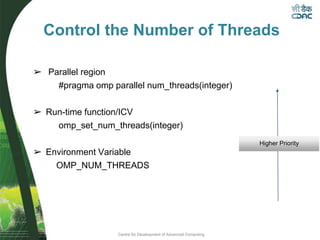
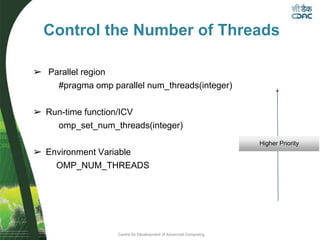
Control the Number of Threads
➢ Parallel region
#pragma omp parallel num_threads(integer)
➢ Run-time function/ICV
omp_set_num_threads(integer)
➢ Environment Variable
OMP_NUM_THREADS
Higher Priority
Centre for Development of Advanced Computing
Good Things about OpenMP
➢ Incrementally Parallelization of sequential code.
➢ Leave thread management to compiler.
➢ Directly supported by compiler.
Centre for Development of Advanced Computing
Limitations
➢ Internal details are hidden
➢ Run efficiently in shared-memory multiprocessor
platforms only but not on distributed memory
➢ Limited performance by memory architecture
Centre for Development of Advanced Computing
References
https://computing.llnl.gov/tutorials/openMP/
http://wiki.scinethpc.ca/wiki/images/9/9b/D s-openmp.pdf
www.openmp.org/
http://openmp.org/sc13/OpenMP4.0_Intro_Y onghongYan_SC13.pdf
Centre for Development of Advanced Computing
Thank You
Centre for Development of Advanced Computing
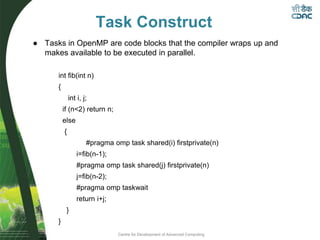
Task Construct
int fib(int n)
{
int i, j;
if (n<2) return n;
else
{
#pragma omp task shared(i) firstprivate(n)
i=fib(n-1);
#pragma omp task shared(j) firstprivate(n)
j=fib(n-2);
#pragma omp taskwait
return i+j;
}
}
● Tasks in OpenMP are code blocks that the compiler wraps up and
makes available to be executed in parallel.
Centre for Development of Advanced Computing
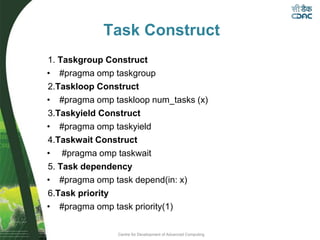
Task Construct
1. Taskgroup Construct
• #pragma omp taskgroup
2.Taskloop Construct
• #pragma omp taskloop num_tasks (x)
3.Taskyield Construct
• #pragma omp taskyield
4.Taskwait Construct
• #pragma omp taskwait
5. Task dependency
• #pragma omp task depend(in: x)
6.Task priority
• #pragma omp task priority(1)
Centre for Development of Advanced Computing
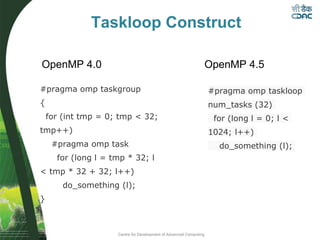
Taskloop Construct
#pragma omp taskgroup
{
for (int tmp = 0; tmp < 32;
tmp++)
#pragma omp task
for (long l = tmp * 32; l
< tmp * 32 + 32; l++)
do_something (l);
}
#pragma omp taskloop
num_tasks (32)
for (long l = 0; l <
1024; l++)
do_something (l);
OpenMP 4.0 OpenMP 4.5
Centre for Development of Advanced Computing
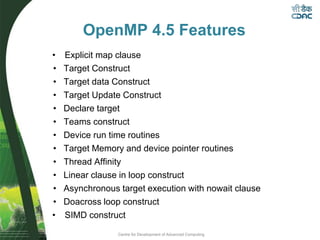
OpenMP 4.5 Features
• Explicit map clause
• Target Construct
• Target data Construct
• Target Update Construct
• Declare target
• Teams construct
• Device run time routines
• Target Memory and device pointer routines
• Thread Affinity
• Linear clause in loop construct
• Asynchronous target execution with nowait clause
• Doacross loop construct
• SIMD construct
Centre for Development of Advanced Computing
Environment Variable
➢ To set number of threads during execution
export OMP_NUM_THREADS=4
➢ To allow run time system to determine the number of
threads
export OMP_DYNAMIC=TRUE
➢ To allow nesting of parallel region
export OMP_NESTED=TRUE
➢ Get thread ID
omp_get_thread_num()
Centre for Development of Advanced Computing
Control the Number of Threads
➢ Parallel region
#pragma omp parallel num_threads(integer)
➢ Run-time function/ICV
omp_set_num_threads(integer)
➢ Environment Variable
OMP_NUM_THREADS
Higher Priority
Centre for Development of Advanced Computing
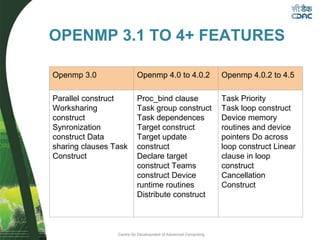
OPENMP 3.1 TO 4+ FEATURES
Openmp 3.0 Openmp 4.0 to 4.0.2 Openmp 4.0.2 to 4.5
Parallel construct
Worksharing
construct
Synronization
construct Data
sharing clauses Task
Construct
Proc_bind clause
Task group construct
Task dependences
Target construct
Target update
construct
Declare target
construct Teams
construct Device
runtime routines
Distribute construct
Task Priority
Task loop construct
Device memory
routines and device
pointers Do across
loop construct Linear
clause in loop
construct
Cancellation
Construct
Centre for Development of Advanced Computing
Good Things about OpenMP
➢ Incrementally Parallelization of sequential code.
➢ Leave thread management to compiler.
➢ Directly supported by compiler.
Centre for Development of Advanced Computing
Limitations
➢ Internal details are hidden
➢ Run efficiently in shared-memory multiprocessor
platforms only but not on distributed memory
➢ Limited performance by memory architecture
Centre for Development of Advanced Computing
References
https://computing.llnl.gov/tutorials/openMP/
http://wiki.scinethpc.ca/wiki/images/9/9b/D s-openmp.pdf
www.openmp.org/
http://openmp.org/sc13/OpenMP4.0_Intro_Y onghongYan_SC13.pdf
Centre for Development of Advanced Computing
References
https://www.openmp.org/#
https://www.openmp.org/resources/openmp-benchmarks/
https://www.openmp.org/resources/openmp-presentations/
https://www.openmp.org/resources/openmp-presentations/sc-19-
booth-talks/
https://www.openmp.org/events/sc21/
Centre for Development of Advanced Computing
Thank You

OpenMP.pptx

  • 1.
    Centre for Developmentof Advanced Computing OpenMP Samir Shaikh C-DAC Pune
  • 2.
    Centre for Developmentof Advanced Computing Contents ➢ Basic Architecture ➢ Sequential Program Execution ➢ Introduction to OpenMP ➢ OpenMP Programming Model ➢ OpenMP Syntax and Execution ➢ OpenMP Directives and Clauses ➢ Race Condition ➢ Environment variables ➢ OpenMP examples ➢ Good things and Limitation of OpenMP ➢ References
  • 3.
    Centre for Developmentof Advanced Computing Parallel programing Architectures/Model .. ❏ Shared-memory Model ❏ Distributed-memory Model ❖ openMP ❖ Pthreads ... ❖ MPI - Message Passing Interface ❏ Hybrid model
  • 4.
    Centre for Developmentof Advanced Computing Basic Architecture
  • 5.
    Centre for Developmentof Advanced Computing Sequential Program Execution When you run sequential program ➢ Instructions executed in serial ➢ Other cores are idle Waste of available resource... We want all cores to be used to execute program. HOW ?
  • 6.
    Centre for Developmentof Advanced Computing OpenMP Introduction ➢ Open Specification for Multi Processing. ➢ It is an specification for ➢ OpenMP is an Application Program Interface (API) for writing multi-threaded, shared memory parallelism. ➢ Easy to create multi-threaded programs in C,C++ and Fortran.
  • 7.
    Centre for Developmentof Advanced Computing OpenMP Versions ➢ Fortran 1.0 was released in October 1997 ○ C/C++ 1.0 was approved in November 1998 ○ version 2.5 joint specification in May 2005 ○ OpenMP 3.0 API released May 2008 ○ Version 4.0 released in July 2013 ○ Version 4.5 released in Nov 2015
  • 8.
    Centre for Developmentof Advanced Computing Why Choose OpenMP ? ➢ Portable ○ standardized for shared memory architectures ➢ Simple and Quick ○ Relatively easy to do parallelization for small parts of an application at a time ○ Incremental parallelization ○ Supports both fine grained and coarse grained parallelism ➢ Compact API ○ Simple and limited set of directives ○ Not automatic parallelization
  • 9.
    Centre for Developmentof Advanced Computing Execution Model ➢ OpenMP program starts single threaded ➢ To create additional threads, user starts a parallel region ○ additional threads are launched to create a team ○ original (master) thread is part of the team ○ threads “go away” at the end of the parallel region: usually sleep or spin ➢ Repeat parallel regions as necessary Fork-join model
  • 10.
    Centre for Developmentof Advanced Computing OpenMP Programming Model #pragma omp parallel { …… …... } main (..) { #pragma omp parallel { …… …... } }
  • 11.
    Centre for Developmentof Advanced Computing Communication Between Threads ➢ Shared Memory Model ○ threads read and write shared variable no need for explicit message passing ○ use synchronization to protect against race conditions ○ change storage attributes for minimizing synchronization and improving cache reuse
  • 12.
    Centre for Developmentof Advanced Computing When to use openMP ? ➢ Target platform is multi core or multiprocessor. ➢ Application is cross-platform ➢ Parallelizable loop ➢ Last-minute optimization
  • 13.
    Centre for Developmentof Advanced Computing OpenMP Basic Syntax ➢ Header file #include <omp.h> ➢ Parallel region: #pragma omp construct_name [clause, clause...] { // .. Do some work here } // end of parallel region/block Environment variables and functions ➢ In Fortran: !$OMP construct [clause [clause] .. ] C$OMP construct [clause [clause] ..] *$OMP construct [clause [clause] ..]
  • 14.
    Centre for Developmentof Advanced Computing Executing OpenMP Program Compilation gcc –fopenmp <program name> –o <execcutable> gfortran –fopenmp <program name> –o <execcutable> ifort <program name> -qopenmp –o <execcutable> icc <program name> -qopenmp –o <execcutable> Execution: ./ <executable-name>
  • 15.
    Centre for Developmentof Advanced Computing Compiler support for OpenMP Compiler Flag GNU (gcc/g++) -fopenmp Intel (icc) -qopenmp Sun -xopenmp Many more….
  • 16.
    Centre for Developmentof Advanced Computing OpenMP Language extensions
  • 17.
    Centre for Developmentof Advanced Computing OpenMP Constructs ➢ Parallel Regions #pragma omp parallel ➢ Worksharing #pragma omp for, #pragma omp sections ➢ Data Environment #pragma omp parallel shared/private (...) ➢ Synchronization #pragma omp barrier, #pragma omp critical
  • 18.
    Centre for Developmentof Advanced Computing Parallel Region ➢ Fork a team of N threads {0.... N-1} ➢ Without it, all codes are sequential
  • 19.
    Centre for Developmentof Advanced Computing Loop Constructs: Parallel do/for In C: #pragma omp parallel for for(i=0; i<n; i++) a[i] = b[i] + c[i] In Fortran: !$omp parallel do Do i=1, n a(i) = b(i) +c(i) enddo
  • 20.
    Centre for Developmentof Advanced Computing Clauses for Parallel constructs ➢ shared ➢ private ➢ firstprivate ➢ lastprivate ➢ nowait #pragma omp parallel [clause, clause, ...] ➢ if ➢ reduction ➢ Schedule ➢ default
  • 21.
    Centre for Developmentof Advanced Computing private Clause ➢ The values of private data are undefined upon entry to and exit from the specific construct. ➢ Loop iteration variable is private by default. Example: #prgma omp parallel for private(a) for(i=0; i<n; i++) { a=i+1; printf(“Thread %d has value of a=%d for i=%dn”, omp_get_thread_num(),a,i) }
  • 22.
    Centre for Developmentof Advanced Computing firstprivate Clause ➢ The clause combines behavior of private clause with automatic initialization of the variables in its list. Example: b=50,n=1858; printf(“Before parallel loop: b=%d ,n=%dn”,b,n) #pragma omp parallel for private(i), firstprivate(b), lastprivate(a) for(i=0; i<n; i++) { a=i+b; } c=a+b;
  • 23.
    Centre for Developmentof Advanced Computing lastprivate Clause ➢ Performs finalization of private variables. ➢ Each thread has its own copy. Example: b=50,n=1858; printf(“Before parallel loop: b=%d ,n=%dn”,b,n) #pragma omp parallel for private(i), firstprivate(b), lastprivate(a) for(i=0; i<n; i++) { a=i+b; } c=a+b;
  • 24.
    Centre for Developmentof Advanced Computing shared Clause ➢ Shared among team of threads. ➢ Each thread can modify shared variables. ➢ Data corruption is possible when multiple threads attempt to update the same memory location. ➢ Data correctness is user’s responsibility.
  • 25.
    Centre for Developmentof Advanced Computing default Clause ➢ Defines the default data scope within parallel region. ➢ default(private | shared | none).
  • 26.
    Centre for Developmentof Advanced Computing nowait Clause ➢ Allow threads that finish earlier to proceed without waiting. ➢ If specified, then threads do not synchronize at the end of parallel loop. #pragma omp parallel nowait
  • 27.
    Centre for Developmentof Advanced Computing reduction Clause ➢ Performs a reduction on variables subject to given operator. #pragma omp parallel for reduction(+ : result) for (unsigned i = 0; i < v.size(); i++) { result += v[i]; ...
  • 28.
    Centre for Developmentof Advanced Computing schedule Clause ➢ Specifies how loop iteration are divided among team of threads. ➢ Supported Scheduling Classes: ○ Static ○ Dynamic ○ Guided ○ runtime #pragma omp parallel for schedule (type,[chunk size]) { // ...some stuff }
  • 29.
    Centre for Developmentof Advanced Computing schedule Clause.. cont schedule(static, [n]) ➢ Each thread is assigned chunks in “round robin” fashion, known as block cyclic scheduling. ➢ If n has not been specified, it will contain CEILING(number_of_iterations / number_of_threads) iterations. ○ Example: loop of length 16, 3 threads, chunk size 2:
  • 30.
    Centre for Developmentof Advanced Computing schedule Clause.. cont schedule(dynamic, [n]) ➢ Iteration of loop are divided into chunks containing n iterations each. ➢ Default chunk size is 1. !$omp do schedule (dynamic) do i=1,8 … (loop body) end do !$omp end do
  • 31.
    Centre for Developmentof Advanced Computing schedule(guided, [n]) ➢ If you specify n, that is the minimum chunk size that each thread should posses. ➢ Size of each successive chunks is exponentially decreasing. ➢ initial chunk size max((num_of_iterations/num_of_threads),n) Subsequent chunks consist of max(remaining_iterations/number_of_threads,n) iterations. Schedule(runtime): export OMP_SCHEDULE “STATIC, 4” ➢ Determine the scheduling type at run time by the OMP_SCHEDULE environment variable. schedule Clause.. cont
  • 32.
    Centre for Developmentof Advanced Computing Work sharing : Section Directive ➢ Each section is executed exactly once and one thread executes one section #pragma omp parallel #pragma omp sections { #pragma omp section x_calculation(); #pragma omp section y_calculation(); #pragma omp section z_calculation(); }
  • 33.
    Centre for Developmentof Advanced Computing Designated section is executed by single thread only. #pragma omp single { a =10; } #pragma omp for { for (i=0;i<N;i++) b[i] = a; } Work sharing : Single Directive
  • 34.
    Centre for Developmentof Advanced Computing ➢ Similar to single, but code block will be executed by the master thread only. #pragma omp master { a =10; } #pragma omp for { for (i=0;i<N;i++) b[i] = a; } Work sharing : Master C/C++: #pragma omp master ----- block of code--
  • 35.
    Centre for Developmentof Advanced Computing Race condition Finding the largest element in a list of numbers. Max = 10 !$omp parallel do do i=1,n if(a(i) .gt. Max) then Max = a(i) endif enddo Thread 0 Read a(i) value = 12 Read Max value = 10 If (a(i) > Max) (12 > 10) Max = a(i) (i.e. 12) Thread 1 Read a(i) value = 11 Read Max value = 10 If (a(i) > Max) (11 > 10) Max = a(i) (i.e. 11
  • 36.
    Centre for Developmentof Advanced Computing Synchronization: Critical Section Directive restrict access to the enclosed code to only one thread at a time. cnt = 0, f=7; #pragma omp parallel { #pragma omp for for(i=0;i<20;i++) { if(b[i] == 0) { #pragma omp critical cnt++; } a[i] = b[i] + f*(i+1); } }
  • 37.
    Centre for Developmentof Advanced Computing Synchronization:Barrier Directive Synchronizes all the threads in a team.
  • 38.
    Centre for Developmentof Advanced Computing int x=2; #pragma omp parallel shared(x) { int tid = omp_get_thread_num(); if(tid == 0) x=5; else printf(“[1] thread %2d: x=%dn”,tid,x); #pragma omp barrier printf(“[2] thread %2d: x=%dn”,tid,x); } Synchronization:Barrier Directive Some threads may still have x=2 here Cache flush + thread synchronization All threads have x=5 here
  • 39.
    Centre for Developmentof Advanced Computing ➢ Mini Critical section. ➢ Specific memory location must be updated atomically. Synchronization:Atomic Directive C: #pragma omp atomic ----- Single line code--
  • 40.
    Centre for Developmentof Advanced Computing Environment Variable ➢ To set number of threads during execution export OMP_NUM_THREADS=4 ➢ To allow run time system to determine the number of threads export OMP_DYNAMIC=TRUE ➢ To allow nesting of parallel region export OMP_NESTED=TRUE ➢ Get thread ID omp_get_thread_num()
  • 41.
    Centre for Developmentof Advanced Computing Control the Number of Threads ➢ Parallel region #pragma omp parallel num_threads(integer) ➢ Run-time function/ICV omp_set_num_threads(integer) ➢ Environment Variable OMP_NUM_THREADS Higher Priority
  • 42.
    Centre for Developmentof Advanced Computing Good Things about OpenMP ➢ Incrementally Parallelization of sequential code. ➢ Leave thread management to compiler. ➢ Directly supported by compiler.
  • 43.
    Centre for Developmentof Advanced Computing Limitations ➢ Internal details are hidden ➢ Run efficiently in shared-memory multiprocessor platforms only but not on distributed memory ➢ Limited performance by memory architecture
  • 44.
    Centre for Developmentof Advanced Computing References https://computing.llnl.gov/tutorials/openMP/ http://wiki.scinethpc.ca/wiki/images/9/9b/D s-openmp.pdf www.openmp.org/ http://openmp.org/sc13/OpenMP4.0_Intro_Y onghongYan_SC13.pdf
  • 45.
    Centre for Developmentof Advanced Computing Thank You
  • 46.
    Centre for Developmentof Advanced Computing Task Construct int fib(int n) { int i, j; if (n<2) return n; else { #pragma omp task shared(i) firstprivate(n) i=fib(n-1); #pragma omp task shared(j) firstprivate(n) j=fib(n-2); #pragma omp taskwait return i+j; } } ● Tasks in OpenMP are code blocks that the compiler wraps up and makes available to be executed in parallel.
  • 47.
    Centre for Developmentof Advanced Computing Task Construct 1. Taskgroup Construct • #pragma omp taskgroup 2.Taskloop Construct • #pragma omp taskloop num_tasks (x) 3.Taskyield Construct • #pragma omp taskyield 4.Taskwait Construct • #pragma omp taskwait 5. Task dependency • #pragma omp task depend(in: x) 6.Task priority • #pragma omp task priority(1)
  • 48.
    Centre for Developmentof Advanced Computing Taskloop Construct #pragma omp taskgroup { for (int tmp = 0; tmp < 32; tmp++) #pragma omp task for (long l = tmp * 32; l < tmp * 32 + 32; l++) do_something (l); } #pragma omp taskloop num_tasks (32) for (long l = 0; l < 1024; l++) do_something (l); OpenMP 4.0 OpenMP 4.5
  • 49.
    Centre for Developmentof Advanced Computing OpenMP 4.5 Features • Explicit map clause • Target Construct • Target data Construct • Target Update Construct • Declare target • Teams construct • Device run time routines • Target Memory and device pointer routines • Thread Affinity • Linear clause in loop construct • Asynchronous target execution with nowait clause • Doacross loop construct • SIMD construct
  • 50.
    Centre for Developmentof Advanced Computing Environment Variable ➢ To set number of threads during execution export OMP_NUM_THREADS=4 ➢ To allow run time system to determine the number of threads export OMP_DYNAMIC=TRUE ➢ To allow nesting of parallel region export OMP_NESTED=TRUE ➢ Get thread ID omp_get_thread_num()
  • 51.
    Centre for Developmentof Advanced Computing Control the Number of Threads ➢ Parallel region #pragma omp parallel num_threads(integer) ➢ Run-time function/ICV omp_set_num_threads(integer) ➢ Environment Variable OMP_NUM_THREADS Higher Priority
  • 52.
    Centre for Developmentof Advanced Computing OPENMP 3.1 TO 4+ FEATURES Openmp 3.0 Openmp 4.0 to 4.0.2 Openmp 4.0.2 to 4.5 Parallel construct Worksharing construct Synronization construct Data sharing clauses Task Construct Proc_bind clause Task group construct Task dependences Target construct Target update construct Declare target construct Teams construct Device runtime routines Distribute construct Task Priority Task loop construct Device memory routines and device pointers Do across loop construct Linear clause in loop construct Cancellation Construct
  • 53.
    Centre for Developmentof Advanced Computing Good Things about OpenMP ➢ Incrementally Parallelization of sequential code. ➢ Leave thread management to compiler. ➢ Directly supported by compiler.
  • 54.
    Centre for Developmentof Advanced Computing Limitations ➢ Internal details are hidden ➢ Run efficiently in shared-memory multiprocessor platforms only but not on distributed memory ➢ Limited performance by memory architecture
  • 55.
    Centre for Developmentof Advanced Computing References https://computing.llnl.gov/tutorials/openMP/ http://wiki.scinethpc.ca/wiki/images/9/9b/D s-openmp.pdf www.openmp.org/ http://openmp.org/sc13/OpenMP4.0_Intro_Y onghongYan_SC13.pdf
  • 56.
    Centre for Developmentof Advanced Computing References https://www.openmp.org/# https://www.openmp.org/resources/openmp-benchmarks/ https://www.openmp.org/resources/openmp-presentations/ https://www.openmp.org/resources/openmp-presentations/sc-19- booth-talks/ https://www.openmp.org/events/sc21/
  • 57.
    Centre for Developmentof Advanced Computing Thank You