OpenMP
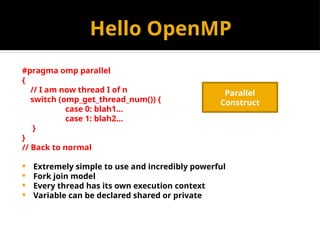
Hello OpenMP
#pragma omp parallel
{
// I am now thread I of n
switch (omp_get_thread_num()) {
case 0: blah1…
case 1: blah2…
}
}
// Back to normal
 Extremely simple to use and incredibly powerful
 Fork join model
 Every thread has its own execution context
 Variable can be declared shared or private
Parallel
Construct
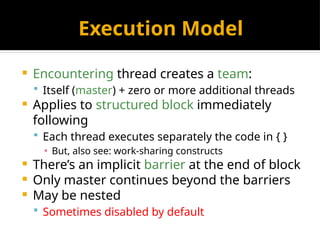
Execution Model
 Encountering thread creates a team:
 Itself (master) + zero or more additional threads
 Applies to structured block immediately
following
 Each thread executes separately the code in { }
▪ But, also see: work-sharing constructs
 There’s an implicit barrier at the end of block
 Only master continues beyond the barriers
 May be nested
 Sometimes disabled by default
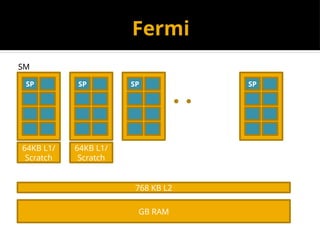
Fermi
SP
SM
SP SP SP
64KB L1/
Scratch
GB RAM
768 KB L2
64KB L1/
Scratch
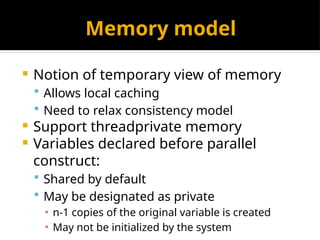
Memory model
 Notion of temporary view of memory
 Allows local caching
 Need to relax consistency model
 Support threadprivate memory
 Variables declared before parallel
construct:
 Shared by default
 May be designated as private
▪ n-1 copies of the original variable is created
▪ May not be initialized by the system
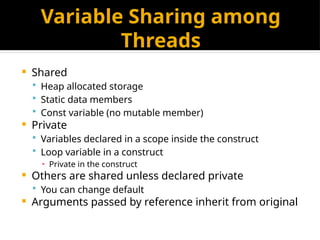
Variable Sharing among
Threads
 Shared
 Heap allocated storage
 Static data members
 Const variable (no mutable member)
 Private
 Variables declared in a scope inside the construct
 Loop variable in a construct
▪ Private in the construct
 Others are shared unless declared private
 You can change default
 Arguments passed by reference inherit from original
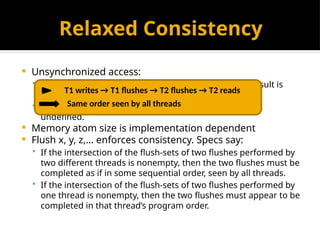
Relaxed Consistency
 Unsynchronized access:
 If two threads write to the same shared variable the result is
undefined.
 If a thread reads and another writes, the read value is
undefined.
 Memory atom size is implementation dependent
 Flush x, y, z,… enforces consistency. Specs say:
 If the intersection of the flush-sets of two flushes performed by
two different threads is nonempty, then the two flushes must be
completed as if in some sequential order, seen by all threads.
 If the intersection of the flush-sets of two flushes performed by
one thread is nonempty, then the two flushes must appear to be
completed in that thread’s program order.
T1 writes → T1 flushes → T2 flushes → T2 reads
Same order seen by all threads
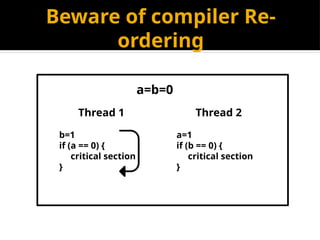
Beware of compiler Re-
ordering
a=b=0
Thread 1
b=1
if (a == 0) {
critical section
}
Thread 2
a=1
if (b == 0) {
critical section
}
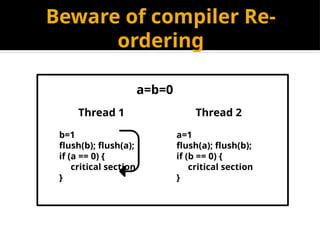
Beware of compiler Re-
ordering
a=b=0
Thread 1
b=1
flush(b); flush(a);
if (a == 0) {
critical section
}
Thread 2
a=1
flush(a); flush(b);
if (b == 0) {
critical section
}
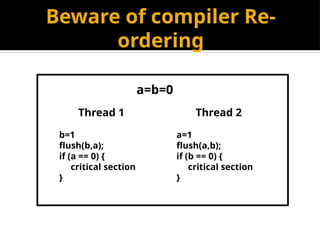
Beware of compiler Re-
ordering
a=b=0
Thread 1
b=1
flush(b,a);
if (a == 0) {
critical section
}
Thread 2
a=1
flush(a,b);
if (b == 0) {
critical section
}

Parallel Computing - openMP -- Lecture 5

  • 1.
  • 2.
    Hello OpenMP #pragma ompparallel { // I am now thread I of n switch (omp_get_thread_num()) { case 0: blah1… case 1: blah2… } } // Back to normal  Extremely simple to use and incredibly powerful  Fork join model  Every thread has its own execution context  Variable can be declared shared or private Parallel Construct
  • 3.
    Execution Model  Encounteringthread creates a team:  Itself (master) + zero or more additional threads  Applies to structured block immediately following  Each thread executes separately the code in { } ▪ But, also see: work-sharing constructs  There’s an implicit barrier at the end of block  Only master continues beyond the barriers  May be nested  Sometimes disabled by default
  • 4.
    Fermi SP SM SP SP SP 64KBL1/ Scratch GB RAM 768 KB L2 64KB L1/ Scratch
  • 5.
    Memory model  Notionof temporary view of memory  Allows local caching  Need to relax consistency model  Support threadprivate memory  Variables declared before parallel construct:  Shared by default  May be designated as private ▪ n-1 copies of the original variable is created ▪ May not be initialized by the system
  • 6.
    Variable Sharing among Threads Shared  Heap allocated storage  Static data members  Const variable (no mutable member)  Private  Variables declared in a scope inside the construct  Loop variable in a construct ▪ Private in the construct  Others are shared unless declared private  You can change default  Arguments passed by reference inherit from original
  • 7.
    Relaxed Consistency  Unsynchronizedaccess:  If two threads write to the same shared variable the result is undefined.  If a thread reads and another writes, the read value is undefined.  Memory atom size is implementation dependent  Flush x, y, z,… enforces consistency. Specs say:  If the intersection of the flush-sets of two flushes performed by two different threads is nonempty, then the two flushes must be completed as if in some sequential order, seen by all threads.  If the intersection of the flush-sets of two flushes performed by one thread is nonempty, then the two flushes must appear to be completed in that thread’s program order. T1 writes → T1 flushes → T2 flushes → T2 reads Same order seen by all threads
  • 8.
    Beware of compilerRe- ordering a=b=0 Thread 1 b=1 if (a == 0) { critical section } Thread 2 a=1 if (b == 0) { critical section }
  • 9.
    Beware of compilerRe- ordering a=b=0 Thread 1 b=1 flush(b); flush(a); if (a == 0) { critical section } Thread 2 a=1 flush(a); flush(b); if (b == 0) { critical section }
  • 10.
    Beware of compilerRe- ordering a=b=0 Thread 1 b=1 flush(b,a); if (a == 0) { critical section } Thread 2 a=1 flush(a,b); if (b == 0) { critical section }