OpenMPOpenMP
History of OpenMPHistory of OpenMP
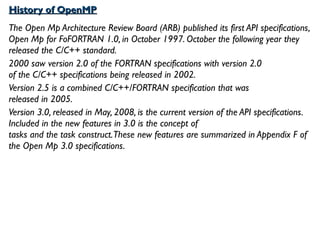
The Open Mp Architecture Review Board (ARB) published its first API specifications,
Open Mp for FoFORTRAN 1.0, in October 1997. October the following year they
released the C/C++ standard.
2000 saw version 2.0 of the FORTRAN specifications with version 2.0
of the C/C++ specifications being released in 2002.
Version 2.5 is a combined C/C++/FORTRAN specification that was
released in 2005.
Version 3.0, released in May, 2008, is the current version of the API specifications.
Included in the new features in 3.0 is the concept of
tasks and the task construct.These new features are summarized in Appendix F of
the Open Mp 3.0 specifications.
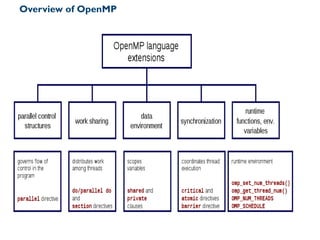
Overview of OpenMP
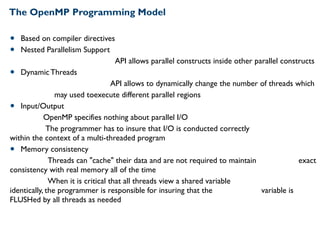
The OpenMP Programming Model
• Based on compiler directives
• Nested Parallelism Support
API allows parallel constructs inside other parallel constructs
• Dynamic Threads
API allows to dynamically change the number of threads which
may used toexecute different parallel regions
• Input/Output
OpenMP specifies nothing about parallel I/O
The programmer has to insure that I/O is conducted correctly
within the context of a multi-threaded program
• Memory consistency
Threads can "cache" their data and are not required to maintain exact
consistency with real memory all of the time
When it is critical that all threads view a shared variable
identically, the programmer is responsible for insuring that the variable is
FLUSHed by all threads as needed
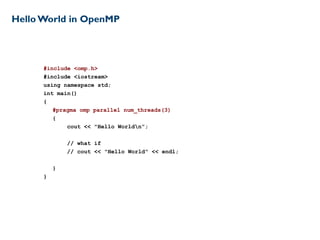
Hello World in OpenMP
#include <omp.h>
#include <iostream>
using namespace std;
int main()
{
#pragma omp parallel num_threads(3)
{
cout << "Hello Worldn”;
// what if
// cout << "Hello World" << endl;
}
}
How Does It Work?
• OpenMP is an implementation of multithreading
• A master thread "forks" a specified number of slave threads
Tasks are divided among slaves
• Slaves run concurrently as the runtime environment allocating threads to different
processors
How Does It Work?
• OpenMP is an implementation of multithreading
• A master thread "forks" a specified number of slave threads
Tasks are divided among slaves
• Slaves run concurrently as the runtime environment allocating threads to different
processors

openmp

  • 1.
  • 2.
    History of OpenMPHistoryof OpenMP The Open Mp Architecture Review Board (ARB) published its first API specifications, Open Mp for FoFORTRAN 1.0, in October 1997. October the following year they released the C/C++ standard. 2000 saw version 2.0 of the FORTRAN specifications with version 2.0 of the C/C++ specifications being released in 2002. Version 2.5 is a combined C/C++/FORTRAN specification that was released in 2005. Version 3.0, released in May, 2008, is the current version of the API specifications. Included in the new features in 3.0 is the concept of tasks and the task construct.These new features are summarized in Appendix F of the Open Mp 3.0 specifications.
  • 3.
  • 4.
    The OpenMP ProgrammingModel • Based on compiler directives • Nested Parallelism Support API allows parallel constructs inside other parallel constructs • Dynamic Threads API allows to dynamically change the number of threads which may used toexecute different parallel regions • Input/Output OpenMP specifies nothing about parallel I/O The programmer has to insure that I/O is conducted correctly within the context of a multi-threaded program • Memory consistency Threads can "cache" their data and are not required to maintain exact consistency with real memory all of the time When it is critical that all threads view a shared variable identically, the programmer is responsible for insuring that the variable is FLUSHed by all threads as needed
  • 5.
    Hello World inOpenMP #include <omp.h> #include <iostream> using namespace std; int main() { #pragma omp parallel num_threads(3) { cout << "Hello Worldn”; // what if // cout << "Hello World" << endl; } }
  • 6.
    How Does ItWork? • OpenMP is an implementation of multithreading • A master thread "forks" a specified number of slave threads Tasks are divided among slaves • Slaves run concurrently as the runtime environment allocating threads to different processors
  • 7.
    How Does ItWork? • OpenMP is an implementation of multithreading • A master thread "forks" a specified number of slave threads Tasks are divided among slaves • Slaves run concurrently as the runtime environment allocating threads to different processors