TITLE
Image
Are There Any Rules of Thumb When It Comes
to 100Gb/S Board Design? A Walkthrough from
Physical Domain to Channel Operating Margin
(COM) Testing.
Jacov Brener (Marvell Israel Ltd)
Liav Ben-Artsi (Marvell Israel Ltd)
Jacov Brener
Senior Signal Integrity Engineer, Marvell Israel Ltd
jacovb@marvell.com |
Jacov is a Senior Signal Integrity Engineer at Marvell Israel Ltd,
starting this year. For the previous 10 years Jacov has worked in Intel's
Communication and Storage Infrastructure Group, most of the time as
package designer and signal/power integrity focal point in a high-speed
PHY team.
Liav Ben-Artsi
Senior Signal Integrity Manager, Marvell Israel Ltd
liav@marvell.com |
Liav is a Senior Signal Integrity Manager at Marvell Israel Ltd. Liav has
worked at Marvell for the last 15 years, most of the time as a signal
integrity engineer, focusing on signal integrity methodologies,
guidelines, test plan definitions and training. He holds several patents
in the field as well as several others pending. Liav took an active part in
IEEE802.3bj standard committee.
SPEAKERS
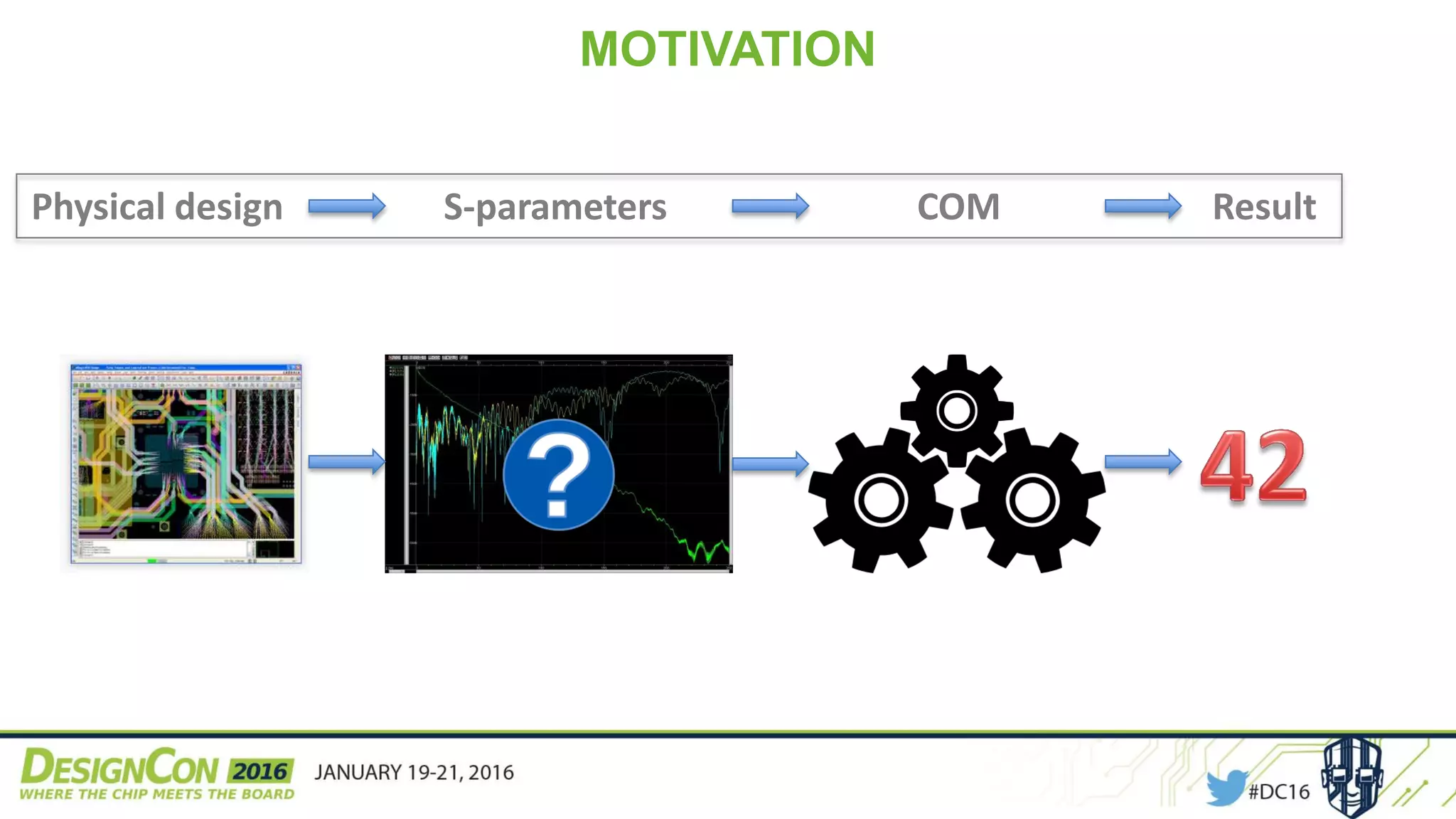
MOTIVATION
COMS-parametersPhysical design Result
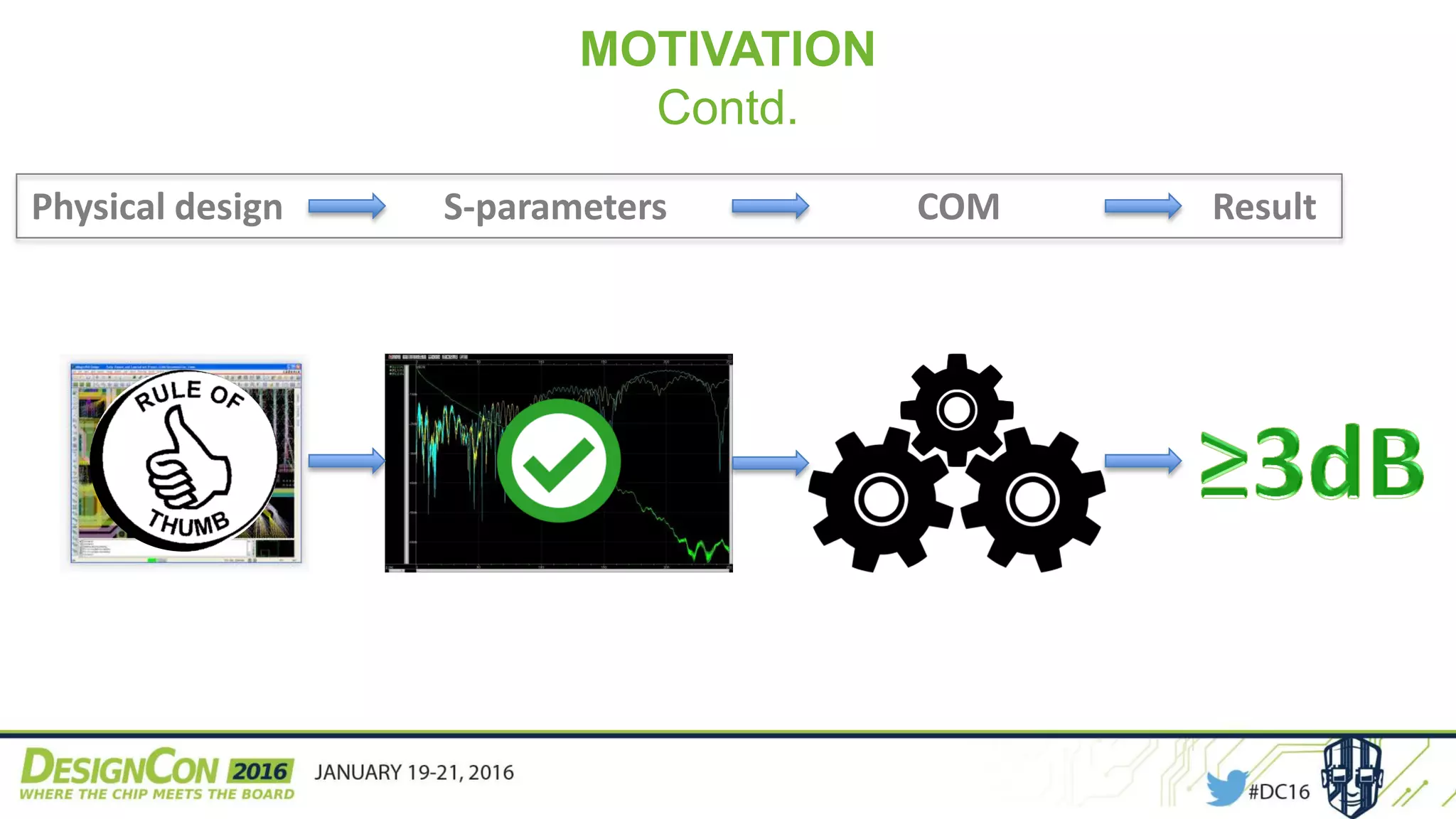
MOTIVATION
Contd.
COMS-parametersPhysical design Result
AGENDA
 Background
 COM basics & test procedure
 DUT host board & reference channel
 Reflections minimization
 Si termination
 Host board discontinuities
 XTALK degradation
 Shield vias
 Termination vias
 De-skewing techniques
 Summary
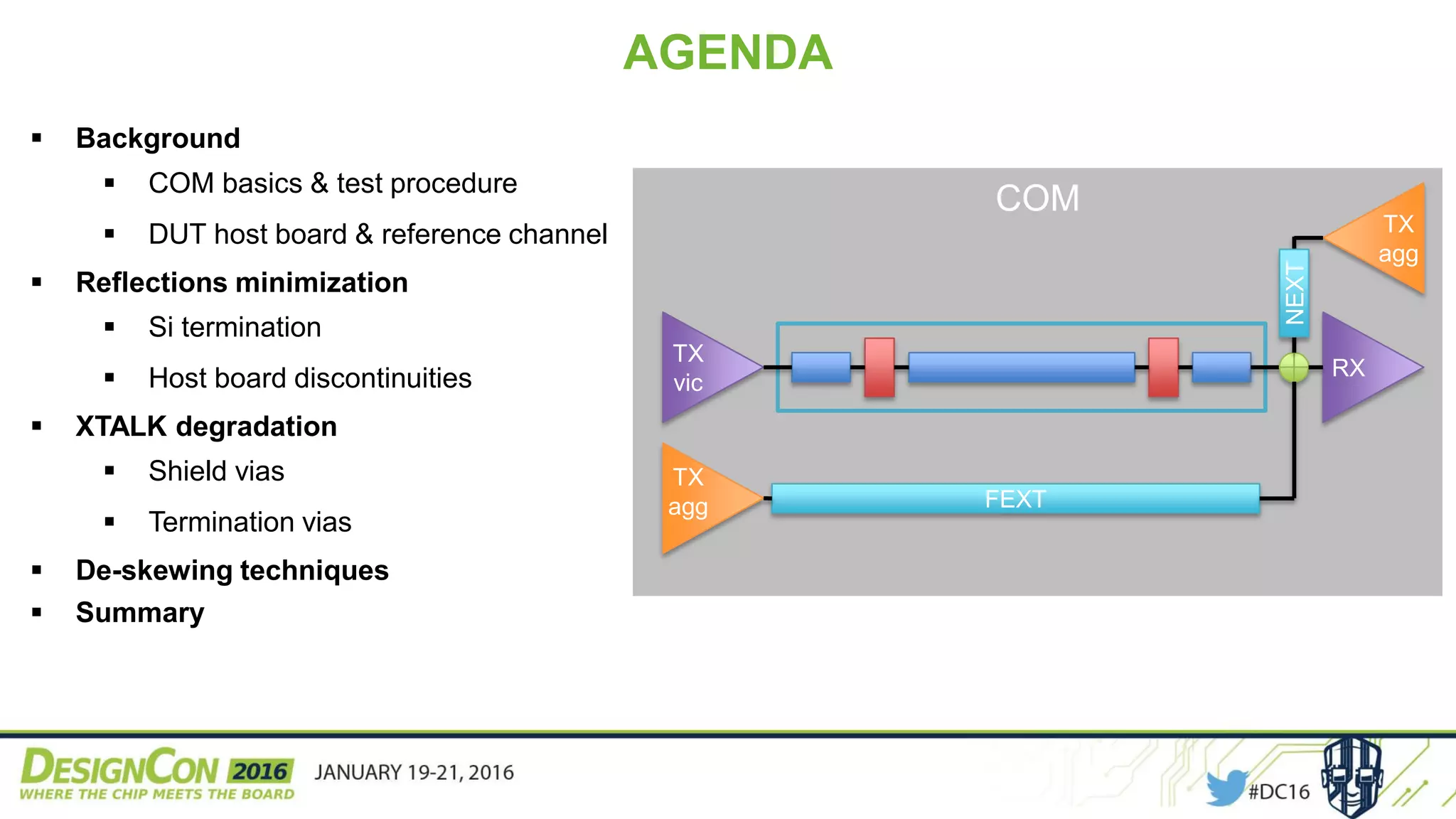
COM
TX
agg
TX
agg
TX
vic
RX
FEXT
NEXT
BACKGROUND
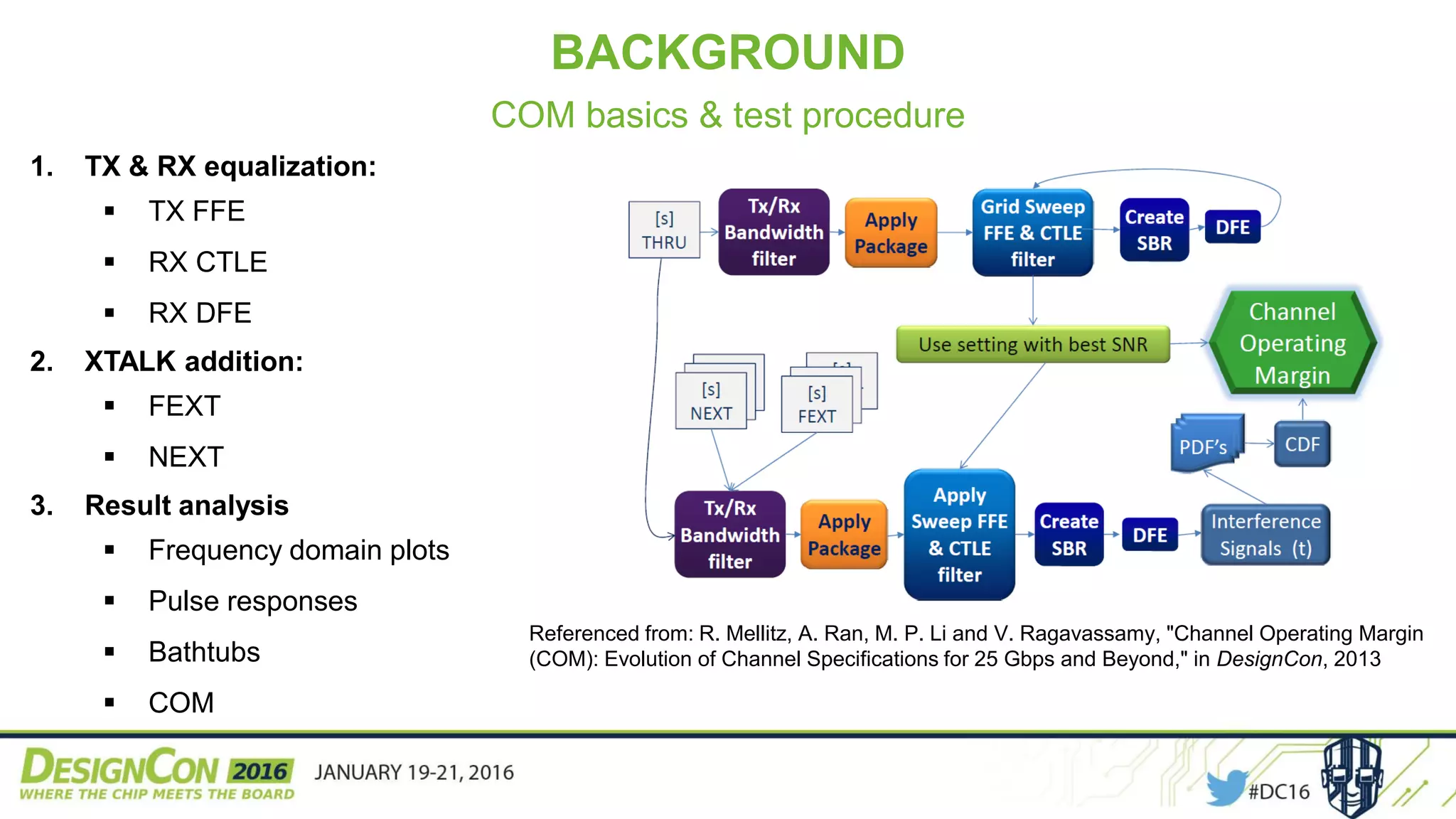
COM basics & test procedure
1. TX & RX equalization:
 TX FFE
 RX CTLE
 RX DFE
2. XTALK addition:
 FEXT
 NEXT
3. Result analysis
 Frequency domain plots
 Pulse responses
 Bathtubs
 COM
Referenced from: R. Mellitz, A. Ran, M. P. Li and V. Ragavassamy, "Channel Operating Margin
(COM): Evolution of Channel Specifications for 25 Gbps and Beyond," in DesignCon, 2013
BACKGROUND
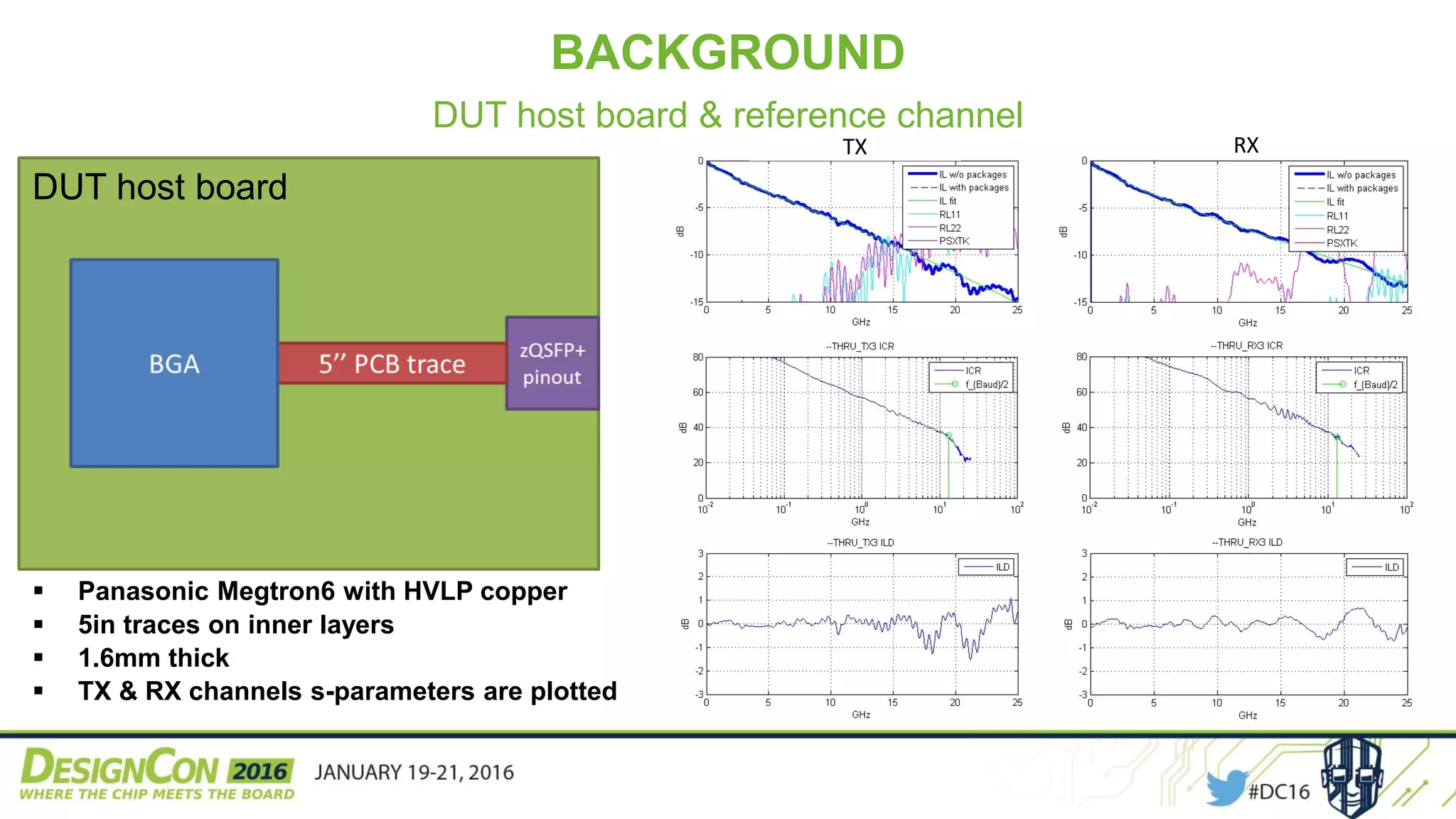
DUT host board & reference channel
 Panasonic Megtron6 with HVLP copper
 5in traces on inner layers
 1.6mm thick
 TX & RX channels s-parameters are plotted
DUT host board
RXTX
BACKGROUND
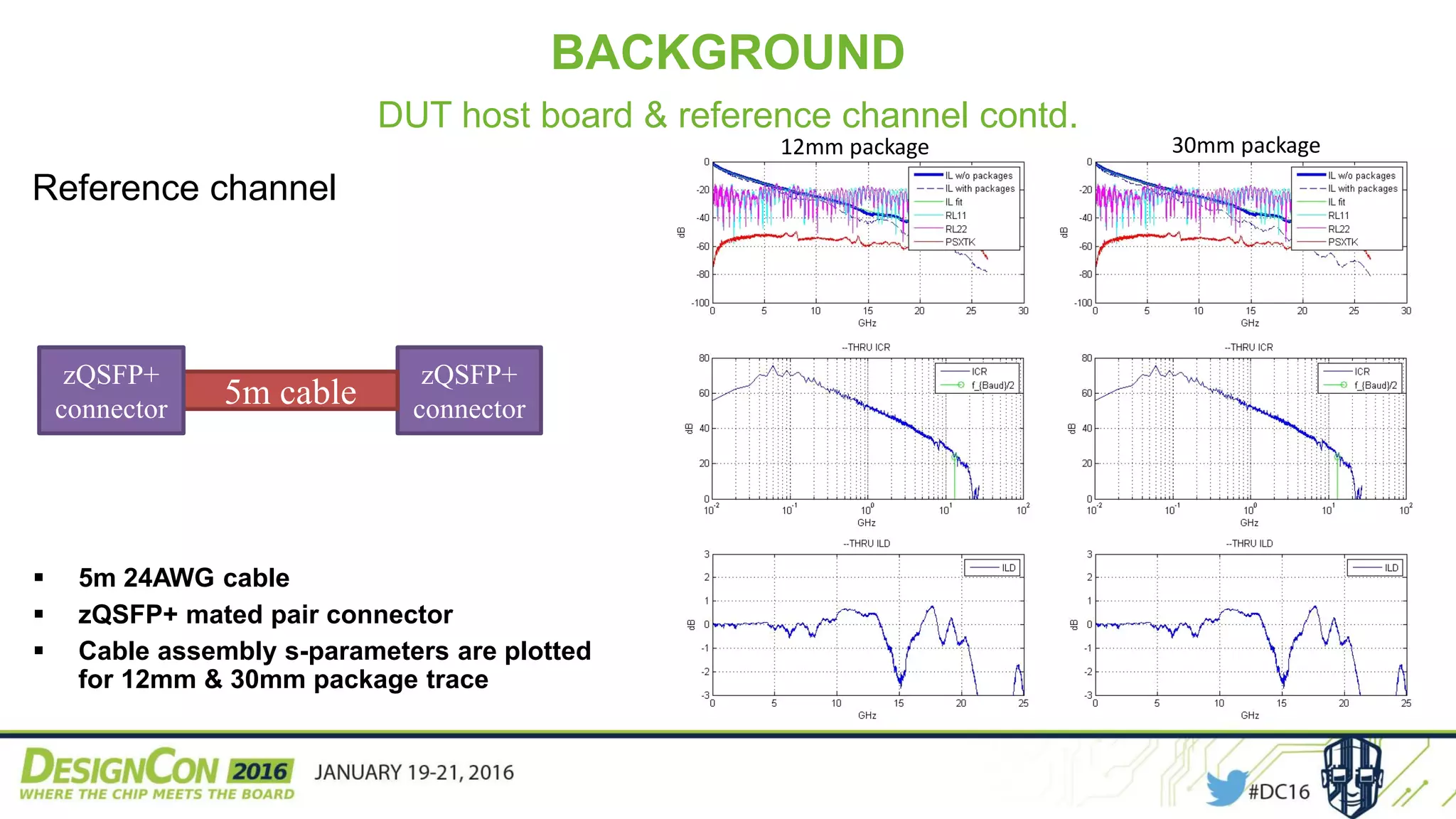
DUT host board & reference channel contd.
 5m 24AWG cable
 zQSFP+ mated pair connector
 Cable assembly s-parameters are plotted
for 12mm & 30mm package trace
Reference channel
zQSFP+
connector5m cable
zQSFP+
connector
30mm package12mm package
REFLECTION MINIMIZATION
Si termination
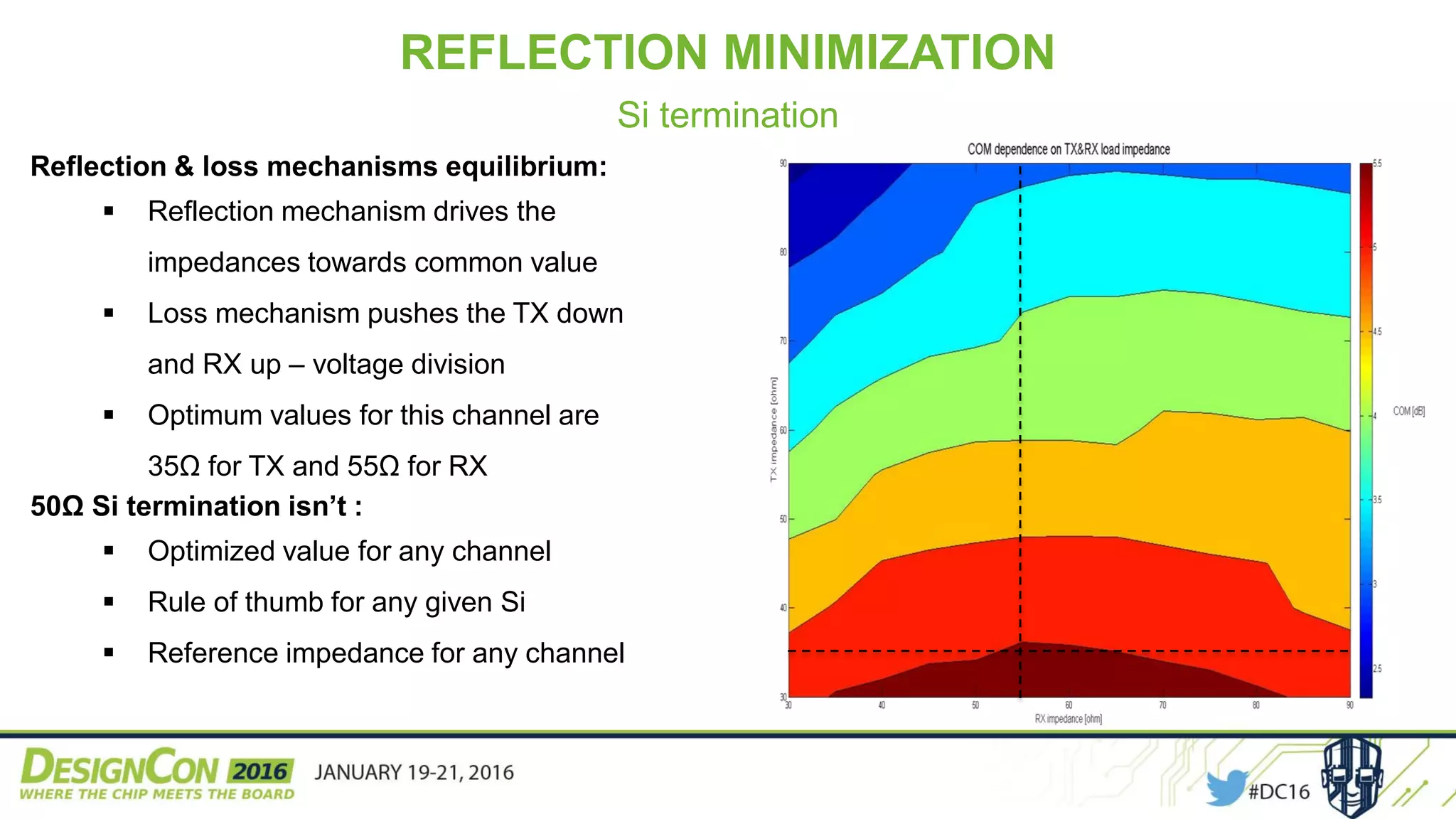
Reflection & loss mechanisms equilibrium:
 Reflection mechanism drives the
impedances towards common value
 Loss mechanism pushes the TX down
and RX up – voltage division
 Optimum values for this channel are
35Ω for TX and 55Ω for RX
50Ω Si termination isn’t :
 Optimized value for any channel
 Rule of thumb for any given Si
 Reference impedance for any channel
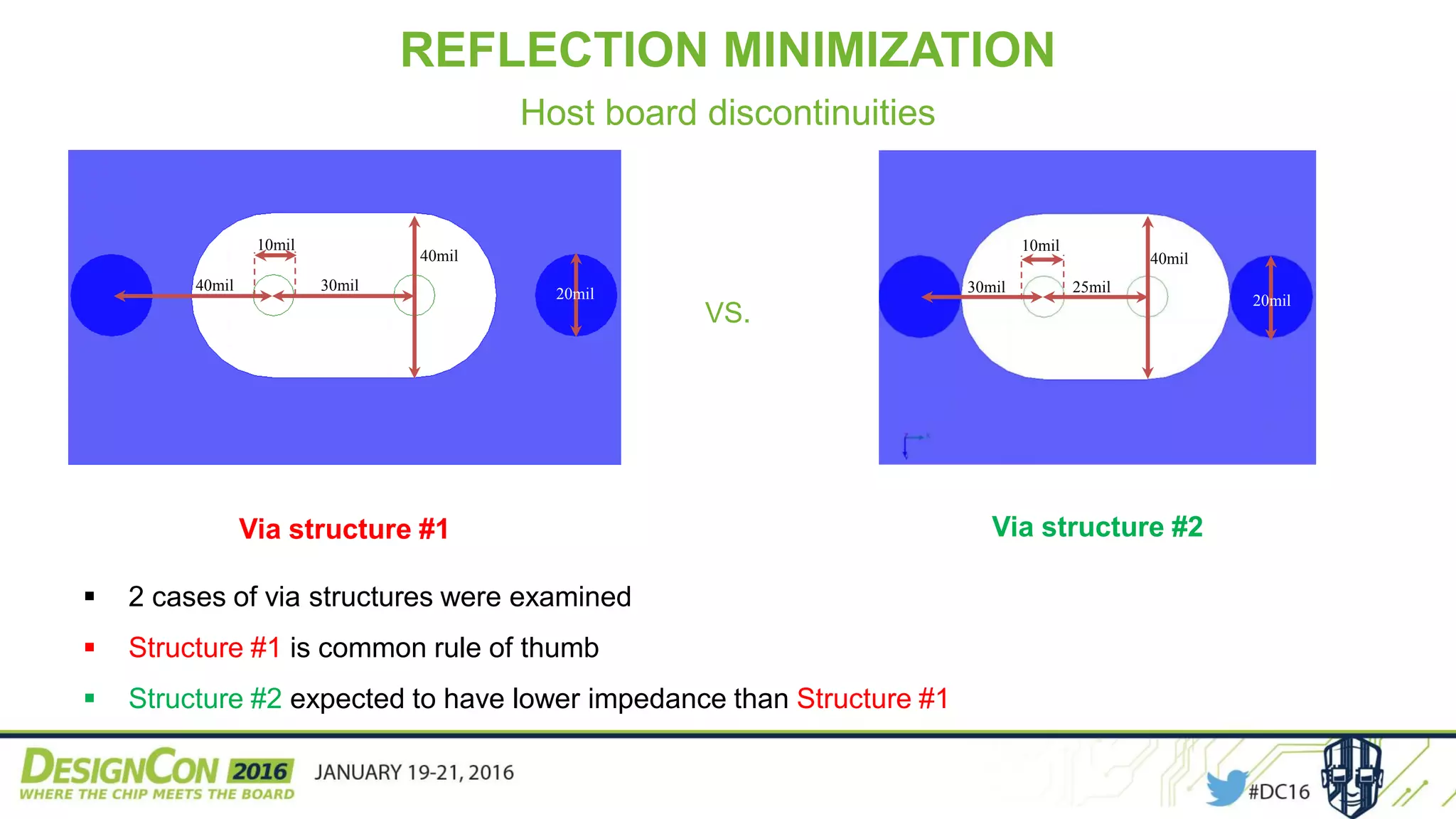
Via structure #1 Via structure #2
VS.
 2 cases of via structures were examined
 Structure #1 is common rule of thumb
 Structure #2 expected to have lower impedance than Structure #1
REFLECTION MINIMIZATION
Host board discontinuities
40mil
30mil40mil
10mil
20mil
40mil
25mil30mil
20mil
10mil
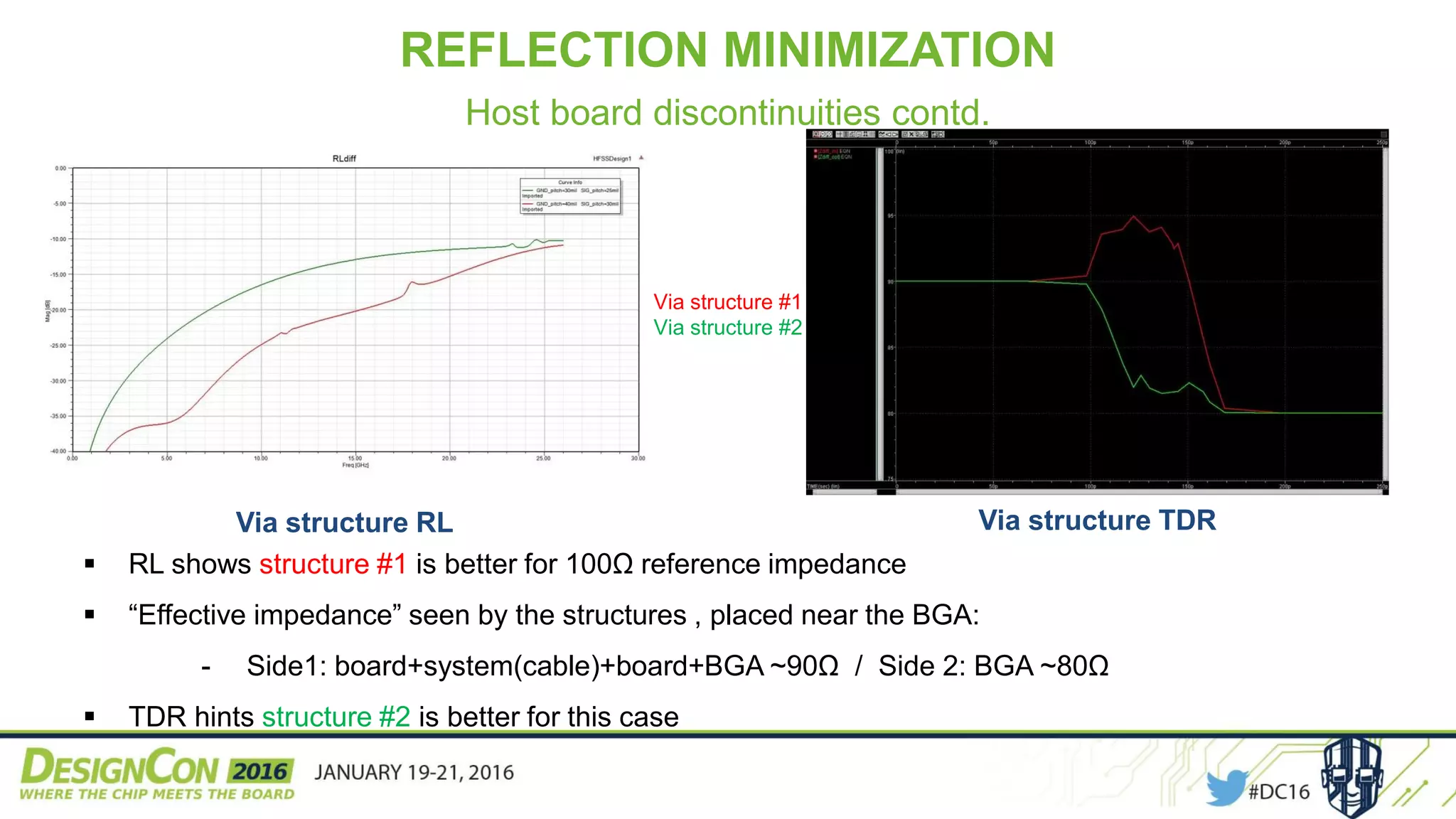
Via structure RL Via structure TDR
Via structure #1
Via structure #2
REFLECTION MINIMIZATION
Host board discontinuities contd.
 RL shows structure #1 is better for 100Ω reference impedance
 “Effective impedance” seen by the structures , placed near the BGA:
- Side1: board+system(cable)+board+BGA ~90Ω / Side 2: BGA ~80Ω
 TDR hints structure #2 is better for this case
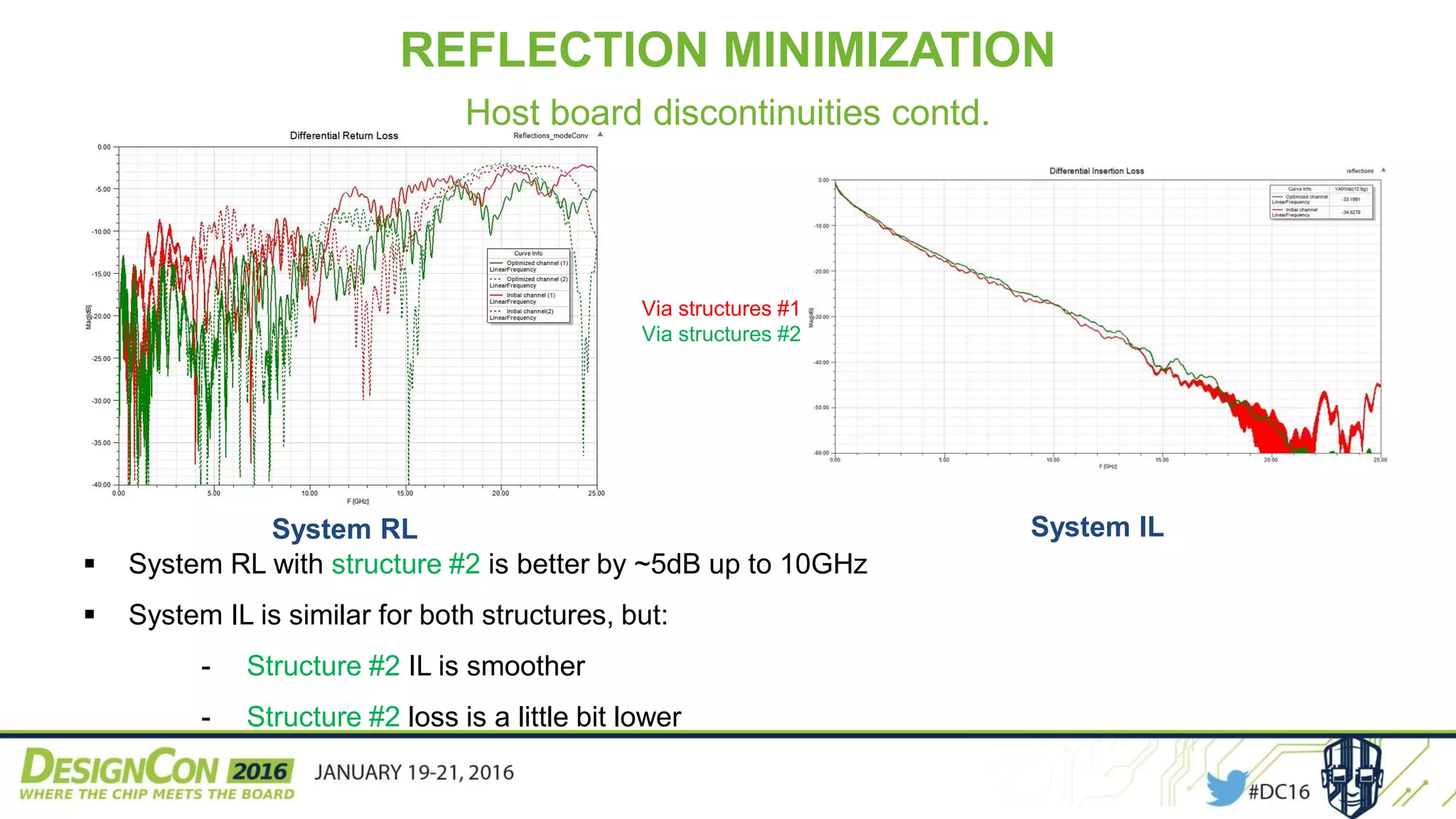
System RL System IL
Via structures #1
Via structures #2
REFLECTION MINIMIZATION
Host board discontinuities contd.
 System RL with structure #2 is better by ~5dB up to 10GHz
 System IL is similar for both structures, but:
- Structure #2 IL is smoother
- Structure #2 loss is a little bit lower
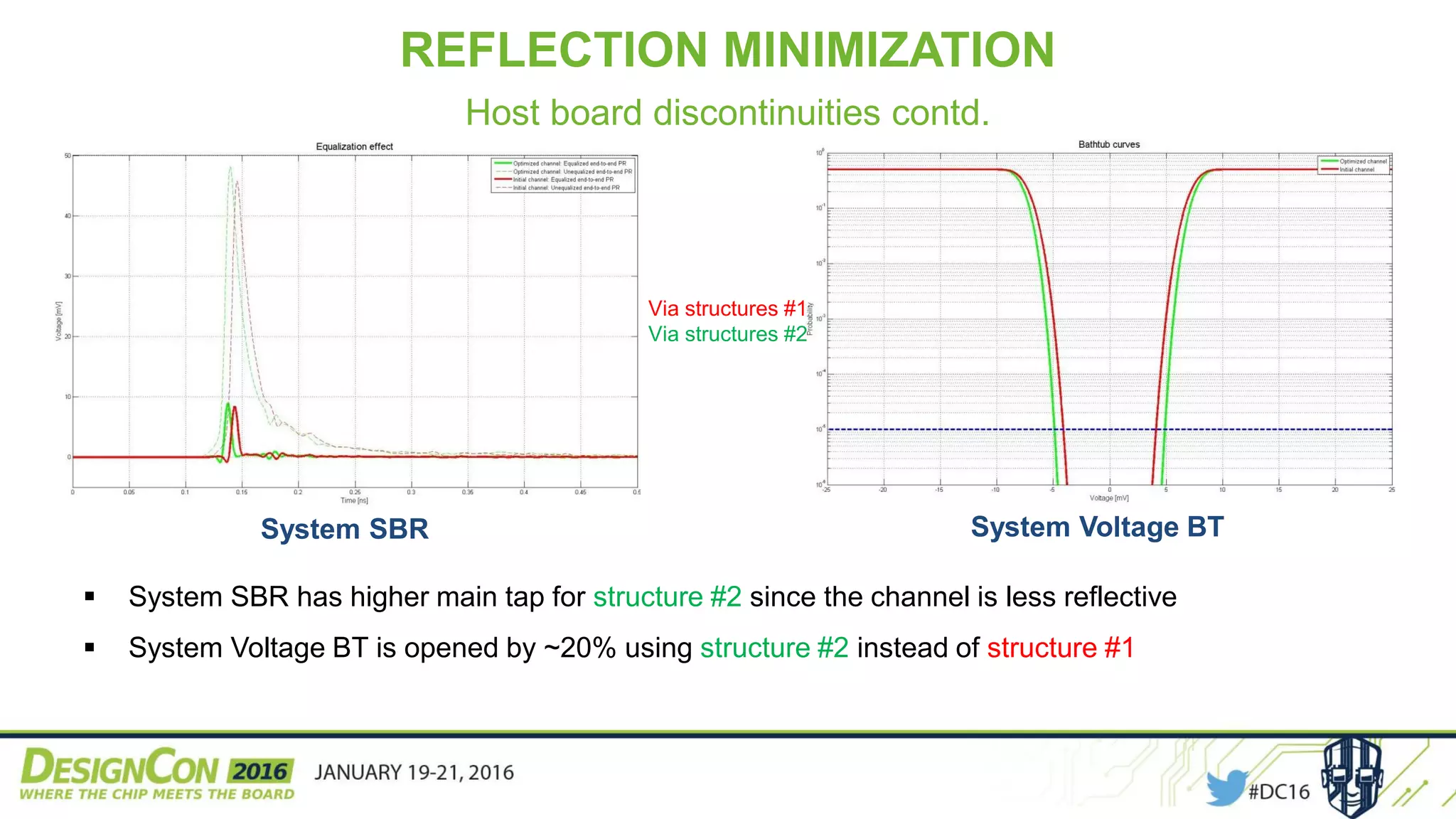
System SBR System Voltage BT
Via structures #1
Via structures #2
REFLECTION MINIMIZATION
Host board discontinuities contd.
 System SBR has higher main tap for structure #2 since the channel is less reflective
 System Voltage BT is opened by ~20% using structure #2 instead of structure #1
Systems with COM [dB]
Structures #1 2.9 (FAIL)
Structures #2 3.65 (PASS)
REFLECTION MINIMIZATION
Host board discontinuities contd.
COM increased by 0.75dB meeting the pass criteria!
General design guidelines :
Usually the “effective impedance” of the system is lower than 100Ω
Match discontinuities impedance to the “effective impedance”
of the system by making them as transparent as possible
For this test case almost minimum distances of S-S and S-G give the best results
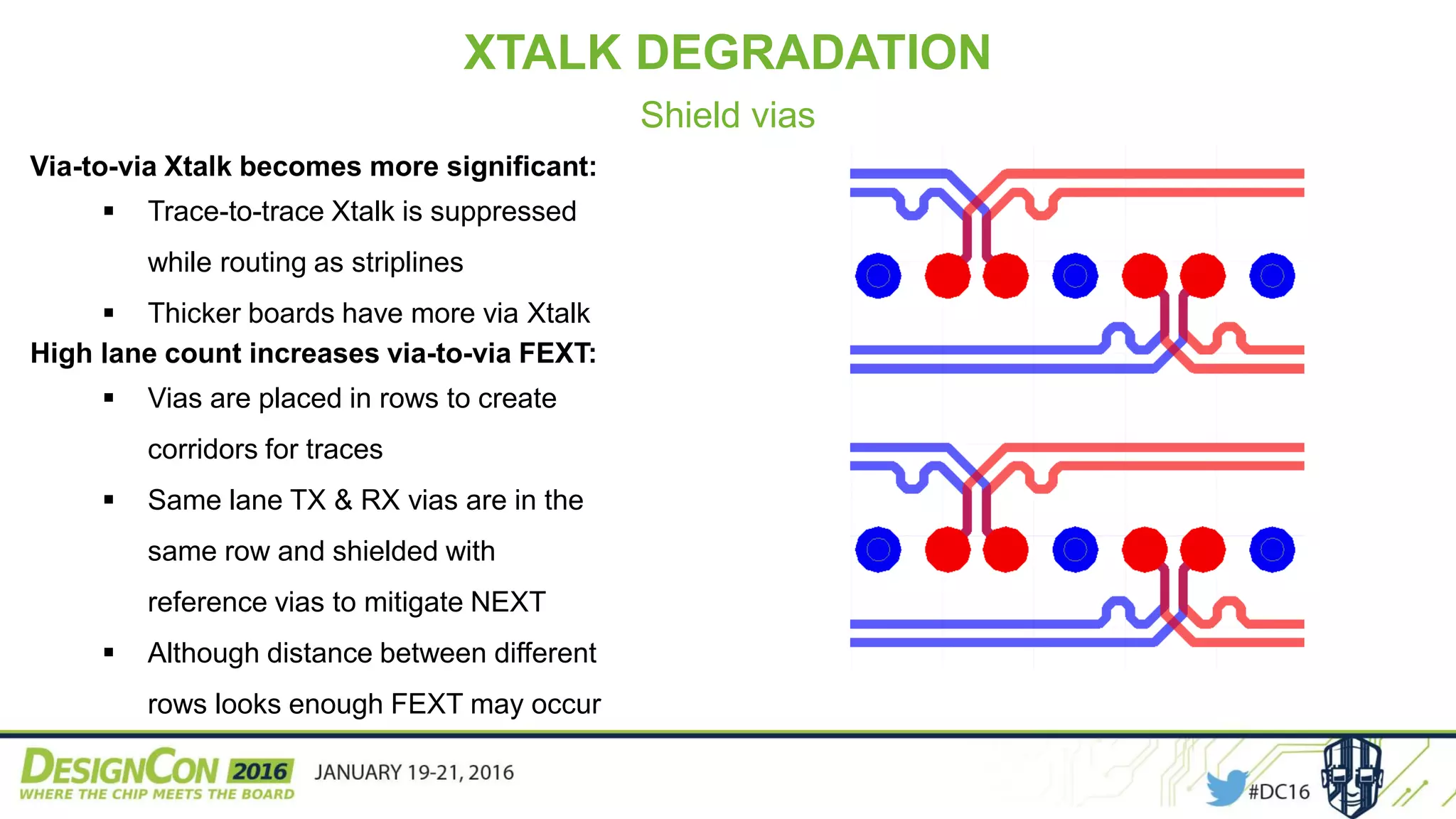
Via-to-via Xtalk becomes more significant:
 Trace-to-trace Xtalk is suppressed
while routing as striplines
 Thicker boards have more via Xtalk
High lane count increases via-to-via FEXT:
 Vias are placed in rows to create
corridors for traces
 Same lane TX & RX vias are in the
same row and shielded with
reference vias to mitigate NEXT
 Although distance between different
rows looks enough FEXT may occur
XTALK DEGRADATION
Shield vias
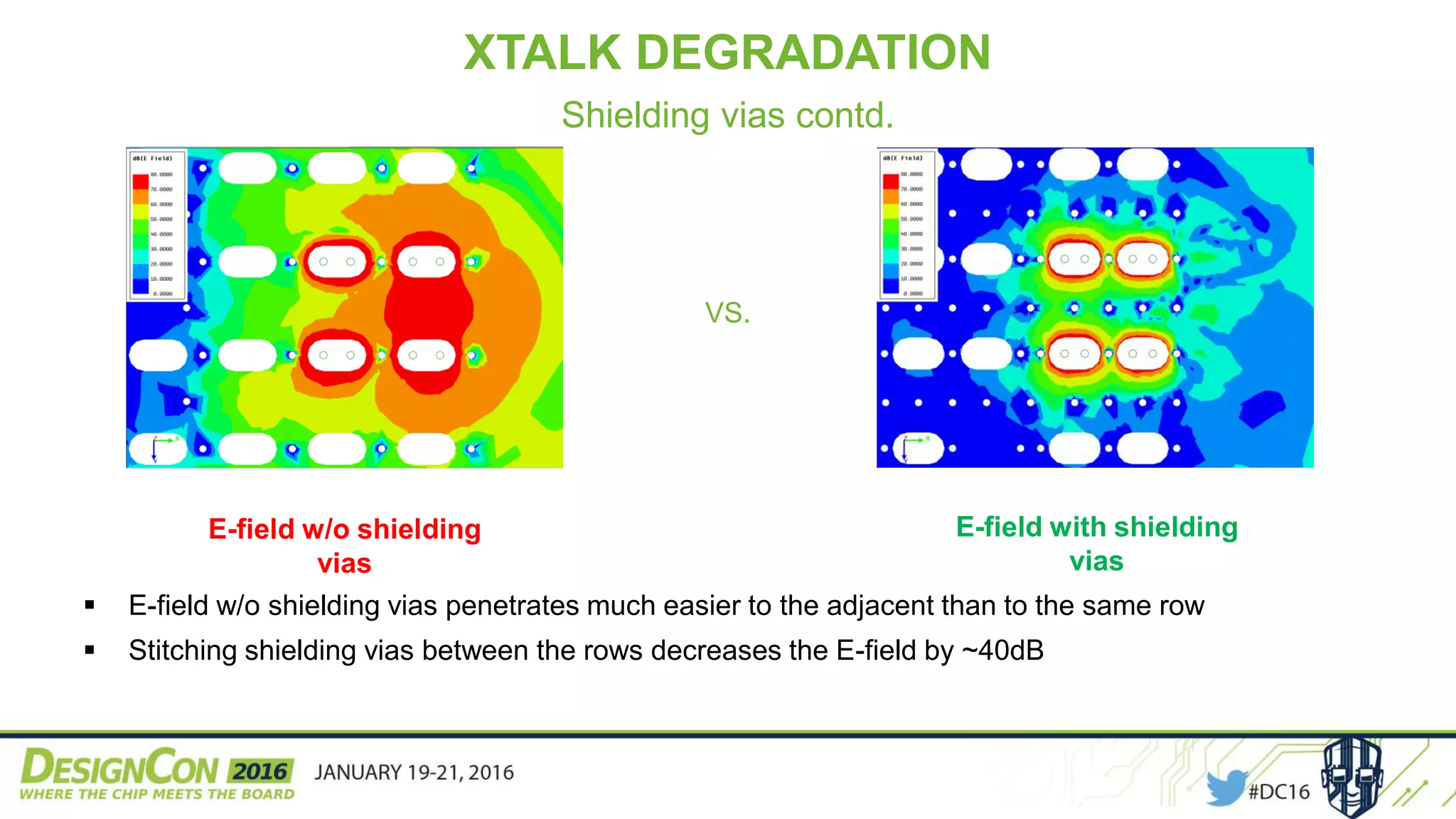
E-field w/o shielding
vias
E-field with shielding
vias
VS.
XTALK DEGRADATION
Shielding vias contd.
 E-field w/o shielding vias penetrates much easier to the adjacent than to the same row
 Stitching shielding vias between the rows decreases the E-field by ~40dB
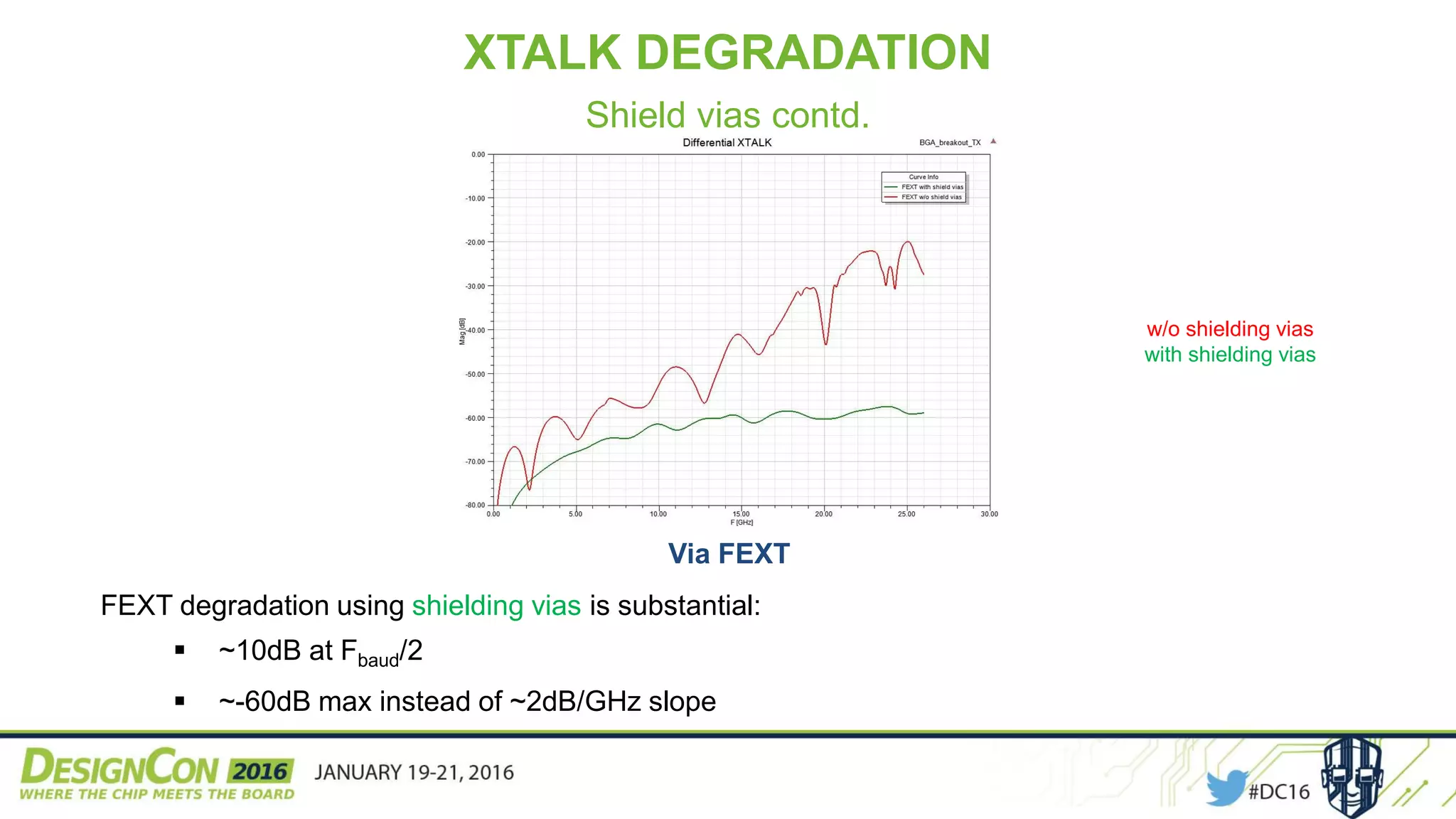
Via FEXT
FEXT degradation using shielding vias is substantial:
 ~10dB at Fbaud/2
 ~-60dB max instead of ~2dB/GHz slope
w/o shielding vias
with shielding vias
XTALK DEGRADATION
Shield vias contd.
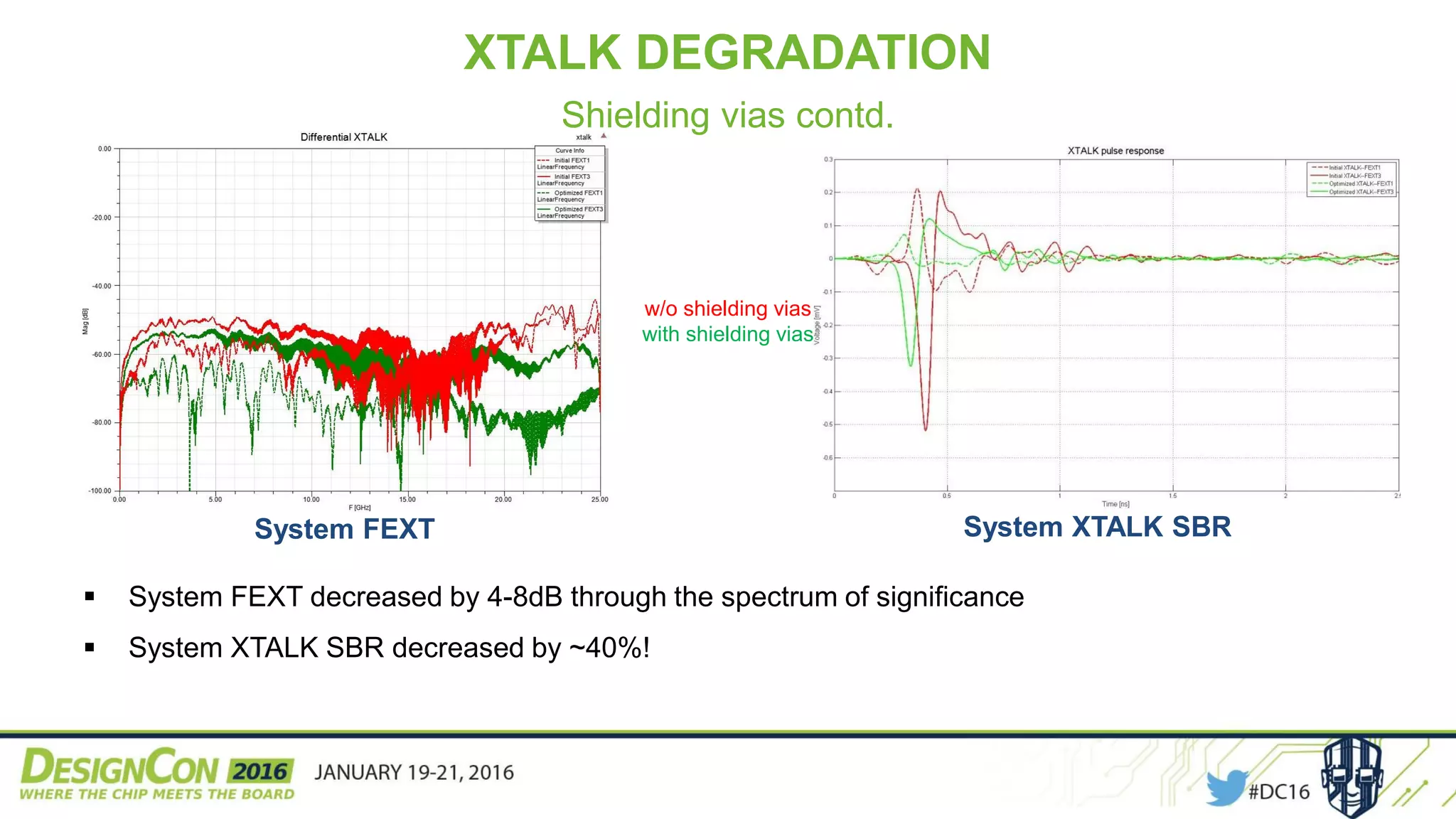
System FEXT System XTALK SBR
w/o shielding vias
with shielding vias
 System FEXT decreased by 4-8dB through the spectrum of significance
 System XTALK SBR decreased by ~40%!
XTALK DEGRADATION
Shielding vias contd.
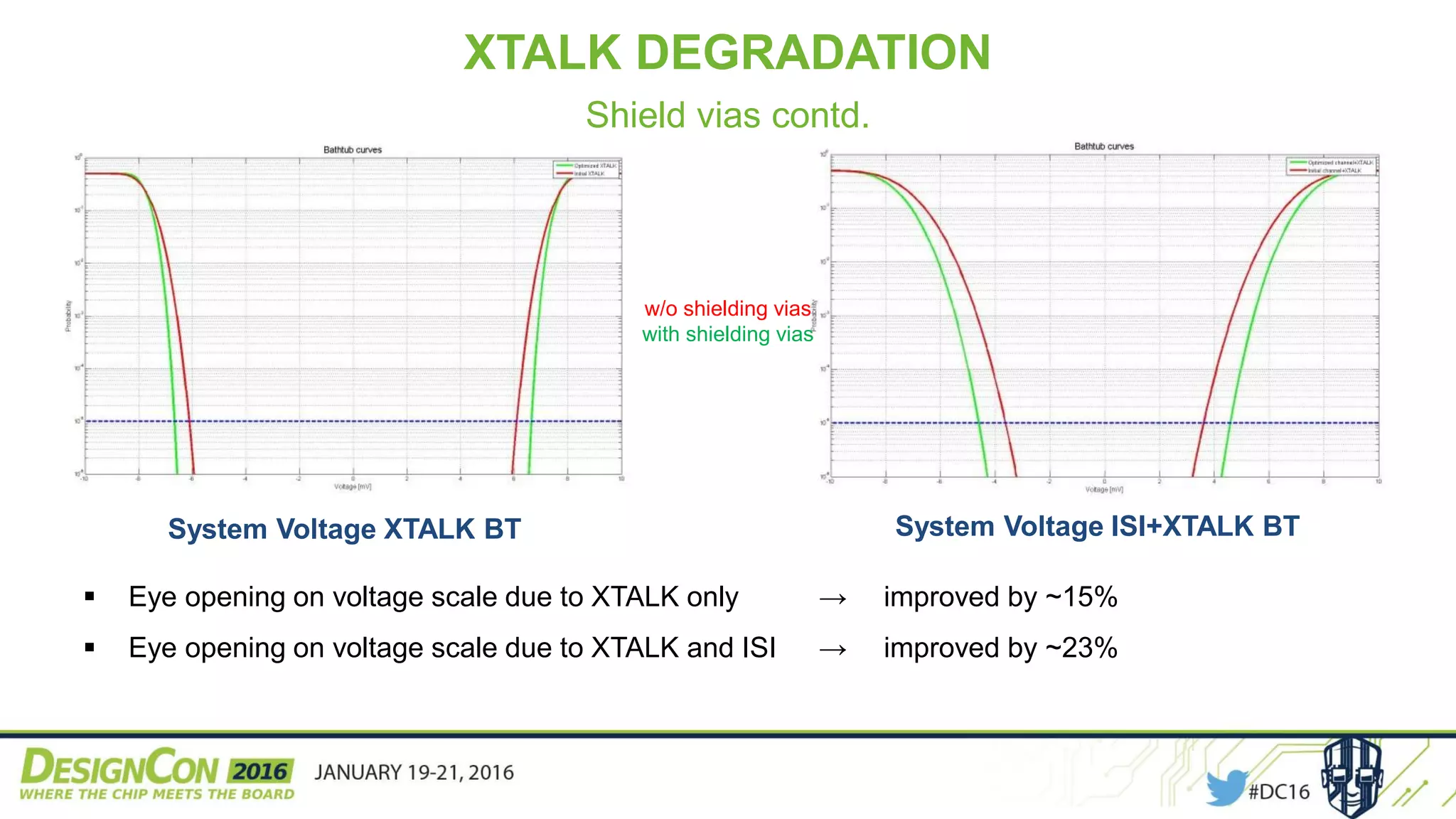
System Voltage XTALK BT System Voltage ISI+XTALK BT
w/o shielding vias
with shielding vias
 Eye opening on voltage scale due to XTALK only → improved by ~15%
 Eye opening on voltage scale due to XTALK and ISI → improved by ~23%
XTALK DEGRADATION
Shield vias contd.
Systems with via structures COM [dB]
w/o shielding vias 3.1
with shielding vias 3.35
COM increased by 0.25dB!
General design guidelines :
Don’t base XTALK expectations purely on the distance and symmetry of the vias
Shield signal vias from all sides, yet bit farther than S-G distance
XTALK DEGRADATION
Shield vias contd.
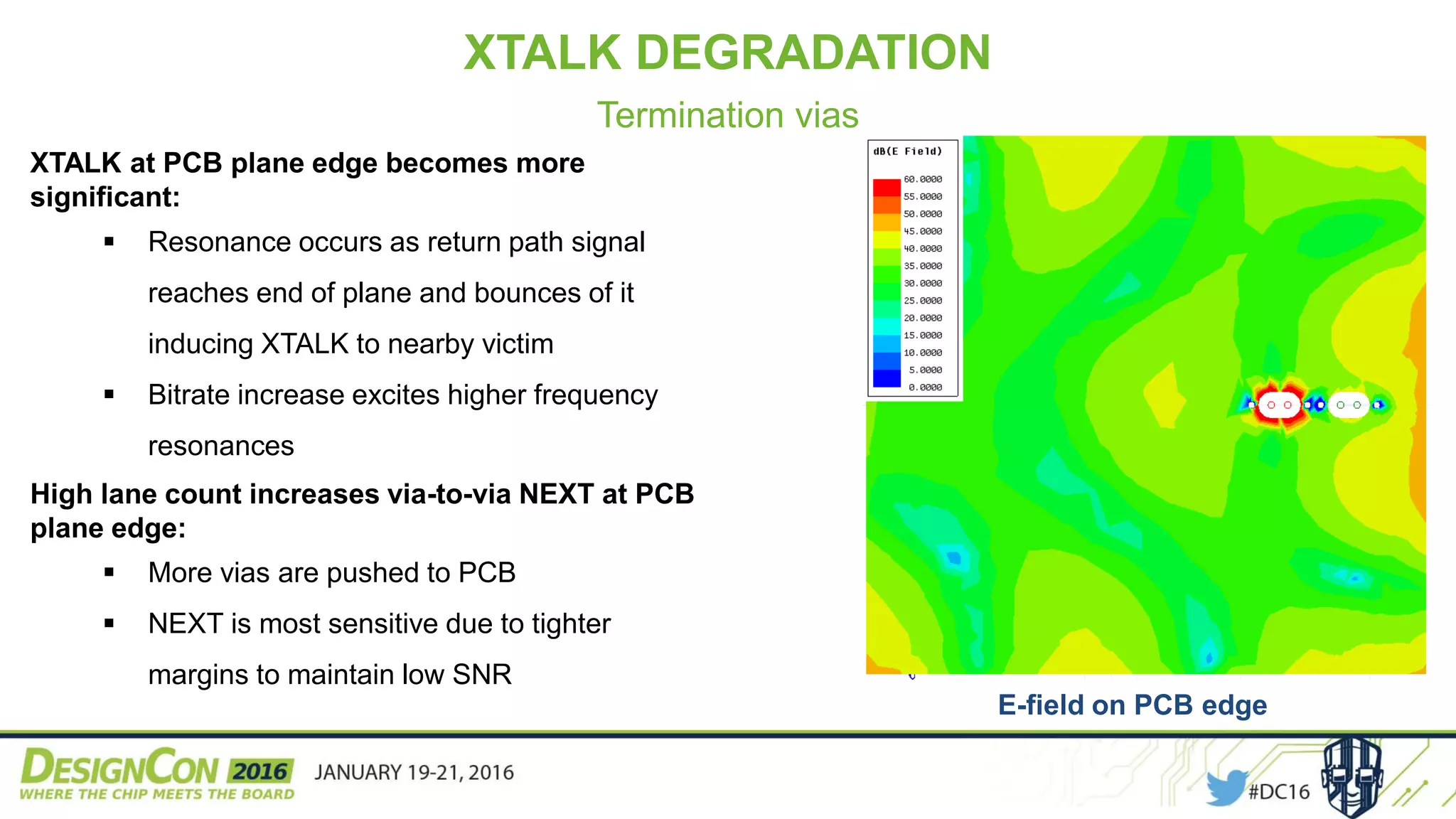
XTALK at PCB plane edge becomes more
significant:
 Resonance occurs as return path signal
reaches end of plane and bounces of it
inducing XTALK to nearby victim
 Bitrate increase excites higher frequency
resonances
High lane count increases via-to-via NEXT at PCB
plane edge:
 More vias are pushed to PCB
 NEXT is most sensitive due to tighter
margins to maintain low SNR
XTALK DEGRADATION
Termination vias
E-field on PCB edge
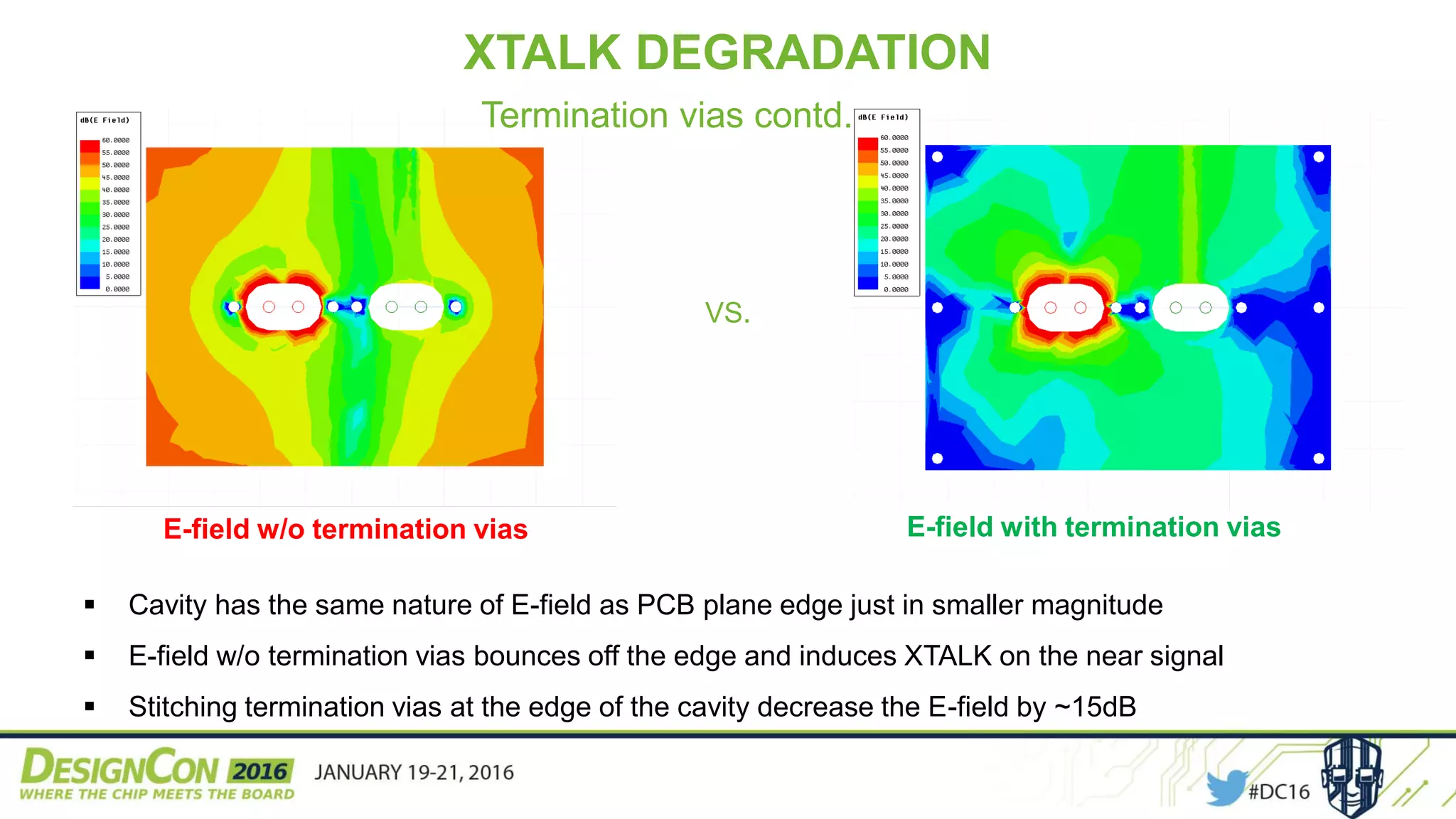
E-field w/o termination vias E-field with termination vias
VS.
XTALK DEGRADATION
Termination vias contd.
 Cavity has the same nature of E-field as PCB plane edge just in smaller magnitude
 E-field w/o termination vias bounces off the edge and induces XTALK on the near signal
 Stitching termination vias at the edge of the cavity decrease the E-field by ~15dB
XTALK DEGRADATION
Termination vias contd.
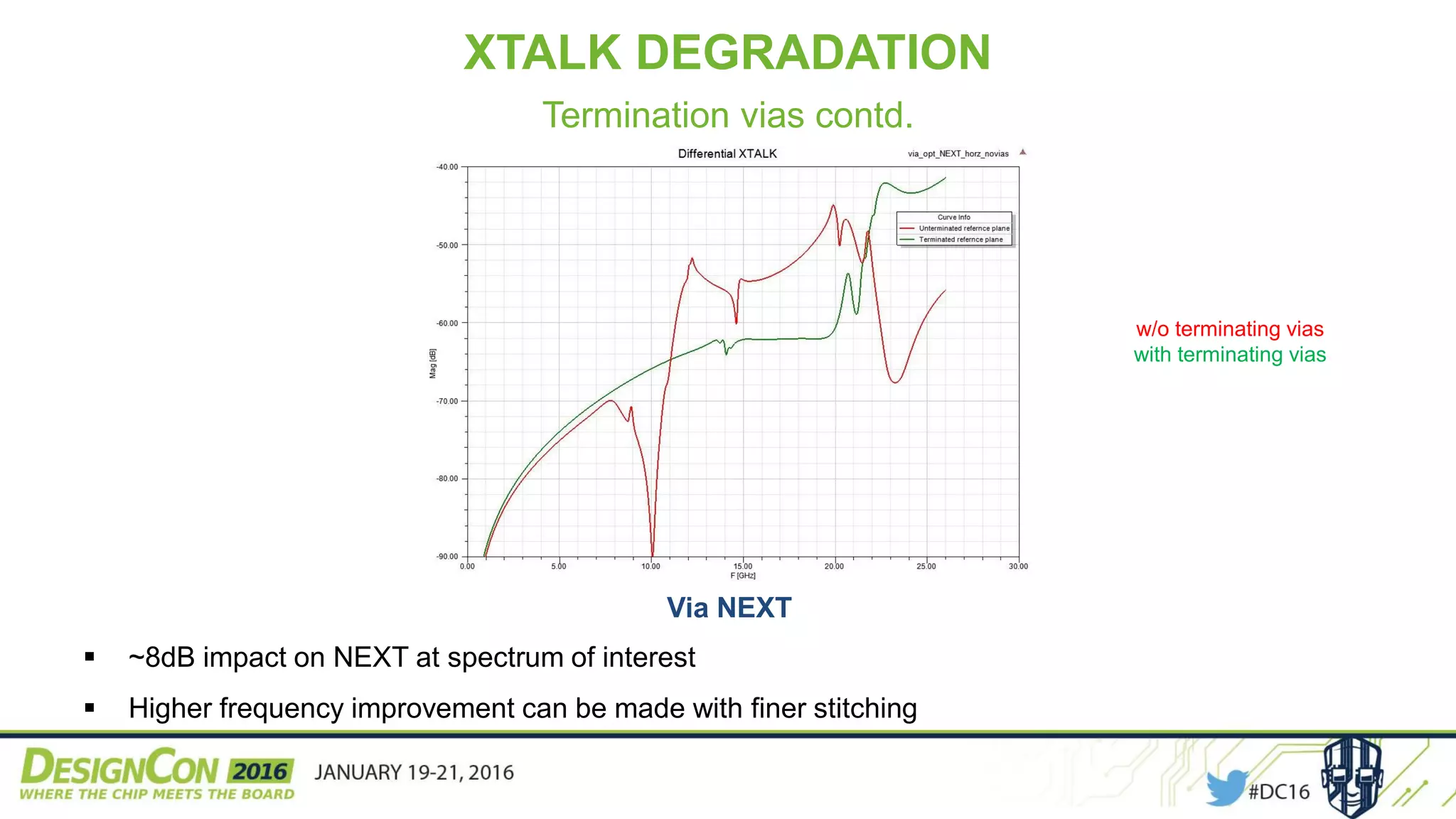
Via NEXT
 ~8dB impact on NEXT at spectrum of interest
 Higher frequency improvement can be made with finer stitching
w/o terminating vias
with terminating vias
Systems type COM [dB]
w/o terminating vias 3.15
with terminating vias 3.25
COM increased by 0.1dB w/o any real effort!
Stitch the edge of the reference plain with terminating vias
 Via-to-via distance ≤120mil for 25Gbps
 For other rates use: 𝑑 𝑚𝑎𝑥 =
𝑣
2𝐹 𝑏𝑎𝑢𝑑
XTALK DEGRADATION
Termination vias contd.
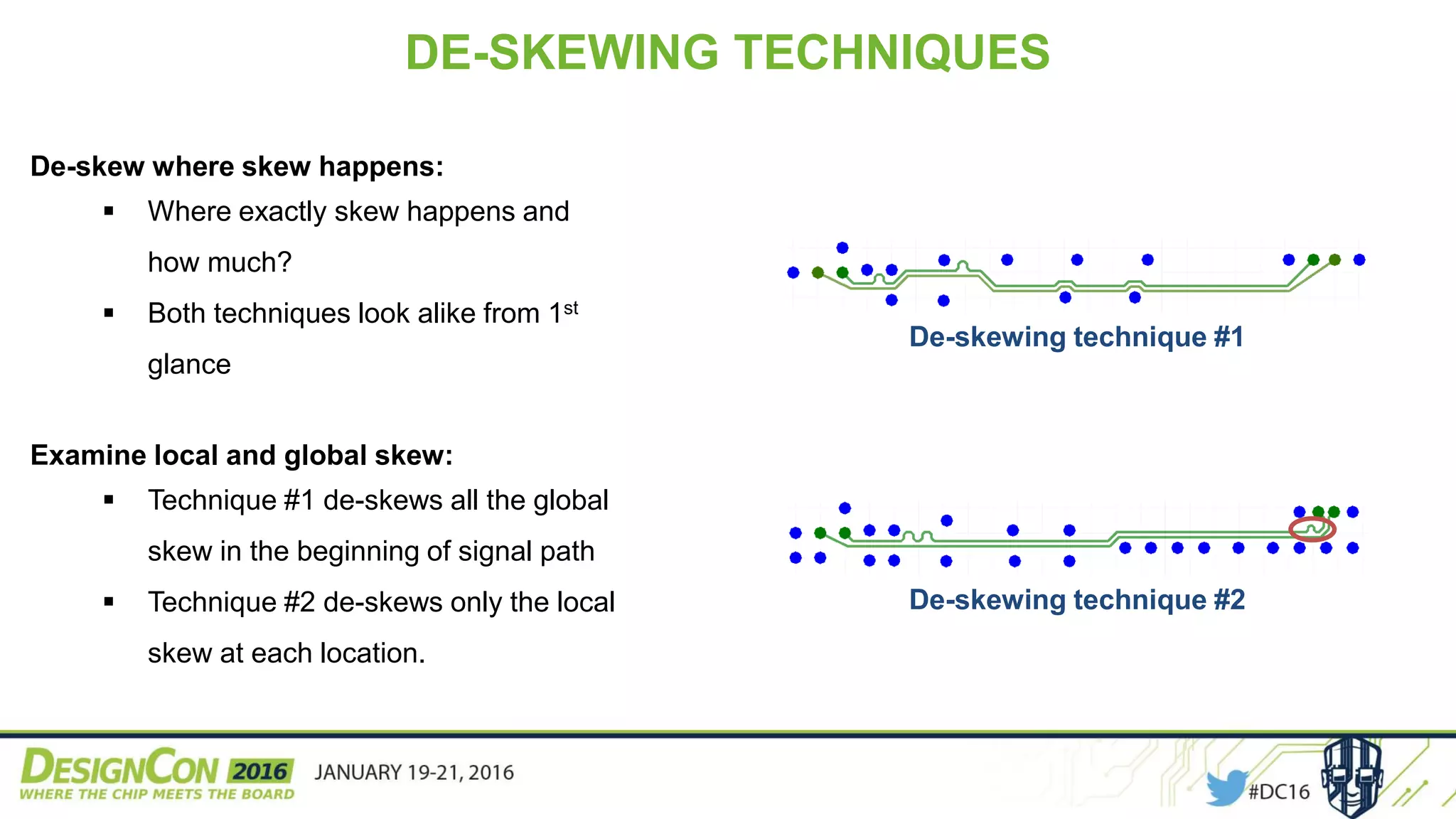
De-skew where skew happens:
 Where exactly skew happens and
how much?
 Both techniques look alike from 1st
glance
Examine local and global skew:
 Technique #1 de-skews all the global
skew in the beginning of signal path
 Technique #2 de-skews only the local
skew at each location.
DE-SKEWING TECHNIQUES
De-skewing technique #1
De-skewing technique #2
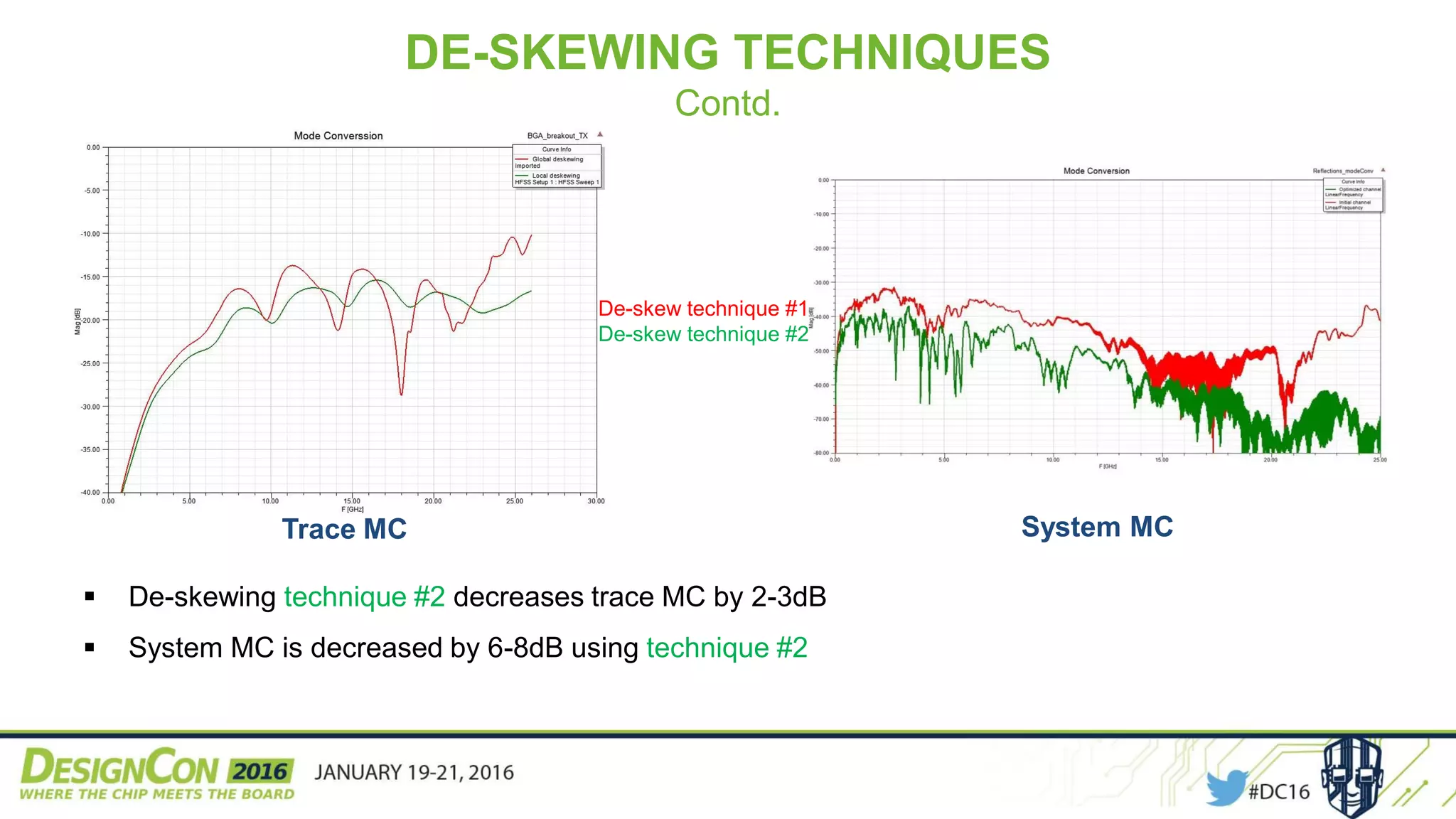
Trace MC System MC
 De-skewing technique #2 decreases trace MC by 2-3dB
 System MC is decreased by 6-8dB using technique #2
DE-SKEWING TECHNIQUES
Contd.
De-skew technique #1
De-skew technique #2
System design phase COM [dB]
Initial 2.35 (FAIL)
Optimized 3.35 (PASS)
COM increased by 1dB , in this case equivalent to ~1in
margin in PCB trace length!
Proper via treatment can increase system’s COM by:
 0.75dB – via matching to the “effective impedance”
 0.25dB – reference via shielding
SUMMARY
SUMMARY
Contd.
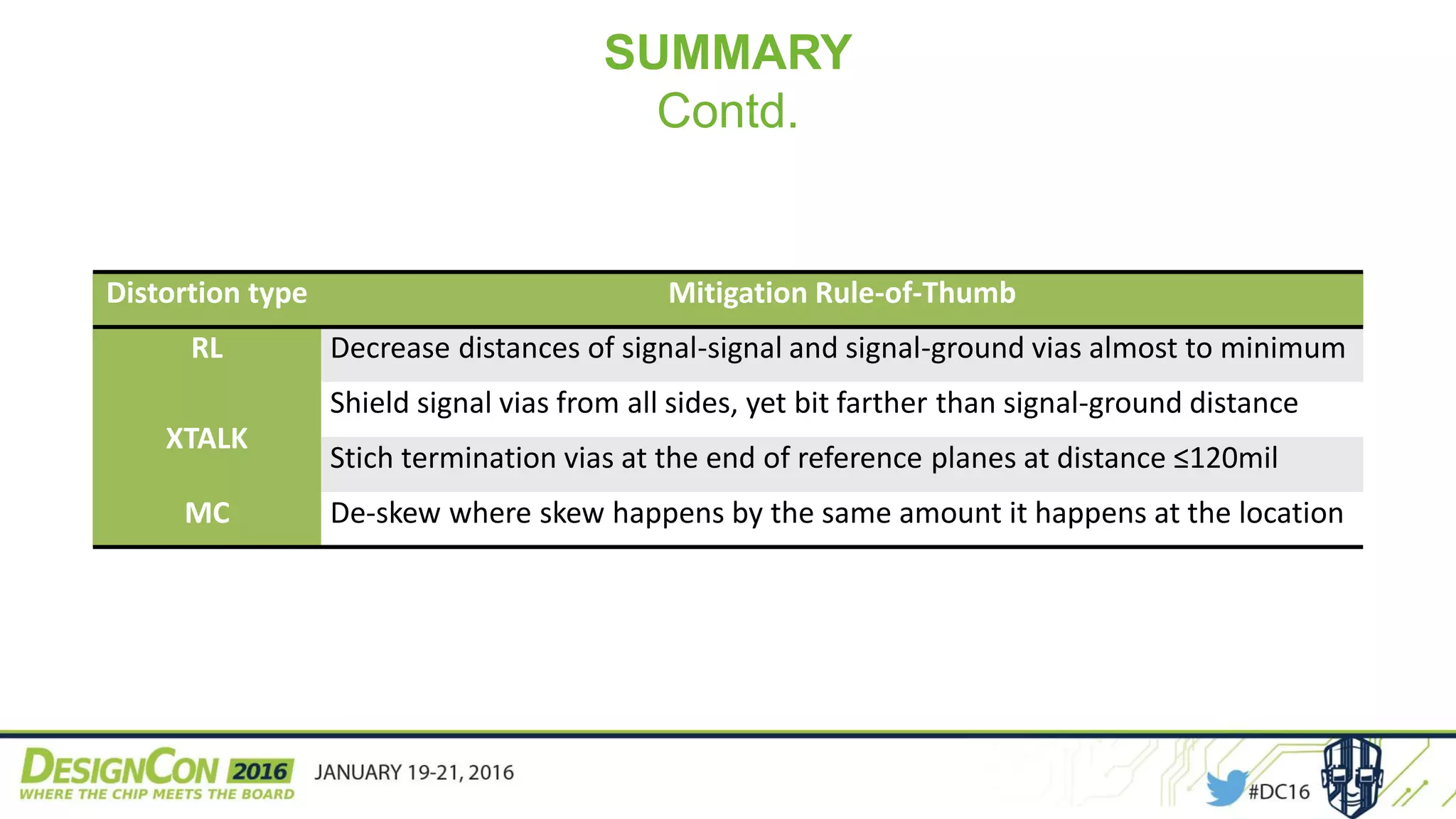
Distortion type Mitigation Rule-of-Thumb
RL Decrease distances of signal-signal and signal-ground vias almost to minimum
XTALK
Shield signal vias from all sides, yet bit farther than signal-ground distance
Stich termination vias at the end of reference planes at distance ≤120mil
MC De-skew where skew happens by the same amount it happens at the location
MORE INFORMATION
 J. Brener and L. Ben-Artsi, "Are There Any Rules of Thumb When It Comes to
100Gb/S Board Design? A Walkthrough from Physical Domain to Channel
Operating Margin (COM) Testing.," DesignCon, 2016.
 jacovb@marvell.com
liav@marvell.com
---
QUESTIONS?
Thank you!

Slides are thereanyrulesofthumb_brener

  • 1.
    TITLE Image Are There AnyRules of Thumb When It Comes to 100Gb/S Board Design? A Walkthrough from Physical Domain to Channel Operating Margin (COM) Testing. Jacov Brener (Marvell Israel Ltd) Liav Ben-Artsi (Marvell Israel Ltd)
  • 2.
    Jacov Brener Senior SignalIntegrity Engineer, Marvell Israel Ltd jacovb@marvell.com | Jacov is a Senior Signal Integrity Engineer at Marvell Israel Ltd, starting this year. For the previous 10 years Jacov has worked in Intel's Communication and Storage Infrastructure Group, most of the time as package designer and signal/power integrity focal point in a high-speed PHY team. Liav Ben-Artsi Senior Signal Integrity Manager, Marvell Israel Ltd liav@marvell.com | Liav is a Senior Signal Integrity Manager at Marvell Israel Ltd. Liav has worked at Marvell for the last 15 years, most of the time as a signal integrity engineer, focusing on signal integrity methodologies, guidelines, test plan definitions and training. He holds several patents in the field as well as several others pending. Liav took an active part in IEEE802.3bj standard committee. SPEAKERS
  • 3.
  • 4.
  • 5.
    AGENDA  Background  COMbasics & test procedure  DUT host board & reference channel  Reflections minimization  Si termination  Host board discontinuities  XTALK degradation  Shield vias  Termination vias  De-skewing techniques  Summary COM TX agg TX agg TX vic RX FEXT NEXT
  • 6.
    BACKGROUND COM basics &test procedure 1. TX & RX equalization:  TX FFE  RX CTLE  RX DFE 2. XTALK addition:  FEXT  NEXT 3. Result analysis  Frequency domain plots  Pulse responses  Bathtubs  COM Referenced from: R. Mellitz, A. Ran, M. P. Li and V. Ragavassamy, "Channel Operating Margin (COM): Evolution of Channel Specifications for 25 Gbps and Beyond," in DesignCon, 2013
  • 7.
    BACKGROUND DUT host board& reference channel  Panasonic Megtron6 with HVLP copper  5in traces on inner layers  1.6mm thick  TX & RX channels s-parameters are plotted DUT host board RXTX
  • 8.
    BACKGROUND DUT host board& reference channel contd.  5m 24AWG cable  zQSFP+ mated pair connector  Cable assembly s-parameters are plotted for 12mm & 30mm package trace Reference channel zQSFP+ connector5m cable zQSFP+ connector 30mm package12mm package
  • 9.
    REFLECTION MINIMIZATION Si termination Reflection& loss mechanisms equilibrium:  Reflection mechanism drives the impedances towards common value  Loss mechanism pushes the TX down and RX up – voltage division  Optimum values for this channel are 35Ω for TX and 55Ω for RX 50Ω Si termination isn’t :  Optimized value for any channel  Rule of thumb for any given Si  Reference impedance for any channel
  • 10.
    Via structure #1Via structure #2 VS.  2 cases of via structures were examined  Structure #1 is common rule of thumb  Structure #2 expected to have lower impedance than Structure #1 REFLECTION MINIMIZATION Host board discontinuities 40mil 30mil40mil 10mil 20mil 40mil 25mil30mil 20mil 10mil
  • 11.
    Via structure RLVia structure TDR Via structure #1 Via structure #2 REFLECTION MINIMIZATION Host board discontinuities contd.  RL shows structure #1 is better for 100Ω reference impedance  “Effective impedance” seen by the structures , placed near the BGA: - Side1: board+system(cable)+board+BGA ~90Ω / Side 2: BGA ~80Ω  TDR hints structure #2 is better for this case
  • 12.
    System RL SystemIL Via structures #1 Via structures #2 REFLECTION MINIMIZATION Host board discontinuities contd.  System RL with structure #2 is better by ~5dB up to 10GHz  System IL is similar for both structures, but: - Structure #2 IL is smoother - Structure #2 loss is a little bit lower
  • 13.
    System SBR SystemVoltage BT Via structures #1 Via structures #2 REFLECTION MINIMIZATION Host board discontinuities contd.  System SBR has higher main tap for structure #2 since the channel is less reflective  System Voltage BT is opened by ~20% using structure #2 instead of structure #1
  • 14.
    Systems with COM[dB] Structures #1 2.9 (FAIL) Structures #2 3.65 (PASS) REFLECTION MINIMIZATION Host board discontinuities contd. COM increased by 0.75dB meeting the pass criteria! General design guidelines : Usually the “effective impedance” of the system is lower than 100Ω Match discontinuities impedance to the “effective impedance” of the system by making them as transparent as possible For this test case almost minimum distances of S-S and S-G give the best results
  • 15.
    Via-to-via Xtalk becomesmore significant:  Trace-to-trace Xtalk is suppressed while routing as striplines  Thicker boards have more via Xtalk High lane count increases via-to-via FEXT:  Vias are placed in rows to create corridors for traces  Same lane TX & RX vias are in the same row and shielded with reference vias to mitigate NEXT  Although distance between different rows looks enough FEXT may occur XTALK DEGRADATION Shield vias
  • 16.
    E-field w/o shielding vias E-fieldwith shielding vias VS. XTALK DEGRADATION Shielding vias contd.  E-field w/o shielding vias penetrates much easier to the adjacent than to the same row  Stitching shielding vias between the rows decreases the E-field by ~40dB
  • 17.
    Via FEXT FEXT degradationusing shielding vias is substantial:  ~10dB at Fbaud/2  ~-60dB max instead of ~2dB/GHz slope w/o shielding vias with shielding vias XTALK DEGRADATION Shield vias contd.
  • 18.
    System FEXT SystemXTALK SBR w/o shielding vias with shielding vias  System FEXT decreased by 4-8dB through the spectrum of significance  System XTALK SBR decreased by ~40%! XTALK DEGRADATION Shielding vias contd.
  • 19.
    System Voltage XTALKBT System Voltage ISI+XTALK BT w/o shielding vias with shielding vias  Eye opening on voltage scale due to XTALK only → improved by ~15%  Eye opening on voltage scale due to XTALK and ISI → improved by ~23% XTALK DEGRADATION Shield vias contd.
  • 20.
    Systems with viastructures COM [dB] w/o shielding vias 3.1 with shielding vias 3.35 COM increased by 0.25dB! General design guidelines : Don’t base XTALK expectations purely on the distance and symmetry of the vias Shield signal vias from all sides, yet bit farther than S-G distance XTALK DEGRADATION Shield vias contd.
  • 21.
    XTALK at PCBplane edge becomes more significant:  Resonance occurs as return path signal reaches end of plane and bounces of it inducing XTALK to nearby victim  Bitrate increase excites higher frequency resonances High lane count increases via-to-via NEXT at PCB plane edge:  More vias are pushed to PCB  NEXT is most sensitive due to tighter margins to maintain low SNR XTALK DEGRADATION Termination vias E-field on PCB edge
  • 22.
    E-field w/o terminationvias E-field with termination vias VS. XTALK DEGRADATION Termination vias contd.  Cavity has the same nature of E-field as PCB plane edge just in smaller magnitude  E-field w/o termination vias bounces off the edge and induces XTALK on the near signal  Stitching termination vias at the edge of the cavity decrease the E-field by ~15dB
  • 23.
    XTALK DEGRADATION Termination viascontd. Via NEXT  ~8dB impact on NEXT at spectrum of interest  Higher frequency improvement can be made with finer stitching w/o terminating vias with terminating vias
  • 24.
    Systems type COM[dB] w/o terminating vias 3.15 with terminating vias 3.25 COM increased by 0.1dB w/o any real effort! Stitch the edge of the reference plain with terminating vias  Via-to-via distance ≤120mil for 25Gbps  For other rates use: 𝑑 𝑚𝑎𝑥 = 𝑣 2𝐹 𝑏𝑎𝑢𝑑 XTALK DEGRADATION Termination vias contd.
  • 25.
    De-skew where skewhappens:  Where exactly skew happens and how much?  Both techniques look alike from 1st glance Examine local and global skew:  Technique #1 de-skews all the global skew in the beginning of signal path  Technique #2 de-skews only the local skew at each location. DE-SKEWING TECHNIQUES De-skewing technique #1 De-skewing technique #2
  • 26.
    Trace MC SystemMC  De-skewing technique #2 decreases trace MC by 2-3dB  System MC is decreased by 6-8dB using technique #2 DE-SKEWING TECHNIQUES Contd. De-skew technique #1 De-skew technique #2
  • 27.
    System design phaseCOM [dB] Initial 2.35 (FAIL) Optimized 3.35 (PASS) COM increased by 1dB , in this case equivalent to ~1in margin in PCB trace length! Proper via treatment can increase system’s COM by:  0.75dB – via matching to the “effective impedance”  0.25dB – reference via shielding SUMMARY
  • 28.
    SUMMARY Contd. Distortion type MitigationRule-of-Thumb RL Decrease distances of signal-signal and signal-ground vias almost to minimum XTALK Shield signal vias from all sides, yet bit farther than signal-ground distance Stich termination vias at the end of reference planes at distance ≤120mil MC De-skew where skew happens by the same amount it happens at the location
  • 29.
    MORE INFORMATION  J.Brener and L. Ben-Artsi, "Are There Any Rules of Thumb When It Comes to 100Gb/S Board Design? A Walkthrough from Physical Domain to Channel Operating Margin (COM) Testing.," DesignCon, 2016.  jacovb@marvell.com liav@marvell.com
  • 30.