IME-USP

What Do the
Asserts in a Unit
Test Tell us About
Code Quality?
Mauricio Aniche
Gustavo Oliva
Marco Gerosa

University of São Paulo (USP)
Unit Tests and Code Quality
 Great  synergy between a testable class
  and a well-designed class (Feathers, 2012)
 The write of unit tests can become
  complex as the interactions between
  software components grow out of control
  (McGregor, 2001)
 Agile practitioners state that unit tests are
  a way to validate and improve class
  design (Beck et al, 2001)
Unit Tests and Asserts
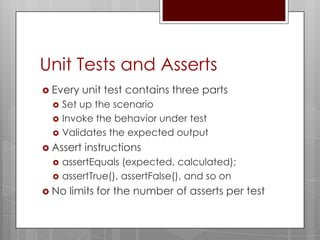
 Every    unit test contains three parts
     Set up the scenario
     Invoke the behavior under test
     Validates the expected output
 Assert   instructions
     assertEquals (expected, calculated);
     assertTrue(), assertFalse(), and so on
 No   limits for the number of asserts per test
A little piece of code
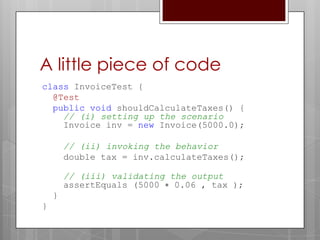
class InvoiceTest {
  @Test
  public void shouldCalculateTaxes() {
    // (i) setting up the scenario
    Invoice inv = new Invoice(5000.0);

        // (ii) invoking the behavior
        double tax = inv.calculateTaxes();

        // (iii) validating the output
        assertEquals (5000 ∗ 0.06 , tax );
    }
}
Why would…
…     a test contain more than one assert?
 Is it a smell of bad code/design?
Research Design
 We    selected 22 projects
     19 from ASF
     3 from a Brazilian consultancy
 Data   extraction from all projects
     Code metrics
 Statistical
            Test
 Qualitative Analysis
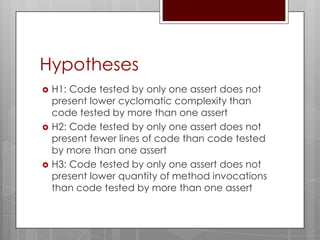
Hypotheses
   H1: Code tested by only one assert does not
    present lower cyclomatic complexity than
    code tested by more than one assert
   H2: Code tested by only one assert does not
    present fewer lines of code than code tested
    by more than one assert
   H3: Code tested by only one assert does not
    present lower quantity of method invocations
    than code tested by more than one assert
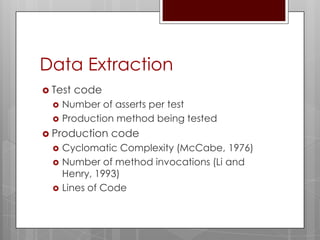
Data Extraction
 Test   code
     Number of asserts per test
     Production method being tested
 Production    code
     Cyclomatic Complexity (McCabe, 1976)
     Number of method invocations (Li and
      Henry, 1993)
     Lines of Code
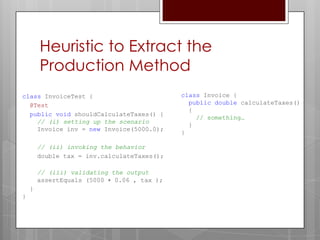
Heuristic to Extract the
        Production Method
class InvoiceTest {                          class Invoice {
  @Test                                        public double calculateTaxes()
                                               {
  public void shouldCalculateTaxes() {
                                                 // something…
    // (i) setting up the scenario
                                               }
    Invoice inv = new Invoice(5000.0);
                                             }

        // (ii) invoking the behavior
        double tax = inv.calculateTaxes();

        // (iii) validating the output
        assertEquals (5000 ∗ 0.06 , tax );
    }
}
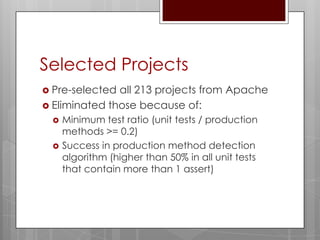
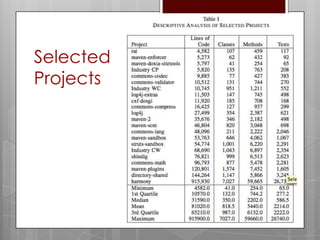
Selected Projects
 Pre-selected all 213 projects from Apache
 Eliminated those because of:
    Minimum test ratio (unit tests / production
     methods >= 0.2)
    Success in production method detection
     algorithm (higher than 50% in all unit tests
     that contain more than 1 assert)
Selected
Projects
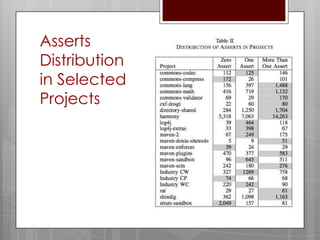
Asserts
Distribution
in Selected
Projects
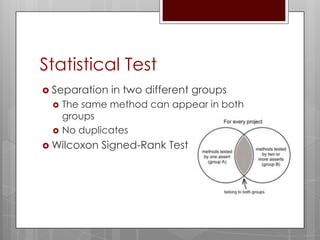
Statistical Test
 Separation   in two different groups
    The same method can appear in both
     groups
    No duplicates
 Wilcoxon   Signed-Rank Test
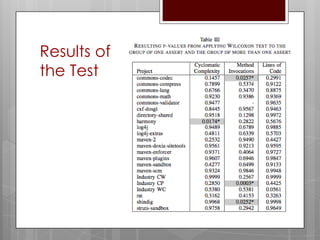
Results of
the Test
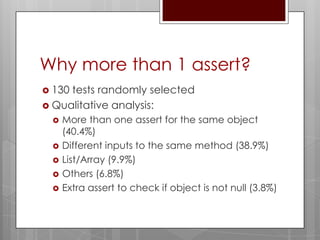
Why more than 1 assert?
 130tests randomly selected
 Qualitative analysis:
    More than one assert for the same object
     (40.4%)
    Different inputs to the same method (38.9%)
    List/Array (9.9%)
    Others (6.8%)
    Extra assert to check if object is not null (3.8%)
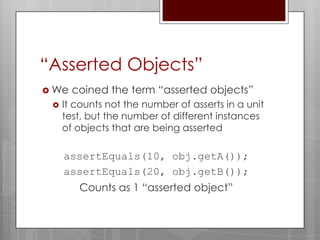
“Asserted Objects”
 We   coined the term “asserted objects”
    It counts not the number of asserts in a unit
     test, but the number of different instances
     of objects that are being asserted

     assertEquals(10, obj.getA());
     assertEquals(20, obj.getB());
        Counts as 1 “asserted object”
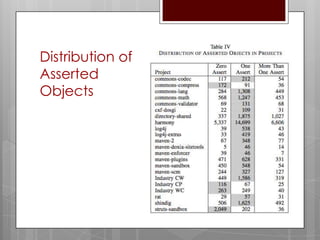
Distribution of
Asserted
Objects
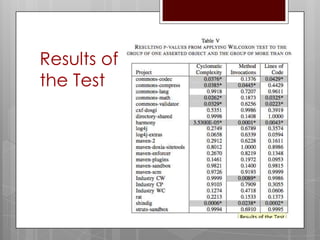
Results of
the Test
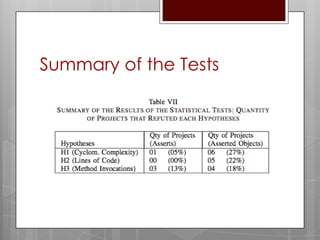
Summary of the Tests
Findings
   Counting the number of asserts in a unit test
    does not give valuable feedback about
    code quality
       But counting the number of asserted objects
        may provide useful information
       However, the difference between both groups
        was not “big”
   A possible explanation:
       Methods that contain higher CC, lines of code,
        and method invocations contains many
        different paths, and developers prefer to write
        all of it in a single unit test, rather than splitting in
        many of them
Threats to Validity
 Many   unit tests variations that are not
  supported by our tool
 The production method detection
  algorithm
 Before/After methods
 The projects’ filtering process
 Integration and system tests
Related Work
 Mostsimilar to our work: Bruntink and van
 Deursen (2006).
    Significant correlation between class
     metrics (fan out, size of a class, response for
     a class) and test metrics (size of the class,
     number of asserts).
Conclusions
 The
    number of asserts does not tell us
 anything about the production code
 quality
    But the number of asserted objects does.
    “More than one asserted object per test”
     smell
 Theneed of replicating the study with a
 larger amount of industry projects
Contact Information
   Mauricio Aniche
    aniche@ime.usp.br / @mauricioaniche
   Gustavo Oliva
    goliva@ime.usp.br / @golivax
   Marco Gerosa
    gerosa@ime.usp.br

Software Engineering & Collaborative Systems
           Research Lab (LAPESSC)
          http://lapessc.ime.usp.br/

What Do the Asserts in a Unit Test Tell Us About Code Quality? (CSMR2013)

  • 1.
    IME-USP What Do the Assertsin a Unit Test Tell us About Code Quality? Mauricio Aniche Gustavo Oliva Marco Gerosa University of São Paulo (USP)
  • 2.
    Unit Tests andCode Quality  Great synergy between a testable class and a well-designed class (Feathers, 2012)  The write of unit tests can become complex as the interactions between software components grow out of control (McGregor, 2001)  Agile practitioners state that unit tests are a way to validate and improve class design (Beck et al, 2001)
  • 3.
    Unit Tests andAsserts  Every unit test contains three parts  Set up the scenario  Invoke the behavior under test  Validates the expected output  Assert instructions  assertEquals (expected, calculated);  assertTrue(), assertFalse(), and so on  No limits for the number of asserts per test
  • 4.
    A little pieceof code class InvoiceTest { @Test public void shouldCalculateTaxes() { // (i) setting up the scenario Invoice inv = new Invoice(5000.0); // (ii) invoking the behavior double tax = inv.calculateTaxes(); // (iii) validating the output assertEquals (5000 ∗ 0.06 , tax ); } }
  • 5.
    Why would… … a test contain more than one assert?  Is it a smell of bad code/design?
  • 6.
    Research Design  We selected 22 projects  19 from ASF  3 from a Brazilian consultancy  Data extraction from all projects  Code metrics  Statistical Test  Qualitative Analysis
  • 7.
    Hypotheses  H1: Code tested by only one assert does not present lower cyclomatic complexity than code tested by more than one assert  H2: Code tested by only one assert does not present fewer lines of code than code tested by more than one assert  H3: Code tested by only one assert does not present lower quantity of method invocations than code tested by more than one assert
  • 8.
    Data Extraction  Test code  Number of asserts per test  Production method being tested  Production code  Cyclomatic Complexity (McCabe, 1976)  Number of method invocations (Li and Henry, 1993)  Lines of Code
  • 9.
    Heuristic to Extractthe Production Method class InvoiceTest { class Invoice { @Test public double calculateTaxes() { public void shouldCalculateTaxes() { // something… // (i) setting up the scenario } Invoice inv = new Invoice(5000.0); } // (ii) invoking the behavior double tax = inv.calculateTaxes(); // (iii) validating the output assertEquals (5000 ∗ 0.06 , tax ); } }
  • 10.
    Selected Projects  Pre-selectedall 213 projects from Apache  Eliminated those because of:  Minimum test ratio (unit tests / production methods >= 0.2)  Success in production method detection algorithm (higher than 50% in all unit tests that contain more than 1 assert)
  • 11.
  • 12.
  • 13.
    Statistical Test  Separation in two different groups  The same method can appear in both groups  No duplicates  Wilcoxon Signed-Rank Test
  • 14.
  • 15.
    Why more than1 assert?  130tests randomly selected  Qualitative analysis:  More than one assert for the same object (40.4%)  Different inputs to the same method (38.9%)  List/Array (9.9%)  Others (6.8%)  Extra assert to check if object is not null (3.8%)
  • 16.
    “Asserted Objects”  We coined the term “asserted objects”  It counts not the number of asserts in a unit test, but the number of different instances of objects that are being asserted assertEquals(10, obj.getA()); assertEquals(20, obj.getB()); Counts as 1 “asserted object”
  • 17.
  • 18.
  • 19.
  • 20.
    Findings  Counting the number of asserts in a unit test does not give valuable feedback about code quality  But counting the number of asserted objects may provide useful information  However, the difference between both groups was not “big”  A possible explanation:  Methods that contain higher CC, lines of code, and method invocations contains many different paths, and developers prefer to write all of it in a single unit test, rather than splitting in many of them
  • 21.
    Threats to Validity Many unit tests variations that are not supported by our tool  The production method detection algorithm  Before/After methods  The projects’ filtering process  Integration and system tests
  • 22.
    Related Work  Mostsimilarto our work: Bruntink and van Deursen (2006).  Significant correlation between class metrics (fan out, size of a class, response for a class) and test metrics (size of the class, number of asserts).
  • 23.
    Conclusions  The number of asserts does not tell us anything about the production code quality  But the number of asserted objects does.  “More than one asserted object per test” smell  Theneed of replicating the study with a larger amount of industry projects
  • 24.
    Contact Information  Mauricio Aniche aniche@ime.usp.br / @mauricioaniche  Gustavo Oliva goliva@ime.usp.br / @golivax  Marco Gerosa gerosa@ime.usp.br Software Engineering & Collaborative Systems Research Lab (LAPESSC) http://lapessc.ime.usp.br/

Editor's Notes

  • #14 É importante dizer o porquê da escolha desse teste estatístico