
Sleep
problems and
Disturbances
Insomnia
Is characterized by difficulty
in falling asleep, frequent
nighttime awakenings,
waking too early, or any
combination of these.
Common Advices for
Insomnia
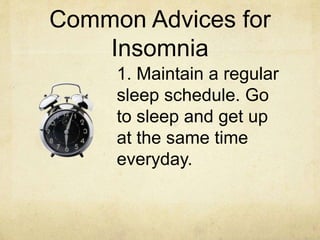
1. Maintain a regular
sleep schedule. Go
to sleep and get up
at the same time
everyday.
HOW MUCH DO WE
REALLY NEED?
Newborns (0-3 mos.) – 14-17
hrs
Infant (4-11 mos.) – 12-15
hrs
Toddlers (1-2 yrs.) – 11-14
hrs
Preschoolers (3-5 yrs.) – 11-
14 hrs
Teenagers (14-17 yrs) – 8-10
hrs
Young Adults (18-25 yrs) – 7-
9hrs
Adults (26-64 yrs) – 7-9 hrs
Older adults (65+) – 7-8 hrs
Reference from https://sleepfoundation.org
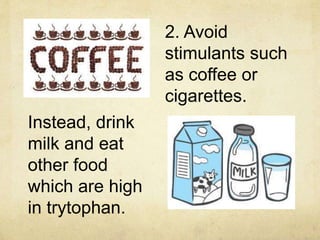
2. Avoid
stimulants such
as coffee or
cigarettes.
Instead, drink
milk and eat
other food
which are high
in trytophan.
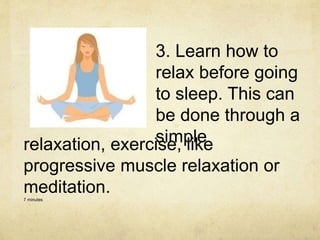
3. Learn how to
relax before going
to sleep. This can
be done through a
simplerelaxation, exercise, like
progressive muscle relaxation or
meditation.7 minutes
SLEEPING
POSITIONS
(Pros and
cons)
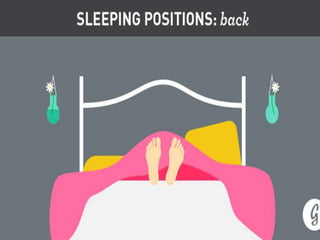
Pros: Many doctors agree that back is best.
Snoozing in savasana pose is a boon for spine and
neck health, because the back is straight and not
forced into any contortions. Plus back sleeping
helps the mattress do its job of supporting the spine.
In a perfect (and kind of uncomfy) world, everyone
would sleep on their backs without a pillow, as this
position leaves the neck in a neutral position. Using
too many pillows, however, can make breathing
more difficult. Dapat yung batok straight lang
Back sleeping is also a winner for the more
cosmetically inclined. Spending all night with the
face out in the air—and not smooshed up against a
pillow—leads to fewer facial wrinkles
Cons: Instances of snoring and sleep apnea
are much more frequent when a person is
sleeping in the supine position. In fact, back
sleeping is so closely linked to sleep apnea
that doctors prescribe side sleeping as a
treatment for the condition . When we sleep
on our backs, gravity forces the base of the
tongue to collapse into the airway, which
obstructs breathing and creates snore
noises.
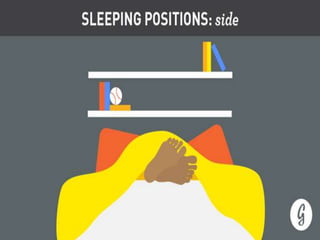
Pros: Doctors encourage sleeping on the
left side during pregnancy because it
improves circulation to the heart, which
benefits both mom and baby. Side sleeping
is also a pregnancy winner because
sleeping on the back puts pressure on the
lower back (which can lead to fainting) and
stomach-sleeping is impossible for obvious
reasons . For those not expecting, sleeping
on the left side can also ease heartburn
and acid reflux, making it easier for people
with these conditions to doze off.
Cons: At the same time, sleeping on the left side
can put pressure on the stomach and lungs
(alternating sides often can help prevent organ
strain). And as almost all side-sleepers know
well, this position can result in the dreaded
squished-arm-numbness. Snuggling into bed with
the arm behind the head is a common sleep
position, but it may adversely affect muscles and
nerves. Resting the head (or the whole body) on
a single arm can restrict blood flow and press
down on the nerves, which results in “rubber arm”
or painful pins and needles. Numb vs cramps In this
position, the shoulder supports a lot of the body’s
weight, which can constrict the neck and
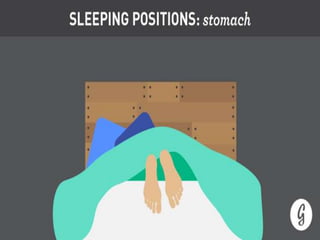
Pros: Stomach sleeping eases snoring and some
cases of sleep apnea
Cons: Resting on the tummy is widely regarded as
the worst sleeping position. It flattens the natural
curve of the spine, which can lead to lower back
pain. Sleeping all night with the head turned to
one side also strains the neck. If this is the
preferred position, try using pillows to gradually
train the body to sleep on one side. Lower back
twinges? Try sticking a pillow under the hips and
lower abdomen to give the bottom of the spine a
boost. Reference from: www.greatist.com
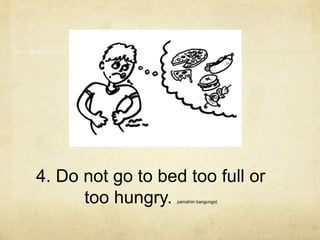
4. Do not go to bed too full or
too hungry. pamahiin bangungot
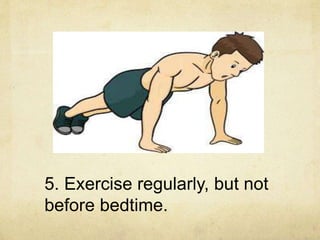
5. Exercise regularly, but not
before bedtime.
6. DON’T FIGHT INSOMNIA.
Instead of forcing the self to
sleep, get out of bed and
engage in some activity. Go
back to bed when you feel
sleepy again.
Narcolepsy
Is characterized by an
uncontrollable tendency to
fall asleep. The disorder is
supposed to be hereditary.
People with narcolepsy have trouble staying
awake; they often feel drowsy and fall asleep,
even in the middle of the day, sometime in the
middle of activities that produce strong emotions.
It is thought that narcolepsy occurs when rapid
eye movement (REM) sleep occurs while people
are awake. Although the cause of narcolepsy is
unknown, it does occasionally run in families. If
one person in a family has the disorder, another
relative may be susceptible to developing it if
certain environmental triggers occur. It is also a
lifelong disease.
Possible treatments:
Medications such as
stimulants (amphetamines,
Ritalin) that increase alertness
are often used to treat
narcolepsy. However, stimulants
may cause side effects including
headaches, nervousness, and
mood changes. Antidepressant
medication is also used to treat
Apnea
Is characterized by breathing
difficulty and even cessation of
breathing while the person is
asleep. It may stop from 20 sec
to 2 mins. Sleeper has to wake
up several times throughout the
night to gulp in air but may not
be aware of it.
2 Types of Sleep Apnea
Obstructive Sleep Apnea
(OSA) – airway is blocked
Central Sleep Apnea –
airway is not blocked
Risk factors for Sleep
Apnea
Male
Overweight
Age over 40
Having a large
neck (17 in or greater
in men, 16 or greater in
women)
Having large tonsils,
large tongue or small
jaw bone
Family history
GERD
Nasal obstruction
Effects of Sleep Apnea if
left untreated
High blood
pressure
Stroke
Heart failure
Diabetes
Depression
Worsening of
ADHD
Headaches
Hypersomnia
Is too much sleep. They
sleep longer than most
people at night but also feel
tired and take sleep naps
during the day.
Cause of Hypersomnia
Sleep disorderslike the
narcolepsy and apnea
Sleep deprivation
Overweight
Drug or alcohol
abuse
Head injury or
neurological
disease
Prescription drugs
such as tranquilizers
or antihistamines
Genetics
Depressions
Possible treatments
Drugs – stimulants or
antidepressants
If you are diagnosed with
this, your doctor might
recommend CPAP or
continuous positive airway
pressure
Somnambulism
Or sleepwalking
The person commonly rises from his
bed and wanders about. In the
morning, sleepwalkers do not have
any memory of their travels. Sleep
walking itself is not dangerous, but
accidents can happen.
Symptoms
Sleep talking
Little or no memory at all
Inappropriate behavior such as urinating in closets, kids
Screaming when sleepwalking
occurs in connection with sleep
terrors
Violent attacks on the person trying
to wake up
Possible treatments
No specific treatments but
sleep hygiene may help
For adults, hypnosis
Common in children but is
usually outgrown over time if not
see a doctor
Nightmares
Are dreams that involve little
or no movement at all. The
contents can be remembered
by the dreamers.
A nightmare is a dream occurring
during rapid eye movement
(REM) sleep that results in
feelings of strong terror, fear,
distress or extreme anxiety. This
phenomenon tends to occur in the
latter part of the night and
oftentimes awakens the sleeper,
who is likely to recall the content
of the dream.
• Anxiety or stress is the most common: In 60
percent of cases, a major life event precedes the
onset of nightmares
• Illness with a fever
• Death of a loved one (bereavement)
• Adverse reaction to or side effect of a drug
• Recent withdrawal from a drug such as sleeping
pills
• Excessive alcohol consumption
• Abrupt alcohol withdrawal
• Breathing disorder in sleep (sleep apnea)
• Sleep disorders (narcolepsy, sleep terror
disorder)
• Eating just before going to bed, which raises the
body's metabolism and brain activity, may cause
Possible treatments
Relaxation therapy – removing of
muscle tension
If you are under severe stress,
seek out to your friends or
relatives. Speaking up what’s on
your mind relieves.
Try regular aerobics routine to be
able to sleep faster, be in deep
sleep, and wake up feeling
Night terrors or horrors
Are often accompanied by a
horrific

Sleeping problems & disturbances

  • 1.
  • 3.
    Insomnia Is characterized bydifficulty in falling asleep, frequent nighttime awakenings, waking too early, or any combination of these.
  • 4.
    Common Advices for Insomnia 1.Maintain a regular sleep schedule. Go to sleep and get up at the same time everyday.
  • 5.
    HOW MUCH DOWE REALLY NEED? Newborns (0-3 mos.) – 14-17 hrs Infant (4-11 mos.) – 12-15 hrs Toddlers (1-2 yrs.) – 11-14 hrs Preschoolers (3-5 yrs.) – 11- 14 hrs
  • 6.
    Teenagers (14-17 yrs)– 8-10 hrs Young Adults (18-25 yrs) – 7- 9hrs Adults (26-64 yrs) – 7-9 hrs Older adults (65+) – 7-8 hrs Reference from https://sleepfoundation.org
  • 7.
    2. Avoid stimulants such ascoffee or cigarettes. Instead, drink milk and eat other food which are high in trytophan.
  • 8.
    3. Learn howto relax before going to sleep. This can be done through a simplerelaxation, exercise, like progressive muscle relaxation or meditation.7 minutes
  • 9.
  • 11.
    Pros: Many doctorsagree that back is best. Snoozing in savasana pose is a boon for spine and neck health, because the back is straight and not forced into any contortions. Plus back sleeping helps the mattress do its job of supporting the spine. In a perfect (and kind of uncomfy) world, everyone would sleep on their backs without a pillow, as this position leaves the neck in a neutral position. Using too many pillows, however, can make breathing more difficult. Dapat yung batok straight lang Back sleeping is also a winner for the more cosmetically inclined. Spending all night with the face out in the air—and not smooshed up against a pillow—leads to fewer facial wrinkles
  • 12.
    Cons: Instances ofsnoring and sleep apnea are much more frequent when a person is sleeping in the supine position. In fact, back sleeping is so closely linked to sleep apnea that doctors prescribe side sleeping as a treatment for the condition . When we sleep on our backs, gravity forces the base of the tongue to collapse into the airway, which obstructs breathing and creates snore noises.
  • 14.
    Pros: Doctors encouragesleeping on the left side during pregnancy because it improves circulation to the heart, which benefits both mom and baby. Side sleeping is also a pregnancy winner because sleeping on the back puts pressure on the lower back (which can lead to fainting) and stomach-sleeping is impossible for obvious reasons . For those not expecting, sleeping on the left side can also ease heartburn and acid reflux, making it easier for people with these conditions to doze off.
  • 15.
    Cons: At thesame time, sleeping on the left side can put pressure on the stomach and lungs (alternating sides often can help prevent organ strain). And as almost all side-sleepers know well, this position can result in the dreaded squished-arm-numbness. Snuggling into bed with the arm behind the head is a common sleep position, but it may adversely affect muscles and nerves. Resting the head (or the whole body) on a single arm can restrict blood flow and press down on the nerves, which results in “rubber arm” or painful pins and needles. Numb vs cramps In this position, the shoulder supports a lot of the body’s weight, which can constrict the neck and
  • 17.
    Pros: Stomach sleepingeases snoring and some cases of sleep apnea Cons: Resting on the tummy is widely regarded as the worst sleeping position. It flattens the natural curve of the spine, which can lead to lower back pain. Sleeping all night with the head turned to one side also strains the neck. If this is the preferred position, try using pillows to gradually train the body to sleep on one side. Lower back twinges? Try sticking a pillow under the hips and lower abdomen to give the bottom of the spine a boost. Reference from: www.greatist.com
  • 18.
    4. Do notgo to bed too full or too hungry. pamahiin bangungot
  • 19.
    5. Exercise regularly,but not before bedtime.
  • 20.
    6. DON’T FIGHTINSOMNIA. Instead of forcing the self to sleep, get out of bed and engage in some activity. Go back to bed when you feel sleepy again.
  • 21.
    Narcolepsy Is characterized byan uncontrollable tendency to fall asleep. The disorder is supposed to be hereditary.
  • 22.
    People with narcolepsyhave trouble staying awake; they often feel drowsy and fall asleep, even in the middle of the day, sometime in the middle of activities that produce strong emotions. It is thought that narcolepsy occurs when rapid eye movement (REM) sleep occurs while people are awake. Although the cause of narcolepsy is unknown, it does occasionally run in families. If one person in a family has the disorder, another relative may be susceptible to developing it if certain environmental triggers occur. It is also a lifelong disease.
  • 23.
    Possible treatments: Medications suchas stimulants (amphetamines, Ritalin) that increase alertness are often used to treat narcolepsy. However, stimulants may cause side effects including headaches, nervousness, and mood changes. Antidepressant medication is also used to treat
  • 24.
    Apnea Is characterized bybreathing difficulty and even cessation of breathing while the person is asleep. It may stop from 20 sec to 2 mins. Sleeper has to wake up several times throughout the night to gulp in air but may not be aware of it.
  • 25.
    2 Types ofSleep Apnea Obstructive Sleep Apnea (OSA) – airway is blocked Central Sleep Apnea – airway is not blocked
  • 26.
    Risk factors forSleep Apnea Male Overweight Age over 40 Having a large neck (17 in or greater in men, 16 or greater in women) Having large tonsils, large tongue or small jaw bone Family history GERD Nasal obstruction
  • 27.
    Effects of SleepApnea if left untreated High blood pressure Stroke Heart failure Diabetes Depression Worsening of ADHD Headaches
  • 28.
    Hypersomnia Is too muchsleep. They sleep longer than most people at night but also feel tired and take sleep naps during the day.
  • 29.
    Cause of Hypersomnia Sleepdisorderslike the narcolepsy and apnea Sleep deprivation Overweight Drug or alcohol abuse Head injury or neurological disease Prescription drugs such as tranquilizers or antihistamines Genetics Depressions
  • 30.
    Possible treatments Drugs –stimulants or antidepressants If you are diagnosed with this, your doctor might recommend CPAP or continuous positive airway pressure
  • 31.
    Somnambulism Or sleepwalking The personcommonly rises from his bed and wanders about. In the morning, sleepwalkers do not have any memory of their travels. Sleep walking itself is not dangerous, but accidents can happen.
  • 32.
    Symptoms Sleep talking Little orno memory at all Inappropriate behavior such as urinating in closets, kids Screaming when sleepwalking occurs in connection with sleep terrors Violent attacks on the person trying to wake up
  • 33.
    Possible treatments No specifictreatments but sleep hygiene may help For adults, hypnosis Common in children but is usually outgrown over time if not see a doctor
  • 34.
    Nightmares Are dreams thatinvolve little or no movement at all. The contents can be remembered by the dreamers.
  • 35.
    A nightmare isa dream occurring during rapid eye movement (REM) sleep that results in feelings of strong terror, fear, distress or extreme anxiety. This phenomenon tends to occur in the latter part of the night and oftentimes awakens the sleeper, who is likely to recall the content of the dream.
  • 36.
    • Anxiety orstress is the most common: In 60 percent of cases, a major life event precedes the onset of nightmares • Illness with a fever • Death of a loved one (bereavement) • Adverse reaction to or side effect of a drug • Recent withdrawal from a drug such as sleeping pills • Excessive alcohol consumption • Abrupt alcohol withdrawal • Breathing disorder in sleep (sleep apnea) • Sleep disorders (narcolepsy, sleep terror disorder) • Eating just before going to bed, which raises the body's metabolism and brain activity, may cause
  • 37.
    Possible treatments Relaxation therapy– removing of muscle tension If you are under severe stress, seek out to your friends or relatives. Speaking up what’s on your mind relieves. Try regular aerobics routine to be able to sleep faster, be in deep sleep, and wake up feeling
  • 38.
    Night terrors orhorrors Are often accompanied by a horrific