Using Competitive Intelligence to
Build Leadership Capability

An Leadership & Management Division Webinar
February 28 , 2014
Zena Applebaum
@ZAppleCI
applebaumz@bennettjones.com
Agenda
• A Comment on Language for this presentation
• Who is Doing Your Job?
•

•
•
•
•
•
•
•
•

Taking it back

Why Now?
What is Competitive Intelligence
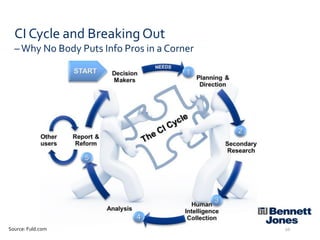
The Intelligence Cycle and Info Pros
Tools, Deliverables & Analysis Frameworks
Communication Success
Fire Fighter to Leader
What Next?
Conclusion & Questions

2
Who is Doing Your Job?
Exercise:

Draw a picture/write a description
– who are you at work?

3
Is Google Doing Your Job?

4
Is McKinsey Doing Your
Job?
5
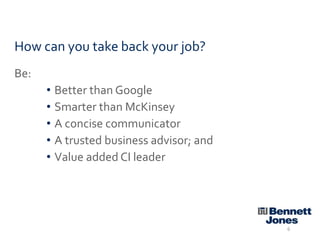
How can you take back your job?
Be:
• Better than Google
• Smarter than McKinsey
• A concise communicator
• A trusted business advisor; and
• Value added CI leader

6
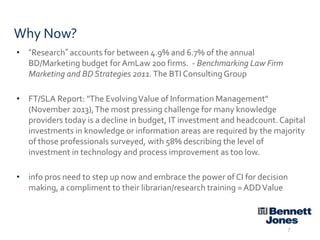
Why Now?
• “Research” accounts for between 4.9% and 6.7% of the annual
BD/Marketing budget for AmLaw 200 firms. - Benchmarking Law Firm
Marketing and BD Strategies 2011. The BTI Consulting Group
• FT/SLA Report: "The Evolving Value of Information Management"
(November 2013), The most pressing challenge for many knowledge
providers today is a decline in budget, IT investment and headcount. Capital
investments in knowledge or information areas are required by the majority
of those professionals surveyed, with 58% describing the level of
investment in technology and process improvement as too low.
• info pros need to step up now and embrace the power of CI for decision
making, a compliment to their librarian/research training = ADD Value

7
The Crystal Ball Feature
• What is the Library 2.0?
There is now, more than ever, a need for librarians to be “big picture” people.
Sure, there will always be the need for cataloguers, reference librarians and
administrative people who keep the day-to-day functioning of the library going,
but what we need most are librarians who are visionaries, people who can see
where we need to be and outline how to get there. Library directors should be
looking at the long-range needs […]and then moving the firm forward. Of
course, the future is unknown. Given the economic climate, the volatility of the
[…] industry and the ever-changing face of […]publishing, it’s impossible to say
with certainty what the future will hold. But we do know it will change, and we
know that we can direct some of that change by anticipating it, planning for it,
working toward it. Surely the Librarian 2.0 will have a feature that will allow
forecasting of the future.
http://www.lexisnexis.com/tsg/gov/Best_Practices_2009.pdf
8
What is Competitive Intelligence?

“systematic and ethical program for gathering, analyzing, and managing external
information that can affect you.” - www.SCIP.org

9
CI Cycle and Breaking Out
– Why No Body Puts Info Pros in a Corner

Source: Fuld.com

10
Where do you find Competitive Intelligence?
• Everywhere!
• Proprietary Information
• Human Intelligence (vendors, suppliers, clients, sales)
• Databases (subscriptions)

• Publicly available information
• Filings
• Newspapers
• Social media

11
CI Job Description
The primary role of this position is the efficient mining, development, reporting and use of
competitive intelligence (CI) data to help drive the firm’s marketing and business development
efforts. Candidate will work in the Business Development Department and report to the CI Manager.
Essential Duties:
• Support business, client, competitive, and market intelligence with complex, on-demand
primary and secondary research. Analyze and summarize findings. Develop intelligence reports
and briefing documents.
• Support market intelligence and monitoring. Train and assist users in creating marketing
environments and news alerts.
• Compile and track CI requests.
• Work with CI manager and BD team to demonstrate ROI on CI.
Specific Requirements:
• Course of study in library or information sciences (MLS or MLIS) strongly preferred.
Combination of education in a research-intensive field with relevant work experience will be
considered.
12
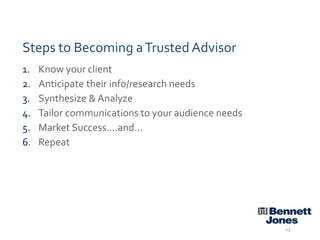
Steps to Becoming a Trusted Advisor
1.
2.
3.
4.
5.
6.

Know your client
Anticipate their info/research needs
Synthesize & Analyze
Tailor communications to your audience needs
Market Success….and…
Repeat

13
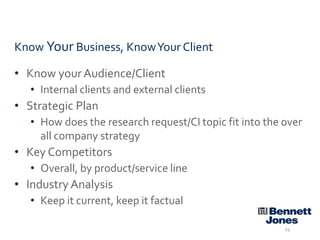
Know Your Business, Know Your Client
• Know your Audience/Client
• Internal clients and external clients

• Strategic Plan
• How does the research request/CI topic fit into the over
all company strategy

• Key Competitors
• Overall, by product/service line

• Industry Analysis
• Keep it current, keep it factual
14
Your Client is the CEO/Strategy Director, BD Director
What are the information/intel needs of the C-Suite?

How can/do you provide these?

15
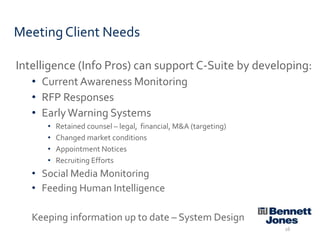
Meeting Client Needs
Intelligence (Info Pros) can support C-Suite by developing:
• Current Awareness Monitoring
• RFP Responses
• Early Warning Systems
•
•
•
•

Retained counsel – legal, financial, M&A (targeting)
Changed market conditions
Appointment Notices
Recruiting Efforts

• Social Media Monitoring
• Feeding Human Intelligence
Keeping information up to date – System Design
16
Current Awareness Monitoring
Opportunity Identification
•
•
•
•

(Crystal Ball!)
Customized Portal w/ or w/o analysts
Automated & annotated newsletters
Alerts from Databases
Filings Monitors

Key Developments – Early Warning Indicators
•
•
•
•

Retained counsel – financial, M&A, advisory
Changed market conditions
Appointment Notices
Recruiting Efforts
17
RFP Responses - A made for Leadership, CI Story
• Perhaps the easiest place to apply traditional CI
analysis techniques and elicitation tactics
• Win/loss analysis
• SWOT
• Should we pursue?

• Timeline analysis

18
Media and Social Monitoring
• Rife spot find qualitative and quantitative data on
clients/prospects as well as competitor clients/prospects
• (in an effort to turn the latter into the former)

• Monitor for tone, content, frequency, trending, sentiment
• Big Data can turn into CI Data points (earlier JD)
Develop a system or software or buy a third party platform.
Mechanics/data can be easily outsourced of but still requires a
heightened knowledge of the firm and its strategy – human touch.

19
Build Internal Networks – Human Intelligence
• In an era of information ubiquity, human intelligence
sets our organizations apart.
• Libraries can take on a (new) role as central hubs for
information can be the hub and spoke for Human
Intelligence and Information Collection (CI Cycle)
• Info Pros/Researchers/Librarians can connect the dots
between secondary, tertiary and human research,
turning it into intelligence.

20
Internal Networks & Data Centers
•
•
•
•
•
•
•

Other Researchers –R&D, KM, Market Research
Accounting Data – P&L, Product Lines
CRM and other Database(s)
Syndicated Research
Subscription Databases
News Media/Social Media Monitoring & Tools
Analysis Reference Tools – Analysis Without Paralysis

21
Providing Added Value – Analysis
Why you don’t need to be afraid…
We view competitive intelligence analysis as the multifaceted means by which
information is interpreted to produce insightful findings (i.e., intelligence) or
recommendations for organizational action. Defined as such, we do not view
analysis as being solely in the domain of either pure art or science, but as
requiring to some degree both of these. We also view analysis as being both a
process (i.e., the multifaceted means we defined) and a product (i.e., the
interpretation output). Lastly, our definition suggests that analysis must pass
the “so what?” test in order to usefully aid decision-making and action-taking.
(http://www.mindshiftsgroup.com/articles/the_farout_method.pdf Fleisher/Bensasson)

22
Analysis Frameworks & Products
Context. A picture frame. A perspective. A methodology. That’s
it, that’s all. Fancy language to explain something we all do
inherently each and every day.
Frameworks are universally understood, taught and used
throughout the business community but you don’t need a business
degree to use them.

23
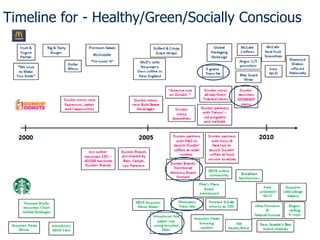
Analysis Framework – TimeLine Analysis
Display events in a chronological and graphical manner to identify
important trends and relationships between competitor business
activities
• Systematic layout of events related to the key question
• Look for events, trends, patterns, and sequences
• Cause & Effect

• List the important events as a chronology
• Array the events for all competitors on the timeline
• Summarize and hypothesize

Timeline Analysis Source: CID July 2012 presentation “Analytical Tools that Deliver Value” Bernaiche/Wergeles
24
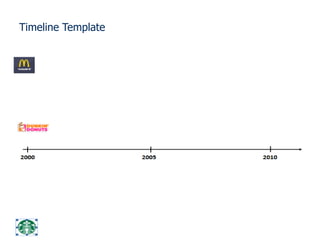
Timeline Template
Timeline for - Healthy/Green/Socially Conscious
Communication
The Medium is the Message – Marshall McLuhan
• How you communicate is as important as what what you
provide.
• What does the data dump say about your understanding of needs
and issues?

• Create a series of CI/Research products that communicate
concisely and directly in line with the client needs.
27
Concise Communication is Essential
Email/Voice mail
•
•
•
•

To the point
Address specific project(s)
Ask for a short meeting to discuss if necessary
Follow Up

Report/Memo/Presentation
•
•
•
•
•

Methodology
Address key priorities, business drivers, dilemma’s
Sharp summary – up front
Possible recommendations
Provide Opportunity for Next Steps

- page 28
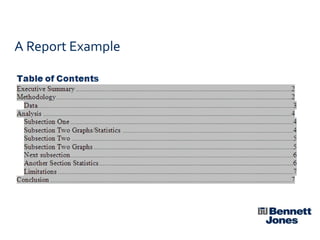
A Report Example
How do you become a leader and trusted advisor?
Ongoing articulation of added value by demonstrating
intelligence expertise in relation to company needs and
Ongoing demonstration of your value by
support of the business goals through effective
articulating the intelligence expertise in
communication. to your company’s
relation
needs and the support of
the business goals

Client specific, anticipated “actionable intelligence” makes for a
trusted advisor and is always better than Google or McKinsey.

30
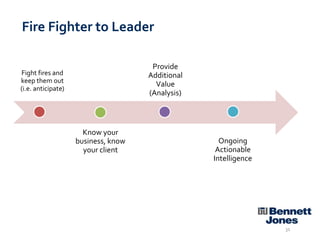
Fire Fighter to Leader
Provide
Additional
Value
(Analysis)

Fight fires and
keep them out
(i.e. anticipate)

Know your
business, know
your client

Ongoing
Actionable
Intelligence

31
Career Resources
Professional Associations/Organizations
• SLA-CID
• SCIP
• Intel Collab
• AIIP

Professional Development/Education
•
•
•
•

SLA CID – CE Courses & Sessions
ICI
Fuld
Mercyhurst

32
What’s Next?
•
•
•
•
•

Hide in plain sight
Get out and be seen
Engender trust, and use it for good
Don’t collect data for data sake – engage the human element
Join the SLA CID as well!

Thank you and good luck in your CI efforts!

33
LMD Announcements
•

Survey link:
http://www.surveymonkey.com/s/52Q5Q58

•

Next webinar:
Writing for Publication
Speakers: Bruce Rosenstein and Stuart Hales
March 19, 2014
2 pm EST

34

Slalmd2014 cid presentation

  • 1.
    Using Competitive Intelligenceto Build Leadership Capability An Leadership & Management Division Webinar February 28 , 2014 Zena Applebaum @ZAppleCI applebaumz@bennettjones.com
  • 2.
    Agenda • A Commenton Language for this presentation • Who is Doing Your Job? • • • • • • • • • Taking it back Why Now? What is Competitive Intelligence The Intelligence Cycle and Info Pros Tools, Deliverables & Analysis Frameworks Communication Success Fire Fighter to Leader What Next? Conclusion & Questions 2
  • 3.
    Who is DoingYour Job? Exercise: Draw a picture/write a description – who are you at work? 3
  • 4.
    Is Google DoingYour Job? 4
  • 5.
    Is McKinsey DoingYour Job? 5
  • 6.
    How can youtake back your job? Be: • Better than Google • Smarter than McKinsey • A concise communicator • A trusted business advisor; and • Value added CI leader 6
  • 7.
    Why Now? • “Research”accounts for between 4.9% and 6.7% of the annual BD/Marketing budget for AmLaw 200 firms. - Benchmarking Law Firm Marketing and BD Strategies 2011. The BTI Consulting Group • FT/SLA Report: "The Evolving Value of Information Management" (November 2013), The most pressing challenge for many knowledge providers today is a decline in budget, IT investment and headcount. Capital investments in knowledge or information areas are required by the majority of those professionals surveyed, with 58% describing the level of investment in technology and process improvement as too low. • info pros need to step up now and embrace the power of CI for decision making, a compliment to their librarian/research training = ADD Value 7
  • 8.
    The Crystal BallFeature • What is the Library 2.0? There is now, more than ever, a need for librarians to be “big picture” people. Sure, there will always be the need for cataloguers, reference librarians and administrative people who keep the day-to-day functioning of the library going, but what we need most are librarians who are visionaries, people who can see where we need to be and outline how to get there. Library directors should be looking at the long-range needs […]and then moving the firm forward. Of course, the future is unknown. Given the economic climate, the volatility of the […] industry and the ever-changing face of […]publishing, it’s impossible to say with certainty what the future will hold. But we do know it will change, and we know that we can direct some of that change by anticipating it, planning for it, working toward it. Surely the Librarian 2.0 will have a feature that will allow forecasting of the future. http://www.lexisnexis.com/tsg/gov/Best_Practices_2009.pdf 8
  • 9.
    What is CompetitiveIntelligence? “systematic and ethical program for gathering, analyzing, and managing external information that can affect you.” - www.SCIP.org 9
  • 10.
    CI Cycle andBreaking Out – Why No Body Puts Info Pros in a Corner Source: Fuld.com 10
  • 11.
    Where do youfind Competitive Intelligence? • Everywhere! • Proprietary Information • Human Intelligence (vendors, suppliers, clients, sales) • Databases (subscriptions) • Publicly available information • Filings • Newspapers • Social media 11
  • 12.
    CI Job Description Theprimary role of this position is the efficient mining, development, reporting and use of competitive intelligence (CI) data to help drive the firm’s marketing and business development efforts. Candidate will work in the Business Development Department and report to the CI Manager. Essential Duties: • Support business, client, competitive, and market intelligence with complex, on-demand primary and secondary research. Analyze and summarize findings. Develop intelligence reports and briefing documents. • Support market intelligence and monitoring. Train and assist users in creating marketing environments and news alerts. • Compile and track CI requests. • Work with CI manager and BD team to demonstrate ROI on CI. Specific Requirements: • Course of study in library or information sciences (MLS or MLIS) strongly preferred. Combination of education in a research-intensive field with relevant work experience will be considered. 12
  • 13.
    Steps to Becominga Trusted Advisor 1. 2. 3. 4. 5. 6. Know your client Anticipate their info/research needs Synthesize & Analyze Tailor communications to your audience needs Market Success….and… Repeat 13
  • 14.
    Know Your Business,Know Your Client • Know your Audience/Client • Internal clients and external clients • Strategic Plan • How does the research request/CI topic fit into the over all company strategy • Key Competitors • Overall, by product/service line • Industry Analysis • Keep it current, keep it factual 14
  • 15.
    Your Client isthe CEO/Strategy Director, BD Director What are the information/intel needs of the C-Suite? How can/do you provide these? 15
  • 16.
    Meeting Client Needs Intelligence(Info Pros) can support C-Suite by developing: • Current Awareness Monitoring • RFP Responses • Early Warning Systems • • • • Retained counsel – legal, financial, M&A (targeting) Changed market conditions Appointment Notices Recruiting Efforts • Social Media Monitoring • Feeding Human Intelligence Keeping information up to date – System Design 16
  • 17.
    Current Awareness Monitoring OpportunityIdentification • • • • (Crystal Ball!) Customized Portal w/ or w/o analysts Automated & annotated newsletters Alerts from Databases Filings Monitors Key Developments – Early Warning Indicators • • • • Retained counsel – financial, M&A, advisory Changed market conditions Appointment Notices Recruiting Efforts 17
  • 18.
    RFP Responses -A made for Leadership, CI Story • Perhaps the easiest place to apply traditional CI analysis techniques and elicitation tactics • Win/loss analysis • SWOT • Should we pursue? • Timeline analysis 18
  • 19.
    Media and SocialMonitoring • Rife spot find qualitative and quantitative data on clients/prospects as well as competitor clients/prospects • (in an effort to turn the latter into the former) • Monitor for tone, content, frequency, trending, sentiment • Big Data can turn into CI Data points (earlier JD) Develop a system or software or buy a third party platform. Mechanics/data can be easily outsourced of but still requires a heightened knowledge of the firm and its strategy – human touch. 19
  • 20.
    Build Internal Networks– Human Intelligence • In an era of information ubiquity, human intelligence sets our organizations apart. • Libraries can take on a (new) role as central hubs for information can be the hub and spoke for Human Intelligence and Information Collection (CI Cycle) • Info Pros/Researchers/Librarians can connect the dots between secondary, tertiary and human research, turning it into intelligence. 20
  • 21.
    Internal Networks &Data Centers • • • • • • • Other Researchers –R&D, KM, Market Research Accounting Data – P&L, Product Lines CRM and other Database(s) Syndicated Research Subscription Databases News Media/Social Media Monitoring & Tools Analysis Reference Tools – Analysis Without Paralysis 21
  • 22.
    Providing Added Value– Analysis Why you don’t need to be afraid… We view competitive intelligence analysis as the multifaceted means by which information is interpreted to produce insightful findings (i.e., intelligence) or recommendations for organizational action. Defined as such, we do not view analysis as being solely in the domain of either pure art or science, but as requiring to some degree both of these. We also view analysis as being both a process (i.e., the multifaceted means we defined) and a product (i.e., the interpretation output). Lastly, our definition suggests that analysis must pass the “so what?” test in order to usefully aid decision-making and action-taking. (http://www.mindshiftsgroup.com/articles/the_farout_method.pdf Fleisher/Bensasson) 22
  • 23.
    Analysis Frameworks &Products Context. A picture frame. A perspective. A methodology. That’s it, that’s all. Fancy language to explain something we all do inherently each and every day. Frameworks are universally understood, taught and used throughout the business community but you don’t need a business degree to use them. 23
  • 24.
    Analysis Framework –TimeLine Analysis Display events in a chronological and graphical manner to identify important trends and relationships between competitor business activities • Systematic layout of events related to the key question • Look for events, trends, patterns, and sequences • Cause & Effect • List the important events as a chronology • Array the events for all competitors on the timeline • Summarize and hypothesize Timeline Analysis Source: CID July 2012 presentation “Analytical Tools that Deliver Value” Bernaiche/Wergeles 24
  • 25.
  • 26.
    Timeline for -Healthy/Green/Socially Conscious
  • 27.
    Communication The Medium isthe Message – Marshall McLuhan • How you communicate is as important as what what you provide. • What does the data dump say about your understanding of needs and issues? • Create a series of CI/Research products that communicate concisely and directly in line with the client needs. 27
  • 28.
    Concise Communication isEssential Email/Voice mail • • • • To the point Address specific project(s) Ask for a short meeting to discuss if necessary Follow Up Report/Memo/Presentation • • • • • Methodology Address key priorities, business drivers, dilemma’s Sharp summary – up front Possible recommendations Provide Opportunity for Next Steps - page 28
  • 29.
  • 30.
    How do youbecome a leader and trusted advisor? Ongoing articulation of added value by demonstrating intelligence expertise in relation to company needs and Ongoing demonstration of your value by support of the business goals through effective articulating the intelligence expertise in communication. to your company’s relation needs and the support of the business goals Client specific, anticipated “actionable intelligence” makes for a trusted advisor and is always better than Google or McKinsey. 30
  • 31.
    Fire Fighter toLeader Provide Additional Value (Analysis) Fight fires and keep them out (i.e. anticipate) Know your business, know your client Ongoing Actionable Intelligence 31
  • 32.
    Career Resources Professional Associations/Organizations •SLA-CID • SCIP • Intel Collab • AIIP Professional Development/Education • • • • SLA CID – CE Courses & Sessions ICI Fuld Mercyhurst 32
  • 33.
    What’s Next? • • • • • Hide inplain sight Get out and be seen Engender trust, and use it for good Don’t collect data for data sake – engage the human element Join the SLA CID as well! Thank you and good luck in your CI efforts! 33
  • 34.
    LMD Announcements • Survey link: http://www.surveymonkey.com/s/52Q5Q58 • Nextwebinar: Writing for Publication Speakers: Bruce Rosenstein and Stuart Hales March 19, 2014 2 pm EST 34