Building an Effective Organizational
Analytics Capability
Jeff Crawford, PhD, PMP
Director of Graduate Programs & Associate Professor
School of Computing and Informatics
Lipscomb University
jeff.crawford@lipscomb.edu
http://technology.lipscomb.edu/
Master of Science (MS) in Informatics and Analytics  Information Security  IT Management 
jeff.crawford@lipscomb.edu
https://www.linkedin.com/in/crawdoctor
Presented at the PMI Nashville 2014 Spring Symposium
April 11, 2014 @ 12:30pm
Music City Center, Nashville, TN
Presentation Thesis
• For organizational analytics to be
maximally effective, you must:
–Take a holistic, long-term view of analytics
• Think in terms of competencies, capabilities
and facilitating conditions
–Practice intentional implementation
• Take a cue from IT
Master of Science (MS) in Informatics and Analytics  Information Security  IT Management 
jeff.crawford@lipscomb.edu
https://www.linkedin.com/in/crawdoctor
What is analytics, exactly?
Master of Science (MS) in Informatics and Analytics  Information Security  IT Management 
jeff.crawford@lipscomb.edu
https://www.linkedin.com/in/crawdoctor
A reasonable view of analytics
• What?
– using data to understand the past and/or address the
present and/or predict the future
• Why?
– data -> information -> decision-making -> effective
decision-making
– competitive necessity
– it’s in the trade press…
Master of Science (MS) in Informatics and Analytics  Information Security  IT Management 
jeff.crawford@lipscomb.edu
https://www.linkedin.com/in/crawdoctor
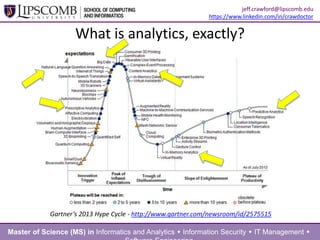
What is analytics, exactly?
Master of Science (MS) in Informatics and Analytics  Information Security  IT Management 
jeff.crawford@lipscomb.edu
https://www.linkedin.com/in/crawdoctor
Gartner’s 2013 Hype Cycle - http://www.gartner.com/newsroom/id/2575515
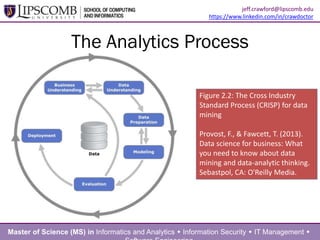
The Analytics Process
Figure 2.2: The Cross Industry
Standard Process (CRISP) for data
mining
Provost, F., & Fawcett, T. (2013).
Data science for business: What
you need to know about data
mining and data-analytic thinking.
Sebastpol, CA: O'Reilly Media.
jeff.crawford@lipscomb.edu
https://www.linkedin.com/in/crawdoctor
Master of Science (MS) in Informatics and Analytics  Information Security  IT Management 
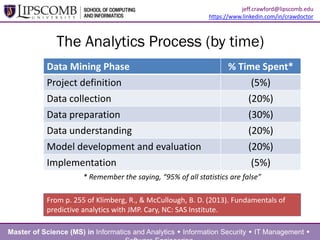
The Analytics Process (by time)
From p. 255 of Klimberg, R., & McCullough, B. D. (2013). Fundamentals of
predictive analytics with JMP. Cary, NC: SAS Institute.
Data Mining Phase % Time Spent*
Project definition (5%)
Data collection (20%)
Data preparation (30%)
Data understanding (20%)
Model development and evaluation (20%)
Implementation (5%)
Master of Science (MS) in Informatics and Analytics  Information Security  IT Management 
jeff.crawford@lipscomb.edu
https://www.linkedin.com/in/crawdoctor
* Remember the saying, “95% of all statistics are false”
ORGANIZATIONAL ANALYTICS
Maturity through Competencies and Capabilities
Master of Science (MS) in Informatics and Analytics  Information Security  IT Management 
jeff.crawford@lipscomb.edu
https://www.linkedin.com/in/crawdoctor
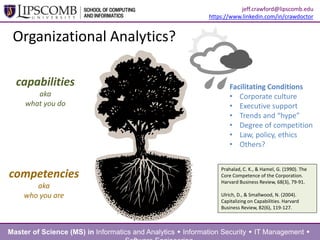
Organizational Analytics?
Prahalad, C. K., & Hamel, G. (1990). The
Core Competence of the Corporation.
Harvard Business Review, 68(3), 79-91.
Ulrich, D., & Smallwood, N. (2004).
Capitalizing on Capabilities. Harvard
Business Review, 82(6), 119-127.
“the diversified
corporation is a large
tree…the root system that
provides
nourishment, sustenance,
and stability is the core
competence” (Prahalad &
Hamel, 1990, p. 81)
“*capabilities are] the
collective skills, abilities
and expertise of an
organization” (Ulrich &
Smallwood, 2004, p. 119)
Facilitating Conditions
• Corporate culture
• Executive support
• Trends and “hype”
• Degree of competition
• Law, policy, ethics
• Others?
Master of Science (MS) in Informatics and Analytics  Information Security  IT Management 
jeff.crawford@lipscomb.edu
https://www.linkedin.com/in/crawdoctor
competencies
aka
who you are
capabilities
aka
what you do
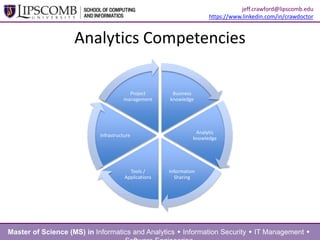
Analytics Competencies
Business
knowledge
Analytic
knowledge
Information
Sharing
Tools /
Applications
Infrastructure
Project
management
Master of Science (MS) in Informatics and Analytics  Information Security  IT Management 
jeff.crawford@lipscomb.edu
https://www.linkedin.com/in/crawdoctor
Business Knowledge
• Analytics efforts flow from a context
– Must know the questions that need answering
– Should know the questions that don’t need
answering
• Analytics efforts have an objective
– Should be aligned with business strategy
– A SWOT perspective
Master of Science (MS) in Informatics and Analytics  Information Security  IT Management 
jeff.crawford@lipscomb.edu
https://www.linkedin.com/in/crawdoctor
Analytics Knowledge
• Classical statistics
– Contemporary application
• Classical research methodology
– Contemporary application
• Mathematics
• Information structures
• Blue sky thinking (CAVU)
• Efficiency perspective
Master of Science (MS) in Informatics and Analytics  Information Security  IT Management 
jeff.crawford@lipscomb.edu
https://www.linkedin.com/in/crawdoctor
Information Sharing
• Knowledge processes (Tryon, 2012)
– Discovery
– Capture
– Organization
– Use
– Transfer
– Retention
• Communication capabilities
– Data visualization (Few, 2012)
– Media richness (Daft & Lengel, 1986)
Daft, R.L. & Lengel, R.H. (1986).
Organizational information
requirements, media richness and
structural design. Management
Science 32(5), 554-571.
Few, S. (2012). Show me the
numbers: Designing tables and
graphs to enlighten. (2nd ed. ed.).
Burlingame, CA: Analytics Press.
Tryon, C. A. (2012). Managing
organizational knowledge: 3rd
generation knowledge
management and beyond. Boca
Raton, FL: CRC Press.
Master of Science (MS) in Informatics and Analytics  Information Security  IT Management 
jeff.crawford@lipscomb.edu
https://www.linkedin.com/in/crawdoctor
Tools / Applications
• Data mining / analysis
– Custom – Java, Python, .NET, etc.
– Off the shelf - SAS, SPSS, R, Oracle, Microsoft, etc.
• Data visualization
– Tableau, Crystal Reports, etc.
• Data extraction / preparation
– Generalist tools
• Spreadsheet, personal database, etc.
– Data interaction standards
• SQL, JSON, XML, etc.
Master of Science (MS) in Informatics and Analytics  Information Security  IT Management 
jeff.crawford@lipscomb.edu
https://www.linkedin.com/in/crawdoctor
Infrastructure
• Contemporary information structures require
significant, sometimes novel investments in
– Software & hardware
• Compute
• Storage
• Communications
– Human capital
• Those producing analytics and those supporting
infrastructure activities are likely not the same
• Acquisition, retention and development
Master of Science (MS) in Informatics and Analytics  Information Security  IT Management 
jeff.crawford@lipscomb.edu
https://www.linkedin.com/in/crawdoctor
Project Management
• Analytics work (typically) has
– Defined objectives
– Duration (deadlines)
– Stakeholders that need “managing”
– Financial implications
– Sourcing arrangements
• PM methodologies can help keep work on
track
– Can also cause a bottleneck…
Master of Science (MS) in Informatics and Analytics  Information Security  IT Management 
jeff.crawford@lipscomb.edu
https://www.linkedin.com/in/crawdoctor
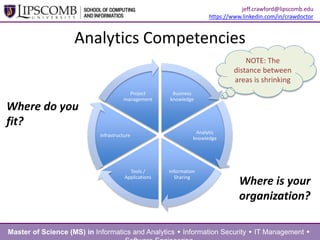
Analytics Competencies
Business
knowledge
Analytic
knowledge
Information
Sharing
Tools /
Applications
Infrastructure
Project
management
Where do you
fit?
Master of Science (MS) in Informatics and Analytics  Information Security  IT Management 
jeff.crawford@lipscomb.edu
https://www.linkedin.com/in/crawdoctor
Where is your
organization?
NOTE: The
distance between
areas is shrinking
Discussion
• What is the opportunity for a project manager
that is new to analytics?
• What are the tangible barriers?
Master of Science (MS) in Informatics and Analytics  Information Security  IT Management 
jeff.crawford@lipscomb.edu
https://www.linkedin.com/in/crawdoctor
Organizational Analytics?
Prahalad, C. K., & Hamel, G. (1990). The
Core Competence of the Corporation.
Harvard Business Review, 68(3), 79-91.
Ulrich, D., & Smallwood, N. (2004).
Capitalizing on Capabilities. Harvard
Business Review, 82(6), 119-127.
Facilitating Conditions
• Corporate culture
• Executive support
• Trends and “hype”
• Degree of competition
• Law, policy, ethics
• Others?
Master of Science (MS) in Informatics and Analytics  Information Security  IT Management 
jeff.crawford@lipscomb.edu
https://www.linkedin.com/in/crawdoctor
competencies
aka
who you are
capabilities
aka
what you do
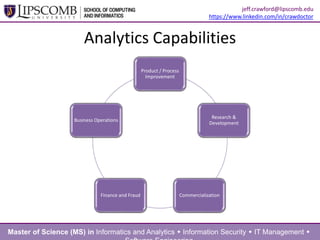
Analytics Capabilities
Product / Process
Improvement
Research &
Development
CommercializationFinance and Fraud
Business Operations
Master of Science (MS) in Informatics and Analytics  Information Security  IT Management 
jeff.crawford@lipscomb.edu
https://www.linkedin.com/in/crawdoctor
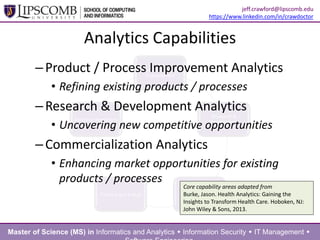
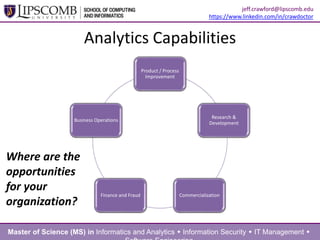
–Product / Process Improvement Analytics
• Refining existing products / processes
–Research & Development Analytics
• Uncovering new competitive opportunities
–Commercialization Analytics
• Enhancing market opportunities for existing
products / processes
Analytics Capabilities
Core capability areas adapted from
Burke, Jason. Health Analytics: Gaining the
Insights to Transform Health Care. Hoboken, NJ:
John Wiley & Sons, 2013.
Master of Science (MS) in Informatics and Analytics  Information Security  IT Management 
jeff.crawford@lipscomb.edu
https://www.linkedin.com/in/crawdoctor
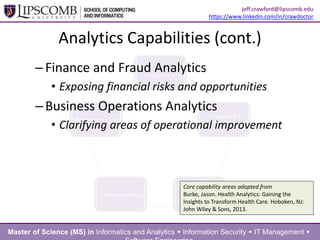
–Finance and Fraud Analytics
• Exposing financial risks and opportunities
–Business Operations Analytics
• Clarifying areas of operational improvement
Analytics Capabilities (cont.)
Core capability areas adapted from
Burke, Jason. Health Analytics: Gaining the
Insights to Transform Health Care. Hoboken, NJ:
John Wiley & Sons, 2013.
Master of Science (MS) in Informatics and Analytics  Information Security  IT Management 
jeff.crawford@lipscomb.edu
https://www.linkedin.com/in/crawdoctor
Analytics Capabilities
Product / Process
Improvement
Research &
Development
CommercializationFinance and Fraud
Business Operations
Master of Science (MS) in Informatics and Analytics  Information Security  IT Management 
jeff.crawford@lipscomb.edu
https://www.linkedin.com/in/crawdoctor
Where are the
opportunities
for your
organization?
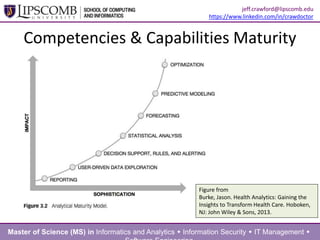
Competencies & Capabilities Maturity
Figure from
Burke, Jason. Health Analytics: Gaining the
Insights to Transform Health Care. Hoboken,
NJ: John Wiley & Sons, 2013.
Master of Science (MS) in Informatics and Analytics  Information Security  IT Management 
jeff.crawford@lipscomb.edu
https://www.linkedin.com/in/crawdoctor
DIFFUSION OF ORGANIZATIONAL
ANALYTICS
Learning from IT’s (many and repeated) mistakes…
Master of Science (MS) in Informatics and Analytics  Information Security  IT Management 
jeff.crawford@lipscomb.edu
https://www.linkedin.com/in/crawdoctor
Common failures within IT
1. Assuming the value will be obvious
2. Pushing the artifact over the rationale (i)T
3. Creating an IT silo
4. Making a poor process faster
5. Ignore / downplay the business problem
6. Fail to acknowledge the diffusion process
Adapted from Marchand, D.A. and Peppard, J., 2013. Why IT Fumbles Analytics.
Harvard Business Review. 91, 1, 104-112.
Master of Science (MS) in Informatics and Analytics  Information Security  IT Management 
jeff.crawford@lipscomb.edu
https://www.linkedin.com/in/crawdoctor
1. Actively communicate value
• Value is a perception defined by the individual
– “Selling” is a key part of the process
• What you see as value, others might see as
– Change
• Process change
• Culture change
• Power change
– Complexity & Chaos
• The language of data
• The order of logic
– A threat
Master of Science (MS) in Informatics and Analytics  Information Security  IT Management 
jeff.crawford@lipscomb.edu
https://www.linkedin.com/in/crawdoctor
2. De-emphasize the tools focus
• Train for problem solving first
– Systematic thinking
– Blue sky thinking
– Collaborative thinking
• Unleash tools only after necessary skills
have been developed
– “More time on the I, less on the T”
(Shah, Horne and Capella, 2012)
– Allegiance to a solution, not a vendor
• The IT “agnostic”
• Invest in implementing the process, not just
the IT tools / infrastructure
Shah, S., Horne, A., &
Capellá, J. (2012). Good
Data Won't Guarantee
Good Decisions. Harvard
Business
Review, 90(4), 23-25.
Master of Science (MS) in Informatics and Analytics  Information Security  IT Management 
jeff.crawford@lipscomb.edu
https://www.linkedin.com/in/crawdoctor
3. Properly structure analytics
• Refine the silo approach to analytics
– Centralized expertise
• Application of specialized analytics knowledge
with generalized context
– Localized expertise
• Application of generalized analytics knowledge
with specialized context
– External expertise
• Analytics as a source of competitive advantage
(Dewhurst, Hancock and Ellsworth, 2013)
• Analytics as a commodity (Carr, 2003)
Carr, N. G. (2003). IT Doesn't
Matter. Harvard Business
Review, 81(5), 41-49.
Dewhurst, M., Hancock, B., &
Ellsworth, D. (2013).
Redesigning Knowledge Work.
Harvard Business
Review, 91(1), 58-64.
Master of Science (MS) in Informatics and Analytics  Information Security  IT Management 
jeff.crawford@lipscomb.edu
https://www.linkedin.com/in/crawdoctor
4. Nurture a learning culture
• Solving today’s problems is not always the right
approach
– How do you get people to think where the ball is
going?
• Allow experimentation
– An agile perspective on failure
• Fail fast
– Sandboxes for “playing”
• Train “informed skeptics” (Shah, Horne and
Capella, 2012)
– Question common assumptions, challenge authority
• Enforce the scientific method
Shah, S., Horne, A., &
Capellá, J. (2012). Good
Data Won't Guarantee
Good Decisions. Harvard
Business
Review, 90(4), 23-25.
Master of Science (MS) in Informatics and Analytics  Information Security  IT Management 
jeff.crawford@lipscomb.edu
https://www.linkedin.com/in/crawdoctor
5. Focus on the business problem
• It’s not enough to have a question to answer
– Does the question have weight?
– Would the answer clearly contribute to the
organization’s bottom line?
– How important is the question among the
universe of other questions you might address?
• Adding value through exploitation activities
– Allow progressive elaboration of the problem
• Attack the problem in short iterative cycles (e.g., agile)
• Adding value through exploration activities
– Uncovering new and important questions through
experimentation
March, J. G. (1991).
Exploration and
exploitation in
organizational
learning. Organization
Science, 2(1), 71-87.
Master of Science (MS) in Informatics and Analytics  Information Security  IT Management 
jeff.crawford@lipscomb.edu
https://www.linkedin.com/in/crawdoctor
6. Practice intentional implementation
• Theory of Reasoned Action (Fishbein & Ajzen, 1977)
– Behavior driven by intentions
– Intentions fed by
• Attitudes
• Subjective norms
• Perceived behavior control
– An extension - Technology Acceptance Model (Davis, 1989)
• Attitudes as “ease of use”, “usefulness”
• Rogers’ Diffusion of Innovations (2003)
– Rate of adoption tied to understanding of adopter
categories (innovators to laggards)
Master of Science (MS) in Informatics and Analytics  Information Security  IT Management 
jeff.crawford@lipscomb.edu
https://www.linkedin.com/in/crawdoctor
A few remaining thoughts…
Master of Science (MS) in Informatics and Analytics  Information Security  IT Management 
jeff.crawford@lipscomb.edu
https://www.linkedin.com/in/crawdoctor
Get Involved in the Analytics Community
• NTC Analytics Peer Network
– site on LinkedIn
• Nashville Tech Breakfast
– 7/15/14 @ Spark in Cool Springs: From Japan to Nashville, Mexico,
Brazil and Beyond: Lessons learned during the geographic expansion of
IT capabilities - a panel discussion with Nissan Americas Vice President
of Information Systems, Steve Lambert, and team.
• Data Science Nashville
– http://www.meetup.com/Data-Science-Nashville/
• Greater Nashville Healthcare Analytics
– https://www.yammer.com/greaternashvillehealthcareanalytics
• Nashville R Users Group
– http://www.meetup.com/Nashville-R-Users-Group/
Master of Science (MS) in Informatics and Analytics  Information Security  IT Management 
jeff.crawford@lipscomb.edu
https://www.linkedin.com/in/crawdoctor
Get Educated
Master of Science (MS) in Informatics and Analytics  Information Security  IT Management 
jeff.crawford@lipscomb.edu
https://www.linkedin.com/in/crawdoctor
Lipscomb’s School of Computing and Informatics
offers the following graduate programs:
– MS in Information Security
– MS in IT Management
– MS in Informatics & Analytics
– MS in Software Engineering
Programs are designed with working professionals in mind. Earn a MS degree in as
little as 12 months. GRE is waived for those with 5 or more years work experience
in their area of study. Now taking applications for August, 2014.
Visit http://technology.lipscomb.edu/ to apply
CONCLUSION
Drawing it all together…
Master of Science (MS) in Informatics and Analytics  Information Security  IT Management 
jeff.crawford@lipscomb.edu
https://www.linkedin.com/in/crawdoctor

Building an Effective Organizational Analytics Capability

  • 1.
    Building an EffectiveOrganizational Analytics Capability Jeff Crawford, PhD, PMP Director of Graduate Programs & Associate Professor School of Computing and Informatics Lipscomb University jeff.crawford@lipscomb.edu http://technology.lipscomb.edu/ Master of Science (MS) in Informatics and Analytics  Information Security  IT Management  jeff.crawford@lipscomb.edu https://www.linkedin.com/in/crawdoctor Presented at the PMI Nashville 2014 Spring Symposium April 11, 2014 @ 12:30pm Music City Center, Nashville, TN
  • 2.
    Presentation Thesis • Fororganizational analytics to be maximally effective, you must: –Take a holistic, long-term view of analytics • Think in terms of competencies, capabilities and facilitating conditions –Practice intentional implementation • Take a cue from IT Master of Science (MS) in Informatics and Analytics  Information Security  IT Management  jeff.crawford@lipscomb.edu https://www.linkedin.com/in/crawdoctor
  • 3.
    What is analytics,exactly? Master of Science (MS) in Informatics and Analytics  Information Security  IT Management  jeff.crawford@lipscomb.edu https://www.linkedin.com/in/crawdoctor
  • 4.
    A reasonable viewof analytics • What? – using data to understand the past and/or address the present and/or predict the future • Why? – data -> information -> decision-making -> effective decision-making – competitive necessity – it’s in the trade press… Master of Science (MS) in Informatics and Analytics  Information Security  IT Management  jeff.crawford@lipscomb.edu https://www.linkedin.com/in/crawdoctor
  • 5.
    What is analytics,exactly? Master of Science (MS) in Informatics and Analytics  Information Security  IT Management  jeff.crawford@lipscomb.edu https://www.linkedin.com/in/crawdoctor Gartner’s 2013 Hype Cycle - http://www.gartner.com/newsroom/id/2575515
  • 6.
    The Analytics Process Figure2.2: The Cross Industry Standard Process (CRISP) for data mining Provost, F., & Fawcett, T. (2013). Data science for business: What you need to know about data mining and data-analytic thinking. Sebastpol, CA: O'Reilly Media. jeff.crawford@lipscomb.edu https://www.linkedin.com/in/crawdoctor Master of Science (MS) in Informatics and Analytics  Information Security  IT Management 
  • 7.
    The Analytics Process(by time) From p. 255 of Klimberg, R., & McCullough, B. D. (2013). Fundamentals of predictive analytics with JMP. Cary, NC: SAS Institute. Data Mining Phase % Time Spent* Project definition (5%) Data collection (20%) Data preparation (30%) Data understanding (20%) Model development and evaluation (20%) Implementation (5%) Master of Science (MS) in Informatics and Analytics  Information Security  IT Management  jeff.crawford@lipscomb.edu https://www.linkedin.com/in/crawdoctor * Remember the saying, “95% of all statistics are false”
  • 8.
    ORGANIZATIONAL ANALYTICS Maturity throughCompetencies and Capabilities Master of Science (MS) in Informatics and Analytics  Information Security  IT Management  jeff.crawford@lipscomb.edu https://www.linkedin.com/in/crawdoctor
  • 9.
    Organizational Analytics? Prahalad, C.K., & Hamel, G. (1990). The Core Competence of the Corporation. Harvard Business Review, 68(3), 79-91. Ulrich, D., & Smallwood, N. (2004). Capitalizing on Capabilities. Harvard Business Review, 82(6), 119-127. “the diversified corporation is a large tree…the root system that provides nourishment, sustenance, and stability is the core competence” (Prahalad & Hamel, 1990, p. 81) “*capabilities are] the collective skills, abilities and expertise of an organization” (Ulrich & Smallwood, 2004, p. 119) Facilitating Conditions • Corporate culture • Executive support • Trends and “hype” • Degree of competition • Law, policy, ethics • Others? Master of Science (MS) in Informatics and Analytics  Information Security  IT Management  jeff.crawford@lipscomb.edu https://www.linkedin.com/in/crawdoctor competencies aka who you are capabilities aka what you do
  • 10.
    Analytics Competencies Business knowledge Analytic knowledge Information Sharing Tools / Applications Infrastructure Project management Masterof Science (MS) in Informatics and Analytics  Information Security  IT Management  jeff.crawford@lipscomb.edu https://www.linkedin.com/in/crawdoctor
  • 11.
    Business Knowledge • Analyticsefforts flow from a context – Must know the questions that need answering – Should know the questions that don’t need answering • Analytics efforts have an objective – Should be aligned with business strategy – A SWOT perspective Master of Science (MS) in Informatics and Analytics  Information Security  IT Management  jeff.crawford@lipscomb.edu https://www.linkedin.com/in/crawdoctor
  • 12.
    Analytics Knowledge • Classicalstatistics – Contemporary application • Classical research methodology – Contemporary application • Mathematics • Information structures • Blue sky thinking (CAVU) • Efficiency perspective Master of Science (MS) in Informatics and Analytics  Information Security  IT Management  jeff.crawford@lipscomb.edu https://www.linkedin.com/in/crawdoctor
  • 13.
    Information Sharing • Knowledgeprocesses (Tryon, 2012) – Discovery – Capture – Organization – Use – Transfer – Retention • Communication capabilities – Data visualization (Few, 2012) – Media richness (Daft & Lengel, 1986) Daft, R.L. & Lengel, R.H. (1986). Organizational information requirements, media richness and structural design. Management Science 32(5), 554-571. Few, S. (2012). Show me the numbers: Designing tables and graphs to enlighten. (2nd ed. ed.). Burlingame, CA: Analytics Press. Tryon, C. A. (2012). Managing organizational knowledge: 3rd generation knowledge management and beyond. Boca Raton, FL: CRC Press. Master of Science (MS) in Informatics and Analytics  Information Security  IT Management  jeff.crawford@lipscomb.edu https://www.linkedin.com/in/crawdoctor
  • 14.
    Tools / Applications •Data mining / analysis – Custom – Java, Python, .NET, etc. – Off the shelf - SAS, SPSS, R, Oracle, Microsoft, etc. • Data visualization – Tableau, Crystal Reports, etc. • Data extraction / preparation – Generalist tools • Spreadsheet, personal database, etc. – Data interaction standards • SQL, JSON, XML, etc. Master of Science (MS) in Informatics and Analytics  Information Security  IT Management  jeff.crawford@lipscomb.edu https://www.linkedin.com/in/crawdoctor
  • 15.
    Infrastructure • Contemporary informationstructures require significant, sometimes novel investments in – Software & hardware • Compute • Storage • Communications – Human capital • Those producing analytics and those supporting infrastructure activities are likely not the same • Acquisition, retention and development Master of Science (MS) in Informatics and Analytics  Information Security  IT Management  jeff.crawford@lipscomb.edu https://www.linkedin.com/in/crawdoctor
  • 16.
    Project Management • Analyticswork (typically) has – Defined objectives – Duration (deadlines) – Stakeholders that need “managing” – Financial implications – Sourcing arrangements • PM methodologies can help keep work on track – Can also cause a bottleneck… Master of Science (MS) in Informatics and Analytics  Information Security  IT Management  jeff.crawford@lipscomb.edu https://www.linkedin.com/in/crawdoctor
  • 17.
    Analytics Competencies Business knowledge Analytic knowledge Information Sharing Tools / Applications Infrastructure Project management Wheredo you fit? Master of Science (MS) in Informatics and Analytics  Information Security  IT Management  jeff.crawford@lipscomb.edu https://www.linkedin.com/in/crawdoctor Where is your organization? NOTE: The distance between areas is shrinking
  • 18.
    Discussion • What isthe opportunity for a project manager that is new to analytics? • What are the tangible barriers? Master of Science (MS) in Informatics and Analytics  Information Security  IT Management  jeff.crawford@lipscomb.edu https://www.linkedin.com/in/crawdoctor
  • 19.
    Organizational Analytics? Prahalad, C.K., & Hamel, G. (1990). The Core Competence of the Corporation. Harvard Business Review, 68(3), 79-91. Ulrich, D., & Smallwood, N. (2004). Capitalizing on Capabilities. Harvard Business Review, 82(6), 119-127. Facilitating Conditions • Corporate culture • Executive support • Trends and “hype” • Degree of competition • Law, policy, ethics • Others? Master of Science (MS) in Informatics and Analytics  Information Security  IT Management  jeff.crawford@lipscomb.edu https://www.linkedin.com/in/crawdoctor competencies aka who you are capabilities aka what you do
  • 20.
    Analytics Capabilities Product /Process Improvement Research & Development CommercializationFinance and Fraud Business Operations Master of Science (MS) in Informatics and Analytics  Information Security  IT Management  jeff.crawford@lipscomb.edu https://www.linkedin.com/in/crawdoctor
  • 21.
    –Product / ProcessImprovement Analytics • Refining existing products / processes –Research & Development Analytics • Uncovering new competitive opportunities –Commercialization Analytics • Enhancing market opportunities for existing products / processes Analytics Capabilities Core capability areas adapted from Burke, Jason. Health Analytics: Gaining the Insights to Transform Health Care. Hoboken, NJ: John Wiley & Sons, 2013. Master of Science (MS) in Informatics and Analytics  Information Security  IT Management  jeff.crawford@lipscomb.edu https://www.linkedin.com/in/crawdoctor
  • 22.
    –Finance and FraudAnalytics • Exposing financial risks and opportunities –Business Operations Analytics • Clarifying areas of operational improvement Analytics Capabilities (cont.) Core capability areas adapted from Burke, Jason. Health Analytics: Gaining the Insights to Transform Health Care. Hoboken, NJ: John Wiley & Sons, 2013. Master of Science (MS) in Informatics and Analytics  Information Security  IT Management  jeff.crawford@lipscomb.edu https://www.linkedin.com/in/crawdoctor
  • 23.
    Analytics Capabilities Product /Process Improvement Research & Development CommercializationFinance and Fraud Business Operations Master of Science (MS) in Informatics and Analytics  Information Security  IT Management  jeff.crawford@lipscomb.edu https://www.linkedin.com/in/crawdoctor Where are the opportunities for your organization?
  • 24.
    Competencies & CapabilitiesMaturity Figure from Burke, Jason. Health Analytics: Gaining the Insights to Transform Health Care. Hoboken, NJ: John Wiley & Sons, 2013. Master of Science (MS) in Informatics and Analytics  Information Security  IT Management  jeff.crawford@lipscomb.edu https://www.linkedin.com/in/crawdoctor
  • 25.
    DIFFUSION OF ORGANIZATIONAL ANALYTICS Learningfrom IT’s (many and repeated) mistakes… Master of Science (MS) in Informatics and Analytics  Information Security  IT Management  jeff.crawford@lipscomb.edu https://www.linkedin.com/in/crawdoctor
  • 26.
    Common failures withinIT 1. Assuming the value will be obvious 2. Pushing the artifact over the rationale (i)T 3. Creating an IT silo 4. Making a poor process faster 5. Ignore / downplay the business problem 6. Fail to acknowledge the diffusion process Adapted from Marchand, D.A. and Peppard, J., 2013. Why IT Fumbles Analytics. Harvard Business Review. 91, 1, 104-112. Master of Science (MS) in Informatics and Analytics  Information Security  IT Management  jeff.crawford@lipscomb.edu https://www.linkedin.com/in/crawdoctor
  • 27.
    1. Actively communicatevalue • Value is a perception defined by the individual – “Selling” is a key part of the process • What you see as value, others might see as – Change • Process change • Culture change • Power change – Complexity & Chaos • The language of data • The order of logic – A threat Master of Science (MS) in Informatics and Analytics  Information Security  IT Management  jeff.crawford@lipscomb.edu https://www.linkedin.com/in/crawdoctor
  • 28.
    2. De-emphasize thetools focus • Train for problem solving first – Systematic thinking – Blue sky thinking – Collaborative thinking • Unleash tools only after necessary skills have been developed – “More time on the I, less on the T” (Shah, Horne and Capella, 2012) – Allegiance to a solution, not a vendor • The IT “agnostic” • Invest in implementing the process, not just the IT tools / infrastructure Shah, S., Horne, A., & Capellá, J. (2012). Good Data Won't Guarantee Good Decisions. Harvard Business Review, 90(4), 23-25. Master of Science (MS) in Informatics and Analytics  Information Security  IT Management  jeff.crawford@lipscomb.edu https://www.linkedin.com/in/crawdoctor
  • 29.
    3. Properly structureanalytics • Refine the silo approach to analytics – Centralized expertise • Application of specialized analytics knowledge with generalized context – Localized expertise • Application of generalized analytics knowledge with specialized context – External expertise • Analytics as a source of competitive advantage (Dewhurst, Hancock and Ellsworth, 2013) • Analytics as a commodity (Carr, 2003) Carr, N. G. (2003). IT Doesn't Matter. Harvard Business Review, 81(5), 41-49. Dewhurst, M., Hancock, B., & Ellsworth, D. (2013). Redesigning Knowledge Work. Harvard Business Review, 91(1), 58-64. Master of Science (MS) in Informatics and Analytics  Information Security  IT Management  jeff.crawford@lipscomb.edu https://www.linkedin.com/in/crawdoctor
  • 30.
    4. Nurture alearning culture • Solving today’s problems is not always the right approach – How do you get people to think where the ball is going? • Allow experimentation – An agile perspective on failure • Fail fast – Sandboxes for “playing” • Train “informed skeptics” (Shah, Horne and Capella, 2012) – Question common assumptions, challenge authority • Enforce the scientific method Shah, S., Horne, A., & Capellá, J. (2012). Good Data Won't Guarantee Good Decisions. Harvard Business Review, 90(4), 23-25. Master of Science (MS) in Informatics and Analytics  Information Security  IT Management  jeff.crawford@lipscomb.edu https://www.linkedin.com/in/crawdoctor
  • 31.
    5. Focus onthe business problem • It’s not enough to have a question to answer – Does the question have weight? – Would the answer clearly contribute to the organization’s bottom line? – How important is the question among the universe of other questions you might address? • Adding value through exploitation activities – Allow progressive elaboration of the problem • Attack the problem in short iterative cycles (e.g., agile) • Adding value through exploration activities – Uncovering new and important questions through experimentation March, J. G. (1991). Exploration and exploitation in organizational learning. Organization Science, 2(1), 71-87. Master of Science (MS) in Informatics and Analytics  Information Security  IT Management  jeff.crawford@lipscomb.edu https://www.linkedin.com/in/crawdoctor
  • 32.
    6. Practice intentionalimplementation • Theory of Reasoned Action (Fishbein & Ajzen, 1977) – Behavior driven by intentions – Intentions fed by • Attitudes • Subjective norms • Perceived behavior control – An extension - Technology Acceptance Model (Davis, 1989) • Attitudes as “ease of use”, “usefulness” • Rogers’ Diffusion of Innovations (2003) – Rate of adoption tied to understanding of adopter categories (innovators to laggards) Master of Science (MS) in Informatics and Analytics  Information Security  IT Management  jeff.crawford@lipscomb.edu https://www.linkedin.com/in/crawdoctor
  • 33.
    A few remainingthoughts… Master of Science (MS) in Informatics and Analytics  Information Security  IT Management  jeff.crawford@lipscomb.edu https://www.linkedin.com/in/crawdoctor
  • 34.
    Get Involved inthe Analytics Community • NTC Analytics Peer Network – site on LinkedIn • Nashville Tech Breakfast – 7/15/14 @ Spark in Cool Springs: From Japan to Nashville, Mexico, Brazil and Beyond: Lessons learned during the geographic expansion of IT capabilities - a panel discussion with Nissan Americas Vice President of Information Systems, Steve Lambert, and team. • Data Science Nashville – http://www.meetup.com/Data-Science-Nashville/ • Greater Nashville Healthcare Analytics – https://www.yammer.com/greaternashvillehealthcareanalytics • Nashville R Users Group – http://www.meetup.com/Nashville-R-Users-Group/ Master of Science (MS) in Informatics and Analytics  Information Security  IT Management  jeff.crawford@lipscomb.edu https://www.linkedin.com/in/crawdoctor
  • 35.
    Get Educated Master ofScience (MS) in Informatics and Analytics  Information Security  IT Management  jeff.crawford@lipscomb.edu https://www.linkedin.com/in/crawdoctor Lipscomb’s School of Computing and Informatics offers the following graduate programs: – MS in Information Security – MS in IT Management – MS in Informatics & Analytics – MS in Software Engineering Programs are designed with working professionals in mind. Earn a MS degree in as little as 12 months. GRE is waived for those with 5 or more years work experience in their area of study. Now taking applications for August, 2014. Visit http://technology.lipscomb.edu/ to apply
  • 36.
    CONCLUSION Drawing it alltogether… Master of Science (MS) in Informatics and Analytics  Information Security  IT Management  jeff.crawford@lipscomb.edu https://www.linkedin.com/in/crawdoctor