See discussions, stats, and author profiles for this publication at: https://www.researchgate.net/publication/281714298
Comparative Study of Slab Culvert Design using IRC 112:2011 and IRC 21:2000
Article · May 2015
CITATIONS
2
READS
19,469
2 authors:
Some of the authors of this publication are also working on these related projects:
deficit irrigation View project
Optimization of Cropping pattern using Linear Programming Model for Markandeya Command Area View project
Shivanand Tenagi
2 PUBLICATIONS   2 CITATIONS   
SEE PROFILE
R. Shreedhar
Gogte Institute of Technology
48 PUBLICATIONS   70 CITATIONS   
SEE PROFILE
All content following this page was uploaded by R. Shreedhar on 13 September 2015.
The user has requested enhancement of the downloaded file.
IJSRD - International Journal for Scientific Research & Development| Vol. 3, Issue 05, 2015 | ISSN (online): 2321-0613
All rights reserved by www.ijsrd.com 107
Comparative Study of Slab Culvert Design using IRC 112:2011 and IRC
21:2000
Shivanand Tenagi1
R. Shreedhar2
1
P. G. Student (Structural Engineering) 2
Associate Professor
1,2
Department of Civil Engineering
1,2
KLS Gogte Institute of Technology, Belagavi, Karnataka, India
Abstract— Reinforced concrete slab type decks are often
referred to as culverts and are commonly used for small
spans. Slab culverts are important hydraulic structures used
in the construction of highway roads. In India, till now
culverts are designed and constructed according to Indian
road congress guidelines as per IRC: 21-2000 code in which
working stress method is used. Recently Indian road
congress has introduced another code IRC: 112-2011 for
design of prestress and RCC bridges using limit state
method. In regards to this, present study has been performed
to know how design of IRC-112 differs from IRC-21 and an
attempt is made to study undefined parameters of IRC: 112-
2011 such as span to depth (L/d) ratio. Present study is
performed on design of RC slab culvert using “working
stress method” using “IRC: 21-2000 and limit state method
using IRC: 112-2011” code specifications. It is observed
that in working stress method, the allowable L/d ratio is 13
and in limit state method, the L/d ratio of 20 is most
preferable. Quantity of materials required in limit state
method is compared with quantity of material required in
working stress method and it is found that concrete can be
saved up to 30 to 35% using limit state method.
Key words: IRC 112:2011, IRC 21:2000
I. INTRODUCTION
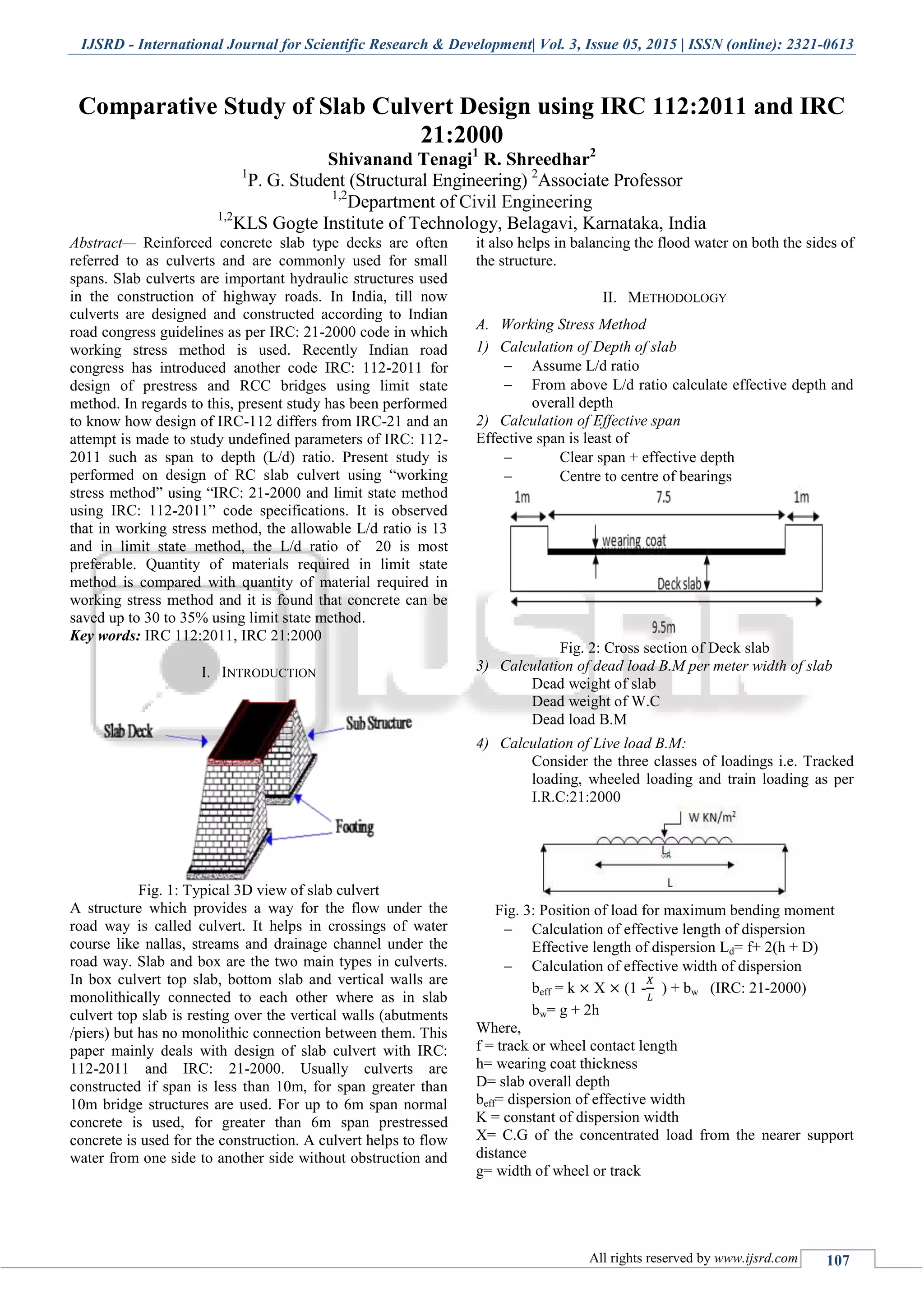
Fig. 1: Typical 3D view of slab culvert
A structure which provides a way for the flow under the
road way is called culvert. It helps in crossings of water
course like nallas, streams and drainage channel under the
road way. Slab and box are the two main types in culverts.
In box culvert top slab, bottom slab and vertical walls are
monolithically connected to each other where as in slab
culvert top slab is resting over the vertical walls (abutments
/piers) but has no monolithic connection between them. This
paper mainly deals with design of slab culvert with IRC:
112-2011 and IRC: 21-2000. Usually culverts are
constructed if span is less than 10m, for span greater than
10m bridge structures are used. For up to 6m span normal
concrete is used, for greater than 6m span prestressed
concrete is used for the construction. A culvert helps to flow
water from one side to another side without obstruction and
it also helps in balancing the flood water on both the sides of
the structure.
II. METHODOLOGY
A. Working Stress Method
1) Calculation of Depth of slab
 Assume L/d ratio
 From above L/d ratio calculate effective depth and
overall depth
2) Calculation of Effective span
Effective span is least of
 Clear span + effective depth
 Centre to centre of bearings
Fig. 2: Cross section of Deck slab
3) Calculation of dead load B.M per meter width of slab
Dead weight of slab
Dead weight of W.C
Dead load B.M
4) Calculation of Live load B.M:
Consider the three classes of loadings i.e. Tracked
loading, wheeled loading and train loading as per
I.R.C:21:2000
Fig. 3: Position of load for maximum bending moment
 Calculation of effective length of dispersion
Effective length of dispersion Ld= f+ 2(h + D)
 Calculation of effective width of dispersion
beff = k X (1 - ) + bw (IRC: 21-2000)
bw= g + 2h
Where,
f = track or wheel contact length
h= wearing coat thickness
D= slab overall depth
beff= dispersion of effective width
K = constant of dispersion width
X= C.G of the concentrated load from the nearer support
distance
g= width of wheel or track
Comparative Study of Slab Culvert Design using IRC 112:2011 and IRC 21:2000
(IJSRD/Vol. 3/Issue 05/2015/026)
All rights reserved by www.ijsrd.com 108
Finally calculation of area of steel is done by using working
stress method formulas.
5) Calculation of shear stresses
Maximum shear force occurs at the support when the live
load is nearer to a support. Here the design shear is
conservatively taken as that at the support.
 Calculation of effective length of dispersion
 Calculation of effective width of dispersion
Fig. 4 Position of load for maximum shear
 Nominal shear stress = Ʈ = Vu/ bd
k1 = 1.14 -0.7d
k2 = 0.5+ 0.25 ρ where ρ =
Ʈc = permissible shear stress = k1 k2 Ʈco
B. Limit State Method
Calculation of Bending Moments and Shear forces remains
same as per working stress method except 1.5 is multiplied
for final design moments and design shear forces. In this
design moment is checked with limiting moment of
resistance and finally area of steel is calculated using design
bending moment.
1) Design shear reinforcement is calculated as per
I.R.C:112-2011 (clause 10.3.2)
V Rdc = [0.12 K (80 ρ1 fck) 0.33
+ 0.15 ϭcp] bwd
K = 1 + √ ≤ 2.0
ϭcpis limited to 0.2fcd
ρ1 = As1/bwd ≤ 0.02
2) Checks for limit state of serviceability:
 Check for Limit State of Deflection:
∆ = ]
W = average intensity
L = Effective length of span
a = Load Effective length
E = Young’s Modulus of concrete = 5000√
I = Moment of Inertia =
 Check for limit state of crack width:
Fig. 5: Cross section and strain diagram
 Calculation of B.M at service load, Ms
Ec = 5000√ = 5000√ = 25000 N/mm2
Ece = 0.5Ec
M = Es/ Ece
 Determination of N.A at working loads
m Ast(d-x)
Ic = + m Ast (d-x)2
Є1 =
Єm = Є1 –
( ) ( )
( )
Crack width = 3 Cmin Єm
III. RESULTS AND DISCUSSIONS
The slab culvert of span 4m to 10m is analysed for various
IRC loadings as per IRC 21-2000 by working stress method
for L/d ratios 12, 13 and 14 and same spans are analysed as
per IRC 112-2011 by limit state method for L/d ratios 18,
19, 20, 21 and 22. The critical case for loading is tracked
vehicle as compared to wheeled and trained vehicle and
hence taken for all the calculations in arriving effective
depth and bending moment.
A. Working Stress Method
Fig. 6: Assumed effective depth in mm
Fig. 7: Required effective depth in mm
With comparison of assumed effective depth and
required effective depth as shown in Fig. 6 and Fig. 7, it can
be concluded that the depths obtained for L/d ratio of 14 as
shown in figure 6 is not sufficient as it less than the required
depth as shown in figure 7 to satisfy the necessary design
checks.
Though L/d ratios of 12 and 13 satisfy the required
depth, the L/d ratio of 13 is economical in comparison to
L/d ratio of 12. Hence L/d ratio of 13 is preferable for the
design of slab culvert by working stress method and
corresponding effective depth and volume of concrete can
be adopted.
Comparative Study of Slab Culvert Design using IRC 112:2011 and IRC 21:2000
(IJSRD/Vol. 3/Issue 05/2015/026)
All rights reserved by www.ijsrd.com 109
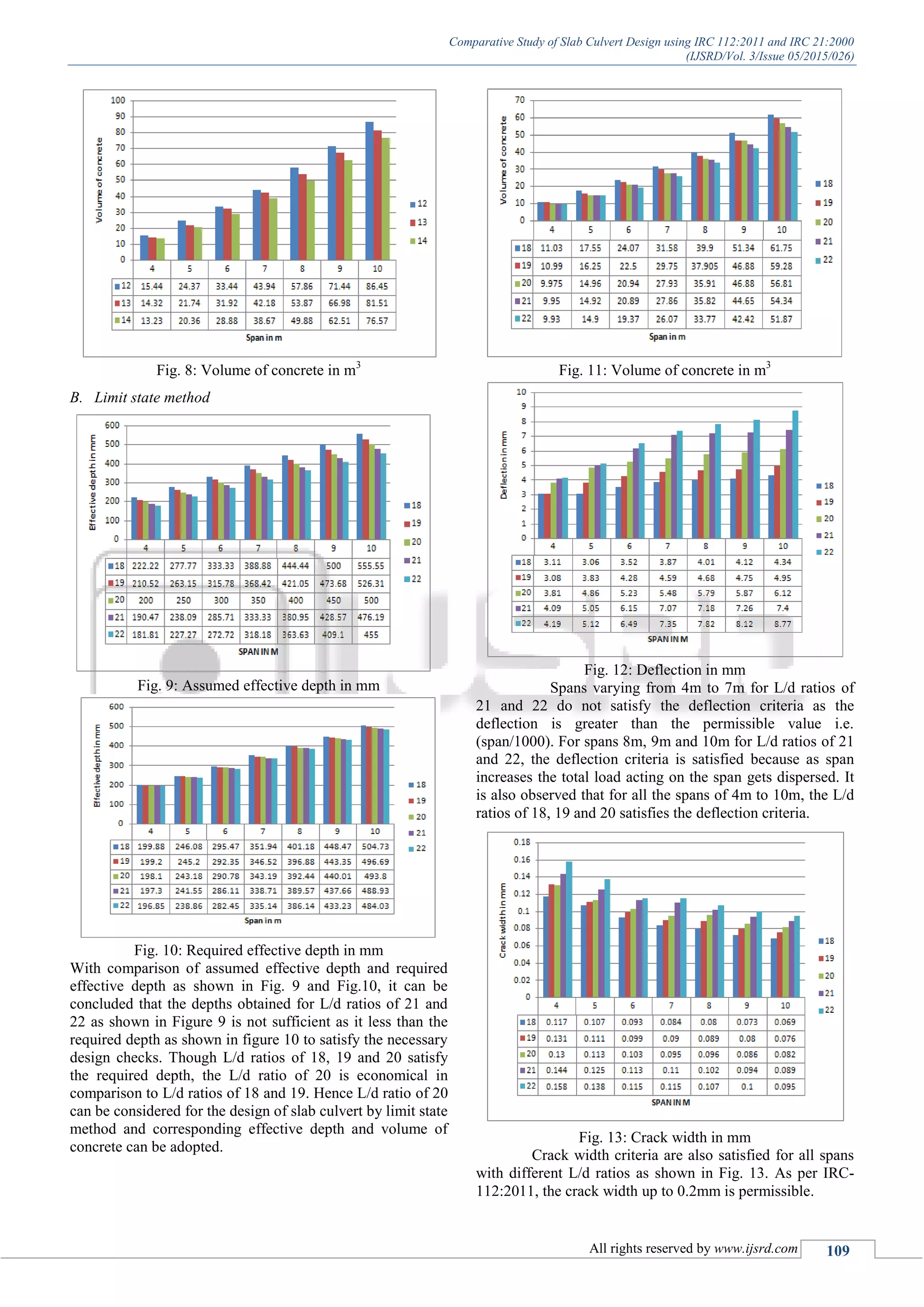
Fig. 8: Volume of concrete in m3
B. Limit state method
Fig. 9: Assumed effective depth in mm
Fig. 10: Required effective depth in mm
With comparison of assumed effective depth and required
effective depth as shown in Fig. 9 and Fig.10, it can be
concluded that the depths obtained for L/d ratios of 21 and
22 as shown in Figure 9 is not sufficient as it less than the
required depth as shown in figure 10 to satisfy the necessary
design checks. Though L/d ratios of 18, 19 and 20 satisfy
the required depth, the L/d ratio of 20 is economical in
comparison to L/d ratios of 18 and 19. Hence L/d ratio of 20
can be considered for the design of slab culvert by limit state
method and corresponding effective depth and volume of
concrete can be adopted.
Fig. 11: Volume of concrete in m3
Fig. 12: Deflection in mm
Spans varying from 4m to 7m for L/d ratios of
21 and 22 do not satisfy the deflection criteria as the
deflection is greater than the permissible value i.e.
(span/1000). For spans 8m, 9m and 10m for L/d ratios of 21
and 22, the deflection criteria is satisfied because as span
increases the total load acting on the span gets dispersed. It
is also observed that for all the spans of 4m to 10m, the L/d
ratios of 18, 19 and 20 satisfies the deflection criteria.
Fig. 13: Crack width in mm
Crack width criteria are also satisfied for all spans
with different L/d ratios as shown in Fig. 13. As per IRC-
112:2011, the crack width up to 0.2mm is permissible.
Comparative Study of Slab Culvert Design using IRC 112:2011 and IRC 21:2000
(IJSRD/Vol. 3/Issue 05/2015/026)
All rights reserved by www.ijsrd.com 110
Fig. 14: Variation of maximum bending moment
Fig. 15: Variation of limiting moment of resistance
In Figures 14 and 15 for L/d ratios of 18 and 19,
there is a less limiting moment utilization capacity in
comparison to L/d ratio of 20. For shorter spans with L/d
ratios of 21 and 22, the limiting moment is less than the
maximum bending moment. Hence L/d ratio 20 can be
considered for safe and economical design of slab culvert by
limit state method.
IV. CONCLUSIONS
1) For design of the slab culvert using working stress
method as per IRC: 21-2000, L/d ratio of 11 to 13 can
be adopted, L/d ratio of 13 is most preferable.
2) For design of the slab culvert using limit state method
as per IRC: 112-2011, L/d ratio of 18 to 20 can be
adopted, L/d ratio of 20 is most preferable.
3) Increase in effective depth with increase in span is
found to be lesser for L/d ratio of 20 when compared to
L/d ratio of 18 and 19. As thickness of slab increases,
the volume of concrete increases and hence dead load
increases.
4) Deflections are within the limiting value as mentioned
in IRC: 112-2011 but this is not a case for L/d ratio
higher than 20.
5) It is observed that in slab culvert for L/d ratio of 20, the
quantity of concrete saved is up to 30 to 35% using
limit state method.
6) In limit state method of design the utilization capacity
of limiting moment will increase with increasing span
which is up to 65%. It is observed that the utilization
capacity for L/d ratio of 18 & 19 is lesser and for L/d
ratio of 21 and 22 it is found to be higher when
compared to L/d ratio of 20.
ACKNOWLEDGEMENTS
The author wishes to thank the Management and Principal
of KLS Gogte Institute of Technology, Belagavi, Karnataka,
India for their continued support in carrying out this
research work.
REFERENCES
[1] “Design of Bridges” by Krishnaraju, Fourth Edition,
Oxford and IBH Publishing Co. Pvt. Ltd., New Delhi,
India, 2012. Page No 86-159.
[2] IRC: 6-2000, “Standard Specifications and Code of
Practice for Road Bridges”, Section II, loads and
stresses, The Indian Roads Congress, New Delhi, India,
2000.
[3] Solanki B.H. and Vakil M.D., “Comparative study for
flexure design using IRC 112:2011 & IRC 21:2000”
International journal of scientific and engineering
research Vol.4 issue-6 june-2013.
[4] Solanki B.H. and Vakil M.D., “Comparative study for
shear design using IRC 112:2011 & IRC 21:2000”
International journal of scientific and engineering
research Vol.4 issue-6 june-2013.
[5] IRC: 21 –2000 “Standard specification and code of
practice for road bridges (Plain and Reinforced)” Indian
road congress, New Delhi, India, 2000.
[6] IRC: 18 –2000 “Standard specification and code of
practice for road bridges (Plain and Reinforced)” Indian
road congress, New Delhi, India.
View publication statsView publication stats

Slabculvert irc21irc112

  • 1.
    See discussions, stats,and author profiles for this publication at: https://www.researchgate.net/publication/281714298 Comparative Study of Slab Culvert Design using IRC 112:2011 and IRC 21:2000 Article · May 2015 CITATIONS 2 READS 19,469 2 authors: Some of the authors of this publication are also working on these related projects: deficit irrigation View project Optimization of Cropping pattern using Linear Programming Model for Markandeya Command Area View project Shivanand Tenagi 2 PUBLICATIONS   2 CITATIONS    SEE PROFILE R. Shreedhar Gogte Institute of Technology 48 PUBLICATIONS   70 CITATIONS    SEE PROFILE All content following this page was uploaded by R. Shreedhar on 13 September 2015. The user has requested enhancement of the downloaded file.
  • 2.
    IJSRD - InternationalJournal for Scientific Research & Development| Vol. 3, Issue 05, 2015 | ISSN (online): 2321-0613 All rights reserved by www.ijsrd.com 107 Comparative Study of Slab Culvert Design using IRC 112:2011 and IRC 21:2000 Shivanand Tenagi1 R. Shreedhar2 1 P. G. Student (Structural Engineering) 2 Associate Professor 1,2 Department of Civil Engineering 1,2 KLS Gogte Institute of Technology, Belagavi, Karnataka, India Abstract— Reinforced concrete slab type decks are often referred to as culverts and are commonly used for small spans. Slab culverts are important hydraulic structures used in the construction of highway roads. In India, till now culverts are designed and constructed according to Indian road congress guidelines as per IRC: 21-2000 code in which working stress method is used. Recently Indian road congress has introduced another code IRC: 112-2011 for design of prestress and RCC bridges using limit state method. In regards to this, present study has been performed to know how design of IRC-112 differs from IRC-21 and an attempt is made to study undefined parameters of IRC: 112- 2011 such as span to depth (L/d) ratio. Present study is performed on design of RC slab culvert using “working stress method” using “IRC: 21-2000 and limit state method using IRC: 112-2011” code specifications. It is observed that in working stress method, the allowable L/d ratio is 13 and in limit state method, the L/d ratio of 20 is most preferable. Quantity of materials required in limit state method is compared with quantity of material required in working stress method and it is found that concrete can be saved up to 30 to 35% using limit state method. Key words: IRC 112:2011, IRC 21:2000 I. INTRODUCTION Fig. 1: Typical 3D view of slab culvert A structure which provides a way for the flow under the road way is called culvert. It helps in crossings of water course like nallas, streams and drainage channel under the road way. Slab and box are the two main types in culverts. In box culvert top slab, bottom slab and vertical walls are monolithically connected to each other where as in slab culvert top slab is resting over the vertical walls (abutments /piers) but has no monolithic connection between them. This paper mainly deals with design of slab culvert with IRC: 112-2011 and IRC: 21-2000. Usually culverts are constructed if span is less than 10m, for span greater than 10m bridge structures are used. For up to 6m span normal concrete is used, for greater than 6m span prestressed concrete is used for the construction. A culvert helps to flow water from one side to another side without obstruction and it also helps in balancing the flood water on both the sides of the structure. II. METHODOLOGY A. Working Stress Method 1) Calculation of Depth of slab  Assume L/d ratio  From above L/d ratio calculate effective depth and overall depth 2) Calculation of Effective span Effective span is least of  Clear span + effective depth  Centre to centre of bearings Fig. 2: Cross section of Deck slab 3) Calculation of dead load B.M per meter width of slab Dead weight of slab Dead weight of W.C Dead load B.M 4) Calculation of Live load B.M: Consider the three classes of loadings i.e. Tracked loading, wheeled loading and train loading as per I.R.C:21:2000 Fig. 3: Position of load for maximum bending moment  Calculation of effective length of dispersion Effective length of dispersion Ld= f+ 2(h + D)  Calculation of effective width of dispersion beff = k X (1 - ) + bw (IRC: 21-2000) bw= g + 2h Where, f = track or wheel contact length h= wearing coat thickness D= slab overall depth beff= dispersion of effective width K = constant of dispersion width X= C.G of the concentrated load from the nearer support distance g= width of wheel or track
  • 3.
    Comparative Study ofSlab Culvert Design using IRC 112:2011 and IRC 21:2000 (IJSRD/Vol. 3/Issue 05/2015/026) All rights reserved by www.ijsrd.com 108 Finally calculation of area of steel is done by using working stress method formulas. 5) Calculation of shear stresses Maximum shear force occurs at the support when the live load is nearer to a support. Here the design shear is conservatively taken as that at the support.  Calculation of effective length of dispersion  Calculation of effective width of dispersion Fig. 4 Position of load for maximum shear  Nominal shear stress = Ʈ = Vu/ bd k1 = 1.14 -0.7d k2 = 0.5+ 0.25 ρ where ρ = Ʈc = permissible shear stress = k1 k2 Ʈco B. Limit State Method Calculation of Bending Moments and Shear forces remains same as per working stress method except 1.5 is multiplied for final design moments and design shear forces. In this design moment is checked with limiting moment of resistance and finally area of steel is calculated using design bending moment. 1) Design shear reinforcement is calculated as per I.R.C:112-2011 (clause 10.3.2) V Rdc = [0.12 K (80 ρ1 fck) 0.33 + 0.15 ϭcp] bwd K = 1 + √ ≤ 2.0 ϭcpis limited to 0.2fcd ρ1 = As1/bwd ≤ 0.02 2) Checks for limit state of serviceability:  Check for Limit State of Deflection: ∆ = ] W = average intensity L = Effective length of span a = Load Effective length E = Young’s Modulus of concrete = 5000√ I = Moment of Inertia =  Check for limit state of crack width: Fig. 5: Cross section and strain diagram  Calculation of B.M at service load, Ms Ec = 5000√ = 5000√ = 25000 N/mm2 Ece = 0.5Ec M = Es/ Ece  Determination of N.A at working loads m Ast(d-x) Ic = + m Ast (d-x)2 Є1 = Єm = Є1 – ( ) ( ) ( ) Crack width = 3 Cmin Єm III. RESULTS AND DISCUSSIONS The slab culvert of span 4m to 10m is analysed for various IRC loadings as per IRC 21-2000 by working stress method for L/d ratios 12, 13 and 14 and same spans are analysed as per IRC 112-2011 by limit state method for L/d ratios 18, 19, 20, 21 and 22. The critical case for loading is tracked vehicle as compared to wheeled and trained vehicle and hence taken for all the calculations in arriving effective depth and bending moment. A. Working Stress Method Fig. 6: Assumed effective depth in mm Fig. 7: Required effective depth in mm With comparison of assumed effective depth and required effective depth as shown in Fig. 6 and Fig. 7, it can be concluded that the depths obtained for L/d ratio of 14 as shown in figure 6 is not sufficient as it less than the required depth as shown in figure 7 to satisfy the necessary design checks. Though L/d ratios of 12 and 13 satisfy the required depth, the L/d ratio of 13 is economical in comparison to L/d ratio of 12. Hence L/d ratio of 13 is preferable for the design of slab culvert by working stress method and corresponding effective depth and volume of concrete can be adopted.
  • 4.
    Comparative Study ofSlab Culvert Design using IRC 112:2011 and IRC 21:2000 (IJSRD/Vol. 3/Issue 05/2015/026) All rights reserved by www.ijsrd.com 109 Fig. 8: Volume of concrete in m3 B. Limit state method Fig. 9: Assumed effective depth in mm Fig. 10: Required effective depth in mm With comparison of assumed effective depth and required effective depth as shown in Fig. 9 and Fig.10, it can be concluded that the depths obtained for L/d ratios of 21 and 22 as shown in Figure 9 is not sufficient as it less than the required depth as shown in figure 10 to satisfy the necessary design checks. Though L/d ratios of 18, 19 and 20 satisfy the required depth, the L/d ratio of 20 is economical in comparison to L/d ratios of 18 and 19. Hence L/d ratio of 20 can be considered for the design of slab culvert by limit state method and corresponding effective depth and volume of concrete can be adopted. Fig. 11: Volume of concrete in m3 Fig. 12: Deflection in mm Spans varying from 4m to 7m for L/d ratios of 21 and 22 do not satisfy the deflection criteria as the deflection is greater than the permissible value i.e. (span/1000). For spans 8m, 9m and 10m for L/d ratios of 21 and 22, the deflection criteria is satisfied because as span increases the total load acting on the span gets dispersed. It is also observed that for all the spans of 4m to 10m, the L/d ratios of 18, 19 and 20 satisfies the deflection criteria. Fig. 13: Crack width in mm Crack width criteria are also satisfied for all spans with different L/d ratios as shown in Fig. 13. As per IRC- 112:2011, the crack width up to 0.2mm is permissible.
  • 5.
    Comparative Study ofSlab Culvert Design using IRC 112:2011 and IRC 21:2000 (IJSRD/Vol. 3/Issue 05/2015/026) All rights reserved by www.ijsrd.com 110 Fig. 14: Variation of maximum bending moment Fig. 15: Variation of limiting moment of resistance In Figures 14 and 15 for L/d ratios of 18 and 19, there is a less limiting moment utilization capacity in comparison to L/d ratio of 20. For shorter spans with L/d ratios of 21 and 22, the limiting moment is less than the maximum bending moment. Hence L/d ratio 20 can be considered for safe and economical design of slab culvert by limit state method. IV. CONCLUSIONS 1) For design of the slab culvert using working stress method as per IRC: 21-2000, L/d ratio of 11 to 13 can be adopted, L/d ratio of 13 is most preferable. 2) For design of the slab culvert using limit state method as per IRC: 112-2011, L/d ratio of 18 to 20 can be adopted, L/d ratio of 20 is most preferable. 3) Increase in effective depth with increase in span is found to be lesser for L/d ratio of 20 when compared to L/d ratio of 18 and 19. As thickness of slab increases, the volume of concrete increases and hence dead load increases. 4) Deflections are within the limiting value as mentioned in IRC: 112-2011 but this is not a case for L/d ratio higher than 20. 5) It is observed that in slab culvert for L/d ratio of 20, the quantity of concrete saved is up to 30 to 35% using limit state method. 6) In limit state method of design the utilization capacity of limiting moment will increase with increasing span which is up to 65%. It is observed that the utilization capacity for L/d ratio of 18 & 19 is lesser and for L/d ratio of 21 and 22 it is found to be higher when compared to L/d ratio of 20. ACKNOWLEDGEMENTS The author wishes to thank the Management and Principal of KLS Gogte Institute of Technology, Belagavi, Karnataka, India for their continued support in carrying out this research work. REFERENCES [1] “Design of Bridges” by Krishnaraju, Fourth Edition, Oxford and IBH Publishing Co. Pvt. Ltd., New Delhi, India, 2012. Page No 86-159. [2] IRC: 6-2000, “Standard Specifications and Code of Practice for Road Bridges”, Section II, loads and stresses, The Indian Roads Congress, New Delhi, India, 2000. [3] Solanki B.H. and Vakil M.D., “Comparative study for flexure design using IRC 112:2011 & IRC 21:2000” International journal of scientific and engineering research Vol.4 issue-6 june-2013. [4] Solanki B.H. and Vakil M.D., “Comparative study for shear design using IRC 112:2011 & IRC 21:2000” International journal of scientific and engineering research Vol.4 issue-6 june-2013. [5] IRC: 21 –2000 “Standard specification and code of practice for road bridges (Plain and Reinforced)” Indian road congress, New Delhi, India, 2000. [6] IRC: 18 –2000 “Standard specification and code of practice for road bridges (Plain and Reinforced)” Indian road congress, New Delhi, India. View publication statsView publication stats