Reinforced Concrete 2012 lecture 10/1
Budapest University of Technology and Economics
Department of Mechanics, Materials and Structures
English courses
Reinforced Concrete Structures
Code: BMEEPSTK601
Lecture no. 10:
FLAT SLABS
Reinforced Concrete 2012 lecture 10/2
Content:
1. Introduction, definitions
2. The effective span
3. Methods of analysis
4. The method of substitutive strips
5. Moment steel distribution above columns
6. System of welded mesh reinforcement
7. Perimeter of flat slabs
8. Loading scheemes
9. Deflections of flat slabs
10. Punching, unbuttoning and perforation
11. Punching of flat slabs – design for shear at the column heads
12. Different types of shear reinforcement used at column heads
Reinforced Concrete 2012 lecture 10/3
1. Introduction, definitions
Flat slabs are two-way slabs supported by point-like supports.
Linear supports:
a) column-beam support a) b)
b) column-wide beam
(dropped slab strip) support
Point-like supports of flat slabs c) d)
c) column (without column head)
d) column with fungiform column head
In flat slabs the total load intensity should be carried in both
perpendicular directions. Beside this, due to shear problems at
column heads, the thickness of flat slab is greater:
Reinforced Concrete 2012 lecture 10/4
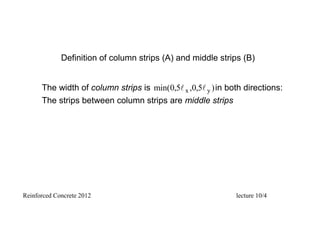
Definition of column strips (A) and middle strips (B)
The width of column strips is )5,0,5,0min( yx ll in both directions:
The strips between column strips are middle strips
Reinforced Concrete 2012 lecture 10/5
Reinforced Concrete 2012 lecture 10/6
2. The effective span
The dashed part of the column head is regarded infinitely rigid.
The peak value of the moment determined at the column axis is
rounded down along the infinitely rigid part of the support:
xxeffx c
3
2
2, ⋅−= ll
yyeffy c
3
2
2, ⋅−= ll
Reinforced Concrete 2012 lecture 10/7
3. Methods of analysis
Numerical methods
Using numerical computerized methods
(for example FEM – the finite element method)
-any ground plan layout,
-any support arrangement and
-any load distribution can be analysed with ease
Manual methods
As manual calculation method the method of substitutive frames or
substitutive beams can be applied. In the latter case the moment
distribution method (the Cross method) can be applied.
Reinforced Concrete 2012 lecture 10/8
4. The method of substitutive beams
Principal steps of the analysis:
-determination of the moment distribution for 1 m wide strip of the
slab in x and y direction respectively for the different loading scheemes
or for the substitutive loading, when plastic method can be applied
-multiplication of the moments by the span perpendicular to the
direction of the strip
-weighing of the moments by multiplication with the weighing
factors below:
+M -M
Column strip 55% 75%
Middle strip 45% 25%
-division of the moments by the strip width, to get the design
moment for 1 m wide strip of the slab
Reinforced Concrete 2012 lecture 10/9
,
Column strip
Middle strip
Reinforced Concrete 2012 lecture 10/10
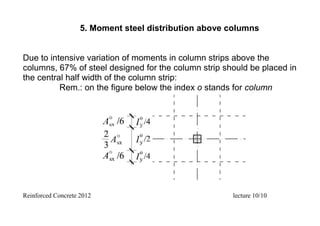
5. Moment steel distribution above columns
Due to intensive variation of moments in column strips above the
columns, 67% of steel designed for the column strip should be placed in
the central half width of the column strip:
Rem.: on the figure below the index o stands for column
Reinforced Concrete 2012 lecture 10/11
6. System of welded mesh reinforcement
Full lines: bottom reinforcement Broken lines: top reinforcement
Extent of mesh overlap see at constructional rules of the design aids
Reinforced Concrete 2012 lecture 10/12
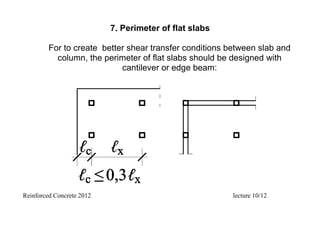
7. Perimeter of flat slabs
For to create better shear transfer conditions between slab and
column, the perimeter of flat slabs should be designed with
cantilever or edge beam:
Reinforced Concrete 2012 lecture 10/13
8. Loading scheemes
To determine extreme values of positive and negative moments and
shear forces at columns, different loading scheemes are applied.
Creation principles of loading scheemes are similar to those used for
continuous beams
For Mmax above column B B
and Bmax:
For maximum and minimum
moments in the spans the
chess-board rule is used:
Reinforced Concrete 2012 lecture 10/14
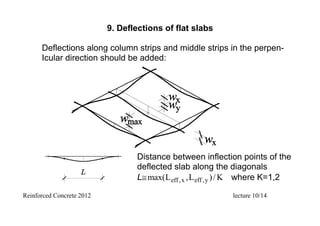
9. Deflections of flat slabs
Deflections along column strips and middle strips in the perpen-
Icular direction should be added:
Distance between inflection points of the
deflected slab along the diagonals
L≅ K/)L,Lmax( y,effx,eff where K=1,2
Reinforced Concrete 2012 lecture 10/15
10. Punching, unbuttoning and perforation
Shear stress distributions in the slab around the column:
Punching due to N unbuttoning due to M perforation due to
N + M
Reinforced Concrete 2012 lecture 10/16
11. Punching of flat slabs – design for shear at the column
heads
1. Danger of compression failure around perimeter uo: vEd ≤ vRd,max
where: vEd=
du
V
o
oEd,β
and cdmax,Rd vf5,0v =
In the above expressions d=
2
dd yx +
v= 0,6(1-
250
fck
)
perimeter u0 perimeter u1
Reinforced Concrete 2012 lecture 10/17
Through the parameter β the effect of unwanted eccentricity of the
support reaction force VEd,o is approximately taken into consideration:
Reinforced Concrete 2012 lecture 10/18
2. No shear reinforcement is needed, if the specific shear capacity of
the concrete along perimeter u1 – at distance 2d from the column
perimeter - is greater than the actual shear stress:
vEd ≤ vRd,c
where:
du
V
v
1
Ed
Ed
β
= and dct,cRd, cfv =
the parameter c is tabulated in the design aids
perimeter u0 perimeter u1
Reinforced Concrete 2012 lecture 10/19
If the concrete’s shear capacity is smaller then the actual shear force:
3. Design of the shear reinforcement
vEd ≤ vRd,cs
vRd,cs is the design value of the spe-
cific punching shear capacity of the slab
designed with shear reinforcement along
the section investigated (N/mm2
):
vRd,cs=0,75vRd,c+ nAswfywd,ef sinα
du
1
1
where: n=
rs
d5,1
Asw is the cross-section of the shear
reinforcement along one of the perimeters investigated
sr radial spacing of elements of the shear reinforcement
Reinforced Concrete 2012 lecture 10/20
fywd,ef = 250 + 0,25d ≤ fywd (N/mm2
) design value of the tensile
strength of punching shear reinforcement
*
α is the angle between axis of the shear reinforcement and the
middle plane of the slab.
Reinforced Concrete 2012 lecture 10/21
4. Check of the shear capacity of the concrete along the perimeter uout
vEd ≤ vRd,c
where:
du
V
v
out
Ed
Ed
β
= or
du
V
v
ef,out
Ed
Ed
β
=
Reinforced Concrete 2012 lecture 10/22
12. Different types of shear reinforcement used at column heads
links cages bent-up bars
Reinforced Concrete 2012 lecture 10/23
welded steel dowels with
jumped heads
spiral links
column longitudinal
bar
links cage welded bent
ladder
hung
link
Reinforced Concrete 2012 lecture 10/24
12. Constructional rules
in transverse direction (perpendicular to the span)smax= 1,5d
further than 2d from the column perimeter: smax= 2d
Reinforced Concrete 2012 lecture 10/25
Placing of links: Placing of bent-up bars:

Flat slab

  • 1.
    Reinforced Concrete 2012lecture 10/1 Budapest University of Technology and Economics Department of Mechanics, Materials and Structures English courses Reinforced Concrete Structures Code: BMEEPSTK601 Lecture no. 10: FLAT SLABS
  • 2.
    Reinforced Concrete 2012lecture 10/2 Content: 1. Introduction, definitions 2. The effective span 3. Methods of analysis 4. The method of substitutive strips 5. Moment steel distribution above columns 6. System of welded mesh reinforcement 7. Perimeter of flat slabs 8. Loading scheemes 9. Deflections of flat slabs 10. Punching, unbuttoning and perforation 11. Punching of flat slabs – design for shear at the column heads 12. Different types of shear reinforcement used at column heads
  • 3.
    Reinforced Concrete 2012lecture 10/3 1. Introduction, definitions Flat slabs are two-way slabs supported by point-like supports. Linear supports: a) column-beam support a) b) b) column-wide beam (dropped slab strip) support Point-like supports of flat slabs c) d) c) column (without column head) d) column with fungiform column head In flat slabs the total load intensity should be carried in both perpendicular directions. Beside this, due to shear problems at column heads, the thickness of flat slab is greater:
  • 4.
    Reinforced Concrete 2012lecture 10/4 Definition of column strips (A) and middle strips (B) The width of column strips is )5,0,5,0min( yx ll in both directions: The strips between column strips are middle strips
  • 5.
  • 6.
    Reinforced Concrete 2012lecture 10/6 2. The effective span The dashed part of the column head is regarded infinitely rigid. The peak value of the moment determined at the column axis is rounded down along the infinitely rigid part of the support: xxeffx c 3 2 2, ⋅−= ll yyeffy c 3 2 2, ⋅−= ll
  • 7.
    Reinforced Concrete 2012lecture 10/7 3. Methods of analysis Numerical methods Using numerical computerized methods (for example FEM – the finite element method) -any ground plan layout, -any support arrangement and -any load distribution can be analysed with ease Manual methods As manual calculation method the method of substitutive frames or substitutive beams can be applied. In the latter case the moment distribution method (the Cross method) can be applied.
  • 8.
    Reinforced Concrete 2012lecture 10/8 4. The method of substitutive beams Principal steps of the analysis: -determination of the moment distribution for 1 m wide strip of the slab in x and y direction respectively for the different loading scheemes or for the substitutive loading, when plastic method can be applied -multiplication of the moments by the span perpendicular to the direction of the strip -weighing of the moments by multiplication with the weighing factors below: +M -M Column strip 55% 75% Middle strip 45% 25% -division of the moments by the strip width, to get the design moment for 1 m wide strip of the slab
  • 9.
    Reinforced Concrete 2012lecture 10/9 , Column strip Middle strip
  • 10.
    Reinforced Concrete 2012lecture 10/10 5. Moment steel distribution above columns Due to intensive variation of moments in column strips above the columns, 67% of steel designed for the column strip should be placed in the central half width of the column strip: Rem.: on the figure below the index o stands for column
  • 11.
    Reinforced Concrete 2012lecture 10/11 6. System of welded mesh reinforcement Full lines: bottom reinforcement Broken lines: top reinforcement Extent of mesh overlap see at constructional rules of the design aids
  • 12.
    Reinforced Concrete 2012lecture 10/12 7. Perimeter of flat slabs For to create better shear transfer conditions between slab and column, the perimeter of flat slabs should be designed with cantilever or edge beam:
  • 13.
    Reinforced Concrete 2012lecture 10/13 8. Loading scheemes To determine extreme values of positive and negative moments and shear forces at columns, different loading scheemes are applied. Creation principles of loading scheemes are similar to those used for continuous beams For Mmax above column B B and Bmax: For maximum and minimum moments in the spans the chess-board rule is used:
  • 14.
    Reinforced Concrete 2012lecture 10/14 9. Deflections of flat slabs Deflections along column strips and middle strips in the perpen- Icular direction should be added: Distance between inflection points of the deflected slab along the diagonals L≅ K/)L,Lmax( y,effx,eff where K=1,2
  • 15.
    Reinforced Concrete 2012lecture 10/15 10. Punching, unbuttoning and perforation Shear stress distributions in the slab around the column: Punching due to N unbuttoning due to M perforation due to N + M
  • 16.
    Reinforced Concrete 2012lecture 10/16 11. Punching of flat slabs – design for shear at the column heads 1. Danger of compression failure around perimeter uo: vEd ≤ vRd,max where: vEd= du V o oEd,β and cdmax,Rd vf5,0v = In the above expressions d= 2 dd yx + v= 0,6(1- 250 fck ) perimeter u0 perimeter u1
  • 17.
    Reinforced Concrete 2012lecture 10/17 Through the parameter β the effect of unwanted eccentricity of the support reaction force VEd,o is approximately taken into consideration:
  • 18.
    Reinforced Concrete 2012lecture 10/18 2. No shear reinforcement is needed, if the specific shear capacity of the concrete along perimeter u1 – at distance 2d from the column perimeter - is greater than the actual shear stress: vEd ≤ vRd,c where: du V v 1 Ed Ed β = and dct,cRd, cfv = the parameter c is tabulated in the design aids perimeter u0 perimeter u1
  • 19.
    Reinforced Concrete 2012lecture 10/19 If the concrete’s shear capacity is smaller then the actual shear force: 3. Design of the shear reinforcement vEd ≤ vRd,cs vRd,cs is the design value of the spe- cific punching shear capacity of the slab designed with shear reinforcement along the section investigated (N/mm2 ): vRd,cs=0,75vRd,c+ nAswfywd,ef sinα du 1 1 where: n= rs d5,1 Asw is the cross-section of the shear reinforcement along one of the perimeters investigated sr radial spacing of elements of the shear reinforcement
  • 20.
    Reinforced Concrete 2012lecture 10/20 fywd,ef = 250 + 0,25d ≤ fywd (N/mm2 ) design value of the tensile strength of punching shear reinforcement * α is the angle between axis of the shear reinforcement and the middle plane of the slab.
  • 21.
    Reinforced Concrete 2012lecture 10/21 4. Check of the shear capacity of the concrete along the perimeter uout vEd ≤ vRd,c where: du V v out Ed Ed β = or du V v ef,out Ed Ed β =
  • 22.
    Reinforced Concrete 2012lecture 10/22 12. Different types of shear reinforcement used at column heads links cages bent-up bars
  • 23.
    Reinforced Concrete 2012lecture 10/23 welded steel dowels with jumped heads spiral links column longitudinal bar links cage welded bent ladder hung link
  • 24.
    Reinforced Concrete 2012lecture 10/24 12. Constructional rules in transverse direction (perpendicular to the span)smax= 1,5d further than 2d from the column perimeter: smax= 2d
  • 25.
    Reinforced Concrete 2012lecture 10/25 Placing of links: Placing of bent-up bars: