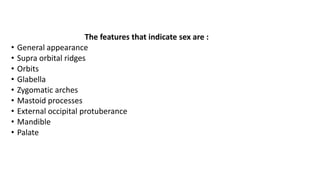
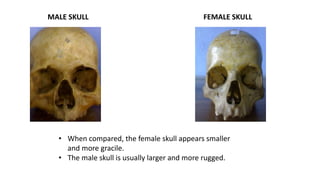
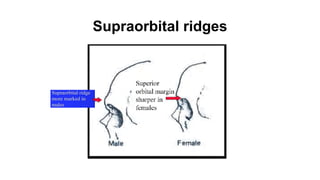
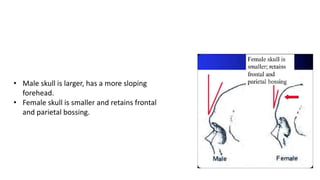
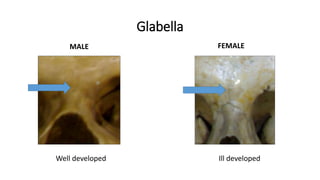
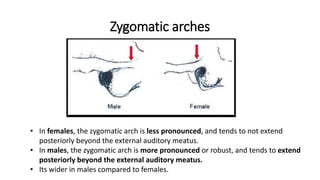
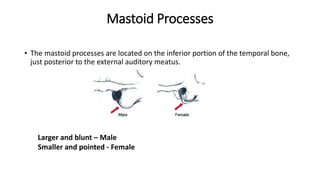
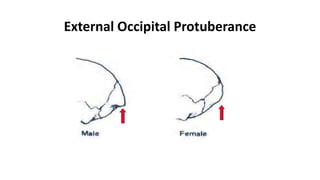
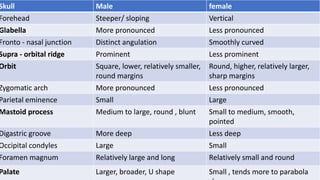
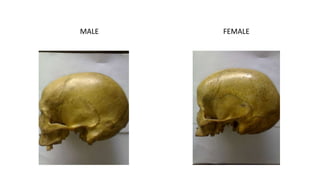
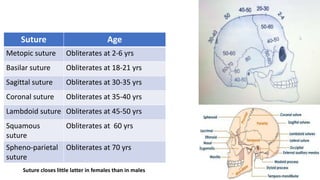
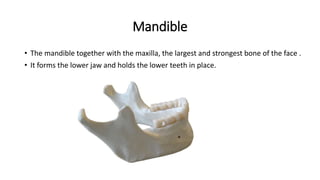
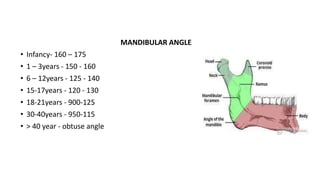
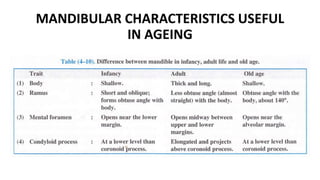
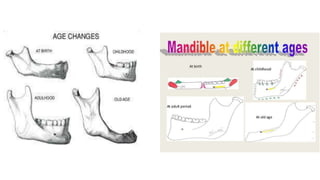
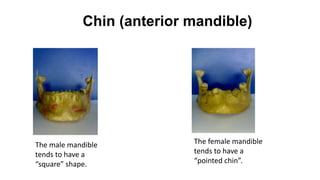
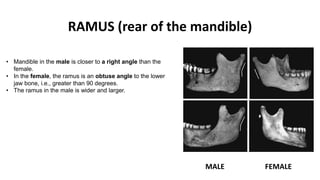
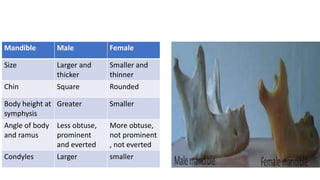
The document discusses identifying human remains using skull and mandible bones. It describes a 5-phase identification procedure including description, number of individuals, sex determination, age estimation, and stature estimation. Sex determination is most accurate using pelvis (95%) or skull and pelvis (98%) and is based on morphological and osteometric differences between males and females. Key skull features for sex determination are the supraorbital ridge, orbits, glabella, zygomatic arches, mastoid processes, and external occipital protuberance. Mandible features include the chin, ramus angle, and palate size. Age-related bone changes and fusion of sutures are also discussed.
![Sphenooccipital Synchondrosis
• [between basal part of occipital bone & adj. body of sphenoid] –
Major skull cartilage centre, fuses by 18-21 years – most useful
skeletal ageing factor.](https://image.slidesharecdn.com/skullandmandible2-230417091210-9bf0d089/85/Skull-and-Mandible-2-pptx-6-320.jpg)





![Introduction to skull[1]](https://cdn.slidesharecdn.com/ss_thumbnails/introductiontoskull1-170504174910-thumbnail.jpg?width=640&height=640&fit=bounds)


