Trainer the Trainer
Experience
•Training Experience
•Worst training experience of a delegate
•What you would like to learn?
Agenda
•Successful Training
•Key Characteristics
•Presenting
•Handling Questions/Challenges
•Session plan
What does successful training look like
for each of these?
Trainer
People are engaged, they learn and we feel it went
well
Trainees
They can share their knowledge/experience, feel
comfortable and can learn techniques to have
successful events
Oxfam/Oxjam
Educates on Oxfam/Oxjam, represents their brand
and encourages/inspires others
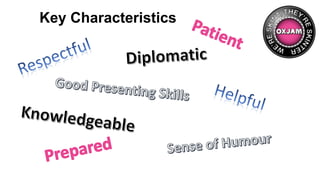
Key Characteristics
Presenting Information
•Face delegates
•Use body language/hand gestures (not
•Wearing a smile
•Hiding reactions
•Speaking/pace
•Reading body language
Handling Questions
• Always invite questions after a lot of information has been shared
or at the end of the session
• Try not to reactive to anything that is said i.e. facial reactions
• Repeat the question your asked to confirm your understanding and
to ensure everyone in the group heard
• If you’re unsure how to answer the question – say something like
‘great question, what does everyone else think?’ – the others
trainers are there to support you
• Don’t be surprised if someone asks a question about something you
covered – that’s ok – no stupid questions!
• If we can’t answer the question ensure you get contact details for
the person and send them the answer later!
Handling Challenges
• Some people may challenge your knowledge, remember we all
have different levels of experience and understanding
• Our job as a trainer is to be diplomatic at all times – the other
trainers can support difficult situations
• If someone is inputting a lot, thank them, and explain you’re going
to have to move on to and will catch them at break/after training
• Remember your notes – the powerpoint should guide you – use
your knowledge and experience to share tips/stories if you get stuck
• Not sure how to handle a question – ask the group if they can
answer – another trainer can then help if needed
• Respect is everything, let people speak, listen to the trainees and
aim to answer their questions/handle concerns and we’ll be grand
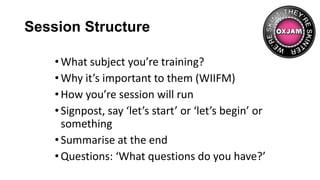
Session Structure
•What subject you’re training?
•Why it’s important to them (WIIFM)
•How you’re session will run
•Signpost, say ‘let’s start’ or ‘let’s begin’ or
something
•Summarise at the end
•Questions: ‘What questions do you have?’

Train the Trainer (Team Skinter)

  • 1.
  • 2.
    Experience •Training Experience •Worst trainingexperience of a delegate •What you would like to learn?
  • 3.
  • 4.
    What does successfultraining look like for each of these? Trainer People are engaged, they learn and we feel it went well Trainees They can share their knowledge/experience, feel comfortable and can learn techniques to have successful events Oxfam/Oxjam Educates on Oxfam/Oxjam, represents their brand and encourages/inspires others
  • 5.
  • 6.
    Presenting Information •Face delegates •Usebody language/hand gestures (not •Wearing a smile •Hiding reactions •Speaking/pace •Reading body language
  • 7.
    Handling Questions • Alwaysinvite questions after a lot of information has been shared or at the end of the session • Try not to reactive to anything that is said i.e. facial reactions • Repeat the question your asked to confirm your understanding and to ensure everyone in the group heard • If you’re unsure how to answer the question – say something like ‘great question, what does everyone else think?’ – the others trainers are there to support you • Don’t be surprised if someone asks a question about something you covered – that’s ok – no stupid questions! • If we can’t answer the question ensure you get contact details for the person and send them the answer later!
  • 8.
    Handling Challenges • Somepeople may challenge your knowledge, remember we all have different levels of experience and understanding • Our job as a trainer is to be diplomatic at all times – the other trainers can support difficult situations • If someone is inputting a lot, thank them, and explain you’re going to have to move on to and will catch them at break/after training • Remember your notes – the powerpoint should guide you – use your knowledge and experience to share tips/stories if you get stuck • Not sure how to handle a question – ask the group if they can answer – another trainer can then help if needed • Respect is everything, let people speak, listen to the trainees and aim to answer their questions/handle concerns and we’ll be grand
  • 9.
    Session Structure •What subjectyou’re training? •Why it’s important to them (WIIFM) •How you’re session will run •Signpost, say ‘let’s start’ or ‘let’s begin’ or something •Summarise at the end •Questions: ‘What questions do you have?’