Sreenu Thalla
Assistant Professor
Department of Pharmacology
4/3/2024 1
Sreenu Thalla, Assistant Professor,
Pharmacology, Skeletal System
HAP - Unit – II
4/3/2024 2
Sreenu Thalla, Assistant Professor,
Pharmacology, Skeletal System
INTRODUCTION
• With its highly engineered joints, the living skeleton is intimately
connected with the muscular system.
• It provides a framework of stiff levers and stable plates that permits
a multitude of movements.
• The skeleton also integrates functionally with the cardiovascular
system – as every second, millions of fresh blood cells pour out of
the bone marrow.
• A healthy diet that provides enough minerals, especially calcium,
along with regular moderate exercise, can reduce the risks of many
bones and joints
4/3/2024 3
Sreenu Thalla, Assistant Professor,
Pharmacology, Skeletal System
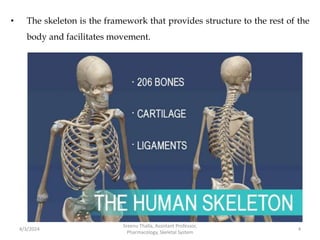
• The skeleton is the framework that provides structure to the rest of the
body and facilitates movement.
4/3/2024 4
Sreenu Thalla, Assistant Professor,
Pharmacology, Skeletal System
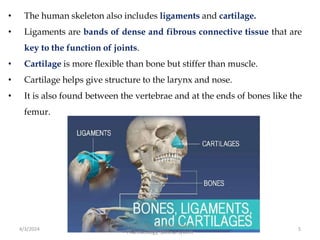
• The human skeleton also includes ligaments and cartilage.
• Ligaments are bands of dense and fibrous connective tissue that are
key to the function of joints.
• Cartilage is more flexible than bone but stiffer than muscle.
• Cartilage helps give structure to the larynx and nose.
• It is also found between the vertebrae and at the ends of bones like the
femur.
4/3/2024 5
Sreenu Thalla, Assistant Professor,
Pharmacology, Skeletal System
LIGAMENTS
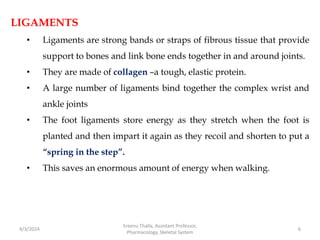
• Ligaments are strong bands or straps of fibrous tissue that provide
support to bones and link bone ends together in and around joints.
• They are made of collagen –a tough, elastic protein.
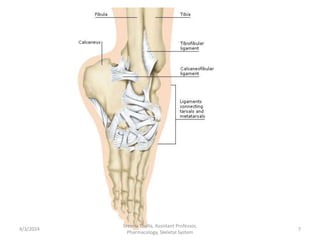
• A large number of ligaments bind together the complex wrist and
ankle joints
• The foot ligaments store energy as they stretch when the foot is
planted and then impart it again as they recoil and shorten to put a
“spring in the step”.
• This saves an enormous amount of energy when walking.
4/3/2024 6
Sreenu Thalla, Assistant Professor,
Pharmacology, Skeletal System
4/3/2024 7
Sreenu Thalla, Assistant Professor,
Pharmacology, Skeletal System
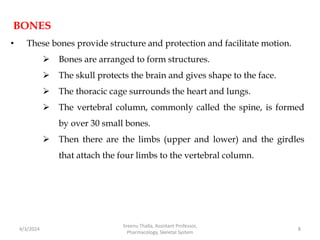
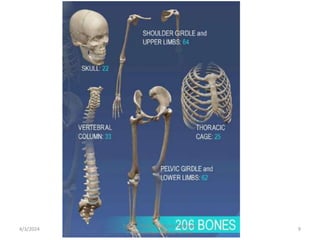
• These bones provide structure and protection and facilitate motion.
 Bones are arranged to form structures.
 The skull protects the brain and gives shape to the face.
 The thoracic cage surrounds the heart and lungs.
 The vertebral column, commonly called the spine, is formed
by over 30 small bones.
 Then there are the limbs (upper and lower) and the girdles
that attach the four limbs to the vertebral column.
BONES
4/3/2024 8
Sreenu Thalla, Assistant Professor,
Pharmacology, Skeletal System
4/3/2024 9
Sreenu Thalla, Assistant Professor,
Pharmacology, Skeletal System
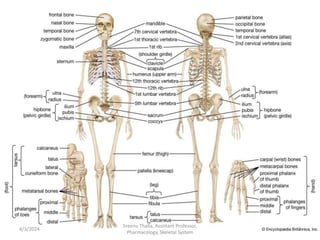
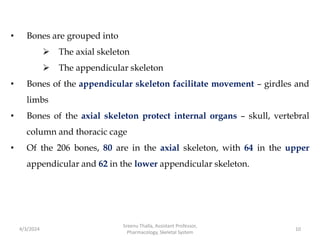
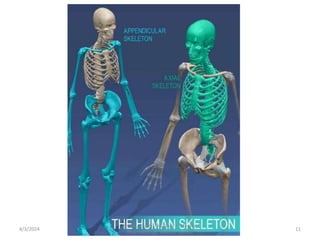
• Bones are grouped into
 The axial skeleton
 The appendicular skeleton
• Bones of the appendicular skeleton facilitate movement – girdles and
limbs
• Bones of the axial skeleton protect internal organs – skull, vertebral
column and thoracic cage
• Of the 206 bones, 80 are in the axial skeleton, with 64 in the upper
appendicular and 62 in the lower appendicular skeleton.
4/3/2024 10
Sreenu Thalla, Assistant Professor,
Pharmacology, Skeletal System
4/3/2024 11
Sreenu Thalla, Assistant Professor,
Pharmacology, Skeletal System
4/3/2024 12
Sreenu Thalla, Assistant Professor,
Pharmacology, Skeletal System
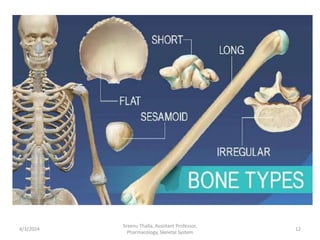
• Bones of the human skeletal system are categorized by their shape and
function into five types.
 The femur is an example of a long bone.
 The frontal bone is a flat bone.
 The patella, also called the knee cap, is a sesamoid bone.
 Carpals (in the hand) and tarsals (in the feet) are examples of
short bones.
 Vertebrae are classified as Irregular shaped bones.
4/3/2024 13
Sreenu Thalla, Assistant Professor,
Pharmacology, Skeletal System
4/3/2024 14
Sreenu Thalla, Assistant Professor,
Pharmacology, Skeletal System
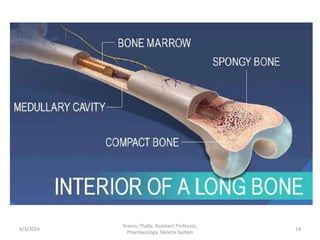
• Long bones have three main parts to them
• The outside of a long bone consists of a layer of compact bone
surrounding spongy bone.
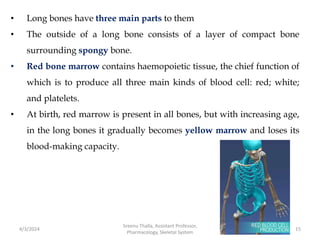
• Red bone marrow contains haemopoietic tissue, the chief function of
which is to produce all three main kinds of blood cell: red; white;
and platelets.
• At birth, red marrow is present in all bones, but with increasing age,
in the long bones it gradually becomes yellow marrow and loses its
blood-making capacity.
4/3/2024 15
Sreenu Thalla, Assistant Professor,
Pharmacology, Skeletal System
4/3/2024 16
Sreenu Thalla, Assistant Professor,
Pharmacology, Skeletal System
• Some bones produce red blood cells
• Red bone marrow is soft tissue located in networks of spongy bone
tissue inside some bones.
• In adults the red marrow in bones produce blood cells of the
 Cranium (skull)
 Vertebrae
 Scapulae (shoulder bones)
 Sternum (bone in the center of the chest)
 Ribs
 Pelvis
 The epiphyseal ends of the large long bones
4/3/2024 17
Sreenu Thalla, Assistant Professor,
Pharmacology, Skeletal System
4/3/2024 18
Sreenu Thalla, Assistant Professor,
Pharmacology, Skeletal System
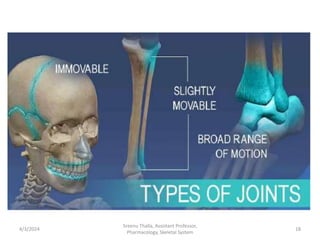
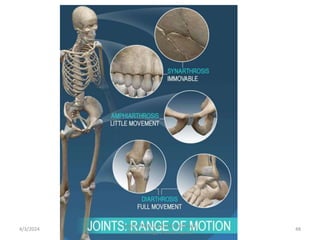
• Some joints don't move or move very little
• One way to classify joints is by range of motion.
• Immovable joints include
 Sutures of the skull
 Articulations between teeth and the mandible
 The joint located between the first pair of ribs and the
sternum.
• Some joints have slight movement; an example is the distal joint
between the tibia and fibula.
• Joints that allow a lot of motion (think of the shoulder, wrist, hip, and
ankle) are located in the upper and lower limbs.
4/3/2024 19
Sreenu Thalla, Assistant Professor,
Pharmacology, Skeletal System
4/3/2024 20
Sreenu Thalla, Assistant Professor,
Pharmacology, Skeletal System
• Infants have more bones than adults
• An infant skeleton has almost 100 more bones than the skeleton of an
adult.
• At first, it is all flexible but strong cartilage.
• Bone formation begins at about three months gestation and continues
after birth into adulthood.
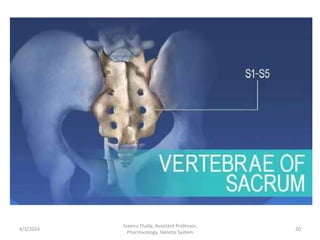
• An example of several bones that fuse over time into one bone is the
sacrum.
• At birth, the sacrum is five vertebrae with discs in between them.
• The sacrum is fully fused into one bone usually by the fourth decade of
life.
4/3/2024 21
Sreenu Thalla, Assistant Professor,
Pharmacology, Skeletal System
4/3/2024 22
Sreenu Thalla, Assistant Professor,
Pharmacology, Skeletal System
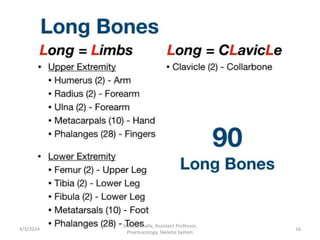
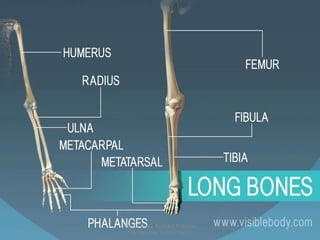
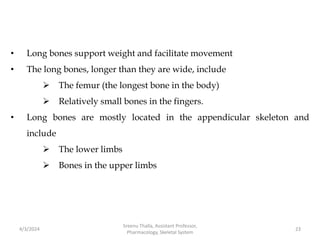
• Long bones support weight and facilitate movement
• The long bones, longer than they are wide, include
 The femur (the longest bone in the body)
 Relatively small bones in the fingers.
• Long bones are mostly located in the appendicular skeleton and
include
 The lower limbs
 Bones in the upper limbs
4/3/2024 23
Sreenu Thalla, Assistant Professor,
Pharmacology, Skeletal System
4/3/2024 24
Sreenu Thalla, Assistant Professor,
Pharmacology, Skeletal System
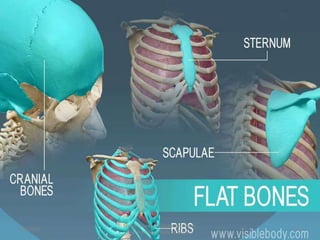
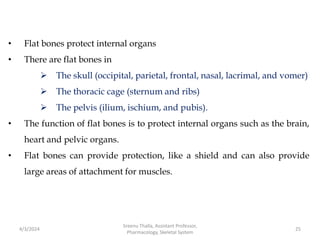
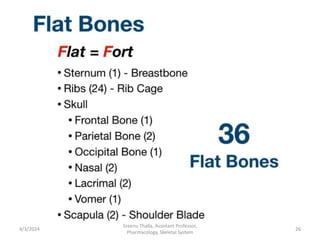
• Flat bones protect internal organs
• There are flat bones in
 The skull (occipital, parietal, frontal, nasal, lacrimal, and vomer)
 The thoracic cage (sternum and ribs)
 The pelvis (ilium, ischium, and pubis).
• The function of flat bones is to protect internal organs such as the brain,
heart and pelvic organs.
• Flat bones can provide protection, like a shield and can also provide
large areas of attachment for muscles.
4/3/2024 25
Sreenu Thalla, Assistant Professor,
Pharmacology, Skeletal System
4/3/2024 26
Sreenu Thalla, Assistant Professor,
Pharmacology, Skeletal System
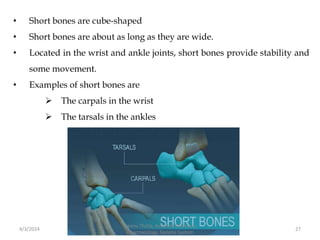
• Short bones are cube-shaped
• Short bones are about as long as they are wide.
• Located in the wrist and ankle joints, short bones provide stability and
some movement.
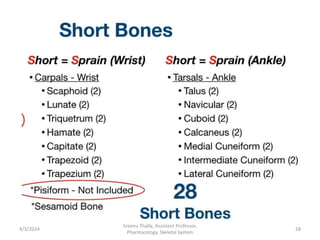
• Examples of short bones are
 The carpals in the wrist
 The tarsals in the ankles
4/3/2024 27
Sreenu Thalla, Assistant Professor,
Pharmacology, Skeletal System
4/3/2024 28
Sreenu Thalla, Assistant Professor,
Pharmacology, Skeletal System
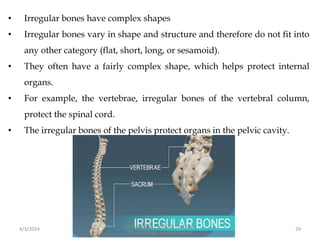
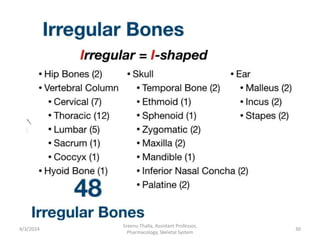
• Irregular bones have complex shapes
• Irregular bones vary in shape and structure and therefore do not fit into
any other category (flat, short, long, or sesamoid).
• They often have a fairly complex shape, which helps protect internal
organs.
• For example, the vertebrae, irregular bones of the vertebral column,
protect the spinal cord.
• The irregular bones of the pelvis protect organs in the pelvic cavity.
4/3/2024 29
Sreenu Thalla, Assistant Professor,
Pharmacology, Skeletal System
4/3/2024 30
Sreenu Thalla, Assistant Professor,
Pharmacology, Skeletal System
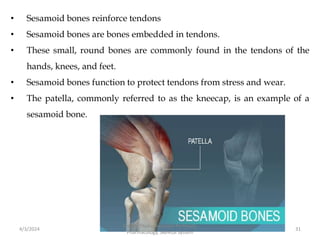
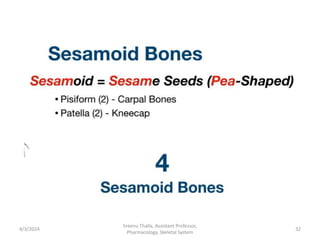
• Sesamoid bones reinforce tendons
• Sesamoid bones are bones embedded in tendons.
• These small, round bones are commonly found in the tendons of the
hands, knees, and feet.
• Sesamoid bones function to protect tendons from stress and wear.
• The patella, commonly referred to as the kneecap, is an example of a
sesamoid bone.
4/3/2024 31
Sreenu Thalla, Assistant Professor,
Pharmacology, Skeletal System
4/3/2024 32
Sreenu Thalla, Assistant Professor,
Pharmacology, Skeletal System
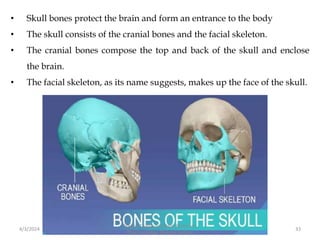
• Skull bones protect the brain and form an entrance to the body
• The skull consists of the cranial bones and the facial skeleton.
• The cranial bones compose the top and back of the skull and enclose
the brain.
• The facial skeleton, as its name suggests, makes up the face of the skull.
4/3/2024 33
Sreenu Thalla, Assistant Professor,
Pharmacology, Skeletal System
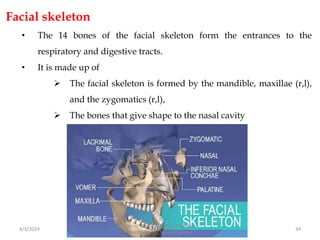
Facial skeleton
• The 14 bones of the facial skeleton form the entrances to the
respiratory and digestive tracts.
• It is made up of
 The facial skeleton is formed by the mandible, maxillae (r,l),
and the zygomatics (r,l),
 The bones that give shape to the nasal cavity
4/3/2024 34
Sreenu Thalla, Assistant Professor,
Pharmacology, Skeletal System
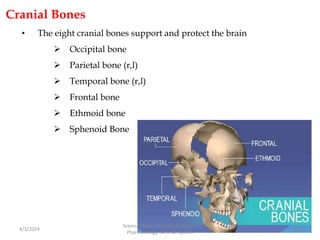
Cranial Bones
• The eight cranial bones support and protect the brain
 Occipital bone
 Parietal bone (r,l)
 Temporal bone (r,l)
 Frontal bone
 Ethmoid bone
 Sphenoid Bone
4/3/2024 35
Sreenu Thalla, Assistant Professor,
Pharmacology, Skeletal System
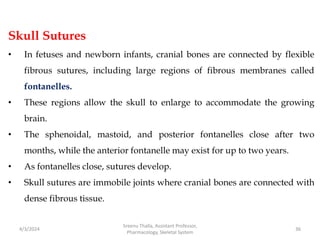
Skull Sutures
• In fetuses and newborn infants, cranial bones are connected by flexible
fibrous sutures, including large regions of fibrous membranes called
fontanelles.
• These regions allow the skull to enlarge to accommodate the growing
brain.
• The sphenoidal, mastoid, and posterior fontanelles close after two
months, while the anterior fontanelle may exist for up to two years.
• As fontanelles close, sutures develop.
• Skull sutures are immobile joints where cranial bones are connected with
dense fibrous tissue.
4/3/2024 36
Sreenu Thalla, Assistant Professor,
Pharmacology, Skeletal System
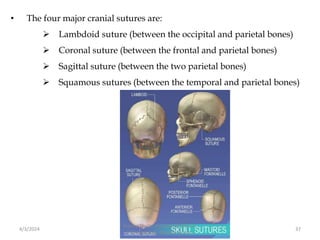
• The four major cranial sutures are:
 Lambdoid suture (between the occipital and parietal bones)
 Coronal suture (between the frontal and parietal bones)
 Sagittal suture (between the two parietal bones)
 Squamous sutures (between the temporal and parietal bones)
4/3/2024 37
Sreenu Thalla, Assistant Professor,
Pharmacology, Skeletal System
4/3/2024 38
Sreenu Thalla, Assistant Professor,
Pharmacology, Skeletal System
• The Hyoid Bone, Laryngeal Skeleton, and Bones of the Inner Ear Are
Commonly Categorized with Skull Bones
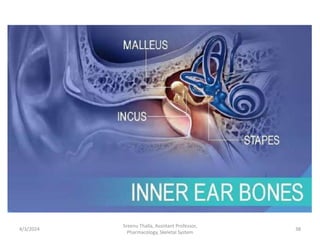
Bones of the inner ear
• Inside the petrous part of the temporal bone are the three smallest
bones of the body
 Malleus
 Incus
 Stapes (this is the smallest bone in the body !!)
• These three bones articulate with each other and transfer vibrations
from the tympanic membrane to the inner ear.
4/3/2024 39
Sreenu Thalla, Assistant Professor,
Pharmacology, Skeletal System
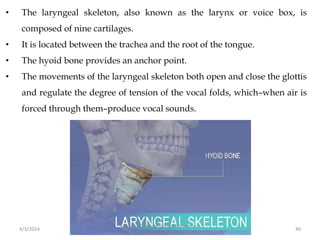
• The laryngeal skeleton, also known as the larynx or voice box, is
composed of nine cartilages.
• It is located between the trachea and the root of the tongue.
• The hyoid bone provides an anchor point.
• The movements of the laryngeal skeleton both open and close the glottis
and regulate the degree of tension of the vocal folds, which–when air is
forced through them–produce vocal sounds.
4/3/2024 40
Sreenu Thalla, Assistant Professor,
Pharmacology, Skeletal System
4/3/2024 41
Sreenu Thalla, Assistant Professor,
Pharmacology, Skeletal System
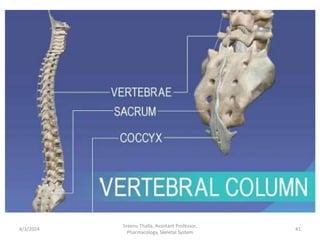
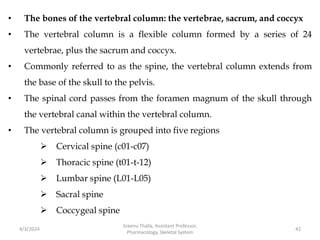
• The bones of the vertebral column: the vertebrae, sacrum, and coccyx
• The vertebral column is a flexible column formed by a series of 24
vertebrae, plus the sacrum and coccyx.
• Commonly referred to as the spine, the vertebral column extends from
the base of the skull to the pelvis.
• The spinal cord passes from the foramen magnum of the skull through
the vertebral canal within the vertebral column.
• The vertebral column is grouped into five regions
 Cervical spine (c01-c07)
 Thoracic spine (t01-t-12)
 Lumbar spine (L01-L05)
 Sacral spine
 Coccygeal spine
4/3/2024 42
Sreenu Thalla, Assistant Professor,
Pharmacology, Skeletal System
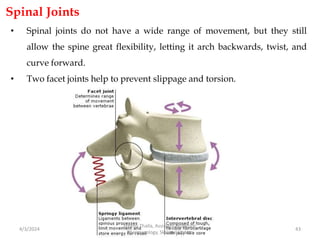
Spinal Joints
• Spinal joints do not have a wide range of movement, but they still
allow the spine great flexibility, letting it arch backwards, twist, and
curve forward.
• Two facet joints help to prevent slippage and torsion.
4/3/2024 43
Sreenu Thalla, Assistant Professor,
Pharmacology, Skeletal System
4/3/2024 44
Sreenu Thalla, Assistant Professor,
Pharmacology, Skeletal System
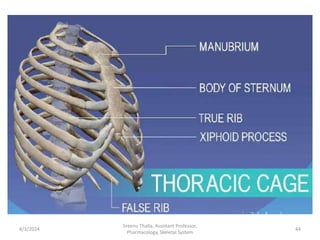
• The bones of the thoracic cage protect internal organs
• The thoracic cage, formed by the ribs and sternum, protects internal
organs and gives attachment to muscles involved in respiration and
upper limb movement.
• The sternum consists of the manubrium, body of the sternum, and
xiphoid process.
• Ribs 1-7 are called true ribs because they articulate directly to the
sternum
• Ribs 8-12 are known as false ribs.
4/3/2024 45
Sreenu Thalla, Assistant Professor,
Pharmacology, Skeletal System
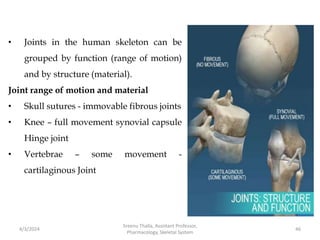
• Joints in the human skeleton can be
grouped by function (range of motion)
and by structure (material).
Joint range of motion and material
• Skull sutures - immovable fibrous joints
• Knee – full movement synovial capsule
Hinge joint
• Vertebrae – some movement -
cartilaginous Joint
4/3/2024 46
Sreenu Thalla, Assistant Professor,
Pharmacology, Skeletal System
• Joints hold the skeleton together and support movement.
• There are two ways to categorize joints.
 The first is by joint function, also referred to as range of
motion.
 The second way to categorize joints is by the material that
holds the bones of the joints together; that is an organization
of joints by structure.
4/3/2024 47
Sreenu Thalla, Assistant Professor,
Pharmacology, Skeletal System
4/3/2024 48
Sreenu Thalla, Assistant Professor,
Pharmacology, Skeletal System
4/3/2024 49
Sreenu Thalla, Assistant Professor,
Pharmacology, Skeletal System
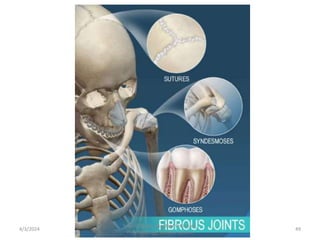
• Joints can be grouped by their structure into fibrous, cartilaginous and
synovial joints
• Fibrous joints –most of these have thick connective tissue between them
which is why most are immovable.
• There are three types of fibrous joints
 Sutures are nonmoving joints that connect bones of the skull.
 The fibrous articulations between the teeth and the mandible or
maxilla
 Asyndesmosis is a joint in which a ligament connects two
bones, allowing for a little movement
4/3/2024 50
Sreenu Thalla, Assistant Professor,
Pharmacology, Skeletal System
4/3/2024 51
Sreenu Thalla, Assistant Professor,
Pharmacology, Skeletal System
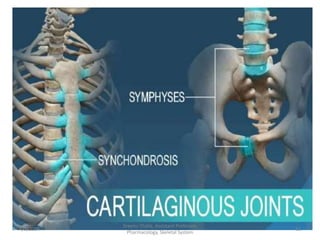
Cartiliginous Joints.
• Joints that unite bones with cartilage are called cartilaginous joints.
• There are two types of cartilaginous joints
 A synchrondosis is an immovable cartilaginous joint. One
example is the joint between the first pair of ribs and the
sternum.
 A symphysis consists of a compressible fibro-cartilaginous
pad that connects two bones, such as the hip bones and the
vertebrae.
4/3/2024 52
Sreenu Thalla, Assistant Professor,
Pharmacology, Skeletal System
4/3/2024 53
Sreenu Thalla, Assistant Professor,
Pharmacology, Skeletal System
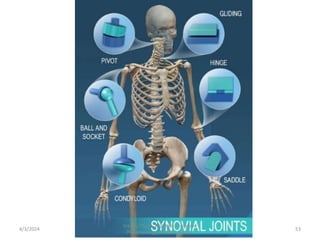
Synovial Joints
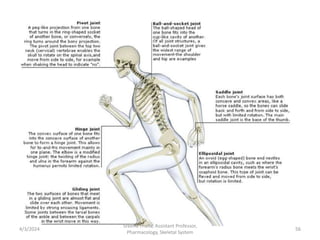
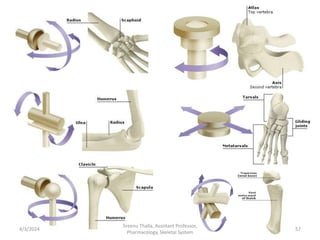
• Synovial joints are characterized by the presence of a capsule between the
two joined bones.
• Bone surfaces at synovial joints are protected by a coating of articular
cartilage. Synovial joints are often supported and reinforced by
surrounding ligaments, which limit movement to prevent injury.
There are six types of synovial joints:
 Gliding joints
 Hinge joints
 A pivot joint which provides rotation.
 A condyloid joint allows for circular motion, flexion, and
extension
 A saddle joint
 The ball-and-socket joint such as in the hip and shoulder
4/3/2024 54
Sreenu Thalla, Assistant Professor,
Pharmacology, Skeletal System
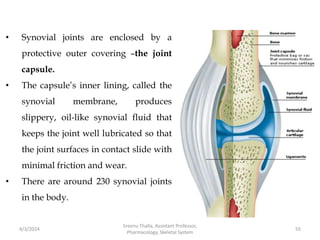
• Synovial joints are enclosed by a
protective outer covering –the joint
capsule.
• The capsule’s inner lining, called the
synovial membrane, produces
slippery, oil-like synovial fluid that
keeps the joint well lubricated so that
the joint surfaces in contact slide with
minimal friction and wear.
• There are around 230 synovial joints
in the body.
4/3/2024 55
Sreenu Thalla, Assistant Professor,
Pharmacology, Skeletal System
4/3/2024 56
Sreenu Thalla, Assistant Professor,
Pharmacology, Skeletal System
4/3/2024 57
Sreenu Thalla, Assistant Professor,
Pharmacology, Skeletal System
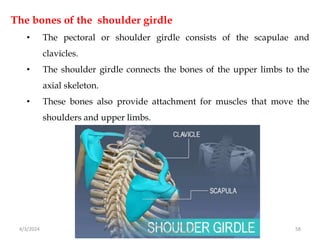
The bones of the shoulder girdle
• The pectoral or shoulder girdle consists of the scapulae and
clavicles.
• The shoulder girdle connects the bones of the upper limbs to the
axial skeleton.
• These bones also provide attachment for muscles that move the
shoulders and upper limbs.
4/3/2024 58
Sreenu Thalla, Assistant Professor,
Pharmacology, Skeletal System
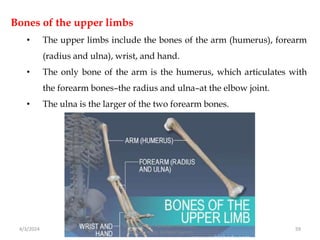
Bones of the upper limbs
• The upper limbs include the bones of the arm (humerus), forearm
(radius and ulna), wrist, and hand.
• The only bone of the arm is the humerus, which articulates with
the forearm bones–the radius and ulna–at the elbow joint.
• The ulna is the larger of the two forearm bones.
4/3/2024 59
Sreenu Thalla, Assistant Professor,
Pharmacology, Skeletal System
Wrist Bones
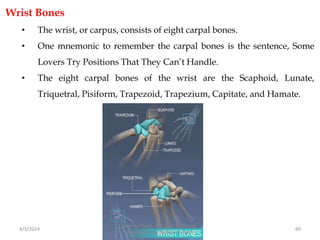
• The wrist, or carpus, consists of eight carpal bones.
• One mnemonic to remember the carpal bones is the sentence, Some
Lovers Try Positions That They Can’t Handle.
• The eight carpal bones of the wrist are the Scaphoid, Lunate,
Triquetral, Pisiform, Trapezoid, Trapezium, Capitate, and Hamate.
4/3/2024 60
Sreenu Thalla, Assistant Professor,
Pharmacology, Skeletal System
Hand Bones
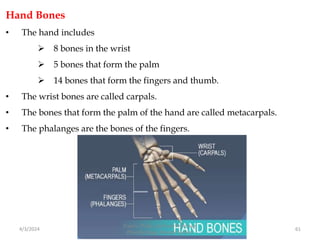
• The hand includes
 8 bones in the wrist
 5 bones that form the palm
 14 bones that form the fingers and thumb.
• The wrist bones are called carpals.
• The bones that form the palm of the hand are called metacarpals.
• The phalanges are the bones of the fingers.
4/3/2024 61
Sreenu Thalla, Assistant Professor,
Pharmacology, Skeletal System
The bones of the pelvis
• The pelvic girdle is a ring of bones attached to the vertebral column
that connects the bones of the lower limbs to the axial skeleton.
• The pelvic girdle consists of the right and left hip bones.
• Each hip bone is a large, flattened, and irregularly shaped fusion of
three bones
 Ilium
 Ischium
 Pubis
4/3/2024 62
Sreenu Thalla, Assistant Professor,
Pharmacology, Skeletal System
4/3/2024 63
Sreenu Thalla, Assistant Professor,
Pharmacology, Skeletal System
FEMALE and MALE PELVIS
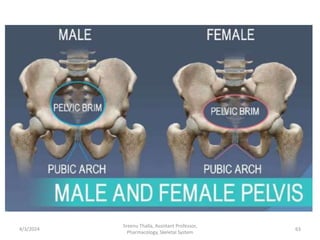
• The female and male pelvises differ in several ways due to
childbearing adaptations in the female.
• The female pelvic brim is larger and wider than the male’s.
• The angle of the pubic arch is greater in the female pelvis (over 90
degrees) than in the male pelvis (less than 90 degrees).
• The male pelvis is deeper and has a narrower pelvic outlet than the
female’s.
4/3/2024 64
Sreenu Thalla, Assistant Professor,
Pharmacology, Skeletal System
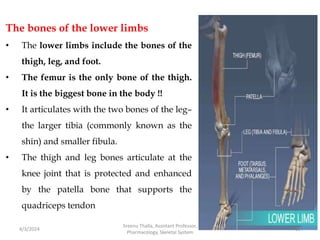
The bones of the lower limbs
• The lower limbs include the bones of the
thigh, leg, and foot.
• The femur is the only bone of the thigh.
It is the biggest bone in the body !!
• It articulates with the two bones of the leg–
the larger tibia (commonly known as the
shin) and smaller fibula.
• The thigh and leg bones articulate at the
knee joint that is protected and enhanced
by the patella bone that supports the
quadriceps tendon
4/3/2024 65
Sreenu Thalla, Assistant Professor,
Pharmacology, Skeletal System
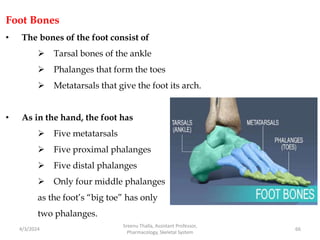
Foot Bones
• The bones of the foot consist of
 Tarsal bones of the ankle
 Phalanges that form the toes
 Metatarsals that give the foot its arch.
• As in the hand, the foot has
 Five metatarsals
 Five proximal phalanges
 Five distal phalanges
 Only four middle phalanges
as the foot’s “big toe” has only
two phalanges.
4/3/2024 66
Sreenu Thalla, Assistant Professor,
Pharmacology, Skeletal System
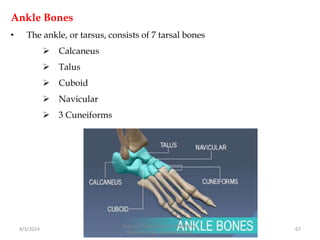
Ankle Bones
• The ankle, or tarsus, consists of 7 tarsal bones
 Calcaneus
 Talus
 Cuboid
 Navicular
 3 Cuneiforms
4/3/2024 67
Sreenu Thalla, Assistant Professor,
Pharmacology, Skeletal System
4/3/2024 68
Sreenu Thalla, Assistant Professor,
Pharmacology, Skeletal System
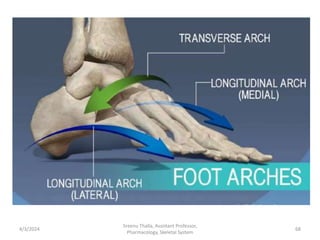
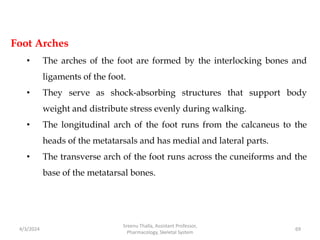
Foot Arches
• The arches of the foot are formed by the interlocking bones and
ligaments of the foot.
• They serve as shock-absorbing structures that support body
weight and distribute stress evenly during walking.
• The longitudinal arch of the foot runs from the calcaneus to the
heads of the metatarsals and has medial and lateral parts.
• The transverse arch of the foot runs across the cuneiforms and the
base of the metatarsal bones.
4/3/2024 69
Sreenu Thalla, Assistant Professor,
Pharmacology, Skeletal System
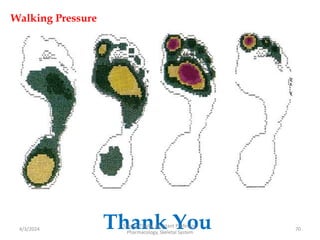
Walking Pressure
Thank You
4/3/2024 70
Sreenu Thalla, Assistant Professor,
Pharmacology, Skeletal System

Skeletal System and its divisions, bones

  • 1.
    Sreenu Thalla Assistant Professor Departmentof Pharmacology 4/3/2024 1 Sreenu Thalla, Assistant Professor, Pharmacology, Skeletal System HAP - Unit – II
  • 2.
    4/3/2024 2 Sreenu Thalla,Assistant Professor, Pharmacology, Skeletal System
  • 3.
    INTRODUCTION • With itshighly engineered joints, the living skeleton is intimately connected with the muscular system. • It provides a framework of stiff levers and stable plates that permits a multitude of movements. • The skeleton also integrates functionally with the cardiovascular system – as every second, millions of fresh blood cells pour out of the bone marrow. • A healthy diet that provides enough minerals, especially calcium, along with regular moderate exercise, can reduce the risks of many bones and joints 4/3/2024 3 Sreenu Thalla, Assistant Professor, Pharmacology, Skeletal System
  • 4.
    • The skeletonis the framework that provides structure to the rest of the body and facilitates movement. 4/3/2024 4 Sreenu Thalla, Assistant Professor, Pharmacology, Skeletal System
  • 5.
    • The humanskeleton also includes ligaments and cartilage. • Ligaments are bands of dense and fibrous connective tissue that are key to the function of joints. • Cartilage is more flexible than bone but stiffer than muscle. • Cartilage helps give structure to the larynx and nose. • It is also found between the vertebrae and at the ends of bones like the femur. 4/3/2024 5 Sreenu Thalla, Assistant Professor, Pharmacology, Skeletal System
  • 6.
    LIGAMENTS • Ligaments arestrong bands or straps of fibrous tissue that provide support to bones and link bone ends together in and around joints. • They are made of collagen –a tough, elastic protein. • A large number of ligaments bind together the complex wrist and ankle joints • The foot ligaments store energy as they stretch when the foot is planted and then impart it again as they recoil and shorten to put a “spring in the step”. • This saves an enormous amount of energy when walking. 4/3/2024 6 Sreenu Thalla, Assistant Professor, Pharmacology, Skeletal System
  • 7.
    4/3/2024 7 Sreenu Thalla,Assistant Professor, Pharmacology, Skeletal System
  • 8.
    • These bonesprovide structure and protection and facilitate motion.  Bones are arranged to form structures.  The skull protects the brain and gives shape to the face.  The thoracic cage surrounds the heart and lungs.  The vertebral column, commonly called the spine, is formed by over 30 small bones.  Then there are the limbs (upper and lower) and the girdles that attach the four limbs to the vertebral column. BONES 4/3/2024 8 Sreenu Thalla, Assistant Professor, Pharmacology, Skeletal System
  • 9.
    4/3/2024 9 Sreenu Thalla,Assistant Professor, Pharmacology, Skeletal System
  • 10.
    • Bones aregrouped into  The axial skeleton  The appendicular skeleton • Bones of the appendicular skeleton facilitate movement – girdles and limbs • Bones of the axial skeleton protect internal organs – skull, vertebral column and thoracic cage • Of the 206 bones, 80 are in the axial skeleton, with 64 in the upper appendicular and 62 in the lower appendicular skeleton. 4/3/2024 10 Sreenu Thalla, Assistant Professor, Pharmacology, Skeletal System
  • 11.
    4/3/2024 11 Sreenu Thalla,Assistant Professor, Pharmacology, Skeletal System
  • 12.
    4/3/2024 12 Sreenu Thalla,Assistant Professor, Pharmacology, Skeletal System
  • 13.
    • Bones ofthe human skeletal system are categorized by their shape and function into five types.  The femur is an example of a long bone.  The frontal bone is a flat bone.  The patella, also called the knee cap, is a sesamoid bone.  Carpals (in the hand) and tarsals (in the feet) are examples of short bones.  Vertebrae are classified as Irregular shaped bones. 4/3/2024 13 Sreenu Thalla, Assistant Professor, Pharmacology, Skeletal System
  • 14.
    4/3/2024 14 Sreenu Thalla,Assistant Professor, Pharmacology, Skeletal System
  • 15.
    • Long boneshave three main parts to them • The outside of a long bone consists of a layer of compact bone surrounding spongy bone. • Red bone marrow contains haemopoietic tissue, the chief function of which is to produce all three main kinds of blood cell: red; white; and platelets. • At birth, red marrow is present in all bones, but with increasing age, in the long bones it gradually becomes yellow marrow and loses its blood-making capacity. 4/3/2024 15 Sreenu Thalla, Assistant Professor, Pharmacology, Skeletal System
  • 16.
    4/3/2024 16 Sreenu Thalla,Assistant Professor, Pharmacology, Skeletal System
  • 17.
    • Some bonesproduce red blood cells • Red bone marrow is soft tissue located in networks of spongy bone tissue inside some bones. • In adults the red marrow in bones produce blood cells of the  Cranium (skull)  Vertebrae  Scapulae (shoulder bones)  Sternum (bone in the center of the chest)  Ribs  Pelvis  The epiphyseal ends of the large long bones 4/3/2024 17 Sreenu Thalla, Assistant Professor, Pharmacology, Skeletal System
  • 18.
    4/3/2024 18 Sreenu Thalla,Assistant Professor, Pharmacology, Skeletal System
  • 19.
    • Some jointsdon't move or move very little • One way to classify joints is by range of motion. • Immovable joints include  Sutures of the skull  Articulations between teeth and the mandible  The joint located between the first pair of ribs and the sternum. • Some joints have slight movement; an example is the distal joint between the tibia and fibula. • Joints that allow a lot of motion (think of the shoulder, wrist, hip, and ankle) are located in the upper and lower limbs. 4/3/2024 19 Sreenu Thalla, Assistant Professor, Pharmacology, Skeletal System
  • 20.
    4/3/2024 20 Sreenu Thalla,Assistant Professor, Pharmacology, Skeletal System
  • 21.
    • Infants havemore bones than adults • An infant skeleton has almost 100 more bones than the skeleton of an adult. • At first, it is all flexible but strong cartilage. • Bone formation begins at about three months gestation and continues after birth into adulthood. • An example of several bones that fuse over time into one bone is the sacrum. • At birth, the sacrum is five vertebrae with discs in between them. • The sacrum is fully fused into one bone usually by the fourth decade of life. 4/3/2024 21 Sreenu Thalla, Assistant Professor, Pharmacology, Skeletal System
  • 22.
    4/3/2024 22 Sreenu Thalla,Assistant Professor, Pharmacology, Skeletal System
  • 23.
    • Long bonessupport weight and facilitate movement • The long bones, longer than they are wide, include  The femur (the longest bone in the body)  Relatively small bones in the fingers. • Long bones are mostly located in the appendicular skeleton and include  The lower limbs  Bones in the upper limbs 4/3/2024 23 Sreenu Thalla, Assistant Professor, Pharmacology, Skeletal System
  • 24.
    4/3/2024 24 Sreenu Thalla,Assistant Professor, Pharmacology, Skeletal System
  • 25.
    • Flat bonesprotect internal organs • There are flat bones in  The skull (occipital, parietal, frontal, nasal, lacrimal, and vomer)  The thoracic cage (sternum and ribs)  The pelvis (ilium, ischium, and pubis). • The function of flat bones is to protect internal organs such as the brain, heart and pelvic organs. • Flat bones can provide protection, like a shield and can also provide large areas of attachment for muscles. 4/3/2024 25 Sreenu Thalla, Assistant Professor, Pharmacology, Skeletal System
  • 26.
    4/3/2024 26 Sreenu Thalla,Assistant Professor, Pharmacology, Skeletal System
  • 27.
    • Short bonesare cube-shaped • Short bones are about as long as they are wide. • Located in the wrist and ankle joints, short bones provide stability and some movement. • Examples of short bones are  The carpals in the wrist  The tarsals in the ankles 4/3/2024 27 Sreenu Thalla, Assistant Professor, Pharmacology, Skeletal System
  • 28.
    4/3/2024 28 Sreenu Thalla,Assistant Professor, Pharmacology, Skeletal System
  • 29.
    • Irregular boneshave complex shapes • Irregular bones vary in shape and structure and therefore do not fit into any other category (flat, short, long, or sesamoid). • They often have a fairly complex shape, which helps protect internal organs. • For example, the vertebrae, irregular bones of the vertebral column, protect the spinal cord. • The irregular bones of the pelvis protect organs in the pelvic cavity. 4/3/2024 29 Sreenu Thalla, Assistant Professor, Pharmacology, Skeletal System
  • 30.
    4/3/2024 30 Sreenu Thalla,Assistant Professor, Pharmacology, Skeletal System
  • 31.
    • Sesamoid bonesreinforce tendons • Sesamoid bones are bones embedded in tendons. • These small, round bones are commonly found in the tendons of the hands, knees, and feet. • Sesamoid bones function to protect tendons from stress and wear. • The patella, commonly referred to as the kneecap, is an example of a sesamoid bone. 4/3/2024 31 Sreenu Thalla, Assistant Professor, Pharmacology, Skeletal System
  • 32.
    4/3/2024 32 Sreenu Thalla,Assistant Professor, Pharmacology, Skeletal System
  • 33.
    • Skull bonesprotect the brain and form an entrance to the body • The skull consists of the cranial bones and the facial skeleton. • The cranial bones compose the top and back of the skull and enclose the brain. • The facial skeleton, as its name suggests, makes up the face of the skull. 4/3/2024 33 Sreenu Thalla, Assistant Professor, Pharmacology, Skeletal System
  • 34.
    Facial skeleton • The14 bones of the facial skeleton form the entrances to the respiratory and digestive tracts. • It is made up of  The facial skeleton is formed by the mandible, maxillae (r,l), and the zygomatics (r,l),  The bones that give shape to the nasal cavity 4/3/2024 34 Sreenu Thalla, Assistant Professor, Pharmacology, Skeletal System
  • 35.
    Cranial Bones • Theeight cranial bones support and protect the brain  Occipital bone  Parietal bone (r,l)  Temporal bone (r,l)  Frontal bone  Ethmoid bone  Sphenoid Bone 4/3/2024 35 Sreenu Thalla, Assistant Professor, Pharmacology, Skeletal System
  • 36.
    Skull Sutures • Infetuses and newborn infants, cranial bones are connected by flexible fibrous sutures, including large regions of fibrous membranes called fontanelles. • These regions allow the skull to enlarge to accommodate the growing brain. • The sphenoidal, mastoid, and posterior fontanelles close after two months, while the anterior fontanelle may exist for up to two years. • As fontanelles close, sutures develop. • Skull sutures are immobile joints where cranial bones are connected with dense fibrous tissue. 4/3/2024 36 Sreenu Thalla, Assistant Professor, Pharmacology, Skeletal System
  • 37.
    • The fourmajor cranial sutures are:  Lambdoid suture (between the occipital and parietal bones)  Coronal suture (between the frontal and parietal bones)  Sagittal suture (between the two parietal bones)  Squamous sutures (between the temporal and parietal bones) 4/3/2024 37 Sreenu Thalla, Assistant Professor, Pharmacology, Skeletal System
  • 38.
    4/3/2024 38 Sreenu Thalla,Assistant Professor, Pharmacology, Skeletal System
  • 39.
    • The HyoidBone, Laryngeal Skeleton, and Bones of the Inner Ear Are Commonly Categorized with Skull Bones Bones of the inner ear • Inside the petrous part of the temporal bone are the three smallest bones of the body  Malleus  Incus  Stapes (this is the smallest bone in the body !!) • These three bones articulate with each other and transfer vibrations from the tympanic membrane to the inner ear. 4/3/2024 39 Sreenu Thalla, Assistant Professor, Pharmacology, Skeletal System
  • 40.
    • The laryngealskeleton, also known as the larynx or voice box, is composed of nine cartilages. • It is located between the trachea and the root of the tongue. • The hyoid bone provides an anchor point. • The movements of the laryngeal skeleton both open and close the glottis and regulate the degree of tension of the vocal folds, which–when air is forced through them–produce vocal sounds. 4/3/2024 40 Sreenu Thalla, Assistant Professor, Pharmacology, Skeletal System
  • 41.
    4/3/2024 41 Sreenu Thalla,Assistant Professor, Pharmacology, Skeletal System
  • 42.
    • The bonesof the vertebral column: the vertebrae, sacrum, and coccyx • The vertebral column is a flexible column formed by a series of 24 vertebrae, plus the sacrum and coccyx. • Commonly referred to as the spine, the vertebral column extends from the base of the skull to the pelvis. • The spinal cord passes from the foramen magnum of the skull through the vertebral canal within the vertebral column. • The vertebral column is grouped into five regions  Cervical spine (c01-c07)  Thoracic spine (t01-t-12)  Lumbar spine (L01-L05)  Sacral spine  Coccygeal spine 4/3/2024 42 Sreenu Thalla, Assistant Professor, Pharmacology, Skeletal System
  • 43.
    Spinal Joints • Spinaljoints do not have a wide range of movement, but they still allow the spine great flexibility, letting it arch backwards, twist, and curve forward. • Two facet joints help to prevent slippage and torsion. 4/3/2024 43 Sreenu Thalla, Assistant Professor, Pharmacology, Skeletal System
  • 44.
    4/3/2024 44 Sreenu Thalla,Assistant Professor, Pharmacology, Skeletal System
  • 45.
    • The bonesof the thoracic cage protect internal organs • The thoracic cage, formed by the ribs and sternum, protects internal organs and gives attachment to muscles involved in respiration and upper limb movement. • The sternum consists of the manubrium, body of the sternum, and xiphoid process. • Ribs 1-7 are called true ribs because they articulate directly to the sternum • Ribs 8-12 are known as false ribs. 4/3/2024 45 Sreenu Thalla, Assistant Professor, Pharmacology, Skeletal System
  • 46.
    • Joints inthe human skeleton can be grouped by function (range of motion) and by structure (material). Joint range of motion and material • Skull sutures - immovable fibrous joints • Knee – full movement synovial capsule Hinge joint • Vertebrae – some movement - cartilaginous Joint 4/3/2024 46 Sreenu Thalla, Assistant Professor, Pharmacology, Skeletal System
  • 47.
    • Joints holdthe skeleton together and support movement. • There are two ways to categorize joints.  The first is by joint function, also referred to as range of motion.  The second way to categorize joints is by the material that holds the bones of the joints together; that is an organization of joints by structure. 4/3/2024 47 Sreenu Thalla, Assistant Professor, Pharmacology, Skeletal System
  • 48.
    4/3/2024 48 Sreenu Thalla,Assistant Professor, Pharmacology, Skeletal System
  • 49.
    4/3/2024 49 Sreenu Thalla,Assistant Professor, Pharmacology, Skeletal System
  • 50.
    • Joints canbe grouped by their structure into fibrous, cartilaginous and synovial joints • Fibrous joints –most of these have thick connective tissue between them which is why most are immovable. • There are three types of fibrous joints  Sutures are nonmoving joints that connect bones of the skull.  The fibrous articulations between the teeth and the mandible or maxilla  Asyndesmosis is a joint in which a ligament connects two bones, allowing for a little movement 4/3/2024 50 Sreenu Thalla, Assistant Professor, Pharmacology, Skeletal System
  • 51.
    4/3/2024 51 Sreenu Thalla,Assistant Professor, Pharmacology, Skeletal System
  • 52.
    Cartiliginous Joints. • Jointsthat unite bones with cartilage are called cartilaginous joints. • There are two types of cartilaginous joints  A synchrondosis is an immovable cartilaginous joint. One example is the joint between the first pair of ribs and the sternum.  A symphysis consists of a compressible fibro-cartilaginous pad that connects two bones, such as the hip bones and the vertebrae. 4/3/2024 52 Sreenu Thalla, Assistant Professor, Pharmacology, Skeletal System
  • 53.
    4/3/2024 53 Sreenu Thalla,Assistant Professor, Pharmacology, Skeletal System
  • 54.
    Synovial Joints • Synovialjoints are characterized by the presence of a capsule between the two joined bones. • Bone surfaces at synovial joints are protected by a coating of articular cartilage. Synovial joints are often supported and reinforced by surrounding ligaments, which limit movement to prevent injury. There are six types of synovial joints:  Gliding joints  Hinge joints  A pivot joint which provides rotation.  A condyloid joint allows for circular motion, flexion, and extension  A saddle joint  The ball-and-socket joint such as in the hip and shoulder 4/3/2024 54 Sreenu Thalla, Assistant Professor, Pharmacology, Skeletal System
  • 55.
    • Synovial jointsare enclosed by a protective outer covering –the joint capsule. • The capsule’s inner lining, called the synovial membrane, produces slippery, oil-like synovial fluid that keeps the joint well lubricated so that the joint surfaces in contact slide with minimal friction and wear. • There are around 230 synovial joints in the body. 4/3/2024 55 Sreenu Thalla, Assistant Professor, Pharmacology, Skeletal System
  • 56.
    4/3/2024 56 Sreenu Thalla,Assistant Professor, Pharmacology, Skeletal System
  • 57.
    4/3/2024 57 Sreenu Thalla,Assistant Professor, Pharmacology, Skeletal System
  • 58.
    The bones ofthe shoulder girdle • The pectoral or shoulder girdle consists of the scapulae and clavicles. • The shoulder girdle connects the bones of the upper limbs to the axial skeleton. • These bones also provide attachment for muscles that move the shoulders and upper limbs. 4/3/2024 58 Sreenu Thalla, Assistant Professor, Pharmacology, Skeletal System
  • 59.
    Bones of theupper limbs • The upper limbs include the bones of the arm (humerus), forearm (radius and ulna), wrist, and hand. • The only bone of the arm is the humerus, which articulates with the forearm bones–the radius and ulna–at the elbow joint. • The ulna is the larger of the two forearm bones. 4/3/2024 59 Sreenu Thalla, Assistant Professor, Pharmacology, Skeletal System
  • 60.
    Wrist Bones • Thewrist, or carpus, consists of eight carpal bones. • One mnemonic to remember the carpal bones is the sentence, Some Lovers Try Positions That They Can’t Handle. • The eight carpal bones of the wrist are the Scaphoid, Lunate, Triquetral, Pisiform, Trapezoid, Trapezium, Capitate, and Hamate. 4/3/2024 60 Sreenu Thalla, Assistant Professor, Pharmacology, Skeletal System
  • 61.
    Hand Bones • Thehand includes  8 bones in the wrist  5 bones that form the palm  14 bones that form the fingers and thumb. • The wrist bones are called carpals. • The bones that form the palm of the hand are called metacarpals. • The phalanges are the bones of the fingers. 4/3/2024 61 Sreenu Thalla, Assistant Professor, Pharmacology, Skeletal System
  • 62.
    The bones ofthe pelvis • The pelvic girdle is a ring of bones attached to the vertebral column that connects the bones of the lower limbs to the axial skeleton. • The pelvic girdle consists of the right and left hip bones. • Each hip bone is a large, flattened, and irregularly shaped fusion of three bones  Ilium  Ischium  Pubis 4/3/2024 62 Sreenu Thalla, Assistant Professor, Pharmacology, Skeletal System
  • 63.
    4/3/2024 63 Sreenu Thalla,Assistant Professor, Pharmacology, Skeletal System
  • 64.
    FEMALE and MALEPELVIS • The female and male pelvises differ in several ways due to childbearing adaptations in the female. • The female pelvic brim is larger and wider than the male’s. • The angle of the pubic arch is greater in the female pelvis (over 90 degrees) than in the male pelvis (less than 90 degrees). • The male pelvis is deeper and has a narrower pelvic outlet than the female’s. 4/3/2024 64 Sreenu Thalla, Assistant Professor, Pharmacology, Skeletal System
  • 65.
    The bones ofthe lower limbs • The lower limbs include the bones of the thigh, leg, and foot. • The femur is the only bone of the thigh. It is the biggest bone in the body !! • It articulates with the two bones of the leg– the larger tibia (commonly known as the shin) and smaller fibula. • The thigh and leg bones articulate at the knee joint that is protected and enhanced by the patella bone that supports the quadriceps tendon 4/3/2024 65 Sreenu Thalla, Assistant Professor, Pharmacology, Skeletal System
  • 66.
    Foot Bones • Thebones of the foot consist of  Tarsal bones of the ankle  Phalanges that form the toes  Metatarsals that give the foot its arch. • As in the hand, the foot has  Five metatarsals  Five proximal phalanges  Five distal phalanges  Only four middle phalanges as the foot’s “big toe” has only two phalanges. 4/3/2024 66 Sreenu Thalla, Assistant Professor, Pharmacology, Skeletal System
  • 67.
    Ankle Bones • Theankle, or tarsus, consists of 7 tarsal bones  Calcaneus  Talus  Cuboid  Navicular  3 Cuneiforms 4/3/2024 67 Sreenu Thalla, Assistant Professor, Pharmacology, Skeletal System
  • 68.
    4/3/2024 68 Sreenu Thalla,Assistant Professor, Pharmacology, Skeletal System
  • 69.
    Foot Arches • Thearches of the foot are formed by the interlocking bones and ligaments of the foot. • They serve as shock-absorbing structures that support body weight and distribute stress evenly during walking. • The longitudinal arch of the foot runs from the calcaneus to the heads of the metatarsals and has medial and lateral parts. • The transverse arch of the foot runs across the cuneiforms and the base of the metatarsal bones. 4/3/2024 69 Sreenu Thalla, Assistant Professor, Pharmacology, Skeletal System
  • 70.
    Walking Pressure Thank You 4/3/202470 Sreenu Thalla, Assistant Professor, Pharmacology, Skeletal System