A PAPER PRESENTATION
ON
SIXTH SENSE TECHNOLOGY
PRESENTED BY: J.G.M.Jagagdeesh Kumar
Department of C.S.E. (IV year)
Affiliated to JNTU K
DJR College of Engineering and Technology,
Gudavalli, Vijayawada
Krishna (dt.), Andhra Pradesh, India.
ABSTRACT
Sixth Sense is a wearable gestural
interface device developed by Pranav
Mistry, a PhD student in the Fluid
Interfaces Group at the MIT Media Lab. It
is similar to Telepointer. The Sixth Sense
prototype comprises a pocket projector, a
mirror and a camera contained in a
pendant like, wearable device. Both the
projector and the camera are connected
to a mobile computing device in the user’s
pocket. The projector projects visual
information enabling surfaces, walls and
physical objects around us to be used as
interfaces; while the camera recognizes
and tracks user's hand gestures and
physical objects using computer- vision
based techniques. The software program
processes the video stream data captured
by the camera and tracks the locations of
the colored markers (visual tracking
fiducially) at the tip of the user’s fingers.
The movements and arrangements of
these fiducially are interpreted into
gestures that act as interaction
instructions for the projected application
interfaces. Sixth Sense supports multi-
touch and multi-user interaction.
INTRODUCTION
Sixth Sense is a wearable
gestural interface that augments
the physical world around us with digital
information and lets us use natural hand
gestures to interact with that information.
It was developed by Pranav Mistry, a PhD
student in the Fluid Interfaces Group at the
MIT Media Lab.
Sixth Sense bridges the gap by bringing
intangible, digital information out into the
tangible world, and allowing us to
interact with this information via natural
hand Sixth Sense comprises a pocket
projector, a mirror and a camera. The
hardware components are coupled in a
pendant like mobile wearable device Sixth
Sense is a mini-projector coupled with a
camera and a cell phone—which acts as
the computer and your connection to the
Cloud, all the information stored on the
web. Sixth Sense can also obey hand
gestures, like in the infamous Minority
Report. The camera recognizes objects
around you instantly, with the micro-
projector overlaying the information on any
surface, including the object itself or your
hand. Then, you can access or manipulate
the information using your fingers. Need to
make a call? Extend your hand on front of
the projector and numbers will appear for
you to click. Need to know the time? Draw
a circle on your wrist and a watch will
appear. Want to take a photo? Just make a
square with your fingers, highlighting what
you want to frame and the system will
make the photo—which you can later
organize with the others using your own
hands over the air. The true power of Sixth
Sense lies on its potential to connect the
real world with the Internet, and overlaying
the information on the world itself.
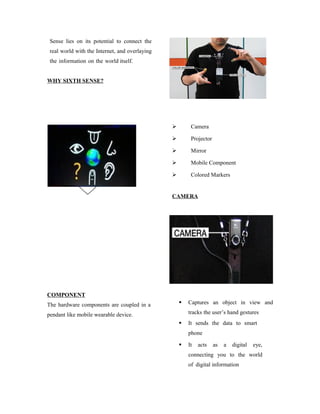
WHY SIXTH SENSE?
COMPONENT
The hardware components are coupled in a
pendant like mobile wearable device.
 Camera
 Projector
 Mirror
 Mobile Component
 Colored Markers
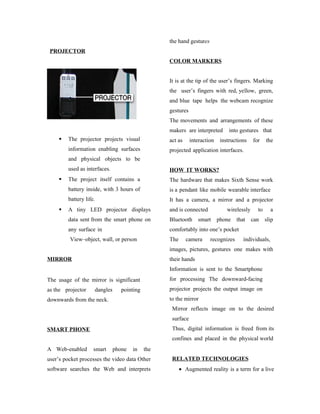
CAMERA
 Captures an object in view and
tracks the user’s hand gestures
 It sends the data to smart
phone
 It acts as a digital eye,
connecting you to the world
of digital information
PROJECTOR
 The projector projects visual
information enabling surfaces
and physical objects to be
used as interfaces.
 The project itself contains a
battery inside, with 3 hours of
battery life.
 A tiny LED projector displays
data sent from the smart phone on
any surface in
View–object, wall, or person
MIRROR
The usage of the mirror is significant
as the projector dangles pointing
downwards from the neck.
SMART PHONE
A Web-enabled smart phone in the
user’s pocket processes the video data Other
software searches the Web and interprets
the hand gestures
COLOR MARKERS
It is at the tip of the user’s fingers. Marking
the user’s fingers with red, yellow, green,
and blue tape helps the webcam recognize
gestures
The movements and arrangements of these
makers are interpreted into gestures that
act as interaction instructions for the
projected application interfaces.
HOW IT WORKS?
The hardware that makes Sixth Sense work
is a pendant like mobile wearable interface
It has a camera, a mirror and a projector
and is connected wirelessly to a
Bluetooth smart phone that can slip
comfortably into one’s pocket
The camera recognizes individuals,
images, pictures, gestures one makes with
their hands
Information is sent to the Smartphone
for processing The downward-facing
projector projects the output image on
to the mirror
Mirror reflects image on to the desired
surface
Thus, digital information is freed from its
confines and placed in the physical world
RELATED TECHNOLOGIES
• Augmented reality is a term for a live
direct or indirect view of a physical
real world environment whose
elements are augmented by virtual
computer generated imagery.
• Gesture recognition is a topic in
computer science and
language technology with the goal
of interpreting human gestures via
mathematical algorithms.
• Computer vision is the science and
technology of machines that see. It
is concerned with the theory
behind artificial systems that extract
information from images.
• Radio Frequency Identification is
basically an electronic tagging
technology that allows the detection,
tracking of tags and consequently
the objects that they are affixed to.
APPLICATIONS
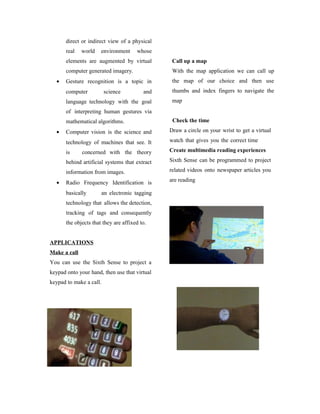
Make a call
You can use the Sixth Sense to project a
keypad onto your hand, then use that virtual
keypad to make a call.
Call up a map
With the map application we can call up
the map of our choice and then use
thumbs and index fingers to navigate the
map
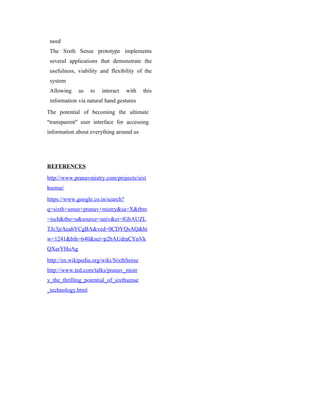
Check the time
Draw a circle on your wrist to get a virtual
watch that gives you the correct time
Create multimedia reading experiences
Sixth Sense can be programmed to project
related videos onto newspaper articles you
are reading
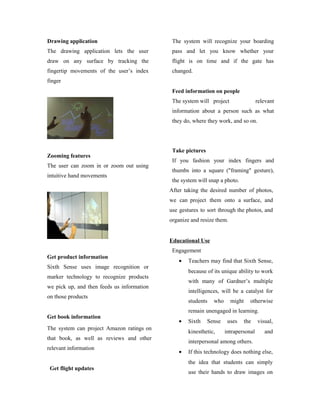
Drawing application
The drawing application lets the user
draw on any surface by tracking the
fingertip movements of the user’s index
finger
Zooming features
The user can zoom in or zoom out using
intuitive hand movements
Get product information
Sixth Sense uses image recognition or
marker technology to recognize products
we pick up, and then feeds us information
on those products
Get book information
The system can project Amazon ratings on
that book, as well as reviews and other
relevant information
Get flight updates
The system will recognize your boarding
pass and let you know whether your
flight is on time and if the gate has
changed.
Feed information on people
The system will project relevant
information about a person such as what
they do, where they work, and so on.
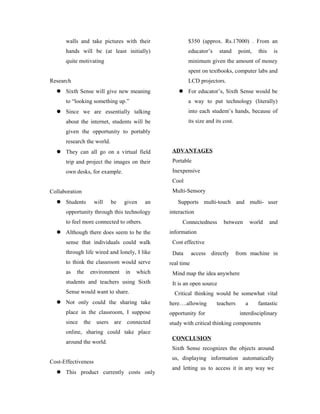
Take pictures
If you fashion your index fingers and
thumbs into a square ("framing" gesture),
the system will snap a photo.
After taking the desired number of photos,
we can project them onto a surface, and
use gestures to sort through the photos, and
organize and resize them.
Educational Use
Engagement
• Teachers may find that Sixth Sense,
because of its unique ability to work
with many of Gardner’s multiple
intelligences, will be a catalyst for
students who might otherwise
remain unengaged in learning.
• Sixth Sense uses the visual,
kinesthetic, intrapersonal and
interpersonal among others.
• If this technology does nothing else,
the idea that students can simply
use their hands to draw images on
walls and take pictures with their
hands will be (at least initially)
quite motivating
Research
 Sixth Sense will give new meaning
to “looking something up.”
 Since we are essentially talking
about the internet, students will be
given the opportunity to portably
research the world.
 They can all go on a virtual field
trip and project the images on their
own desks, for example.
Collaboration
 Students will be given an
opportunity through this technology
to feel more connected to others.
 Although there does seem to be the
sense that individuals could walk
through life wired and lonely, I like
to think the classroom would serve
as the environment in which
students and teachers using Sixth
Sense would want to share.
 Not only could the sharing take
place in the classroom, I suppose
since the users are connected
online, sharing could take place
around the world.
Cost-Effectiveness
 This product currently costs only
$350 (approx. Rs.17000) . From an
educator’s stand point, this is
minimum given the amount of money
spent on textbooks, computer labs and
LCD projectors.
 For educator’s, Sixth Sense would be
a way to put technology (literally)
into each student’s hands, because of
its size and its cost.
ADVANTAGES
Portable
Inexpensive
Cool
Multi-Sensory
Supports multi-touch and multi- user
interaction
Connectedness between world and
information
Cost effective
Data access directly from machine in
real time
Mind map the idea anywhere
It is an open source
Critical thinking would be somewhat vital
here….allowing teachers a fantastic
opportunity for interdisciplinary
study with critical thinking components
CONCLUSION
Sixth Sense recognizes the objects around
us, displaying information automatically
and letting us to access it in any way we
need
The Sixth Sense prototype implements
several applications that demonstrate the
usefulness, viability and flexibility of the
system
Allowing us to interact with this
information via natural hand gestures
The potential of becoming the ultimate
"transparent" user interface for accessing
information about everything around us
REFERENCES
http://www.pranavmistry.com/projects/sixt
hsense/
https://www.google.co.in/search?
q=sixth+sense+pranav+mistry&sa=X&tbm
=isch&tbo=u&source=univ&ei=lGbAUZL
TJc3jrAeahYCgBA&ved=0CDYQsAQ&bi
w=1241&bih=640&sei=p2bAUdraCYnVk
QXerYHoAg
http://en.wikipedia.org/wiki/SixthSense
http://www.ted.com/talks/pranav_mistr
y_the_thrilling_potential_of_sixthsense
_technology.html

Sixth sense

  • 1.
    A PAPER PRESENTATION ON SIXTHSENSE TECHNOLOGY PRESENTED BY: J.G.M.Jagagdeesh Kumar Department of C.S.E. (IV year) Affiliated to JNTU K DJR College of Engineering and Technology, Gudavalli, Vijayawada Krishna (dt.), Andhra Pradesh, India.
  • 2.
    ABSTRACT Sixth Sense isa wearable gestural interface device developed by Pranav Mistry, a PhD student in the Fluid Interfaces Group at the MIT Media Lab. It is similar to Telepointer. The Sixth Sense prototype comprises a pocket projector, a mirror and a camera contained in a pendant like, wearable device. Both the projector and the camera are connected to a mobile computing device in the user’s pocket. The projector projects visual information enabling surfaces, walls and physical objects around us to be used as interfaces; while the camera recognizes and tracks user's hand gestures and physical objects using computer- vision based techniques. The software program processes the video stream data captured by the camera and tracks the locations of the colored markers (visual tracking fiducially) at the tip of the user’s fingers. The movements and arrangements of these fiducially are interpreted into gestures that act as interaction instructions for the projected application interfaces. Sixth Sense supports multi- touch and multi-user interaction. INTRODUCTION Sixth Sense is a wearable gestural interface that augments the physical world around us with digital information and lets us use natural hand gestures to interact with that information. It was developed by Pranav Mistry, a PhD student in the Fluid Interfaces Group at the MIT Media Lab. Sixth Sense bridges the gap by bringing intangible, digital information out into the tangible world, and allowing us to interact with this information via natural hand Sixth Sense comprises a pocket projector, a mirror and a camera. The hardware components are coupled in a pendant like mobile wearable device Sixth Sense is a mini-projector coupled with a camera and a cell phone—which acts as the computer and your connection to the Cloud, all the information stored on the web. Sixth Sense can also obey hand gestures, like in the infamous Minority Report. The camera recognizes objects around you instantly, with the micro- projector overlaying the information on any surface, including the object itself or your hand. Then, you can access or manipulate the information using your fingers. Need to make a call? Extend your hand on front of the projector and numbers will appear for you to click. Need to know the time? Draw a circle on your wrist and a watch will appear. Want to take a photo? Just make a square with your fingers, highlighting what you want to frame and the system will make the photo—which you can later organize with the others using your own hands over the air. The true power of Sixth
  • 3.
    Sense lies onits potential to connect the real world with the Internet, and overlaying the information on the world itself. WHY SIXTH SENSE? COMPONENT The hardware components are coupled in a pendant like mobile wearable device.  Camera  Projector  Mirror  Mobile Component  Colored Markers CAMERA  Captures an object in view and tracks the user’s hand gestures  It sends the data to smart phone  It acts as a digital eye, connecting you to the world of digital information
  • 4.
    PROJECTOR  The projectorprojects visual information enabling surfaces and physical objects to be used as interfaces.  The project itself contains a battery inside, with 3 hours of battery life.  A tiny LED projector displays data sent from the smart phone on any surface in View–object, wall, or person MIRROR The usage of the mirror is significant as the projector dangles pointing downwards from the neck. SMART PHONE A Web-enabled smart phone in the user’s pocket processes the video data Other software searches the Web and interprets the hand gestures COLOR MARKERS It is at the tip of the user’s fingers. Marking the user’s fingers with red, yellow, green, and blue tape helps the webcam recognize gestures The movements and arrangements of these makers are interpreted into gestures that act as interaction instructions for the projected application interfaces. HOW IT WORKS? The hardware that makes Sixth Sense work is a pendant like mobile wearable interface It has a camera, a mirror and a projector and is connected wirelessly to a Bluetooth smart phone that can slip comfortably into one’s pocket The camera recognizes individuals, images, pictures, gestures one makes with their hands Information is sent to the Smartphone for processing The downward-facing projector projects the output image on to the mirror Mirror reflects image on to the desired surface Thus, digital information is freed from its confines and placed in the physical world RELATED TECHNOLOGIES • Augmented reality is a term for a live
  • 5.
    direct or indirectview of a physical real world environment whose elements are augmented by virtual computer generated imagery. • Gesture recognition is a topic in computer science and language technology with the goal of interpreting human gestures via mathematical algorithms. • Computer vision is the science and technology of machines that see. It is concerned with the theory behind artificial systems that extract information from images. • Radio Frequency Identification is basically an electronic tagging technology that allows the detection, tracking of tags and consequently the objects that they are affixed to. APPLICATIONS Make a call You can use the Sixth Sense to project a keypad onto your hand, then use that virtual keypad to make a call. Call up a map With the map application we can call up the map of our choice and then use thumbs and index fingers to navigate the map Check the time Draw a circle on your wrist to get a virtual watch that gives you the correct time Create multimedia reading experiences Sixth Sense can be programmed to project related videos onto newspaper articles you are reading
  • 6.
    Drawing application The drawingapplication lets the user draw on any surface by tracking the fingertip movements of the user’s index finger Zooming features The user can zoom in or zoom out using intuitive hand movements Get product information Sixth Sense uses image recognition or marker technology to recognize products we pick up, and then feeds us information on those products Get book information The system can project Amazon ratings on that book, as well as reviews and other relevant information Get flight updates The system will recognize your boarding pass and let you know whether your flight is on time and if the gate has changed. Feed information on people The system will project relevant information about a person such as what they do, where they work, and so on. Take pictures If you fashion your index fingers and thumbs into a square ("framing" gesture), the system will snap a photo. After taking the desired number of photos, we can project them onto a surface, and use gestures to sort through the photos, and organize and resize them. Educational Use Engagement • Teachers may find that Sixth Sense, because of its unique ability to work with many of Gardner’s multiple intelligences, will be a catalyst for students who might otherwise remain unengaged in learning. • Sixth Sense uses the visual, kinesthetic, intrapersonal and interpersonal among others. • If this technology does nothing else, the idea that students can simply use their hands to draw images on
  • 7.
    walls and takepictures with their hands will be (at least initially) quite motivating Research  Sixth Sense will give new meaning to “looking something up.”  Since we are essentially talking about the internet, students will be given the opportunity to portably research the world.  They can all go on a virtual field trip and project the images on their own desks, for example. Collaboration  Students will be given an opportunity through this technology to feel more connected to others.  Although there does seem to be the sense that individuals could walk through life wired and lonely, I like to think the classroom would serve as the environment in which students and teachers using Sixth Sense would want to share.  Not only could the sharing take place in the classroom, I suppose since the users are connected online, sharing could take place around the world. Cost-Effectiveness  This product currently costs only $350 (approx. Rs.17000) . From an educator’s stand point, this is minimum given the amount of money spent on textbooks, computer labs and LCD projectors.  For educator’s, Sixth Sense would be a way to put technology (literally) into each student’s hands, because of its size and its cost. ADVANTAGES Portable Inexpensive Cool Multi-Sensory Supports multi-touch and multi- user interaction Connectedness between world and information Cost effective Data access directly from machine in real time Mind map the idea anywhere It is an open source Critical thinking would be somewhat vital here….allowing teachers a fantastic opportunity for interdisciplinary study with critical thinking components CONCLUSION Sixth Sense recognizes the objects around us, displaying information automatically and letting us to access it in any way we
  • 8.
    need The Sixth Senseprototype implements several applications that demonstrate the usefulness, viability and flexibility of the system Allowing us to interact with this information via natural hand gestures The potential of becoming the ultimate "transparent" user interface for accessing information about everything around us REFERENCES http://www.pranavmistry.com/projects/sixt hsense/ https://www.google.co.in/search? q=sixth+sense+pranav+mistry&sa=X&tbm =isch&tbo=u&source=univ&ei=lGbAUZL TJc3jrAeahYCgBA&ved=0CDYQsAQ&bi w=1241&bih=640&sei=p2bAUdraCYnVk QXerYHoAg http://en.wikipedia.org/wiki/SixthSense http://www.ted.com/talks/pranav_mistr y_the_thrilling_potential_of_sixthsense _technology.html