Surveillance of hepatitis B and C
in the EU/EEA
Programme for HIV, STI and Viral Hepatitis B and C infections
June 2016
European Centre for Disease Prevention and Control
Surveillance of hepatitis B and C
- Principles
• Surveillance programme coordinated by ECDC
• Data from 31 countries are uploaded annually into the
European Surveillance System (TESSy) - a purpose-built
web-based system for data collection
• Case-based and aggregate reporting possible
• Countries requested to follow the EU 2012 case
definitions, including acute and newly diagnosed chronic
infections
• Data collected on 35 variables
• Data validated by Member States
Hepatitis B data and trends
Hepatitis B data: reporting countries and
case definitions used
30 countries provided hepatitis B data in 2014
• Eight countries could only provide data on acute cases
Case definitions varied:
• 18 countries used the EU 2012 case definition
• Five countries used the EU 2008 case definition
• Seven countries used national case definitions
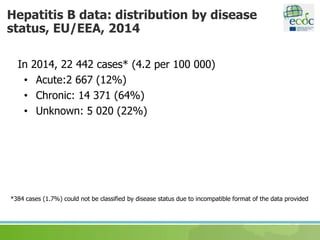
In 2014, 22 442 cases* (4.2 per 100 000)
• Acute:2 667 (12%)
• Chronic: 14 371 (64%)
• Unknown: 5 020 (22%)
Hepatitis B data: distribution by disease
status, EU/EEA, 2014
*384 cases (1.7%) could not be classified by disease status due to incompatible format of the data provided
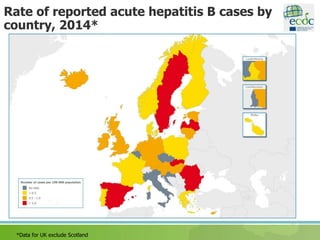
Rate of reported acute hepatitis B cases by
country, 2014*
*Data for UK exclude Scotland
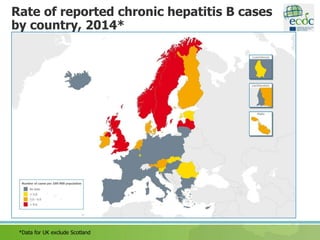
Rate of reported chronic hepatitis B cases
by country, 2014*
*Data for UK exclude Scotland
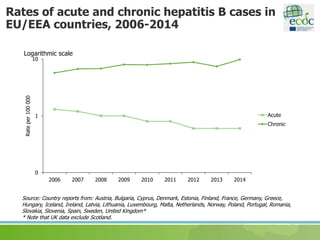
Rates of acute and chronic hepatitis B cases in
EU/EEA countries, 2006-2014
Source: Country reports from: Austria, Bulgaria, Cyprus, Denmark, Estonia, Finland, France, Germany, Greece,
Hungary, Iceland, Ireland, Latvia, Lithuania, Luxembourg, Malta, Netherlands, Norway, Poland, Portugal, Romania,
Slovakia, Slovenia, Spain, Sweden, United Kingdom*
* Note that UK data exclude Scotland.
0
1
10
2006 2007 2008 2009 2010 2011 2012 2013 2014
Rateper100000
Logarithmic scale
Acute
Chronic
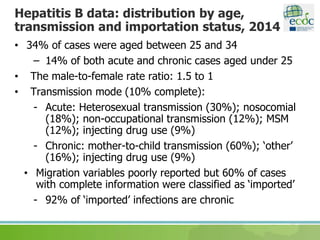
Hepatitis B data: distribution by age,
transmission and importation status, 2014
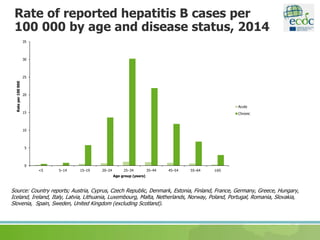
• 34% of cases were aged between 25 and 34
– 14% of both acute and chronic cases aged under 25
• The male-to-female rate ratio: 1.5 to 1
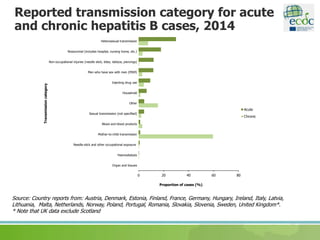
• Transmission mode (10% complete):
- Acute: Heterosexual transmission (30%); nosocomial
(18%); non-occupational transmission (12%); MSM
(12%); injecting drug use (9%)
- Chronic: mother-to-child transmission (60%); ‘other’
(16%); injecting drug use (9%)
• Migration variables poorly reported but 60% of cases
with complete information were classified as ‘imported’
- 92% of ‘imported’ infections are chronic
Rate of reported hepatitis B cases per
100 000 by age and disease status, 2014
Source: Country reports; Austria, Cyprus, Czech Republic, Denmark, Estonia, Finland, France, Germany, Greece, Hungary,
Iceland, Ireland, Italy, Latvia, Lithuania, Luxembourg, Malta, Netherlands, Norway, Poland, Portugal, Romania, Slovakia,
Slovenia, Spain, Sweden, United Kingdom (excluding Scotland).
0
5
10
15
20
25
30
35
<5 5–14 15–19 20–24 25–34 35–44 45–54 55–64 ≥65
Rateper100000
Age group (years)
Acute
Chronic
Reported transmission category for acute
and chronic hepatitis B cases, 2014
Source: Country reports from: Austria, Denmark, Estonia, Finland, France, Germany, Hungary, Ireland, Italy, Latvia,
Lithuania, Malta, Netherlands, Norway, Poland, Portugal, Romania, Slovakia, Slovenia, Sweden, United Kingdom*.
* Note that UK data exclude Scotland
0 20 40 60 80
Heterosexual transmission
Nosocomial (includes hospital, nursing home, etc.)
Non-occupational injuries (needle stick, bites, tattoos, piercings)
Men who have sex with men (MSM)
Injecting drug use
Household
Other
Sexual transmission (not specified)
Blood and blood products
Mother-to-child transmission
Needle-stick and other occupational exposure
Haemodialysis
Organ and tissues
Proportion of cases (%)
Transmissioncategory
Acute
Chronic
Hepatitis C data and trends
Hepatitis C data: reporting countries and
case definitions used
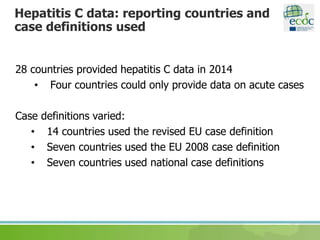
28 countries provided hepatitis C data in 2014
• Four countries could only provide data on acute cases
Case definitions varied:
• 14 countries used the revised EU case definition
• Seven countries used the EU 2008 case definition
• Seven countries used national case definitions
Hepatitis C data: distribution by disease
status, EU/EEA, 2014
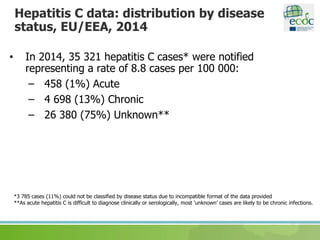
• In 2014, 35 321 hepatitis C cases* were notified
representing a rate of 8.8 cases per 100 000:
– 458 (1%) Acute
– 4 698 (13%) Chronic
– 26 380 (75%) Unknown**
*3 785 cases (11%) could not be classified by disease status due to incompatible format of the data provided
**As acute hepatitis C is difficult to diagnose clinically or serologically, most ‘unknown’ cases are likely to be chronic infections.
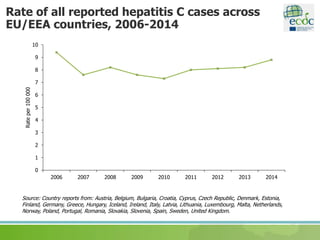
Rate of all reported hepatitis C cases across
EU/EEA countries, 2006-2014
Source: Country reports from: Austria, Belgium, Bulgaria, Croatia, Cyprus, Czech Republic, Denmark, Estonia,
Finland, Germany, Greece, Hungary, Iceland, Ireland, Italy, Latvia, Lithuania, Luxembourg, Malta, Netherlands,
Norway, Poland, Portugal, Romania, Slovakia, Slovenia, Spain, Sweden, United Kingdom.
0
1
2
3
4
5
6
7
8
9
10
2006 2007 2008 2009 2010 2011 2012 2013 2014
Rateper100000
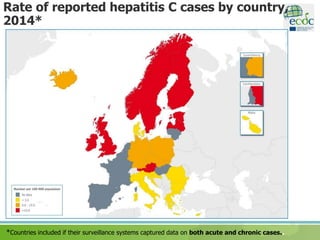
Rate of reported hepatitis C cases by country,
2014*
*Countries included if their surveillance systems captured data on both acute and chronic cases..
Hepatitis C: distribution by age,
transmission and importation status, 2014
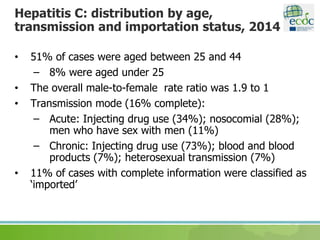
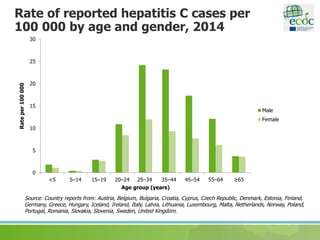
• 51% of cases were aged between 25 and 44
– 8% were aged under 25
• The overall male-to-female rate ratio was 1.9 to 1
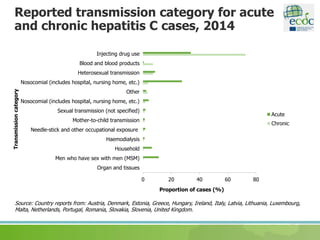
• Transmission mode (16% complete):
– Acute: Injecting drug use (34%); nosocomial (28%);
men who have sex with men (11%)
– Chronic: Injecting drug use (73%); blood and blood
products (7%); heterosexual transmission (7%)
• 11% of cases with complete information were classified as
‘imported’
Rate of reported hepatitis C cases per
100 000 by age and gender, 2014
Source: Country reports from: Austria, Belgium, Bulgaria, Croatia, Cyprus, Czech Republic, Denmark, Estonia, Finland,
Germany, Greece, Hungary, Iceland, Ireland, Italy, Latvia, Lithuania, Luxembourg, Malta, Netherlands, Norway, Poland,
Portugal, Romania, Slovakia, Slovenia, Sweden, United Kingdom.
0
5
10
15
20
25
30
<5 5–14 15–19 20–24 25–34 35–44 45–54 55–64 ≥65
Rateper100000
Age group (years)
Male
Female
Reported transmission category for acute
and chronic hepatitis C cases, 2014
Source: Country reports from: Austria, Denmark, Estonia, Greece, Hungary, Ireland, Italy, Latvia, Lithuania, Luxembourg,
Malta, Netherlands, Portugal, Romania, Slovakia, Slovenia, United Kingdom.
0 20 40 60 80
Injecting drug use
Blood and blood products
Heterosexual transmission
Nosocomial (includes hospital, nursing home, etc.)
Other
Nosocomial (includes hospital, nursing home, etc.)
Sexual transmission (not specified)
Mother-to-child transmission
Needle-stick and other occupational exposure
Haemodialysis
Household
Men who have sex with men (MSM)
Organ and tissues
Proportion of cases (%)
Transmissioncategory
Acute
Chronic
Conclusions
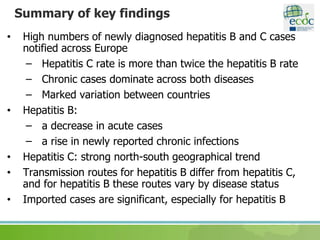
Summary of key findings
• High numbers of newly diagnosed hepatitis B and C cases
notified across Europe
– Hepatitis C rate is more than twice the hepatitis B rate
– Chronic cases dominate across both diseases
– Marked variation between countries
• Hepatitis B:
– a decrease in acute cases
– a rise in newly reported chronic infections
• Hepatitis C: strong north-south geographical trend
• Transmission routes for hepatitis B differ from hepatitis C,
and for hepatitis B these routes vary by disease status
• Imported cases are significant, especially for hepatitis B
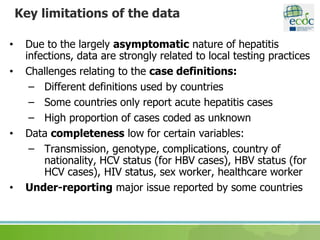
Key limitations of the data
• Due to the largely asymptomatic nature of hepatitis
infections, data are strongly related to local testing practices
• Challenges relating to the case definitions:
– Different definitions used by countries
– Some countries only report acute hepatitis cases
– High proportion of cases coded as unknown
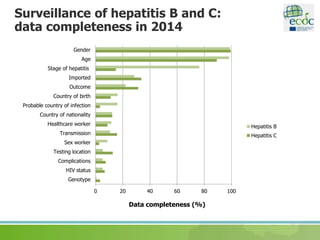
• Data completeness low for certain variables:
– Transmission, genotype, complications, country of
nationality, HCV status (for HBV cases), HBV status (for
HCV cases), HIV status, sex worker, healthcare worker
• Under-reporting major issue reported by some countries
Other information
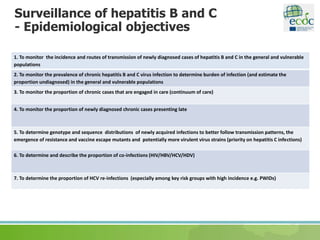
Surveillance of hepatitis B and C
- Epidemiological objectives
1. To monitor the incidence and routes of transmission of newly diagnosed cases of hepatitis B and C in the general and vulnerable
populations
2. To monitor the prevalence of chronic hepatitis B and C virus infection to determine burden of infection (and estimate the
proportion undiagnosed) in the general and vulnerable populations
3. To monitor the proportion of chronic cases that are engaged in care (continuum of care)
4. To monitor the proportion of newly diagnosed chronic cases presenting late
5. To determine genotype and sequence distributions of newly acquired infections to better follow transmission patterns, the
emergence of resistance and vaccine escape mutants and potentially more virulent virus strains (priority on hepatitis C infections)
6. To determine and describe the proportion of co-infections (HIV/HBV/HCV/HDV)
7. To determine the proportion of HCV re-infections (especially among key risk groups with high incidence e.g. PWIDs)
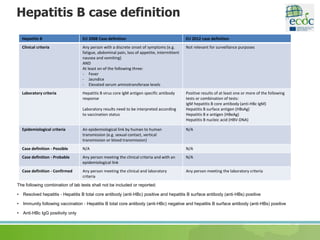
Hepatitis B case definition
The following combination of lab tests shall not be included or reported:
• Resolved hepatitis ‐ Hepatitis B total core antibody (anti‐HBc) positive and hepatitis B surface antibody (anti‐HBs) positive
• Immunity following vaccination ‐ Hepatitis B total core antibody (anti‐HBc) negative and hepatitis B surface antibody (anti‐HBs) positive
• Anti‐HBc IgG positivity only
Hepatitis B EU 2008 Case definition EU 2012 case definition
Clinical criteria Any person with a discrete onset of symptoms (e.g.
fatigue, abdominal pain, loss of appetite, intermittent
nausea and vomiting)
AND
At least on of the following three:
- Fever
- Jaundice
- Elevated serum aminotransferase levels
Not relevant for surveillance purposes
Laboratory criteria Hepatitis B virus core IgM antigen specific antibody
response
Laboratory results need to be interpreted according
to vaccination status
Positive results of at least one or more of the following
tests or combination of tests:
IgM hepatitis B core antibody (anti-HBc IgM)
Hepatitis B surface antigen (HBsAg)
Hepatitis B e antigen (HBeAg)
Hepatitis B nucleic acid (HBV-DNA)
Epidemiological criteria An epidemiological link by human to human
transmission (e.g. sexual contact, vertical
transmission or blood transmission)
N/A
Case definition - Possible N/A N/A
Case definition - Probable Any person meeting the clinical criteria and with an
epidemiological link
N/A
Case definition - Confirmed Any person meeting the clinical and laboratory
criteria
Any person meeting the laboratory criteria
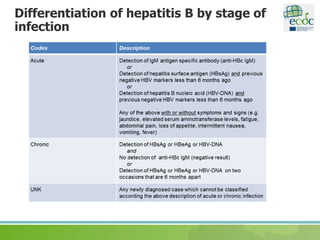
Differentiation of hepatitis B by stage of
infection
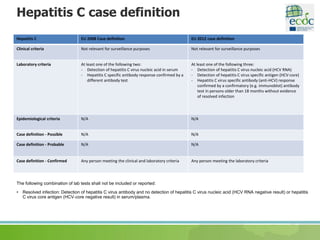
Hepatitis C case definition
Hepatitis C EU 2008 Case definition EU 2012 case definition
Clinical criteria Not relevant for surveillance purposes Not relevant for surveillance purposes
Laboratory criteria At least one of the following two:
- Detection of hepatitis C virus nucleic acid in serum
- Hepatitis C specific antibody response confirmed by a
different antibody test
At least one of the following three:
- Detection of hepatitis C virus nucleic acid (HCV RNA)
- Detection of hepatitis C virus specific antigen (HCV-core)
- Hepatitis C virus specific antibody (anti-HCV) response
confirmed by a confirmatory (e.g. immunoblot) antibody
test in persons older than 18 months without evidence
of resolved infection
Epidemiological criteria N/A N/A
Case definition - Possible N/A N/A
Case definition - Probable N/A N/A
Case definition - Confirmed Any person meeting the clinical and laboratory criteria Any person meeting the laboratory criteria
The following combination of lab tests shall not be included or reported:
• Resolved infection: Detection of hepatitis C virus antibody and no detection of hepatitis C virus nucleic acid (HCV RNA negative result) or hepatitis
C virus core antigen (HCV‐core negative result) in serum/plasma.
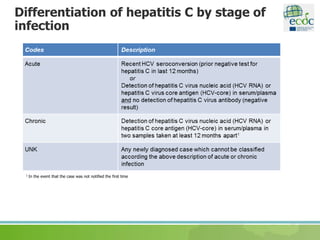
Differentiation of hepatitis C by stage of
infection
1 In the event that the case was not notified the first time
Surveillance of hepatitis B and C:
data completeness in 2014
0 20 40 60 80 100
Genotype
HIV status
Complications
Testing location
Sex worker
Transmission
Healthcare worker
Country of nationality
Probable country of infection
Country of birth
Outcome
Imported
Stage of hepatitis
Age
Gender
Data completeness (%)
Hepatitis B
Hepatitis C
Acknowledgements
Thank you to the following groups and individuals:
• The European Hepatitis B and C Network and Coordination
Committee.
• EU/EEA country hepatitis and surveillance contact points.
• Surveillance colleagues at ECDC: Catalin Albu, Julien
Beauté, Denis Coulombier, Catia Cunha, Gaetan Guyodo,
Františka Hruba, Valentina Lazdina, Phillip Zucs.
• Colleagues in the programme on HIV/AIDS, STI and Viral
Hepatitis B and C: Andrew Amato-Gauci, Caroline Daamen.
www.ecdc.europa.eu
Contact: stihivhep@ecdc.europa.eu

Surveillance data on hepatitis B and C in EU/EEA 2014

  • 1.
    Surveillance of hepatitisB and C in the EU/EEA Programme for HIV, STI and Viral Hepatitis B and C infections June 2016 European Centre for Disease Prevention and Control
  • 2.
    Surveillance of hepatitisB and C - Principles • Surveillance programme coordinated by ECDC • Data from 31 countries are uploaded annually into the European Surveillance System (TESSy) - a purpose-built web-based system for data collection • Case-based and aggregate reporting possible • Countries requested to follow the EU 2012 case definitions, including acute and newly diagnosed chronic infections • Data collected on 35 variables • Data validated by Member States
  • 3.
    Hepatitis B dataand trends
  • 4.
    Hepatitis B data:reporting countries and case definitions used 30 countries provided hepatitis B data in 2014 • Eight countries could only provide data on acute cases Case definitions varied: • 18 countries used the EU 2012 case definition • Five countries used the EU 2008 case definition • Seven countries used national case definitions
  • 5.
    In 2014, 22442 cases* (4.2 per 100 000) • Acute:2 667 (12%) • Chronic: 14 371 (64%) • Unknown: 5 020 (22%) Hepatitis B data: distribution by disease status, EU/EEA, 2014 *384 cases (1.7%) could not be classified by disease status due to incompatible format of the data provided
  • 6.
    Rate of reportedacute hepatitis B cases by country, 2014* *Data for UK exclude Scotland
  • 7.
    Rate of reportedchronic hepatitis B cases by country, 2014* *Data for UK exclude Scotland
  • 8.
    Rates of acuteand chronic hepatitis B cases in EU/EEA countries, 2006-2014 Source: Country reports from: Austria, Bulgaria, Cyprus, Denmark, Estonia, Finland, France, Germany, Greece, Hungary, Iceland, Ireland, Latvia, Lithuania, Luxembourg, Malta, Netherlands, Norway, Poland, Portugal, Romania, Slovakia, Slovenia, Spain, Sweden, United Kingdom* * Note that UK data exclude Scotland. 0 1 10 2006 2007 2008 2009 2010 2011 2012 2013 2014 Rateper100000 Logarithmic scale Acute Chronic
  • 9.
    Hepatitis B data:distribution by age, transmission and importation status, 2014 • 34% of cases were aged between 25 and 34 – 14% of both acute and chronic cases aged under 25 • The male-to-female rate ratio: 1.5 to 1 • Transmission mode (10% complete): - Acute: Heterosexual transmission (30%); nosocomial (18%); non-occupational transmission (12%); MSM (12%); injecting drug use (9%) - Chronic: mother-to-child transmission (60%); ‘other’ (16%); injecting drug use (9%) • Migration variables poorly reported but 60% of cases with complete information were classified as ‘imported’ - 92% of ‘imported’ infections are chronic
  • 10.
    Rate of reportedhepatitis B cases per 100 000 by age and disease status, 2014 Source: Country reports; Austria, Cyprus, Czech Republic, Denmark, Estonia, Finland, France, Germany, Greece, Hungary, Iceland, Ireland, Italy, Latvia, Lithuania, Luxembourg, Malta, Netherlands, Norway, Poland, Portugal, Romania, Slovakia, Slovenia, Spain, Sweden, United Kingdom (excluding Scotland). 0 5 10 15 20 25 30 35 <5 5–14 15–19 20–24 25–34 35–44 45–54 55–64 ≥65 Rateper100000 Age group (years) Acute Chronic
  • 11.
    Reported transmission categoryfor acute and chronic hepatitis B cases, 2014 Source: Country reports from: Austria, Denmark, Estonia, Finland, France, Germany, Hungary, Ireland, Italy, Latvia, Lithuania, Malta, Netherlands, Norway, Poland, Portugal, Romania, Slovakia, Slovenia, Sweden, United Kingdom*. * Note that UK data exclude Scotland 0 20 40 60 80 Heterosexual transmission Nosocomial (includes hospital, nursing home, etc.) Non-occupational injuries (needle stick, bites, tattoos, piercings) Men who have sex with men (MSM) Injecting drug use Household Other Sexual transmission (not specified) Blood and blood products Mother-to-child transmission Needle-stick and other occupational exposure Haemodialysis Organ and tissues Proportion of cases (%) Transmissioncategory Acute Chronic
  • 12.
    Hepatitis C dataand trends
  • 13.
    Hepatitis C data:reporting countries and case definitions used 28 countries provided hepatitis C data in 2014 • Four countries could only provide data on acute cases Case definitions varied: • 14 countries used the revised EU case definition • Seven countries used the EU 2008 case definition • Seven countries used national case definitions
  • 14.
    Hepatitis C data:distribution by disease status, EU/EEA, 2014 • In 2014, 35 321 hepatitis C cases* were notified representing a rate of 8.8 cases per 100 000: – 458 (1%) Acute – 4 698 (13%) Chronic – 26 380 (75%) Unknown** *3 785 cases (11%) could not be classified by disease status due to incompatible format of the data provided **As acute hepatitis C is difficult to diagnose clinically or serologically, most ‘unknown’ cases are likely to be chronic infections.
  • 15.
    Rate of allreported hepatitis C cases across EU/EEA countries, 2006-2014 Source: Country reports from: Austria, Belgium, Bulgaria, Croatia, Cyprus, Czech Republic, Denmark, Estonia, Finland, Germany, Greece, Hungary, Iceland, Ireland, Italy, Latvia, Lithuania, Luxembourg, Malta, Netherlands, Norway, Poland, Portugal, Romania, Slovakia, Slovenia, Spain, Sweden, United Kingdom. 0 1 2 3 4 5 6 7 8 9 10 2006 2007 2008 2009 2010 2011 2012 2013 2014 Rateper100000
  • 16.
    Rate of reportedhepatitis C cases by country, 2014* *Countries included if their surveillance systems captured data on both acute and chronic cases..
  • 17.
    Hepatitis C: distributionby age, transmission and importation status, 2014 • 51% of cases were aged between 25 and 44 – 8% were aged under 25 • The overall male-to-female rate ratio was 1.9 to 1 • Transmission mode (16% complete): – Acute: Injecting drug use (34%); nosocomial (28%); men who have sex with men (11%) – Chronic: Injecting drug use (73%); blood and blood products (7%); heterosexual transmission (7%) • 11% of cases with complete information were classified as ‘imported’
  • 18.
    Rate of reportedhepatitis C cases per 100 000 by age and gender, 2014 Source: Country reports from: Austria, Belgium, Bulgaria, Croatia, Cyprus, Czech Republic, Denmark, Estonia, Finland, Germany, Greece, Hungary, Iceland, Ireland, Italy, Latvia, Lithuania, Luxembourg, Malta, Netherlands, Norway, Poland, Portugal, Romania, Slovakia, Slovenia, Sweden, United Kingdom. 0 5 10 15 20 25 30 <5 5–14 15–19 20–24 25–34 35–44 45–54 55–64 ≥65 Rateper100000 Age group (years) Male Female
  • 19.
    Reported transmission categoryfor acute and chronic hepatitis C cases, 2014 Source: Country reports from: Austria, Denmark, Estonia, Greece, Hungary, Ireland, Italy, Latvia, Lithuania, Luxembourg, Malta, Netherlands, Portugal, Romania, Slovakia, Slovenia, United Kingdom. 0 20 40 60 80 Injecting drug use Blood and blood products Heterosexual transmission Nosocomial (includes hospital, nursing home, etc.) Other Nosocomial (includes hospital, nursing home, etc.) Sexual transmission (not specified) Mother-to-child transmission Needle-stick and other occupational exposure Haemodialysis Household Men who have sex with men (MSM) Organ and tissues Proportion of cases (%) Transmissioncategory Acute Chronic
  • 20.
  • 21.
    Summary of keyfindings • High numbers of newly diagnosed hepatitis B and C cases notified across Europe – Hepatitis C rate is more than twice the hepatitis B rate – Chronic cases dominate across both diseases – Marked variation between countries • Hepatitis B: – a decrease in acute cases – a rise in newly reported chronic infections • Hepatitis C: strong north-south geographical trend • Transmission routes for hepatitis B differ from hepatitis C, and for hepatitis B these routes vary by disease status • Imported cases are significant, especially for hepatitis B
  • 22.
    Key limitations ofthe data • Due to the largely asymptomatic nature of hepatitis infections, data are strongly related to local testing practices • Challenges relating to the case definitions: – Different definitions used by countries – Some countries only report acute hepatitis cases – High proportion of cases coded as unknown • Data completeness low for certain variables: – Transmission, genotype, complications, country of nationality, HCV status (for HBV cases), HBV status (for HCV cases), HIV status, sex worker, healthcare worker • Under-reporting major issue reported by some countries
  • 23.
  • 24.
    Surveillance of hepatitisB and C - Epidemiological objectives 1. To monitor the incidence and routes of transmission of newly diagnosed cases of hepatitis B and C in the general and vulnerable populations 2. To monitor the prevalence of chronic hepatitis B and C virus infection to determine burden of infection (and estimate the proportion undiagnosed) in the general and vulnerable populations 3. To monitor the proportion of chronic cases that are engaged in care (continuum of care) 4. To monitor the proportion of newly diagnosed chronic cases presenting late 5. To determine genotype and sequence distributions of newly acquired infections to better follow transmission patterns, the emergence of resistance and vaccine escape mutants and potentially more virulent virus strains (priority on hepatitis C infections) 6. To determine and describe the proportion of co-infections (HIV/HBV/HCV/HDV) 7. To determine the proportion of HCV re-infections (especially among key risk groups with high incidence e.g. PWIDs)
  • 25.
    Hepatitis B casedefinition The following combination of lab tests shall not be included or reported: • Resolved hepatitis ‐ Hepatitis B total core antibody (anti‐HBc) positive and hepatitis B surface antibody (anti‐HBs) positive • Immunity following vaccination ‐ Hepatitis B total core antibody (anti‐HBc) negative and hepatitis B surface antibody (anti‐HBs) positive • Anti‐HBc IgG positivity only Hepatitis B EU 2008 Case definition EU 2012 case definition Clinical criteria Any person with a discrete onset of symptoms (e.g. fatigue, abdominal pain, loss of appetite, intermittent nausea and vomiting) AND At least on of the following three: - Fever - Jaundice - Elevated serum aminotransferase levels Not relevant for surveillance purposes Laboratory criteria Hepatitis B virus core IgM antigen specific antibody response Laboratory results need to be interpreted according to vaccination status Positive results of at least one or more of the following tests or combination of tests: IgM hepatitis B core antibody (anti-HBc IgM) Hepatitis B surface antigen (HBsAg) Hepatitis B e antigen (HBeAg) Hepatitis B nucleic acid (HBV-DNA) Epidemiological criteria An epidemiological link by human to human transmission (e.g. sexual contact, vertical transmission or blood transmission) N/A Case definition - Possible N/A N/A Case definition - Probable Any person meeting the clinical criteria and with an epidemiological link N/A Case definition - Confirmed Any person meeting the clinical and laboratory criteria Any person meeting the laboratory criteria
  • 26.
    Differentiation of hepatitisB by stage of infection
  • 27.
    Hepatitis C casedefinition Hepatitis C EU 2008 Case definition EU 2012 case definition Clinical criteria Not relevant for surveillance purposes Not relevant for surveillance purposes Laboratory criteria At least one of the following two: - Detection of hepatitis C virus nucleic acid in serum - Hepatitis C specific antibody response confirmed by a different antibody test At least one of the following three: - Detection of hepatitis C virus nucleic acid (HCV RNA) - Detection of hepatitis C virus specific antigen (HCV-core) - Hepatitis C virus specific antibody (anti-HCV) response confirmed by a confirmatory (e.g. immunoblot) antibody test in persons older than 18 months without evidence of resolved infection Epidemiological criteria N/A N/A Case definition - Possible N/A N/A Case definition - Probable N/A N/A Case definition - Confirmed Any person meeting the clinical and laboratory criteria Any person meeting the laboratory criteria The following combination of lab tests shall not be included or reported: • Resolved infection: Detection of hepatitis C virus antibody and no detection of hepatitis C virus nucleic acid (HCV RNA negative result) or hepatitis C virus core antigen (HCV‐core negative result) in serum/plasma.
  • 28.
    Differentiation of hepatitisC by stage of infection 1 In the event that the case was not notified the first time
  • 29.
    Surveillance of hepatitisB and C: data completeness in 2014 0 20 40 60 80 100 Genotype HIV status Complications Testing location Sex worker Transmission Healthcare worker Country of nationality Probable country of infection Country of birth Outcome Imported Stage of hepatitis Age Gender Data completeness (%) Hepatitis B Hepatitis C
  • 30.
    Acknowledgements Thank you tothe following groups and individuals: • The European Hepatitis B and C Network and Coordination Committee. • EU/EEA country hepatitis and surveillance contact points. • Surveillance colleagues at ECDC: Catalin Albu, Julien Beauté, Denis Coulombier, Catia Cunha, Gaetan Guyodo, Františka Hruba, Valentina Lazdina, Phillip Zucs. • Colleagues in the programme on HIV/AIDS, STI and Viral Hepatitis B and C: Andrew Amato-Gauci, Caroline Daamen.
  • 31.