Some teaching strategies particularly beneficial to EAL pupils
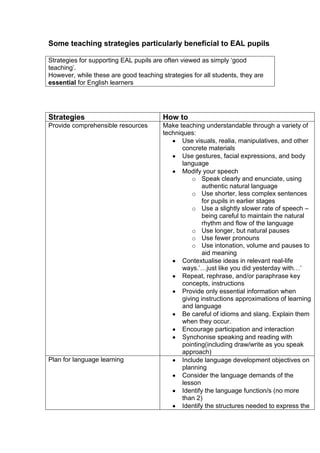
Strategies for supporting EAL pupils are often viewed as simply ‘good
teaching’.
However, while these are good teaching strategies for all students, they are
essential for English learners

Strategies

How to

Provide comprehensible resources

Make teaching understandable through a variety of
techniques:
Use visuals, realia, manipulatives, and other
concrete materials
Use gestures, facial expressions, and body
language
Modify your speech
o Speak clearly and enunciate, using
authentic natural language
o Use shorter, less complex sentences
for pupils in earlier stages
o Use a slightly slower rate of speech –
being careful to maintain the natural
rhythm and flow of the language
o Use longer, but natural pauses
o Use fewer pronouns
o Use intonation, volume and pauses to
aid meaning
Contextualise ideas in relevant real-life
ways.’…just like you did yesterday with…’
Repeat, rephrase, and/or paraphrase key
concepts, instructions
Provide only essential information when
giving instructions approximations of learning
and language
Be careful of idioms and slang. Explain them
when they occur.
Encourage participation and interaction
Synchonise speaking and reading with
pointing(including draw/write as you speak
approach)
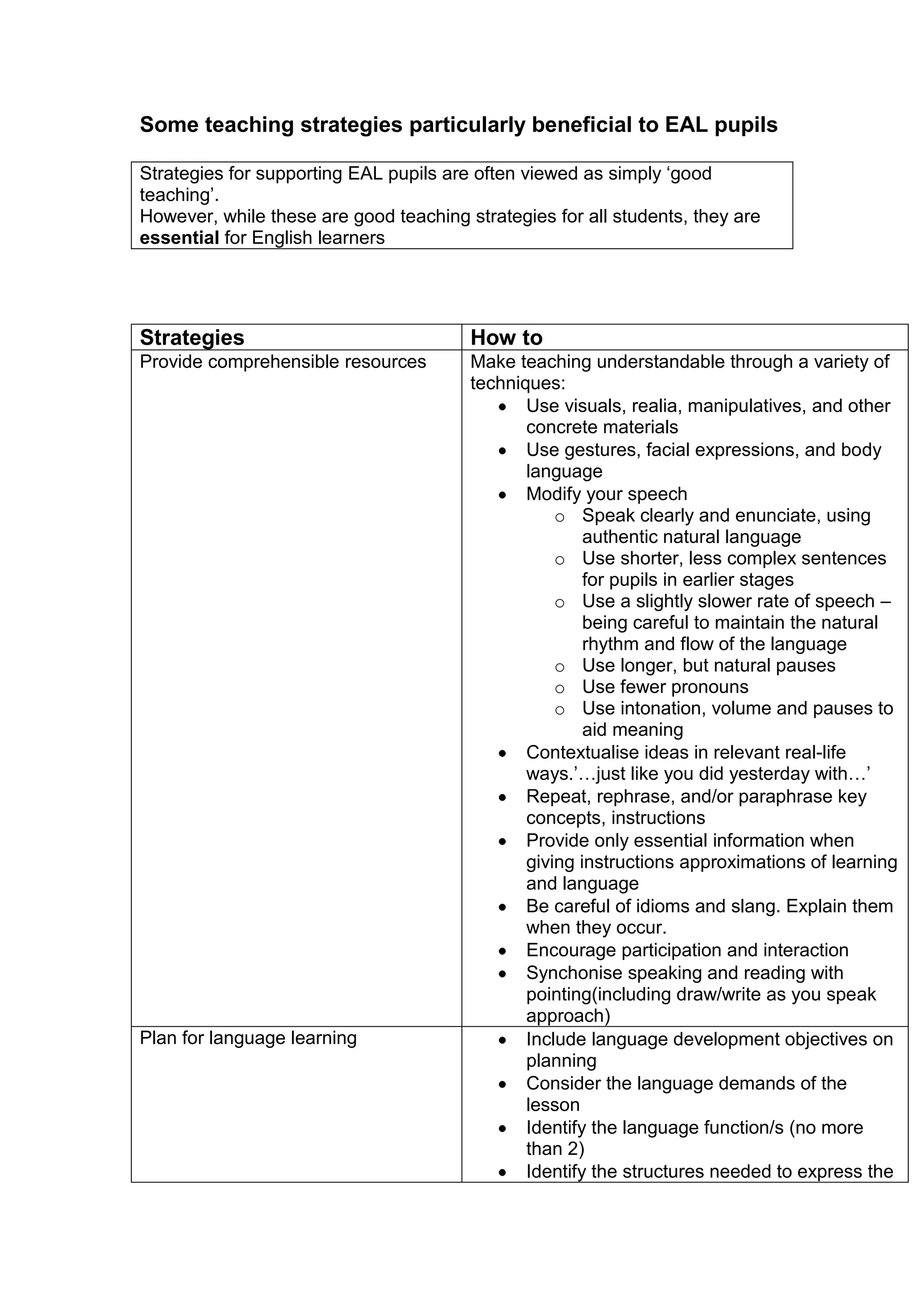
Include language development objectives on
planning
Consider the language demands of the
lesson
Identify the language function/s (no more
than 2)
Identify the structures needed to express the

Plan for language learning
functions
Explicitly model the language
Give pupils opportunity to use and rehearse
the language orally
Use scaffolds
The use of scaffolds enables pupils to
develop understanding that would
otherwise be beyond their
independent capacity

Modelling or demonstration – provides pupils
with a clear picture of what is expected.
Includes modelling writing (e.g. sentence
patterns for beginners, organising
paragraphs for more advanced learners).
The extra- linguistic clues clarify instructions
and provide concrete examples of the
finished product. Any task that is introduced
for the first time should be modelled
Bridging – activating prior knowledge to
provide a personal link that demonstrates the
relevance of the new material to the pupils’
lives, linking known to unknown. Includes
brainstorming, developing anticipatory
charts, identifying related
literature/resources/experiences, using
writing frames.
Contextualisation – alternative ways to
convey meaning and promote
understanding, using visuals, manipulatives,
video clips, graphic organiser, realia
Schema building – make explicit the
connections that exist between and across
concepts and the curriculum. Use strategies
such as graphic organisers (charts, maps,
tables, webs, diagrams, etc) to enable pupils
to see how concepts fit together, in the
‘larger scheme of things’.
Metacognitive development – explicit
teaching and learning of independent
learning strategies to enable them to tackle
higher what I want to know, what I learnt),
think – alouds.
Text re- representation – This strategy
enables pupils to use familiar text and then
practice and extend writing to a new genre
and for a new purpose. Includes cloze
exercise (with word banks), matching
sentence halves, summarising a
story/chapter, writing captions to capture the
main ideas, writing an ‘eye-witness’ account
of an historical event, developing
collaborative posters or dialogues
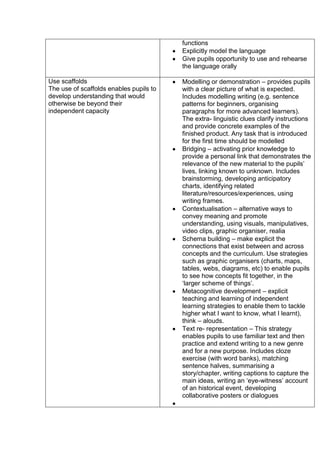
Use appropriate questioning
strategies

Include opportunities for
speaking and listening

Check for
comprehension/clarification

Treat errors and grammar
appropriately

Use both display (requiring pupils to display
knowledge) and referential questions
(requiring pupils to refer to their own
background knowledge or related
experiences or opinions)
Display questions – to check for
understanding
Referential questions – encourage pupils to
engage in language interactions at a higher
level.
Match questions to language proficiency –
encourage participation by varying the questions
asked of individuals. Early stage learners can be
asked to point, gesture, or respond with words or
phrases, after hearing other pupils model the
answers.
Paired talk – should be embedded across
the curriculum
Snowballing
Listening triangles
Jigsaw activities
Home / expert groups
Barrier games
Collaborative learning activities
Drama activities
Freeze frames
Conscience Alley
Hot seating etc
Talk planners
Check for understanding by
Asking pupils to re-state the task
Asking pupils to illustrate and or describe the
task and steps involved to a partner
Asking pupils to act out or role play
instructions
Teacher asking more ‘referential’ questions
which require comprehension
Do not rely on simply asking ‘do you
understand?”
Teach pupils how ask for help or clarification
Provide feedback to lead learner to next
stage of development
In the early stages of language proficiency,
fluency is more important than accuracy.
Focus on correction when the meaning is not
clear.
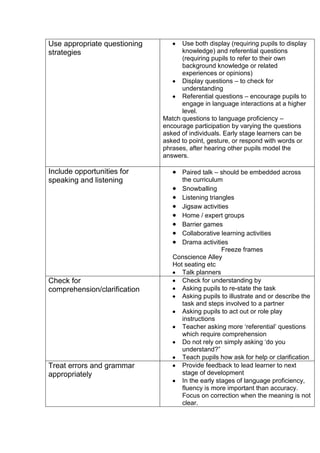
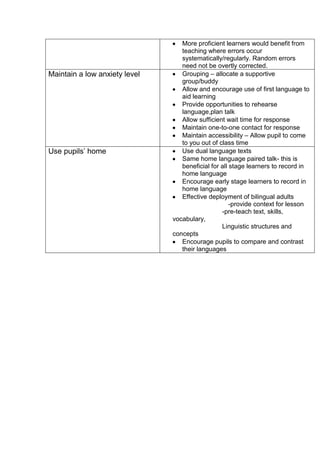
Maintain a low anxiety level

Use pupils’ home

More proficient learners would benefit from
teaching where errors occur
systematically/regularly. Random errors
need not be overtly corrected.
Grouping – allocate a supportive
group/buddy
Allow and encourage use of first language to
aid learning
Provide opportunities to rehearse
language,plan talk
Allow sufficient wait time for response
Maintain one-to-one contact for response
Maintain accessibility – Allow pupil to come
to you out of class time
Use dual language texts
Same home language paired talk- this is
beneficial for all stage learners to record in
home language
Encourage early stage learners to record in
home language
Effective deployment of bilingual adults
-provide context for lesson
-pre-teach text, skills,
vocabulary,
Linguistic structures and
concepts
Encourage pupils to compare and contrast
their languages

Eal teaching strategies1

  • 1.
    Some teaching strategiesparticularly beneficial to EAL pupils Strategies for supporting EAL pupils are often viewed as simply ‘good teaching’. However, while these are good teaching strategies for all students, they are essential for English learners Strategies How to Provide comprehensible resources Make teaching understandable through a variety of techniques: Use visuals, realia, manipulatives, and other concrete materials Use gestures, facial expressions, and body language Modify your speech o Speak clearly and enunciate, using authentic natural language o Use shorter, less complex sentences for pupils in earlier stages o Use a slightly slower rate of speech – being careful to maintain the natural rhythm and flow of the language o Use longer, but natural pauses o Use fewer pronouns o Use intonation, volume and pauses to aid meaning Contextualise ideas in relevant real-life ways.’…just like you did yesterday with…’ Repeat, rephrase, and/or paraphrase key concepts, instructions Provide only essential information when giving instructions approximations of learning and language Be careful of idioms and slang. Explain them when they occur. Encourage participation and interaction Synchonise speaking and reading with pointing(including draw/write as you speak approach) Include language development objectives on planning Consider the language demands of the lesson Identify the language function/s (no more than 2) Identify the structures needed to express the Plan for language learning
  • 2.
    functions Explicitly model thelanguage Give pupils opportunity to use and rehearse the language orally Use scaffolds The use of scaffolds enables pupils to develop understanding that would otherwise be beyond their independent capacity Modelling or demonstration – provides pupils with a clear picture of what is expected. Includes modelling writing (e.g. sentence patterns for beginners, organising paragraphs for more advanced learners). The extra- linguistic clues clarify instructions and provide concrete examples of the finished product. Any task that is introduced for the first time should be modelled Bridging – activating prior knowledge to provide a personal link that demonstrates the relevance of the new material to the pupils’ lives, linking known to unknown. Includes brainstorming, developing anticipatory charts, identifying related literature/resources/experiences, using writing frames. Contextualisation – alternative ways to convey meaning and promote understanding, using visuals, manipulatives, video clips, graphic organiser, realia Schema building – make explicit the connections that exist between and across concepts and the curriculum. Use strategies such as graphic organisers (charts, maps, tables, webs, diagrams, etc) to enable pupils to see how concepts fit together, in the ‘larger scheme of things’. Metacognitive development – explicit teaching and learning of independent learning strategies to enable them to tackle higher what I want to know, what I learnt), think – alouds. Text re- representation – This strategy enables pupils to use familiar text and then practice and extend writing to a new genre and for a new purpose. Includes cloze exercise (with word banks), matching sentence halves, summarising a story/chapter, writing captions to capture the main ideas, writing an ‘eye-witness’ account of an historical event, developing collaborative posters or dialogues
  • 3.
    Use appropriate questioning strategies Includeopportunities for speaking and listening Check for comprehension/clarification Treat errors and grammar appropriately Use both display (requiring pupils to display knowledge) and referential questions (requiring pupils to refer to their own background knowledge or related experiences or opinions) Display questions – to check for understanding Referential questions – encourage pupils to engage in language interactions at a higher level. Match questions to language proficiency – encourage participation by varying the questions asked of individuals. Early stage learners can be asked to point, gesture, or respond with words or phrases, after hearing other pupils model the answers. Paired talk – should be embedded across the curriculum Snowballing Listening triangles Jigsaw activities Home / expert groups Barrier games Collaborative learning activities Drama activities Freeze frames Conscience Alley Hot seating etc Talk planners Check for understanding by Asking pupils to re-state the task Asking pupils to illustrate and or describe the task and steps involved to a partner Asking pupils to act out or role play instructions Teacher asking more ‘referential’ questions which require comprehension Do not rely on simply asking ‘do you understand?” Teach pupils how ask for help or clarification Provide feedback to lead learner to next stage of development In the early stages of language proficiency, fluency is more important than accuracy. Focus on correction when the meaning is not clear.
  • 4.
    Maintain a lowanxiety level Use pupils’ home More proficient learners would benefit from teaching where errors occur systematically/regularly. Random errors need not be overtly corrected. Grouping – allocate a supportive group/buddy Allow and encourage use of first language to aid learning Provide opportunities to rehearse language,plan talk Allow sufficient wait time for response Maintain one-to-one contact for response Maintain accessibility – Allow pupil to come to you out of class time Use dual language texts Same home language paired talk- this is beneficial for all stage learners to record in home language Encourage early stage learners to record in home language Effective deployment of bilingual adults -provide context for lesson -pre-teach text, skills, vocabulary, Linguistic structures and concepts Encourage pupils to compare and contrast their languages