Six Sigma >> PPE compliance
Background & Theory
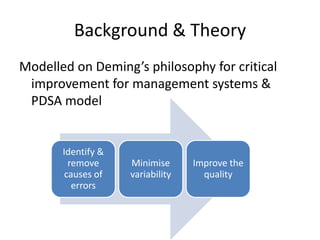
Modelled on Deming’s philosophy for critical
 improvement for management systems &
 PDSA model


       Identify &
         remove     Minimise      Improve the
        causes of   variability     quality
          errors
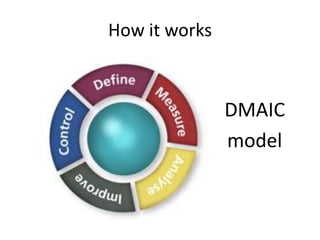
How it works


               DMAIC
               model
Application of Six Sigma
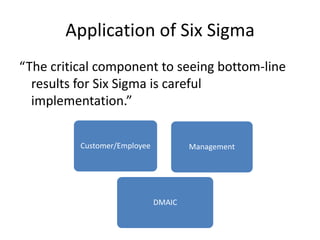
“The critical component to seeing bottom-line
  results for Six Sigma is careful
  implementation.”


          Customer/Employee           Management


                              DMAIC
PPE Compliance
Scenario-
The Manager of the surgical ward at *Health Care
  Improvement Hospital* has received the results
  of the recent audit of ‘Hand hygiene’ on the
  ward. The results are not favourable.
The audit was concerned with the Staff’s practice of
  hand hygiene, in compliance with the recently
  implemented ‘5 moments of hand hygiene’
  guidelines set by the World Health Organization.
Define

  Need for
                Health risk
improvement


       Fails to meet
           needs
Measure

                      Other
When?   Frequency?
                     issues?
Analyse

Cause of non-      Cause &        Verifying the
 compliances    effect analysis      cause
Improve

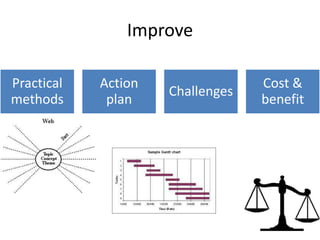
Practical   Action                Cost &
                     Challenges
methods      plan                 benefit
Control

            Critical
           questions

          Before/after
             charts

Six sigma- PPE - Jade

  • 1.
    Six Sigma >>PPE compliance
  • 2.
    Background & Theory Modelledon Deming’s philosophy for critical improvement for management systems & PDSA model Identify & remove Minimise Improve the causes of variability quality errors
  • 3.
    How it works DMAIC model
  • 4.
    Application of SixSigma “The critical component to seeing bottom-line results for Six Sigma is careful implementation.” Customer/Employee Management DMAIC
  • 5.
    PPE Compliance Scenario- The Managerof the surgical ward at *Health Care Improvement Hospital* has received the results of the recent audit of ‘Hand hygiene’ on the ward. The results are not favourable. The audit was concerned with the Staff’s practice of hand hygiene, in compliance with the recently implemented ‘5 moments of hand hygiene’ guidelines set by the World Health Organization.
  • 6.
    Define Needfor Health risk improvement Fails to meet needs
  • 7.
    Measure Other When? Frequency? issues?
  • 8.
    Analyse Cause of non- Cause & Verifying the compliances effect analysis cause
  • 9.
    Improve Practical Action Cost & Challenges methods plan benefit
  • 10.
    Control Critical questions Before/after charts

Editor's Notes

  • #3 Six sigma is modelled on Dr Edward Deming’s philosophy for critical improvement for management systems & PDSA (Plan, do, study, act) modelThe theory behind the model is- seeking to improve the quality of process outcomes by identifying and removing the causesof errors effectively minimizing variability in the process.The original intention for and application of the Six Sigma model, was to initiate projects to be carried out within an organization following a defined sequence of steps and has quantified financial targets – applied to other areas such as manufacturing or health care the targets can be modified to those such as ‘yield’, ‘errors’ or ‘incidents’---------------------------------------------Information adapted from:Wayne, D. (n.d.). Deming management philosophy and so-called six sigma quality. Retrieved January 3, 2012, from Q-skills: Q-skillsAntony, Jiju. "Pros and cons of Six Sigma: an academic perspective". Archived from the original on July 23, 2008. http://web.archive.org/web/20080723015058/http://www.onesixsigma.com/node/7630. Retrieved January, 2012.
  • #4 The model’s made-up of five steps to apply to any procedure to improve effectiveness and/or quality of the outcome.1.      Define: Setting the context and objectives for the improvement project.2.      Measure: Determining the baseline performance and capability of the process or system to be improved.3.      Analyse: Use data and tools to understand the cause-and-effect relationships in the process, system or initiative. 4.      Improve: Develop the modifications that lead to a validated improvement.5.      Control: Establish plans and procedures to ensure that the improvements are sustained.--------------------------------------Information adapted from:Six Sigma Tools: The DMAIC Process . (2011). Retrieved January 3, 2012, from DMAIC tools: http://www.dmaictools.com/General Electrics. (n.d.). What is six sigma? The roadmap to customer impact. Retrieved January 3, 2012, from General Electrics: http://www.ge.com/sixsigma/SixSigma.pdfDe Feo, Joseph A.; Barnard, William (2005). JURAN Institute's Six Sigma Breakthrough and Beyond - Quality Performance Breakthrough Methods. Tata McGraw-Hill Publishing Company Limited. ISBN 0-07-059881-9.Image sourced from:http://www.google.com.au/imgres?q=six+sigma&um=1&hl=en&qscrl=1&nord=1&rlz=1T4ADFA_enAU367AU368&biw=1366&bih=528&tbm=isch&tbnid=ehRdd_dB92cmRM:&imgrefurl=http://www.crmbi.com/CRMBI/Solutions/SixSigma.aspx&docid=Ml6bn0Lwe06RfM&imgurl=http://www.crmbi.com/CRMBI/images/SixSigmaCircle.jpg&w=200&h=192&ei=tW8DT46uEozItAaygdm_Aw&zoom=1
  • #5 Leavitt (2002) states that “The critical component to seeing bottom-line results for Six Sigma is careful implementation.”Application of the DMAIC model of Six Sigma may be instigated by, customer/employee surveys and suggestions, benchmarking studies, or existing projects and initiatives. Management may identify potential improvement areas and establish a process or to generate, capture, and prioritize project ideas. It’s important to note also that, the implementation of an initiative needs to be aligned with strategic objectives and possess a quality focus, to be effective & sustainable.----------------------------Information adapted from:Leavitt, P. (2002). Lessons Learned in Six Sigma Implementation. Retrieved January 3, 2012, from American productivity & quality centre : http://www.providersedge.com/docs/leadership_articles/Lessons_Learned_in_6Sigma_Implementation.pdfQuote sourced from:Leavitt, P. (2002). Lessons Learned in Six Sigma Implementation. Page 1. Retrieved January 3, 2012, from American productivity & quality centre : http://www.providersedge.com/docs/leadership_articles/Lessons_Learned_in_6Sigma_Implementation.pdf
  • #6 To aid the illustration of the application of Six Sigma to the area of Personal Protective Equipment compliance, is a Scenario- The Manager of the surgical ward at *Health Care Improvement Hospital* has received the results of the recent audit of ‘Hand hygiene’ on the ward. The results are not favourable.The audit was concerned with the Staff’s practice of hand hygiene, in compliance with the recently implemented ‘5 moments of hand hygiene’ guidelines set by the World Health Organization.Hand hygiene can be considered as a mechanism of Personal Protective equipment, as not only is it of importance to the care of patients (for example in the lowered risk of hospital acquired infection), but we as health care workers must also be conscientious of keeping our hands clean (for example after patient contact) in regards to the preservation of our own health.----------------------------------------------------5 moments of hand hygiene:World Health Organization. (2012). Five Moments for Hand Hygiene. Retrieved January 3, 2012, from Clean Care is Safer Care: http://www.who.int/gpsc/tools/Five_moments/en/
  • #7 During the Define phase, an agreement must be reached in regards to what the initiative will encompass & what it should accomplishIdentifying the compliance with Hand hygiene as an area of improvement – in this case identified by the manager, through audit resultsAlso identified is the risk to both Staff members & patientsThe current increased risk of health adversities to Staff & Patient related to transmitted pathogens, made evident by the results of the audit, fails to meet the needs of the individuals involved and the organisation------------------------------------Information adapted from:Abilla, P. (2010). Lean Six Sigma: The DMAIC Framework. Retrieved January 3, 2012, from Shmula: http://www.shmula.com/lean-six-sigma-the-dmaic-framework/2874/
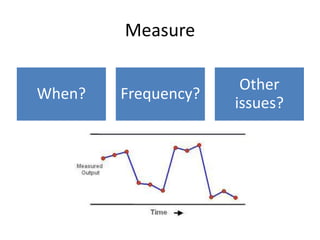
  • #8 During the Measure phase, the focus shifts from the point of “agreeing that X is the problem” to “agreeing on what’s the phenomena that is happening such that it is a problem?” So in order to find out why the compliance with the 5 moments of hand hygiene is not at an acceptable level, it would be useful to know when and how often the non-compliances occur and any other issues related. After collecting this data.. A more specific problem- that has the most significant impact, can be selected through further analysis and an improvement target can be set.A run chart, would be an effective tool to be implemented during the measurement phase..Run charts, also known as line graphs, display process performance over time.--------------------------------Information adapted from:Abilla, P. (2010). Lean Six Sigma: The DMAIC Framework. Retrieved January 3, 2012, from Shmula: http://www.shmula.com/lean-six-sigma-the-dmaic-framework/2874/Image sourced from: http://www.google.com.au/imgres?q=run+chart&um=1&hl=en&sa=N&qscrl=1&nord=1&rlz=1T4ADFA_enAU367AU368&biw=1366&bih=528&tbm=isch&tbnid=MQfxL5YfFyNAFM:&imgrefurl=http://www.qualitytrainingportal.com/resources/problem_solving/problem-solving_tools-run_charts.htm&docid=0nF3kmcQxeUGFM&imgurl=http://www.qualitytrainingportal.com/resources/problem_solving/images/run_chart.gif&w=502&h=247&ei=e5oDT4fwL4OcsAaMiqn0Dw&zoom=1&iact=rc&dur=1&sig=108125072540068073160&page=1&tbnh=104&tbnw=211&start=0&ndsp=10&ved=1t:429,r:1,s:0&tx=79&ty=54
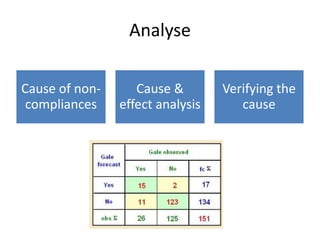
  • #9 In the Analysing Phase, the focus is to identify the root causes for the problems within the organisation & process, and the experience of the staff.Which involves;Using data to focus the team on finding and verifying the true root causes of non compliancesPerforming Cause and Effect analysis Continue analysis until the level of actionable root causes is reachedVerification of the root causes, can be achieved by applying appropriate toolsie. Contingency tableVerified Root Causes will form the foundation for solutions in the Improve Phase – failing to find true root causes will cause the organisation to implement change in the wrong areas and will subsequently miss the targeted improvement The contingency table was utilised to analyse the non-compliance events on the Surgical ward.. With the left column as ‘Attendance at Hand hygiene inservice’ and across the top ‘Non-compliance observed’.The results indicated that the majority of non-compliances sat with those of the staff who had not attended the Hand hygeine inservice, although there were a small number of non-compliances amongst those who had attended.--------------------------------------Information adapted from:Abilla, P. (2010). Lean Six Sigma: The DMAIC Framework. Retrieved January 3, 2012, from Shmula: http://www.shmula.com/lean-six-sigma-the-dmaic-framework/2874/Image sourced from: http://www.google.com.au/imgres?q=contingency+table&um=1&hl=en&qscrl=1&nord=1&rlz=1T4ADFA_enAU367AU368&biw=1366&bih=528&tbm=isch&tbnid=x-zEa_0kLArTqM:&imgrefurl=http://www.eumetcal.org/resources/ukmeteocal/verification/www/english/msg/ver_categ_forec/uos1/uos1_ko1.htm&docid=3NYlgwkXDtP_kM&imgurl=http://www.eumetcal.org/resources/ukmeteocal/verification/www/resource/msg/verification/images/Cont.table_2B.jpg&w=305&h=202&ei=O6ADT5uYLo2csAbSxtzaDw&zoom=1
  • #10 In theImprove Phase, the assumption is that the root causes have been reached and some or most were validated. Working within that context the next steps are; To brainstorm the potential practical methods to address the root causes. *ie. Conducting more inservices, with mandatory attendance to one sessionAnaction plan must be formulated. This is typically a Gantt Chart showing people responsible for which action item and a date by which it should be completed. IdentifyingBarriers and Aids, is an exercise that shows what challenges may be, for implementing the improvements – this will usually contain issues related to people. Cost and Benefit Analysis will show the cost of the project and the potential benefit. In most organizations, this step is completed by both the person leading the initiative & the person in control of the financing----------------------------------------------------------Information adapted from:Abilla, P. (2010). Lean Six Sigma: The DMAIC Framework. Retrieved January 3, 2012, from Shmula: http://www.shmula.com/lean-six-sigma-the-dmaic-framework/2874/Images sourced from: http://www.google.com.au/imgres?q=brainstorm&um=1&hl=en&qscrl=1&nord=1&rlz=1T4ADFA_enAU367AU368&biw=1366&bih=528&tbm=isch&tbnid=yAgxJ_h5iZiJzM:&imgrefurl=http://www.writedesignonline.com/organizers/brainstorm.html&docid=jT4nbAPse-LTXM&imgurl=http://www.writedesignonline.com/organizers/WebGO.gif&w=388&h=306&ei=Y6cDT8rqF5GPsAbOhMXJDw&zoom=1http://www.google.com.au/imgres?q=gantt+chart&um=1&hl=en&sa=N&qscrl=1&nord=1&rlz=1T4ADFA_enAU367AU368&biw=1366&bih=528&tbm=isch&tbnid=1PXUz2NCOUdbPM:&imgrefurl=http://www.promana.net/making-use-of-gantt-charts/&docid=fqGGH4jY1fSkkM&imgurl=http://www.promana.net/wp-content/uploads/ganttchart.gif&w=478&h=303&ei=7qYDT6_PPIfAswb4nqHSDw&zoom=1http://www.google.com.au/imgres?q=scales&um=1&hl=en&qscrl=1&nord=1&rlz=1T4ADFA_enAU367AU368&biw=1366&bih=528&tbm=isch&tbnid=jFrV8rkRgDNhiM:&imgrefurl=http://www.lavazzaarticle.net/balances-scales/&docid=r584YxqtnK8Q_M&imgurl=http://www.lavazzaarticle.net/wp-content/uploads/2011/08/Balances-Scales-1.gif&w=640&h=468&ei=A6kDT4u3NsuKswaX2YHoBA&zoom=1
  • #11 In the final phase of the DMAIC model,Control, the focus is on verifying whether the changes made in ‘the Improve stage’ led to the expected changes/outcomes. Part of the Control Phase is to also verify the significance of improvement, if there was any at all.There are some critical questions to evaluate the success of the initiative..How is it known the problem has been reduced? How is it known that the problem will not come back? How is it known you are measuring the right process indicators? What did was learnt while leading the project? Though generally, the critical output in ‘the Control stage’ is a before/after chart, in our scenario for the surgical ward, it would be a before/after comparison of graphs showing performance levels of compliance with the 5 moments of Hand hygeine && from this, the manager would be able to determine whether the implementation of mandatory inservice education & training for each staff memeber, was an effective initiative. **In the spirit of happy endings, quality improvement & safe health care- provision and delivery, the process was implemented with care & stringency & was able to significantly improve the compliance on the Surgical Ward at the Health Care Improvement Hospital with the WHO’s hand hygiene guidelines!--------------------------------------------------------Information adapted from:Abilla, P. (2010). Lean Six Sigma: The DMAIC Framework. Retrieved January 3, 2012, from Shmula: http://www.shmula.com/lean-six-sigma-the-dmaic-framework/2874/Image sourced from: http://www.google.com.au/imgres?q=questions&um=1&hl=en&qscrl=1&nord=1&rlz=1T4ADFA_enAU367AU368&biw=1366&bih=528&tbm=isch&tbnid=GixQgMlM-8l5KM:&imgrefurl=http://www.inlign.com.au/osteopathy/frequently-asked-questions/&docid=IwflqMnO2e_XjM&imgurl=http://www.inlign.com.au/images/osteopathy_questions.jpg&w=400&h=300&ei=kKoDT-nXBM3QsgaNovChAQ&zoom=1