Empowering students, whilst
    they’re students..
 Equipping students with the personal
  tools & skills they need to become
         leaders as graduates .

        Fact or fiction?..
The need for student learners?

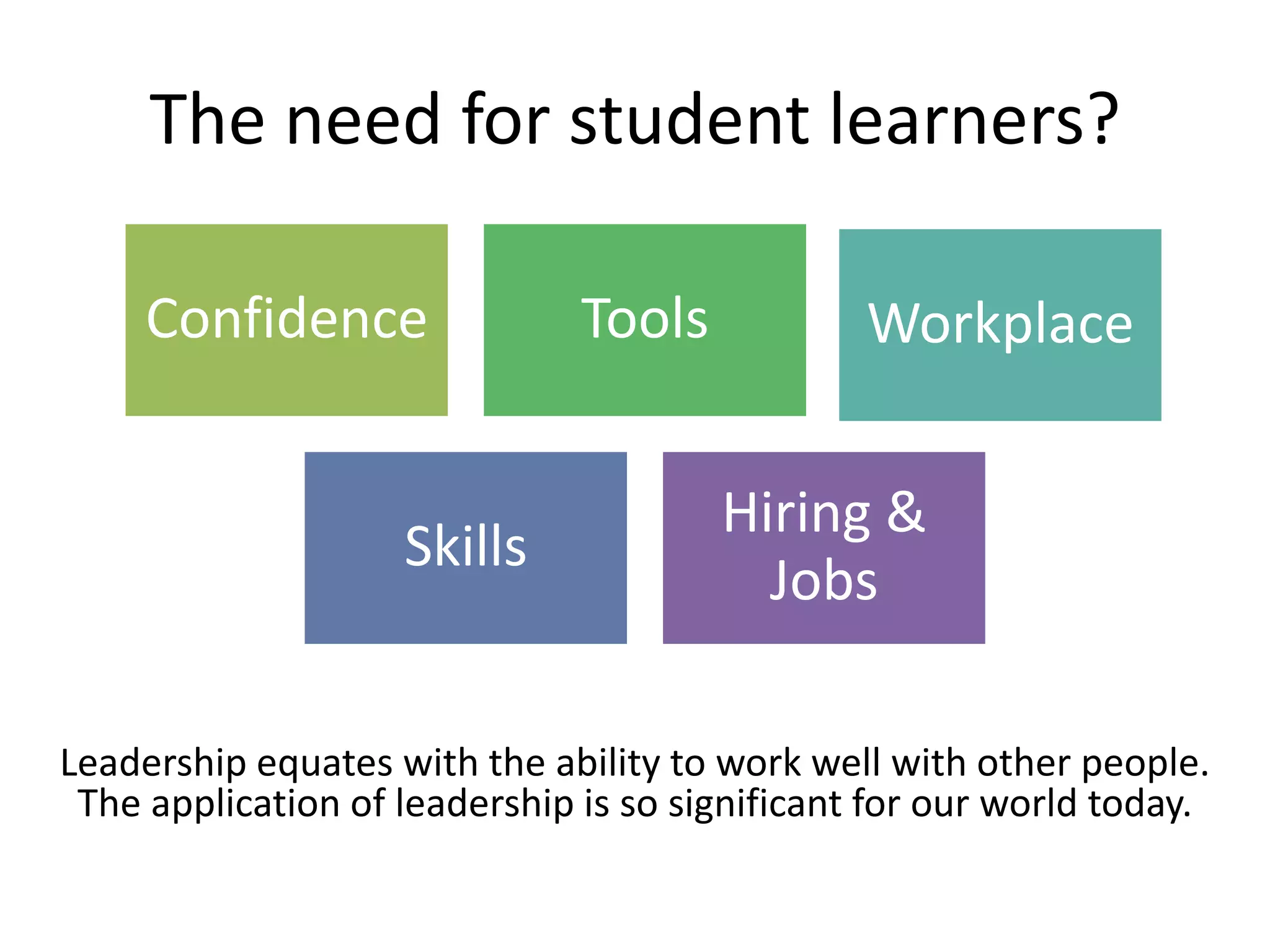
     Confidence                Tools            Workplace


                                       Hiring &
                    Skills
                                         Jobs

Leadership equates with the ability to work well with other people.
 The application of leadership is so significant for our world today.
An effective leadership style?


            Shared leadership requires
             strengths and abilities not
              normally associated with
            the ‘traditional stereotype’
                    of leadership
How can students develop leadership
              skills?

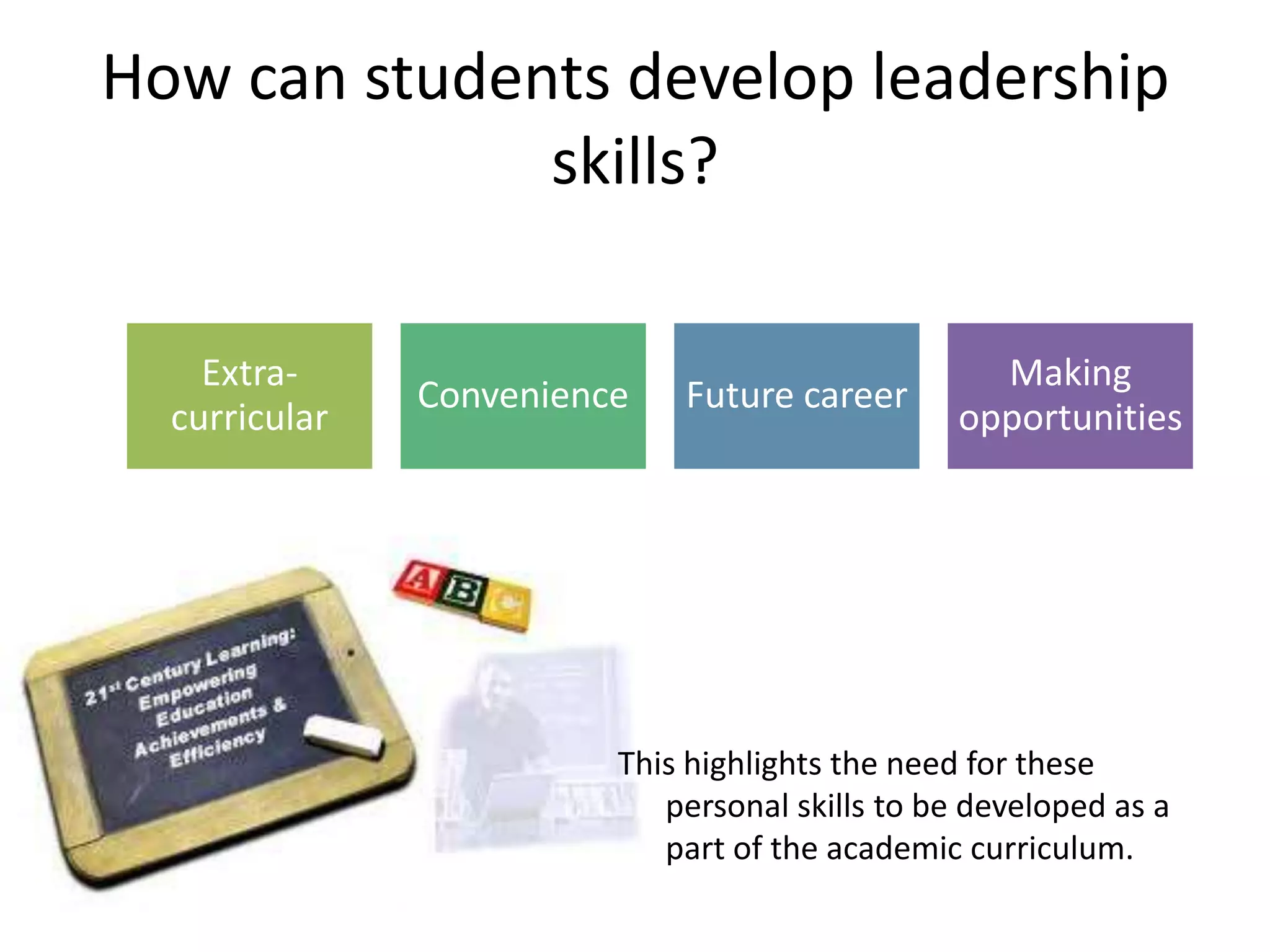
    Extra-                                         Making
               Convenience   Future career
  curricular                                     opportunities


                         This highlights the need for these
                            personal skills to be developed as a
                            part of the academic curriculum.
Recommendations for education?
    Inclusion in
    curriculum

     Learning
     activities

    Contextual
   leadership?

Empowering students

  • 1.
    Empowering students, whilst they’re students.. Equipping students with the personal tools & skills they need to become leaders as graduates . Fact or fiction?..
  • 2.
    The need forstudent learners? Confidence Tools Workplace Hiring & Skills Jobs Leadership equates with the ability to work well with other people. The application of leadership is so significant for our world today.
  • 3.
    An effective leadershipstyle? Shared leadership requires strengths and abilities not normally associated with the ‘traditional stereotype’ of leadership
  • 4.
    How can studentsdevelop leadership skills? Extra- Making Convenience Future career curricular opportunities This highlights the need for these personal skills to be developed as a part of the academic curriculum.
  • 5.
    Recommendations for education? Inclusion in curriculum Learning activities Contextual leadership?

Editor's Notes

  • #3 Students would benefit significantly by learning leadership skills as a part of their tertiary education, so that they feel confident that they have the tools & also the confidence to use them, once they are in a working environment, as a graduate. Students need to have their capacity for self-reliance, social and cultural capital, appreciation for lifelong learning, creativity, conflict-resolution and team-building skills, ethics etc, nurtured in order to become more developed and applicable to new situations faced in the workplace as graduates.. The previous presentations are all examples of this. It’s without surprise that, leadership skills are also ranked as one of the main factors considered when hiring graduates- which has been identified through studies where managers of both small & larger organisations have been asked to identify qualities they’re looking for in graduates.Leadership equates with the ability to work well with other people. The application of leadership is so significant for our world today.-----------------------------------------------------Information adapted from:Omatsu, G. (n.d.). Student leadership training booklet. Retrieved January 18, 2012, from: www.csun.edu/eop/htdocs/leadership_booklet.pdfSimilarGreenwald, R. (2010, December). Today's students need leadership training like never before. Retrieved January 18, 2012, from The chronicle of higher education: http://chronicle.com/article/Todays-Students-Need/125604/
  • #4 If you were to pose the question “How many people consider themselves leaders?” in a room full of University students, it is likely that only a few would answer affirmatively. But imagine if you were to ask a slightly different question, like, “How many people here are able to work well with others and get things done together?” Considerably more, and possibly the majority of the room would raise their hands.Successful leadership is now conceptualised as embedded in an individual’s ability to work well with others to get things done.Shared leadership has been described as the ability of a person to work well with others. Shared leadership requires strengths and abilities not normally associated with the ‘traditional stereotype’ of leadership: the capacity for nurturing others, facilitating other’s development of ideas and bringing out their best talents, the ability for conflict mediation, the quality to express empathy and compassion for others and educate others about the importance of these, and the ability to encourage different viewpoints.--------------------------------------------Information adapted from:Omatsu, G. (n.d.). Student leadership training booklet. Retrieved January 18, 2012, from: www.csun.edu/eop/htdocs/leadership_booklet.pdfSimilarImage sourced from:http://www.google.com.au/imgres?q=student+activist&um=1&hl=en&qscrl=1&nord=1&rlz=1T4ADFA_enAU367AU368&biw=1366&bih=556&tbm=isch&tbnid=Qop0_gHzLVcb0M:&imgrefurl=http://www.facebook.com/group.php%3Fgid%3D169443304344&docid=JzUx_H9AwsOqSM&imgurl=http://profile.ak.fbcdn.net/hprofile-ak-snc4/50315_169443304344_2093612_n.jpg&w=200&h=288&ei=97cWT6jRFO7N4QTP-tSnBA&zoom=1
  • #5 Unfortunately, in today’s tertiary education system for Nurses, students are not presented with the opportunity to learn the leadership skills that are crucial to our future careers. In my experience, most universities courses, do not include in the curriculum, the development of student leadership skills,but relegated to “extra-curricular” activities — i.e., it is regarded as part of students’ non-academic activities in clubs and organisations. For most students, learning leadership skills during their studies isn’t convenient because it needs to be done in addition to their academic workload. Especially for students who work in order to pay for their education - they may not have the time to participate in student groups in order to learn leadership skills. Given this reality of this situation, that development of personal skills are not explicitly developed as a part of our educational framework, what can a student do to gain the necessary leadership skills that will empower them to prepare for the challenges of their future jobs? There is no simple answer, students need to think about what they wish/need to acquire from their education. Within my own personal education, electives have not been permitted but I have been able to place preferences for Practical placements, allowing some power, to choose what’s most important to my own career. Students who have the possibility to choose elective units, need to do so wisely, keeping in mind units that provide some basis for leadership development. Using group projects as opportunities to work on personal and leadership skills, is an excellent opportunity to develop these skills within a less-threatening environment - in comparison to the workforce.This highlights the need for these personal skills to be developed as a part of the academic curriculum. -----------------------------------------------------Information adapted from:Omatsu, G. (n.d.). Student leadership training booklet. Retrieved January 18, 2012, from: www.csun.edu/eop/htdocs/leadership_booklet.pdfSimilarH., T., Prince (n.d.). Teaching Leadership: A journey into the unknown. Retrieved January 18, 2012, from www.utexas.edu/lbj/research/leadership/.../teaching_leadership.pdfSimilarImages sourced from:http://www.google.com.au/imgres?q=education&um=1&hl=en&qscrl=1&nord=1&rlz=1T4ADFA_enAU367AU368&biw=1366&bih=556&tbm=isch&tbnid=mSVUvcJ1O6g1RM:&imgrefurl=http://www.praxa.com.au/Products/Pages/Education.aspx&docid=nIFDxr6Apz_H-M&imgurl=http://www.praxa.com.au/Products/PublishingImages/Education%252520Services.jpg&w=675&h=394&ei=sMMWT_iPFM2O4gTmosjxAw&zoom=
  • #6 We can assume that a complete theory addressing how the development of leaders could be facilitated as a part of an academic curriculum, would identify critical leadership knowledge, skills, values, attitudes,and beliefs. It would have to tell us what can be learned and what may be innate. The theory would also have to inform both students and teachers how each leadership outcomes would be taught or developed. Different learning activities would be required to bring about changes in different dimensions of leadership. Some longitudinal studies of developmental changes and the ability to participate more effectively in leadership roles and processes are under way at Alvorno College, Yale University, and the U. S. Military Academy at West Point.But it will many years before these results will be in and we will know what has been learned from a practical point of view. But it will many years before these results will be in and we will know what has been learned from a practical point of view. -------------------------------------------------Information adapted from:Mentkowski, M., & Associates. Learning that lasts: Integrating learning, development, and performance in college and beyond. San Francisco: Jossey-Bass, 2000.H., T., Prince (n.d.). Teaching Leadership: A journey into the unknown. Retrieved January 18, 2012, from www.utexas.edu/lbj/research/leadership/.../teaching_leadership.pdfSimilarImage sourced from:http://www.google.com.au/imgres?q=student+learning&um=1&hl=en&sa=X&qscrl=1&nord=1&rlz=1T4ADFA_enAU367AU368&biw=1366&bih=556&tbm=isch&tbnid=CORxLodPel2F2M:&imgrefurl=http://maasd.edublogs.org/2010/01/17/creating-an-environment-which-meets-student-learning-needs/&docid=B_rWRxOOIevi2M&imgurl=http://maasd.edublogs.org/files/2010/01/brainstorming_10_08_08_pc_pro_me.jpg&w=1600&h=1600&ei=Q7kWT829IMio4gSiv62HBA&zoom=1