Restoring Context in Online Teaching
with Artificial Intelligence and
Multimodal Learning Experiences
Keynote at the SITE Interactive Conference
28th October 2021
by Dr Daniele Di Mitri
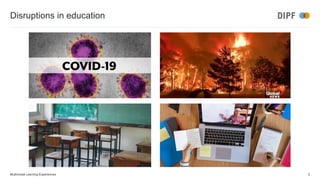
Disruptions in education
Multimodal Learning Experiences 2
Question time: What about you education institution?
Multimodal Learning Experiences 3
Context and Multimodality
Background
Multimodal Learning Experiences 4
Actual learning requires authentic practice
Multimodal Learning Experiences 5
Learning about a skill Practicing a skill
Traditional education technologies
• Traditional desktop based computers offers limited
modalities of interaction mainly audio/video
• Mobile devices offer more modalities but remain
constraint to small screen
• Learning activities are mainly designed around the
device
• Gap between knowledge acquisition and knowledge
application
• Lack of authentic and deliberate practice
Multimodal Learning Experiences 6
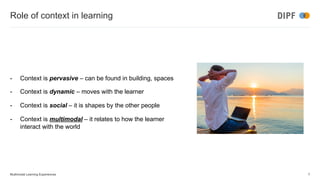
Role of context in learning
- Context is pervasive – can be found in building, spaces
- Context is dynamic – moves with the learner
- Context is social – it is shapes by the other people
- Context is multimodal – it relates to how the learner
interact with the world
Multimodal Learning Experiences 7
Theoretical groundings of Multimodal Learning
• Embodied learning (EL) learning and skill acquisition as grounded in the body and the
environment it is operating (Robbins & Aydede, 2009)
‒ perception via senses, motor activity, and introspection
‒ same principle of cognitive offloading of Dual Coding Theory (Clark & Paivio 1991)
‒ movements, gestures help to free memory resources
‒ better recall rates for training (Kiefer et al., 2015)
• Deliberate practice (DP) learning
‒ repeated perception-action cycles
‒ conscious, structured practice required for sustained improvement (Ericsson et al 1993)
‒ requires high cognitive load (Rikers et al., 2004)
‒ Integrated EL in DP would distribute the cognitive load
‒ must be done in an authentic setting (Neelen & Kirschner, 2018)
Multimodal Learning Experiences 8
Bloom’s theory: domains of learning & the 2-sigma problem
Multimodal Learning Experiences 9
New technological affordances
+
learning analytics approach
"measurement, collection, analysis and
reporting of data about learners”
Multimodal Learning Experiences
data from multimodal and multi-sensor
interfaces
= Multimodal Learning Analytics
a more accurate representation of the
learning process
10
Multimodal Learning Experiences
Multimodal Learning Experiences (MLX)
“any digital-enhanced learning activity using more than two modalities within an authentic learning setting”
Multimodal Learning Experiences 11
(1) Sensors (2) Authentic practice (3) Immersive tech
The 3 pillars of MLX
Some examples from related research
Benefits of MLX for teaching and
learning
Multimodal Learning Experiences 12
Benefit 1) Create richer online learning experiences
Multimodal Learning Experiences 13
Open Source Real-time Infrastructure for Zoom Augmentation https://zoomsense.org/
Example: ZoomSense
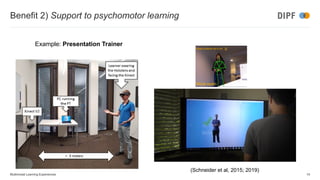
Benefit 2) Support to psychomotor learning
Multimodal Learning Experiences 14
(Schneider et al, 2015; 2019)
Example: Presentation Trainer
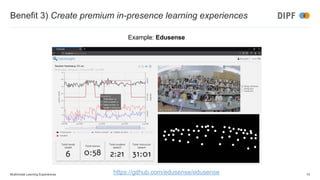
Benefit 3) Create premium in-presence learning experiences
Multimodal Learning Experiences 15
Example: Edusense
https://github.com/edusense/edusense
Designing MLX systems that works (and that fail gracefully)
Engineering MLX systems
Multimodal Learning Experiences 16
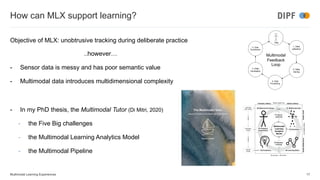
How can MLX support learning?
Objective of MLX: unobtrusive tracking during deliberate practice
..however…
- Sensor data is messy and has poor semantic value
- Multimodal data introduces multidimensional complexity
- In my PhD thesis, the Multimodal Tutor (Di Mitri, 2020)
- the Five Big challenges
- the Multimodal Learning Analytics Model
- the Multimodal Pipeline
Multimodal Learning Experiences 17
5. Data
Exploitation
User
1. Data
collection
3. Data
Processing
4. Data
Annotation
2. Data
storing
Multimodal
Feedback
Loop
Structure of a generic MLX system
Multimodal Learning Experiences 18
• Interaction layer
• the user interface (UI), the sensors and actuators
• Data layer
• collection, storing, annotation, processing
multimodal data
• Feedback layer
• feedback strategy, real-time or retrospective
• Task layer
• task sequence, modelling, constraints etc.
EEG
Empatica
Myo
Leap
Motion
Data collection & storing challenges
19
Multimodal Learning Experiences
Modalities Sensors Controllers
Multimodal
Learning
Hub
example data from
EMG sensor
(Schneider et
al, 2018)
Multimodal Learning Experiences
Data annotation challenge
Multimodal Learning Experiences
20
Multimodal Learning Experiences
Real-time feedback architecture (Di Mitri et al., 2021)
Sensors
CPRTutor
C# app
SharpFlow
Python3
TCP
client
TCP
server
Chunk
(1 CC – 0.5
sec)
Classification ML models
ClassRate
ClassRelease
ClassDepth
ArmsLocked
BodyWeight
Feedback
21
Positive effect of real-time feedback
error rates drops shortly
after the feedback is fired
22
Multimodal Learning Experiences
Design Based Research
• First Iteration:
‒ Basic requirement analysis -- what needs to be
practice, how can it be practice, usually skills are
complex
‒ Part task analysis -- to select a small part of the
skill
‒ Prototype development ---
‒ User tests to test feasibility, user experience,
usability, F score, etc.
• Second iteration:
‒ Improve prototype
‒ Involve experts (optional to help to improve the
prototype)
‒ Evaluations to test learning gains might be possible
Multimodal Learning Experiences 23
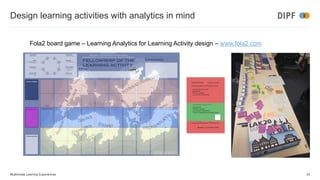
Design learning activities with analytics in mind
Multimodal Learning Experiences 24
Fola2 board game – Learning Analytics for Learning Activity design – www.fola2.com
MLX systems that we created so far
Application use cases
Multimodal Learning Experiences 25
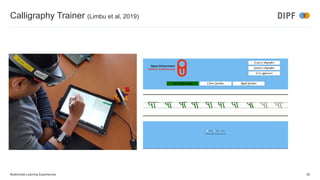
Calligraphy Trainer (Limbu et al, 2019)
26
Multimodal Learning Experiences
CPR Tutor (Di Mitri et al 2020)
Multimodal Learning Experiences
Lock your
arms!
Use your
body
weight!
Release
the
compression!
*Metronome
sound 110bpm*
Check
compressio
n depth!
Microsoft
Kinect v2
Simpad
Laerdal
ResusciAnne
Myo armband
27
Multimodal Learning Experiences
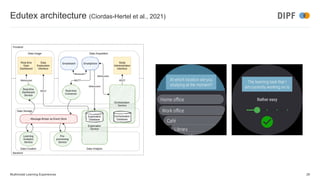
Edutex architecture (Ciordas-Hertel et al., 2021)
Multimodal Learning Experiences 28
Many other examples
Multimodal Learning Experiences 29
• Salsa Trainer (Romano et al. 2019)
• Tennis Table Tutor (Asyraaf et al., 2021)
• Mode of transportation tracking (Di Mitri et al., 2020)
• Pilates Trainer (Meik et al., 2021)
• … more to come …
Immersive Learning for Psychomotor Skills
Multimodal Learning Experiences 30
• Multimodal Immersive Learning with Artificial Intelligence for
Psychomotor Skills
• BMBF project with DFKI, RWTH Aachen, TH Köln, DSHS
• Two main use cases
‒ Running use case
‒ Assembly Human-Robot collaboration
• https://milki-psy.de/
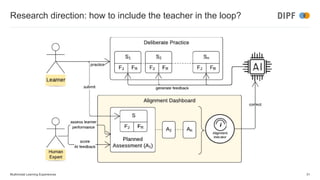
Research direction: how to include the teacher in the loop?
Multimodal Learning Experiences 31
Caveats of MLX – and data centric technologies
1. Privacy and ethical concerns – for which purpose are
student’s data collected?
2. Deviate from original learning goals -> Alignment
problem
3. Data intensive technologies can deepen social
inequalities – expensive hardware amplifies the digital
devide
4. Deepening of social fragmentation and isolation
5. Threaten the student or teacher’s agency (e.g. no
forgiveness, no learn by your mistakes)
What else?
Multimodal Learning Experiences 32
Conclusions
• Multimodal Learning Experiences can improve online/teaching learning
1. by creating richer online learning experiences
2. by supporting to psychomotor learning tasks
3. by creating premium in-presence learning experiences
Restoring context, especially when learning in isolation
• However, they also introduce some risks
• We need more research on how to mitigate these risks and maximise benefits
Multimodal Learning Experiences 33
Thanks for listening!
Daniele Di Mitri
dimitri@dipf.de
@dimstudi0
34
Multimodal Learning Experiences
Q&A time
Multimodal Learning Experiences 35

SITE Interactive kenyote 2021

  • 1.
    Restoring Context inOnline Teaching with Artificial Intelligence and Multimodal Learning Experiences Keynote at the SITE Interactive Conference 28th October 2021 by Dr Daniele Di Mitri
  • 2.
  • 3.
    Question time: Whatabout you education institution? Multimodal Learning Experiences 3
  • 4.
  • 5.
    Actual learning requiresauthentic practice Multimodal Learning Experiences 5 Learning about a skill Practicing a skill
  • 6.
    Traditional education technologies •Traditional desktop based computers offers limited modalities of interaction mainly audio/video • Mobile devices offer more modalities but remain constraint to small screen • Learning activities are mainly designed around the device • Gap between knowledge acquisition and knowledge application • Lack of authentic and deliberate practice Multimodal Learning Experiences 6
  • 7.
    Role of contextin learning - Context is pervasive – can be found in building, spaces - Context is dynamic – moves with the learner - Context is social – it is shapes by the other people - Context is multimodal – it relates to how the learner interact with the world Multimodal Learning Experiences 7
  • 8.
    Theoretical groundings ofMultimodal Learning • Embodied learning (EL) learning and skill acquisition as grounded in the body and the environment it is operating (Robbins & Aydede, 2009) ‒ perception via senses, motor activity, and introspection ‒ same principle of cognitive offloading of Dual Coding Theory (Clark & Paivio 1991) ‒ movements, gestures help to free memory resources ‒ better recall rates for training (Kiefer et al., 2015) • Deliberate practice (DP) learning ‒ repeated perception-action cycles ‒ conscious, structured practice required for sustained improvement (Ericsson et al 1993) ‒ requires high cognitive load (Rikers et al., 2004) ‒ Integrated EL in DP would distribute the cognitive load ‒ must be done in an authentic setting (Neelen & Kirschner, 2018) Multimodal Learning Experiences 8
  • 9.
    Bloom’s theory: domainsof learning & the 2-sigma problem Multimodal Learning Experiences 9
  • 10.
    New technological affordances + learninganalytics approach "measurement, collection, analysis and reporting of data about learners” Multimodal Learning Experiences data from multimodal and multi-sensor interfaces = Multimodal Learning Analytics a more accurate representation of the learning process 10 Multimodal Learning Experiences
  • 11.
    Multimodal Learning Experiences(MLX) “any digital-enhanced learning activity using more than two modalities within an authentic learning setting” Multimodal Learning Experiences 11 (1) Sensors (2) Authentic practice (3) Immersive tech The 3 pillars of MLX
  • 12.
    Some examples fromrelated research Benefits of MLX for teaching and learning Multimodal Learning Experiences 12
  • 13.
    Benefit 1) Createricher online learning experiences Multimodal Learning Experiences 13 Open Source Real-time Infrastructure for Zoom Augmentation https://zoomsense.org/ Example: ZoomSense
  • 14.
    Benefit 2) Supportto psychomotor learning Multimodal Learning Experiences 14 (Schneider et al, 2015; 2019) Example: Presentation Trainer
  • 15.
    Benefit 3) Createpremium in-presence learning experiences Multimodal Learning Experiences 15 Example: Edusense https://github.com/edusense/edusense
  • 16.
    Designing MLX systemsthat works (and that fail gracefully) Engineering MLX systems Multimodal Learning Experiences 16
  • 17.
    How can MLXsupport learning? Objective of MLX: unobtrusive tracking during deliberate practice ..however… - Sensor data is messy and has poor semantic value - Multimodal data introduces multidimensional complexity - In my PhD thesis, the Multimodal Tutor (Di Mitri, 2020) - the Five Big challenges - the Multimodal Learning Analytics Model - the Multimodal Pipeline Multimodal Learning Experiences 17 5. Data Exploitation User 1. Data collection 3. Data Processing 4. Data Annotation 2. Data storing Multimodal Feedback Loop
  • 18.
    Structure of ageneric MLX system Multimodal Learning Experiences 18 • Interaction layer • the user interface (UI), the sensors and actuators • Data layer • collection, storing, annotation, processing multimodal data • Feedback layer • feedback strategy, real-time or retrospective • Task layer • task sequence, modelling, constraints etc.
  • 19.
    EEG Empatica Myo Leap Motion Data collection &storing challenges 19 Multimodal Learning Experiences Modalities Sensors Controllers Multimodal Learning Hub example data from EMG sensor (Schneider et al, 2018) Multimodal Learning Experiences
  • 20.
    Data annotation challenge MultimodalLearning Experiences 20 Multimodal Learning Experiences
  • 21.
    Real-time feedback architecture(Di Mitri et al., 2021) Sensors CPRTutor C# app SharpFlow Python3 TCP client TCP server Chunk (1 CC – 0.5 sec) Classification ML models ClassRate ClassRelease ClassDepth ArmsLocked BodyWeight Feedback 21
  • 22.
    Positive effect ofreal-time feedback error rates drops shortly after the feedback is fired 22 Multimodal Learning Experiences
  • 23.
    Design Based Research •First Iteration: ‒ Basic requirement analysis -- what needs to be practice, how can it be practice, usually skills are complex ‒ Part task analysis -- to select a small part of the skill ‒ Prototype development --- ‒ User tests to test feasibility, user experience, usability, F score, etc. • Second iteration: ‒ Improve prototype ‒ Involve experts (optional to help to improve the prototype) ‒ Evaluations to test learning gains might be possible Multimodal Learning Experiences 23
  • 24.
    Design learning activitieswith analytics in mind Multimodal Learning Experiences 24 Fola2 board game – Learning Analytics for Learning Activity design – www.fola2.com
  • 25.
    MLX systems thatwe created so far Application use cases Multimodal Learning Experiences 25
  • 26.
    Calligraphy Trainer (Limbuet al, 2019) 26 Multimodal Learning Experiences
  • 27.
    CPR Tutor (DiMitri et al 2020) Multimodal Learning Experiences Lock your arms! Use your body weight! Release the compression! *Metronome sound 110bpm* Check compressio n depth! Microsoft Kinect v2 Simpad Laerdal ResusciAnne Myo armband 27 Multimodal Learning Experiences
  • 28.
    Edutex architecture (Ciordas-Hertelet al., 2021) Multimodal Learning Experiences 28
  • 29.
    Many other examples MultimodalLearning Experiences 29 • Salsa Trainer (Romano et al. 2019) • Tennis Table Tutor (Asyraaf et al., 2021) • Mode of transportation tracking (Di Mitri et al., 2020) • Pilates Trainer (Meik et al., 2021) • … more to come …
  • 30.
    Immersive Learning forPsychomotor Skills Multimodal Learning Experiences 30 • Multimodal Immersive Learning with Artificial Intelligence for Psychomotor Skills • BMBF project with DFKI, RWTH Aachen, TH Köln, DSHS • Two main use cases ‒ Running use case ‒ Assembly Human-Robot collaboration • https://milki-psy.de/
  • 31.
    Research direction: howto include the teacher in the loop? Multimodal Learning Experiences 31
  • 32.
    Caveats of MLX– and data centric technologies 1. Privacy and ethical concerns – for which purpose are student’s data collected? 2. Deviate from original learning goals -> Alignment problem 3. Data intensive technologies can deepen social inequalities – expensive hardware amplifies the digital devide 4. Deepening of social fragmentation and isolation 5. Threaten the student or teacher’s agency (e.g. no forgiveness, no learn by your mistakes) What else? Multimodal Learning Experiences 32
  • 33.
    Conclusions • Multimodal LearningExperiences can improve online/teaching learning 1. by creating richer online learning experiences 2. by supporting to psychomotor learning tasks 3. by creating premium in-presence learning experiences Restoring context, especially when learning in isolation • However, they also introduce some risks • We need more research on how to mitigate these risks and maximise benefits Multimodal Learning Experiences 33
  • 34.
    Thanks for listening! DanieleDi Mitri dimitri@dipf.de @dimstudi0 34 Multimodal Learning Experiences
  • 35.