Resetting education and training
through recent research
Session 1: Didactics for Digital Education
Dr. Riina Vuorikari
DG Joint Research Centre
European Commission
• Pandemic as a reference point: What could be learnt to
create more conducive learning environments in the
future?
• Today’s challenge: Citizens interacting with AI systems in
a confident, critical and responsible way
• Tomorrow: Future learning technologies (balance
between human autonomy and machines, LifeComp)
This talk
• Pandemic as a reference point: What could be learnt to
create more conducive learning environments in the
future?
• Today’s challenge: Citizens interacting with AI systems in
a confident, critical and responsible way
• Tomorrow: Future learning technologies, and the balance
between human autonomy and machines
This talk
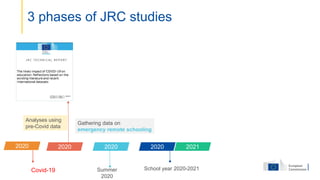
3 phases of JRC studies
2020 2020 2020 2020 2021
Analyses using
pre-Covid data
Gathering data on
emergency remote schooling
Covid-19 Summer
2020
School year 2020-2021
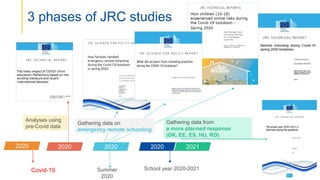
3 phases of JRC studies
2020 2020 2020 2020 2021
Analyses using
pre-Covid data
Gathering data on
emergency remote schooling
Covid-19 Summer
2020
School year 2020-2021
Gathering data from
a more planned response
(DK, EE, ES, HU, RO)
6
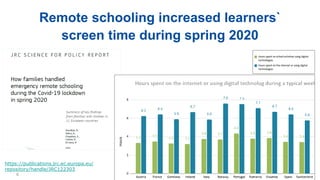
Remote schooling increased learners`
screen time during spring 2020
https://publications.jrc.ec.europa.eu/
repository/handle/JRC122303
7
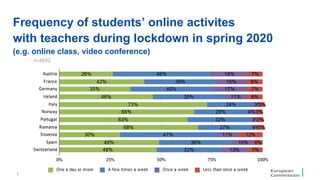
Frequency of students’ online activites
with teachers during lockdown in spring 2020
(e.g. online class, video conference)
8
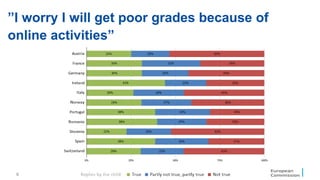
”I worry I will get poor grades because of
online activities”
9
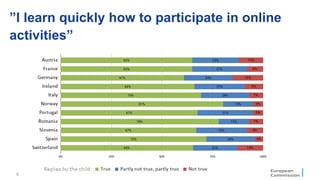
”I learn quickly how to participate in online
activities”
• Developing positive attitudes towards learning
• can help learners to overcome some of the potential challenges,
e.g. those posed by online learning during remote/hybrid education.
• Both parents and teachers play a fundamental role (OECD,
2020).
• Focus on the balance between screen time and off-screen
activities in education, it is important also from the equity
perspective
• How to design inspirational educational on-screen and off-
screen activities that involve social aspects of learning?
• Not all families have skills and resources to support children’s
digital learning activities, e.g. 28% of EU adults with children have
low digital skills + 8% no digital skills at all.
Take-home messages
• Pandemic as a reference point: What could be learnt to
create more conducive learning environments for the
future?
• Today’s challenge: Citizens interacting with AI systems in
a confident, critical and responsible way
• Tomorrow: Future learning technologies, and the balance
between human autonomy and machines
This talk
Sources: https://blog.google/products/gmail/save-time-with-smart-reply-in-gmail/;
https://help.apple.com/assets/5F9C37DC680CE2523318A9E4/5F9C37E3680CE25233
18A9EC/en_GB/7bfb31e3c39725feb7a7213db8f4c38a.png
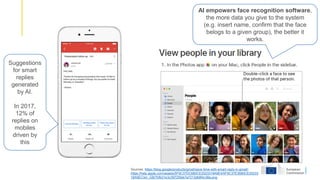
Suggestions
for smart
replies
generated
by AI.
In 2017,
12% of
replies on
mobiles
driven by
this
AI empowers face recognition software,
the more data you give to the system
(e.g. insert name, confirm that the face
belogs to a given group), the better it
works.
Source: https://9to5mac.com/2019/01/18/irobot-roomba-siri-control/;
* https://foundation.mozilla.org/en/privacynotincluded/irobot-roomba-s-series/
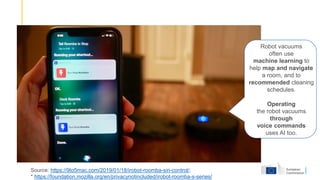
Robot vacuums
often use
machine learning to
help map and navigate
a room, and to
recommended cleaning
schedules.
Operating
the robot vacuums
through
voice commands
uses AI too.
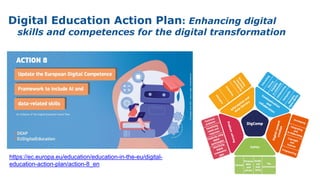
https://ec.europa.eu/education/education-in-the-eu/digital-
education-action-plan/action-8_en
Digital Education Action Plan: Enhancing digital
skills and competences for the digital transformation
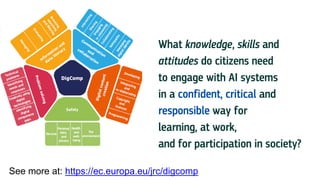
What knowledge, skills and
attitudes do citizens need
to engage with AI systems
in a confident, critical and
responsible way for
learning, at work,
and for participation in society?
See more at: https://ec.europa.eu/jrc/digcomp
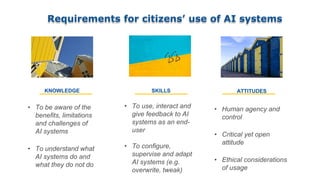
Requirements for citizens’ use of AI systems
KNOWLEDGE
• To be aware of the
benefits, limitations
and challenges of
AI systems
• To understand what
AI systems do and
what they do not do
SKILLS
• To use, interact and
give feedback to AI
systems as an end-
user
• To configure,
supervise and adapt
AI systems (e.g.
overwrite, tweak)
ATTITUDES
• Human agency and
control
• Critical yet open
attitude
• Ethical considerations
of usage
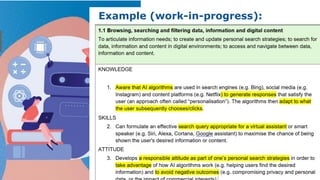
Example (work-in-progress):
Public online validation starts today
until Nov 228!
Participate and find out more at:
https://ec.europa.eu/eusurvey/runner/DigComp
#SELFIEforTEACHERS_EU
https://ec.europa.eu/educators-go-digital
• Pandemic as a reference point: What could be learnt to
create more conducive learning environments for the
future?
• Today’s challenge: Citizens interacting with AI systems in
a confident, critical and responsible way
• Tomorrow: Future learning technologies (balance
between human autonomy and machines, LifeComp)
This talk
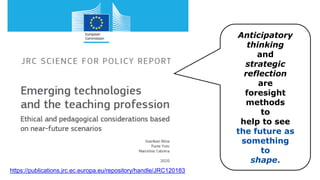
Anticipatory
thinking
and
strategic
reflection
are
foresight
methods
to
help to see
the future as
something
to
shape.
https://publications.jrc.ec.europa.eu/repository/handle/JRC120183
• Should machines or algorithms take decisions which teaching
professionals with adequate pedagogical and subject-specific content
knowledge would otherwise take?
• Under which conditions should a software application autonomously make a
pedagogical judgement?
• Underlying pedagogical models and their aims?
• How are the data models constructed and how traceable are the decisions made by
the software (e.g. explicability)?
• What are their aims? To support learner agency and help develop a variety of
competences (e.g. in the cognitive domain, social and emotional learning)
or to make these core competences redundant?
Key challenges of emerging educational technologies
23
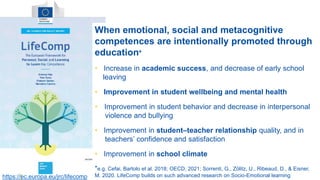
When emotional, social and metacognitive
competences are intentionally promoted through
education*
• Increase in academic success, and decrease of early school
leaving
• Improvement in student wellbeing and mental health
• Improvement in student behavior and decrease in interpersonal
violence and bullying
• Improvement in student–teacher relationship quality, and in
teachers’ confidence and satisfaction
• Improvement in school climate
*e.g. Cefai, Bartolo et al. 2018; OECD, 2021; Sorrenti, G., Zölitz, U., Ribeaud, D., & Eisner,
M. 2020. LifeComp builds on such advanced research on Socio-Emotional learning
https://ec.europa.eu/jrc/lifecomp
24
 Physical school closure due to the pandemic and the lack of in-person
contact may make students less externally motivated to engage in
learning activities.
 Social and Emotional education is key to building emotional resiliency
in individuals
 Mainstreaming the development of Personal, Social and Learning to
Learn Key competence in educational institutions all over Europe makes
sense!
 Lack of skills to teach the socio-emotional and learning to learn
competences is one of the main barriers to adopting teaching strategies.
Open online course to promote LifeComp
25
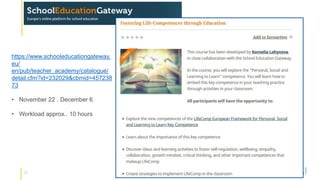
https://www.schooleducationgateway.
eu/
en/pub/teacher_academy/catalogue/
detail.cfm?id=232029&cbmid=457238
73
• November 22 . December 6
• Workload approx.. 10 hours
26
Thank you! Kiitos!
Riina.Vuorikari@ec.europa.eu
https://twitter.com/vuorikari
https://www.slideshare.net/vuorikari

Resetting education through recent research

  • 1.
    Resetting education andtraining through recent research Session 1: Didactics for Digital Education Dr. Riina Vuorikari DG Joint Research Centre European Commission
  • 2.
    • Pandemic asa reference point: What could be learnt to create more conducive learning environments in the future? • Today’s challenge: Citizens interacting with AI systems in a confident, critical and responsible way • Tomorrow: Future learning technologies (balance between human autonomy and machines, LifeComp) This talk
  • 3.
    • Pandemic asa reference point: What could be learnt to create more conducive learning environments in the future? • Today’s challenge: Citizens interacting with AI systems in a confident, critical and responsible way • Tomorrow: Future learning technologies, and the balance between human autonomy and machines This talk
  • 4.
    3 phases ofJRC studies 2020 2020 2020 2020 2021 Analyses using pre-Covid data Gathering data on emergency remote schooling Covid-19 Summer 2020 School year 2020-2021
  • 5.
    3 phases ofJRC studies 2020 2020 2020 2020 2021 Analyses using pre-Covid data Gathering data on emergency remote schooling Covid-19 Summer 2020 School year 2020-2021 Gathering data from a more planned response (DK, EE, ES, HU, RO)
  • 6.
    6 Remote schooling increasedlearners` screen time during spring 2020 https://publications.jrc.ec.europa.eu/ repository/handle/JRC122303
  • 7.
    7 Frequency of students’online activites with teachers during lockdown in spring 2020 (e.g. online class, video conference)
  • 8.
    8 ”I worry Iwill get poor grades because of online activities”
  • 9.
    9 ”I learn quicklyhow to participate in online activities”
  • 10.
    • Developing positiveattitudes towards learning • can help learners to overcome some of the potential challenges, e.g. those posed by online learning during remote/hybrid education. • Both parents and teachers play a fundamental role (OECD, 2020). • Focus on the balance between screen time and off-screen activities in education, it is important also from the equity perspective • How to design inspirational educational on-screen and off- screen activities that involve social aspects of learning? • Not all families have skills and resources to support children’s digital learning activities, e.g. 28% of EU adults with children have low digital skills + 8% no digital skills at all. Take-home messages
  • 11.
    • Pandemic asa reference point: What could be learnt to create more conducive learning environments for the future? • Today’s challenge: Citizens interacting with AI systems in a confident, critical and responsible way • Tomorrow: Future learning technologies, and the balance between human autonomy and machines This talk
  • 12.
    Sources: https://blog.google/products/gmail/save-time-with-smart-reply-in-gmail/; https://help.apple.com/assets/5F9C37DC680CE2523318A9E4/5F9C37E3680CE25233 18A9EC/en_GB/7bfb31e3c39725feb7a7213db8f4c38a.png Suggestions for smart replies generated byAI. In 2017, 12% of replies on mobiles driven by this AI empowers face recognition software, the more data you give to the system (e.g. insert name, confirm that the face belogs to a given group), the better it works.
  • 13.
    Source: https://9to5mac.com/2019/01/18/irobot-roomba-siri-control/; * https://foundation.mozilla.org/en/privacynotincluded/irobot-roomba-s-series/ Robotvacuums often use machine learning to help map and navigate a room, and to recommended cleaning schedules. Operating the robot vacuums through voice commands uses AI too.
  • 14.
  • 15.
    What knowledge, skillsand attitudes do citizens need to engage with AI systems in a confident, critical and responsible way for learning, at work, and for participation in society? See more at: https://ec.europa.eu/jrc/digcomp
  • 16.
    Requirements for citizens’use of AI systems KNOWLEDGE • To be aware of the benefits, limitations and challenges of AI systems • To understand what AI systems do and what they do not do SKILLS • To use, interact and give feedback to AI systems as an end- user • To configure, supervise and adapt AI systems (e.g. overwrite, tweak) ATTITUDES • Human agency and control • Critical yet open attitude • Ethical considerations of usage
  • 17.
  • 18.
    Public online validationstarts today until Nov 228! Participate and find out more at: https://ec.europa.eu/eusurvey/runner/DigComp
  • 19.
  • 20.
    • Pandemic asa reference point: What could be learnt to create more conducive learning environments for the future? • Today’s challenge: Citizens interacting with AI systems in a confident, critical and responsible way • Tomorrow: Future learning technologies (balance between human autonomy and machines, LifeComp) This talk
  • 21.
    Anticipatory thinking and strategic reflection are foresight methods to help to see thefuture as something to shape. https://publications.jrc.ec.europa.eu/repository/handle/JRC120183
  • 22.
    • Should machinesor algorithms take decisions which teaching professionals with adequate pedagogical and subject-specific content knowledge would otherwise take? • Under which conditions should a software application autonomously make a pedagogical judgement? • Underlying pedagogical models and their aims? • How are the data models constructed and how traceable are the decisions made by the software (e.g. explicability)? • What are their aims? To support learner agency and help develop a variety of competences (e.g. in the cognitive domain, social and emotional learning) or to make these core competences redundant? Key challenges of emerging educational technologies
  • 23.
    23 When emotional, socialand metacognitive competences are intentionally promoted through education* • Increase in academic success, and decrease of early school leaving • Improvement in student wellbeing and mental health • Improvement in student behavior and decrease in interpersonal violence and bullying • Improvement in student–teacher relationship quality, and in teachers’ confidence and satisfaction • Improvement in school climate *e.g. Cefai, Bartolo et al. 2018; OECD, 2021; Sorrenti, G., Zölitz, U., Ribeaud, D., & Eisner, M. 2020. LifeComp builds on such advanced research on Socio-Emotional learning https://ec.europa.eu/jrc/lifecomp
  • 24.
    24  Physical schoolclosure due to the pandemic and the lack of in-person contact may make students less externally motivated to engage in learning activities.  Social and Emotional education is key to building emotional resiliency in individuals  Mainstreaming the development of Personal, Social and Learning to Learn Key competence in educational institutions all over Europe makes sense!  Lack of skills to teach the socio-emotional and learning to learn competences is one of the main barriers to adopting teaching strategies. Open online course to promote LifeComp
  • 25.
  • 26.