Transformasi Sistem Koordinat
dan Proyeksi Peta
Dany Laksono
February 9, 2020
Mata Pelatihan WebGIS dan Transformasi Sistem Koordinat
SKKNI Teknisi Utama – Analis Sistem Informasi Geografis
Transformasi Sistem Koordinat dan Proyeksi Peta
• Pengenalan Materi
• Sistem Koordinat Peta
• Bentuk Bumi: Bola, Ellpisoid dan Geoid
• Distorsi Peta dan Tissot Indicatrix
• Proyeksi Peta
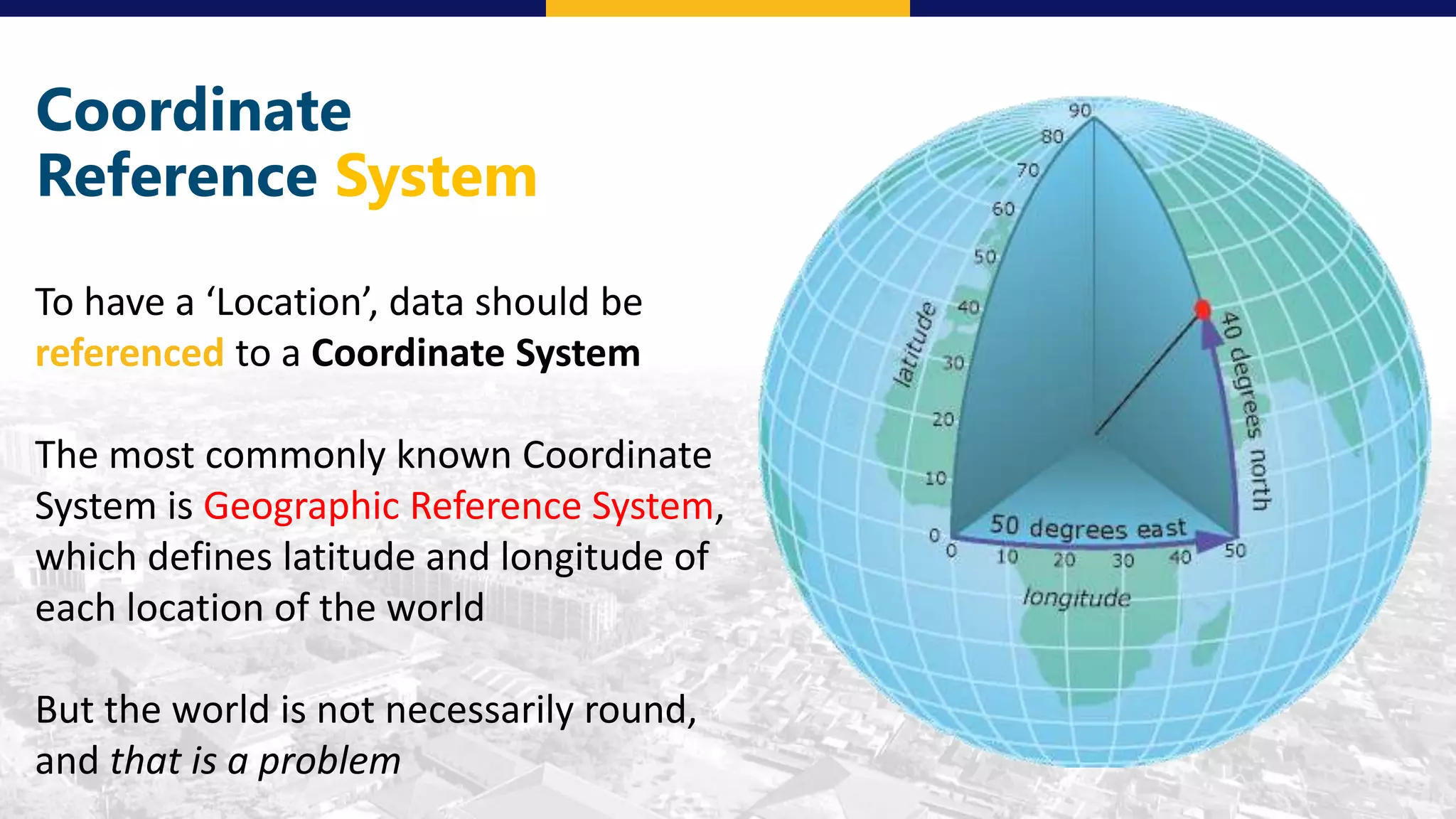
To have a ‘Location’, data should be
referenced to a Coordinate System
The most commonly known Coordinate
System is Geographic Reference System,
which defines latitude and longitude of
each location of the world
But the world is not necessarily round,
and that is a problem
Coordinate
Reference System
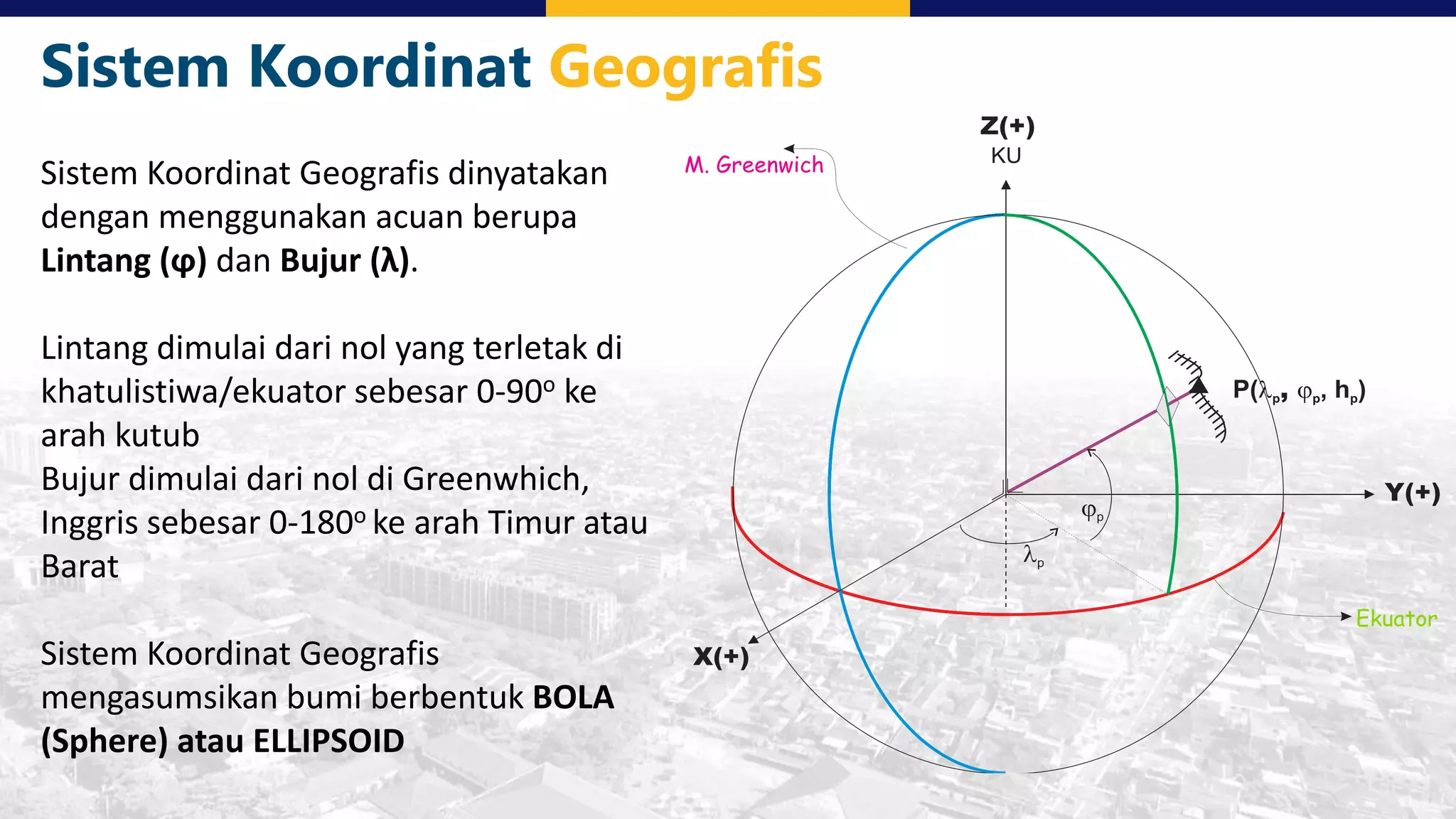
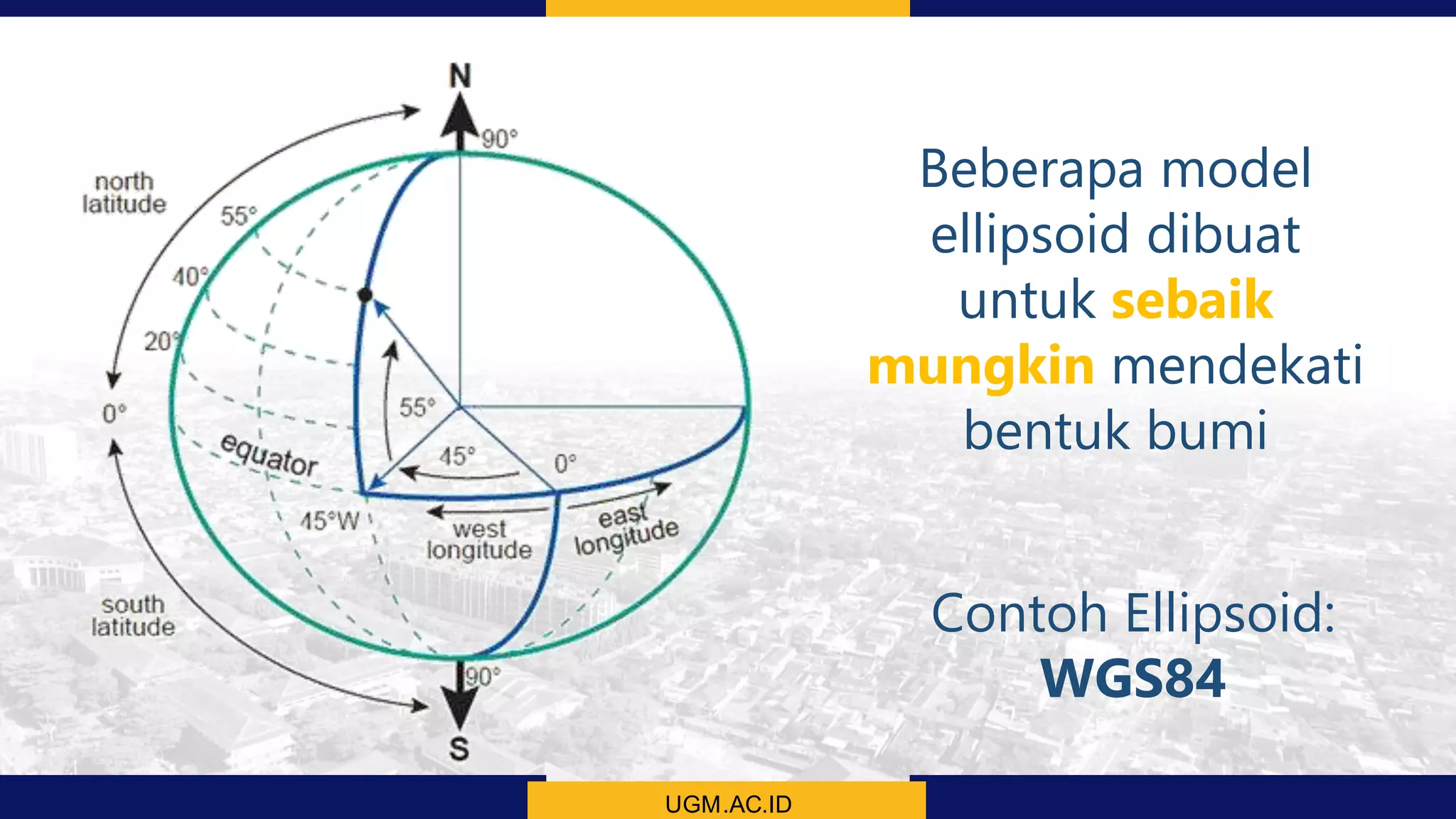
Sistem Koordinat Geografis dinyatakan
dengan menggunakan acuan berupa
Lintang (ϕ) dan Bujur (λ).
Lintang dimulai dari nol yang terletak di
khatulistiwa/ekuator sebesar 0-90o ke
arah kutub
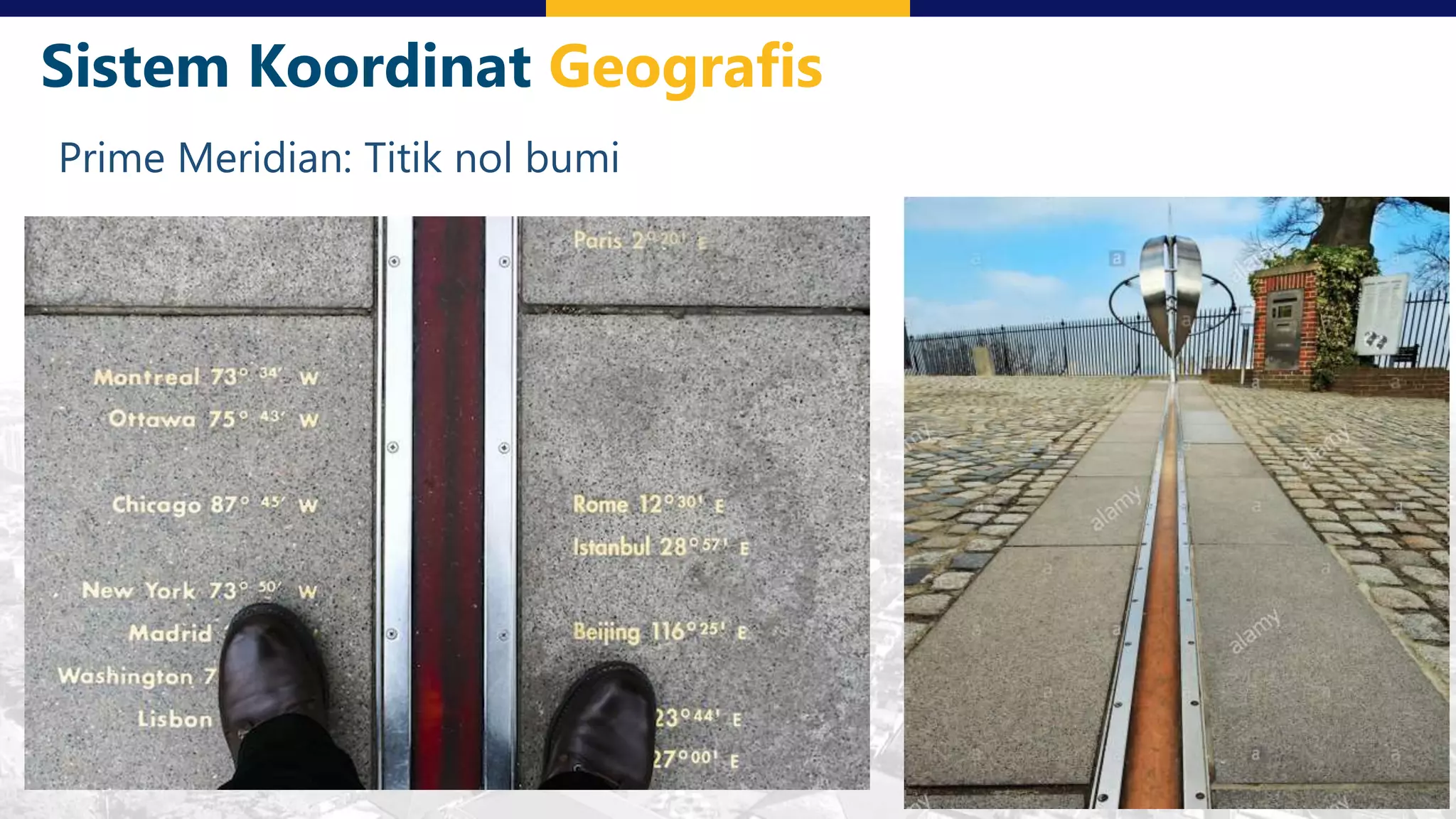
Bujur dimulai dari nol di Greenwhich,
Inggris sebesar 0-180o ke arah Timur atau
Barat
Sistem Koordinat Geografis
mengasumsikan bumi berbentuk BOLA
(Sphere) atau ELLIPSOID
Sistem Koordinat Geografis
Prime Meridian: Titik nol bumi
UGM.AC.ID
Longley et al, (2005)
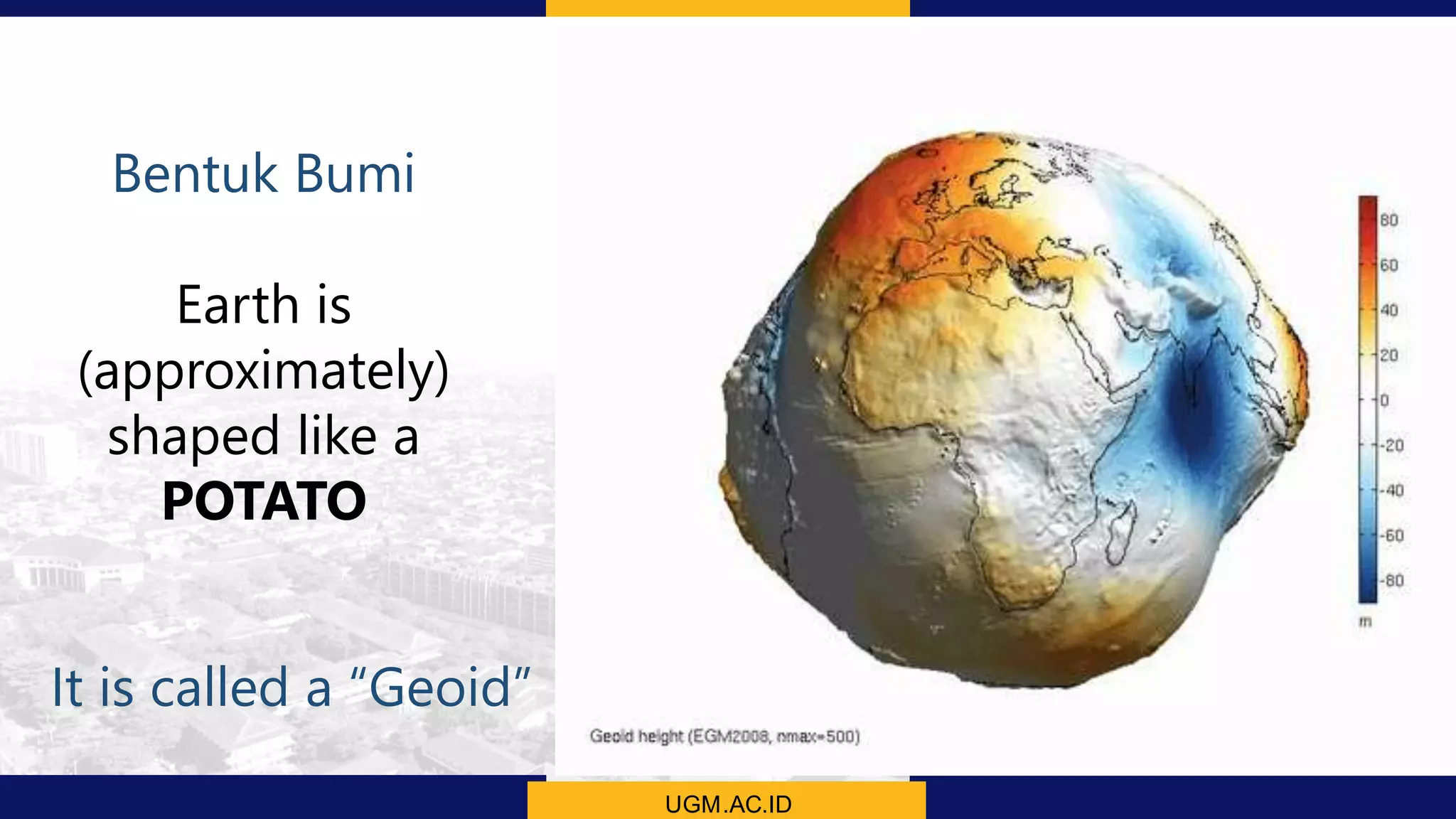
Bentuk Bumi
Earth is
(approximately)
shaped like a
POTATO
It is called a “Geoid”
UGM.AC.ID
To simplify map calculations, earth is modeled as
ellipsoid
The Figure of The Earth
UGM.AC.ID
The Ellipsoid
Ellipsoid dibuat
untuk mendekati
bentuk ideal
permukaan bumi
sebaik mungkin
UGM.AC.ID
Beberapa model
ellipsoid dibuat
untuk sebaik
mungkin mendekati
bentuk bumi
Contoh Ellipsoid:
WGS84
UGM.AC.ID
Question:
What can we do with maps?
UGM.AC.ID
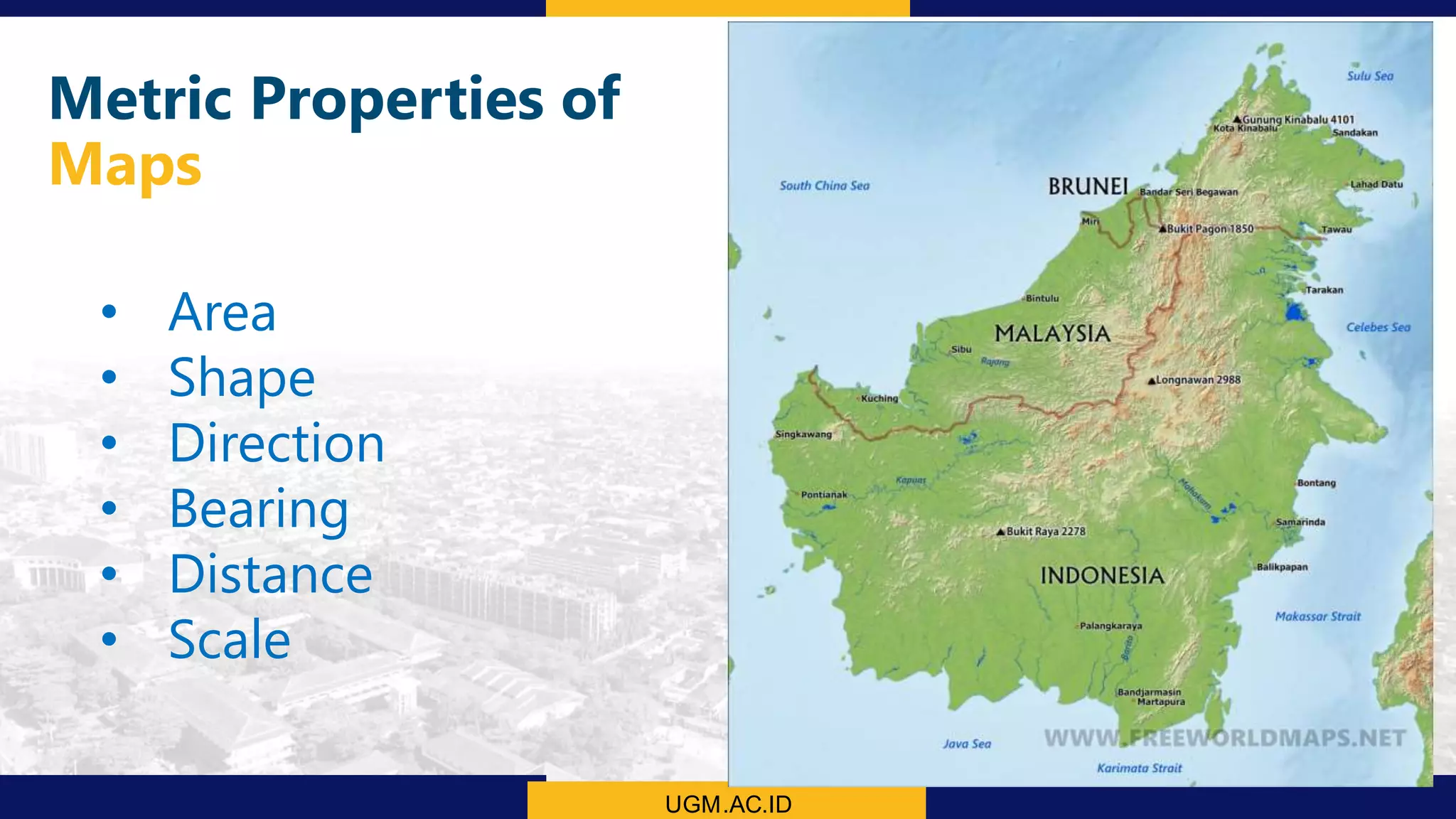
• Area
• Shape
• Direction
• Bearing
• Distance
• Scale
Metric Properties of
Maps
UGM.AC.ID
Map Distortion:
Because the earth is not flat
We can’t have all those map properties caused by Map Distortions.
Thus, we need some trade-offs
UGM.AC.ID
Longley et al, (2005)
Map Projection:
A systematic transformation
of the latitudes and
longitudes of locations
from the surface of
a sphere or an ellipsoid into
locations on a plane
Map Projection:
Because maps is
flat
UGM.AC.ID
Map Projection:
Because maps is flat Lintang dan Bujur
Tidak ideal untuk
digunakan dalam peta,
misalnya untuk
mengukur jarak
Pada peta, digunakan
satuan X dan Y dari
system koordinat
proyeksi peta
Proses pemetaan
meliputi pemodelan
permukaan bumi dalam
pendekatan bentuk
tertentu
UGM.AC.ID
Map Projection: Because maps is flat
azimuthal cylindricalconical
UGM.AC.ID
Map Projection: Because maps is flat
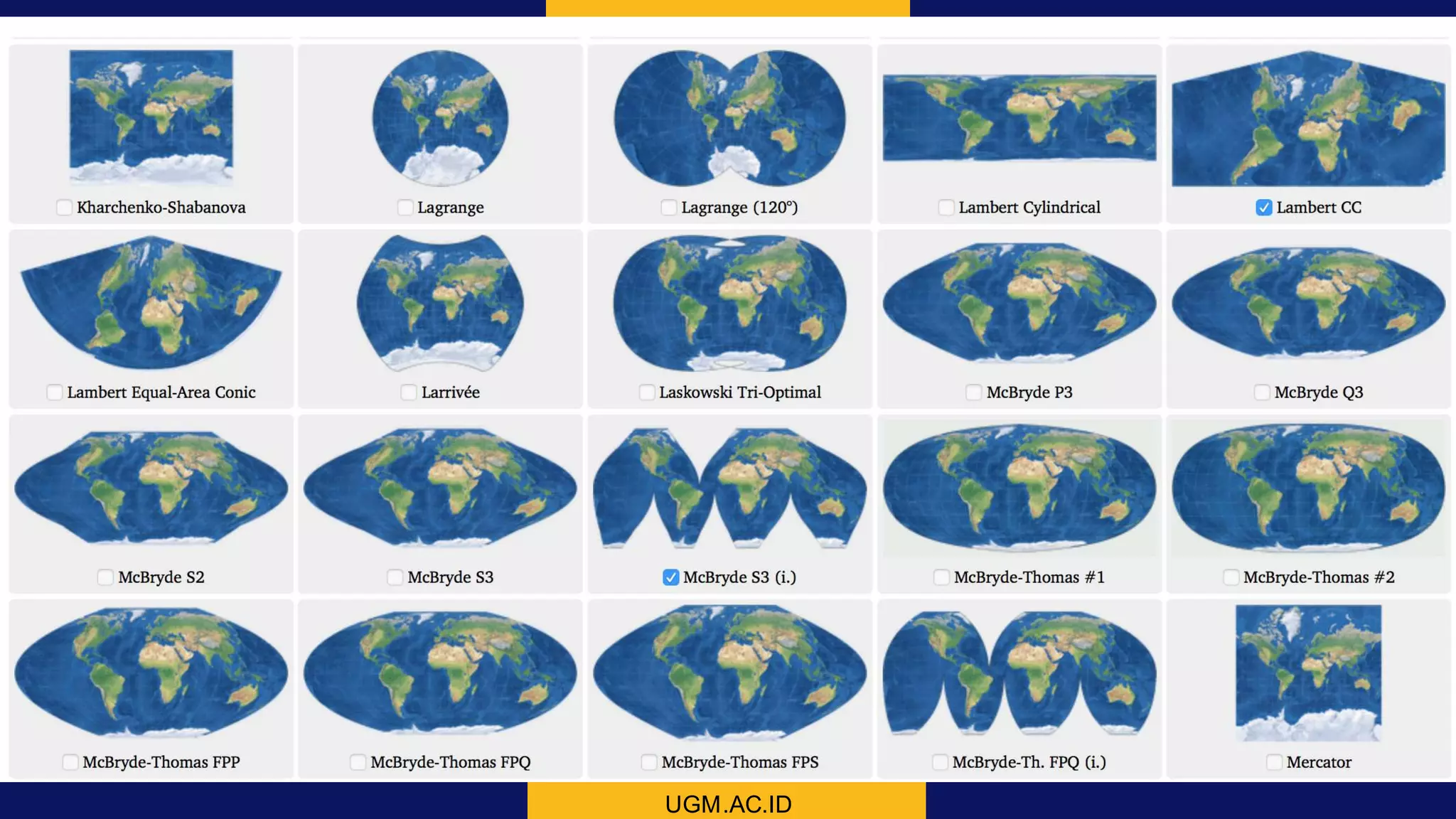
There are A LOT kinds of
map projections. Each
with different properties
UGM.AC.ID
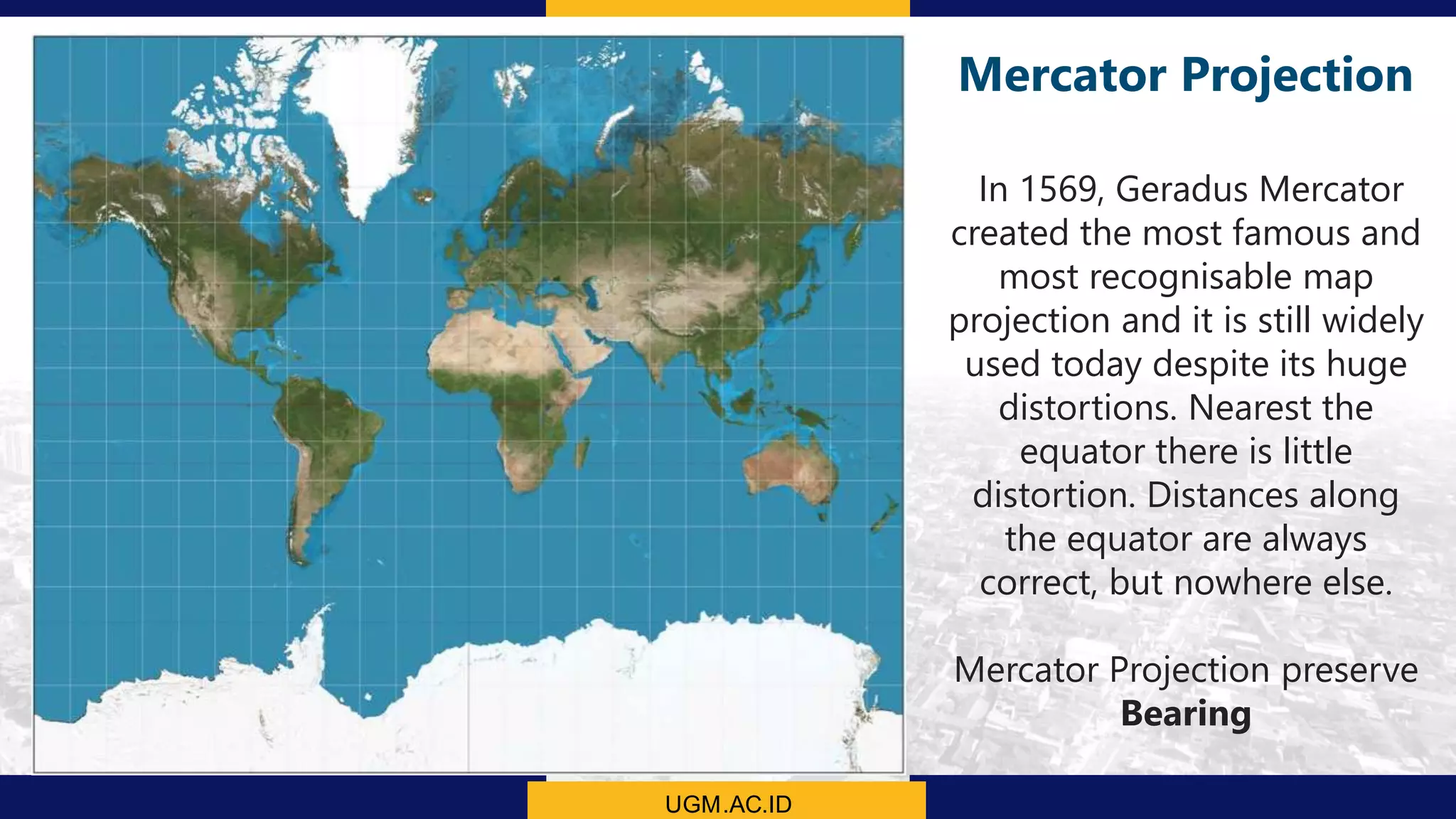
Mercator Projection
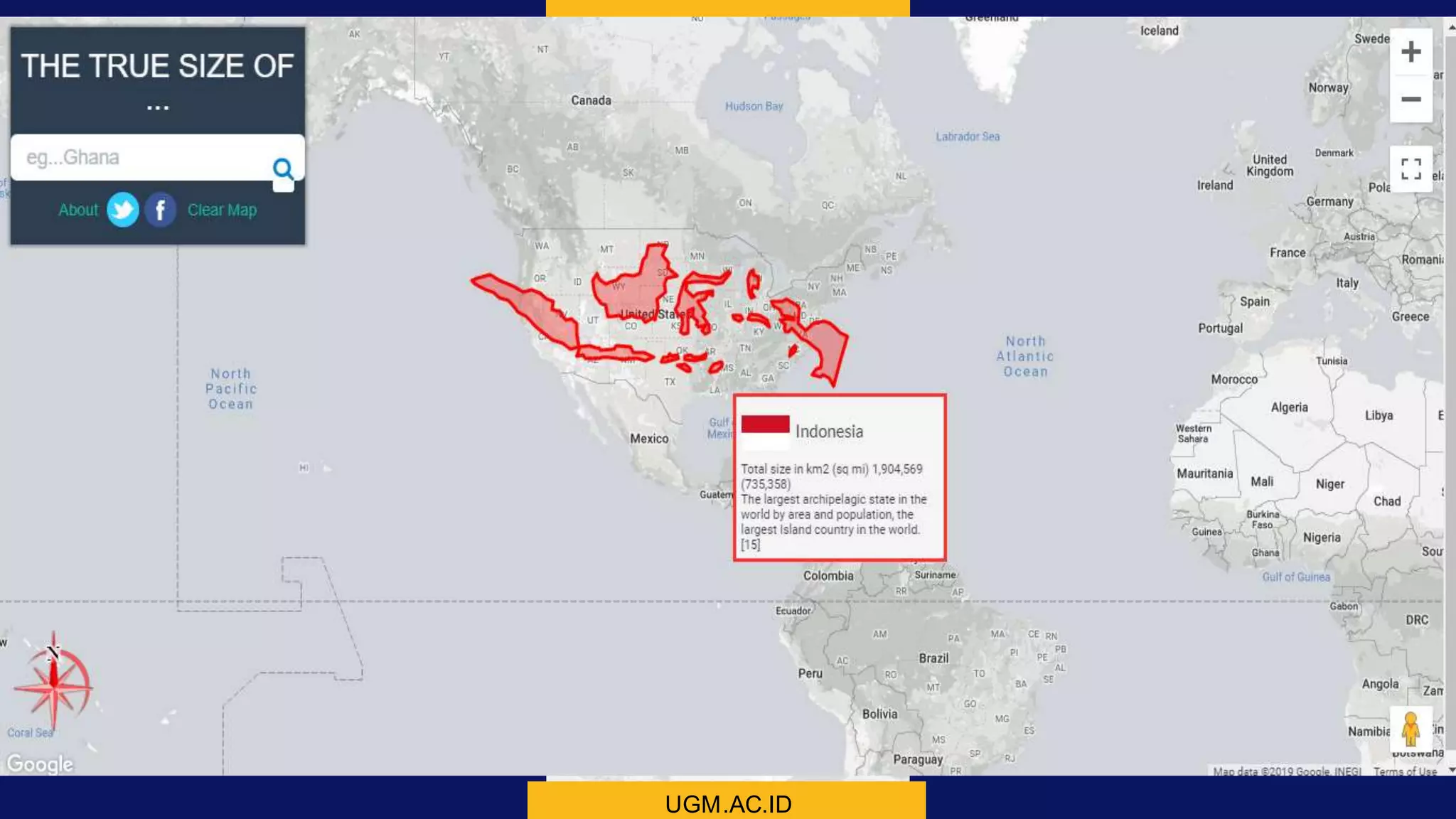
In 1569, Geradus Mercator
created the most famous and
most recognisable map
projection and it is still widely
used today despite its huge
distortions. Nearest the
equator there is little
distortion. Distances along
the equator are always
correct, but nowhere else.
Mercator Projection preserve
Bearing
UGM.AC.ID
Mercator Projection
Each projection is
created with specific
purposes
UGM.AC.ID
Map Projection:
Because maps is flat
UGM.AC.ID
Map Projection:
Because maps is flat
UGM.AC.ID
Axis Maps.com
Every map
projection distorts
some Map
Properties in some
ways
UGM.AC.ID
Longley et al, (2005)
UGM.AC.ID
Axis Maps.com
UGM.AC.ID
Axis Maps.com
Choosing the right
map projection
Each map projection is
designed for particular
purpose
Pick the right coordinate
system according to which
Map Properties to keep,
i.e. Area, shape or bearings
Why do we need to
know this?
Survey-scale inaccuracy
or positioning errors can
lead to costly construction
mistakes such as bridge
misalignments.
NOAA, Image courtesy of
Zurich U.S.
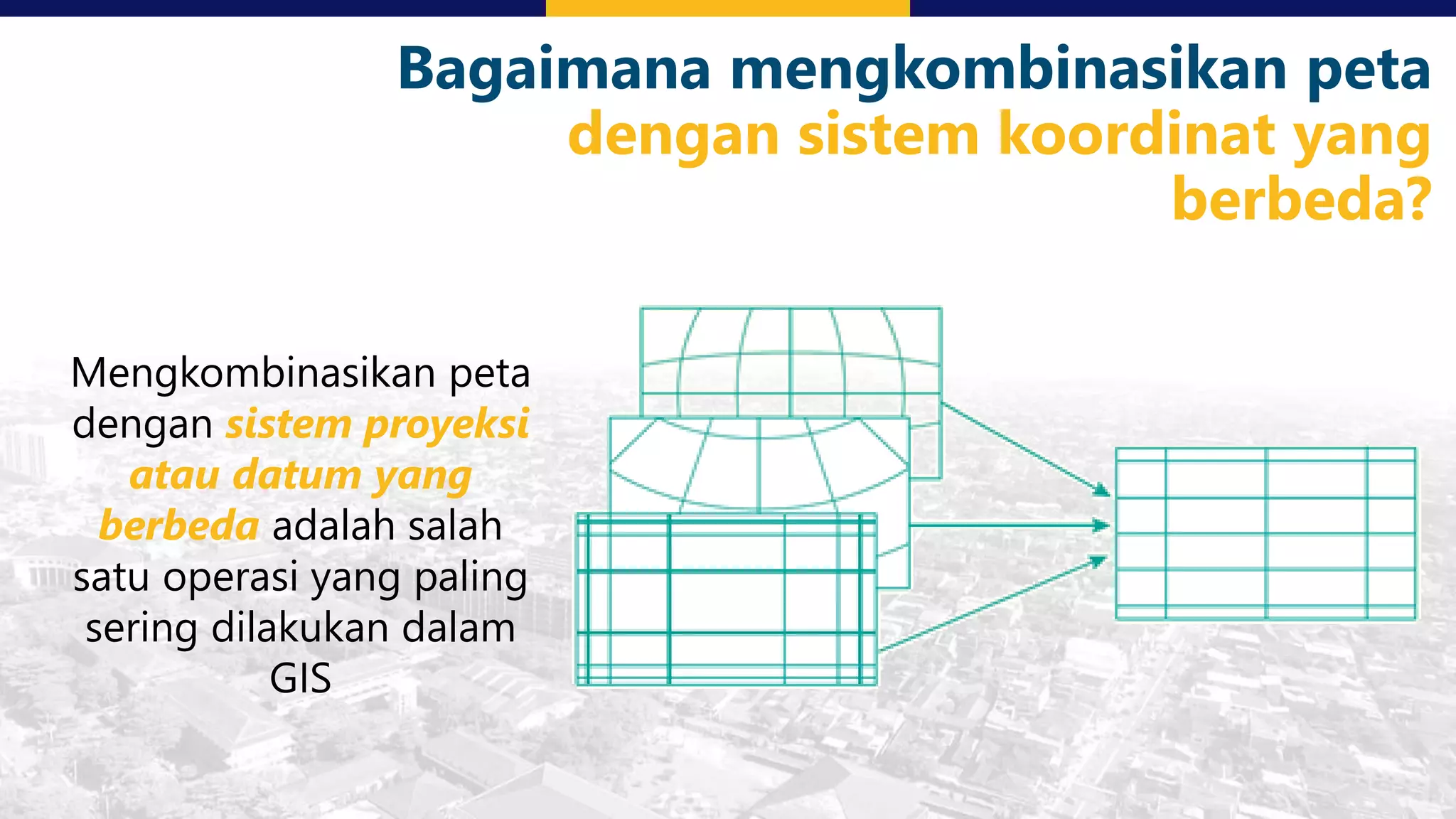
Bagaimana mengkombinasikan peta
dengan sistem koordinat yang
berbeda?
Mengkombinasikan peta
dengan sistem proyeksi
atau datum yang
berbeda adalah salah
satu operasi yang paling
sering dilakukan dalam
GIS
Transformasi Koordinat
Transformasi antara sistem proyeksi satu ke yang lan
https://kartoweb.itc.nl/
Transformasi Koordinat
Transformasi antara datum satu ke yang lan
Transformasi Koordinat
Transformasi
sistem proyeksi
yang memiliki
datum berbeda
The EPSG code
EPSG is a database of coordinate systems which lists all
CRS, Datums, etc. in the world
The EPSG code
An EPSG code might refer to a:
• Coordinate Reference System (CRS) – like EPSG4326,
which refers to the coordinate reference system WGS 84.
• Datum – like EPSG 6326, which refers to the datum used
in the coordinate reference system WGS 84.
• Area of use – like EPSG 1262, which refers to the entire
world.
• Prime Meridian – like EPSG 8901, which refers to the
meridian passing through Greenwich.
https://tomroth.com.au/epsg/
The EPSG code
The EPSG code
EPSG biasa digunakan untuk menyatakan CRS (sistem acuan
koordinat) pada perangkat lunak GIS, termasuk WebGIS
https://epsg.io/transform
UGM.AC.ID
https://mercator.tass.com/
https://www.axismaps.com/guide/general/map-projections/
https://www.atlasandboots.com/map-projections/
http://geokov.com/education/map-projection.aspx
https://volaya.github.io/gis-book/en/Cartography.html
Referensi
TERIMA KASIH

Sistem dan Transformasi Koordinat

Editor's Notes

  • #11 https://www.icsm.gov.au/education/fundamentals-mapping/datums
  • #12 https://gisgeography.com/wgs84-world-geodetic-system/
  • #24 “The Waterman Butterfly Projection” by Steve Waterman
  • #27 In cartography, a Tissot's indicatrix (Tissot indicatrix, Tissot's ellipse, Tissot ellipse, ellipse of distortion) (plural: "Tissot's indicatrices") is a mathematical contrivance presented by French mathematician Nicolas Auguste Tissot in 1859 and 1871 in order to characterize local distortions due to map projection. It is the geometry that results from projecting a circle of infinitesimal radius from a curved geometric model, such as a globe, onto a map. Tissot proved that the resulting diagram is an ellipse whose axes indicate the two principal directions along which scale is maximal and minimal at that point on the map.