Analisis Kebutuhan Sistem
Dany Laksono
February 9, 2020
Mata Pelatihan WebGIS dan Transformasi Sistem Koordinat
SKKNI Teknisi Utama – Analis Sistem Informasi Geografis
Analisis Kebutuhan Sistem
• Bagaimana internet bekerja?
• Bahasa dan Protokol komunikasi inter-net
• Bagaimana halaman web dibuat?
• Praktek: HTML, CSS, JS
Review: Geographic
Information System
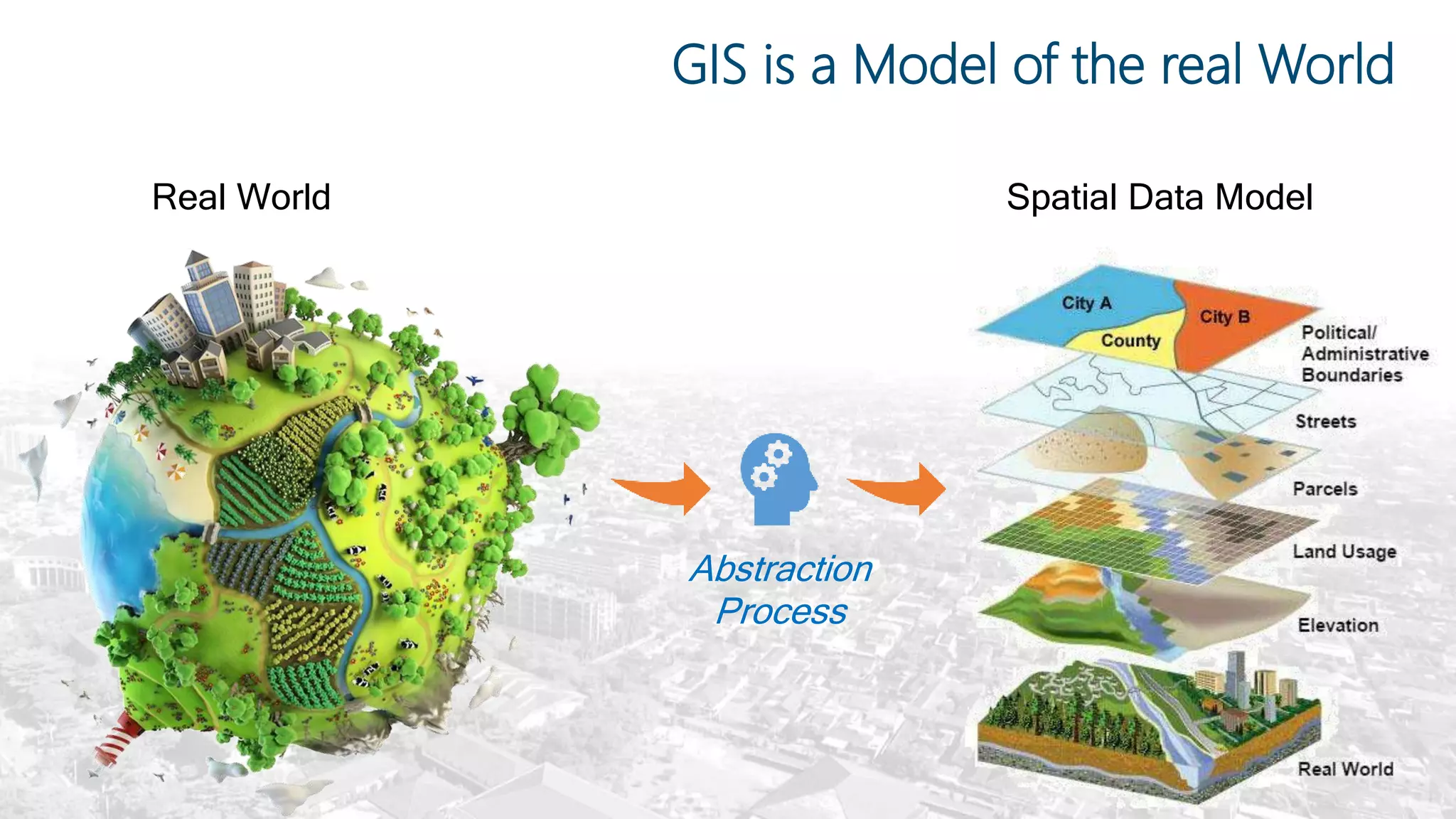
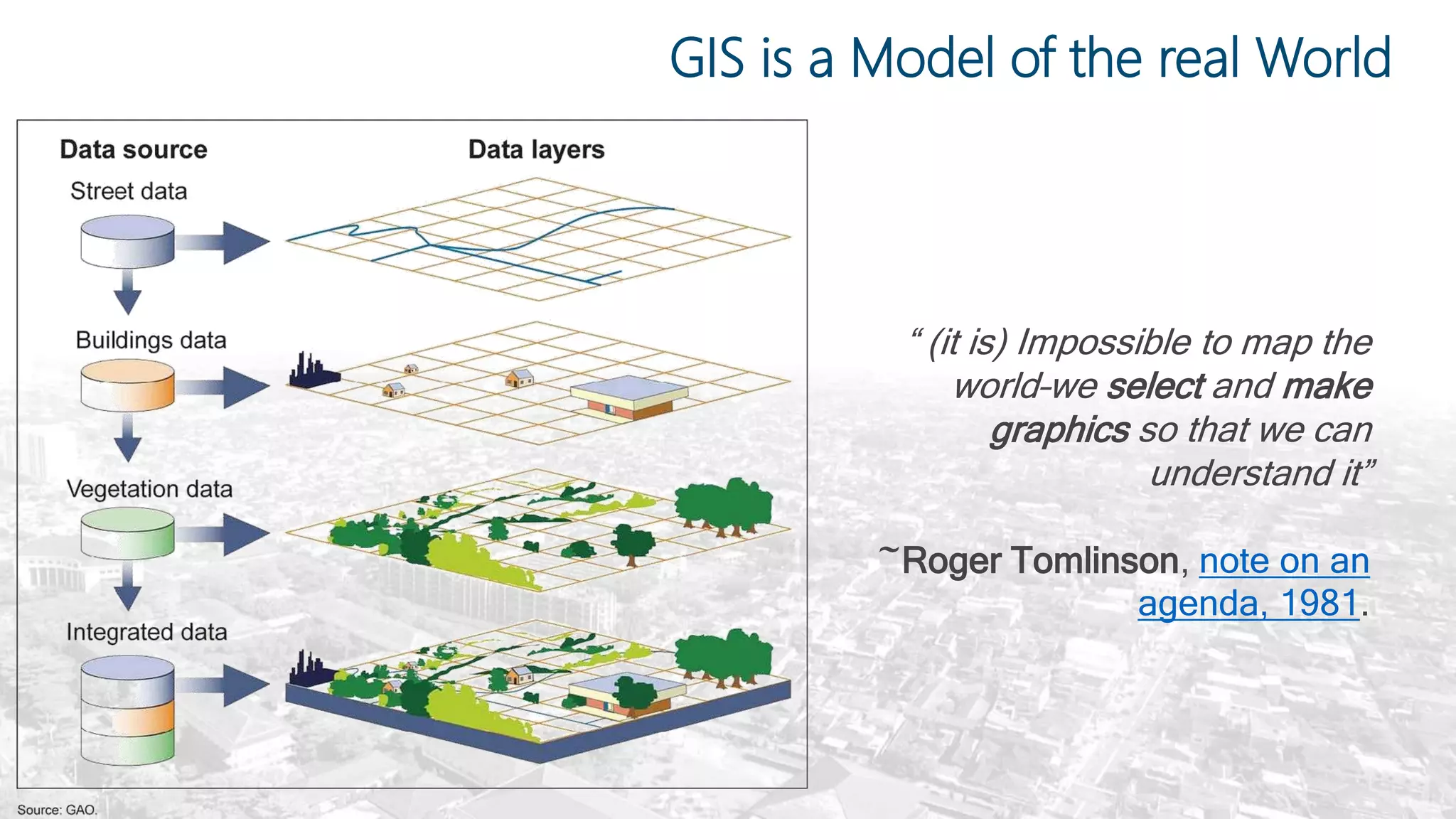
GIS is a Model of the real World
Abstraction
Process
Real World Spatial Data Model
“ (it is) Impossible to map the
world–we select and make
graphics so that we can
understand it”
~ Roger Tomlinson, note on an
agenda, 1981.
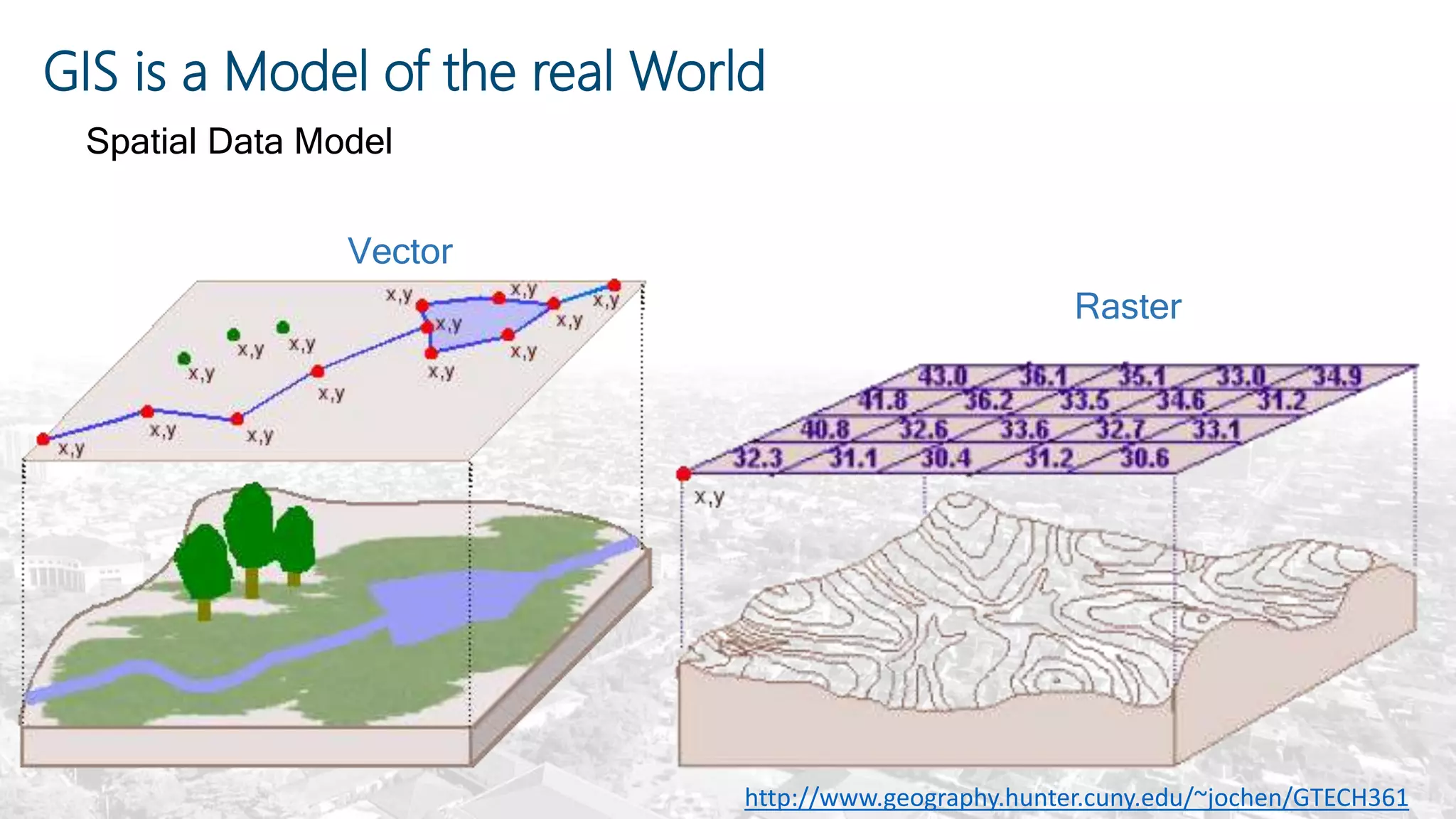
GIS is a Model of the real World
Spatial Data Model
http://www.geography.hunter.cuny.edu/~jochen/GTECH361
Raster
Vector
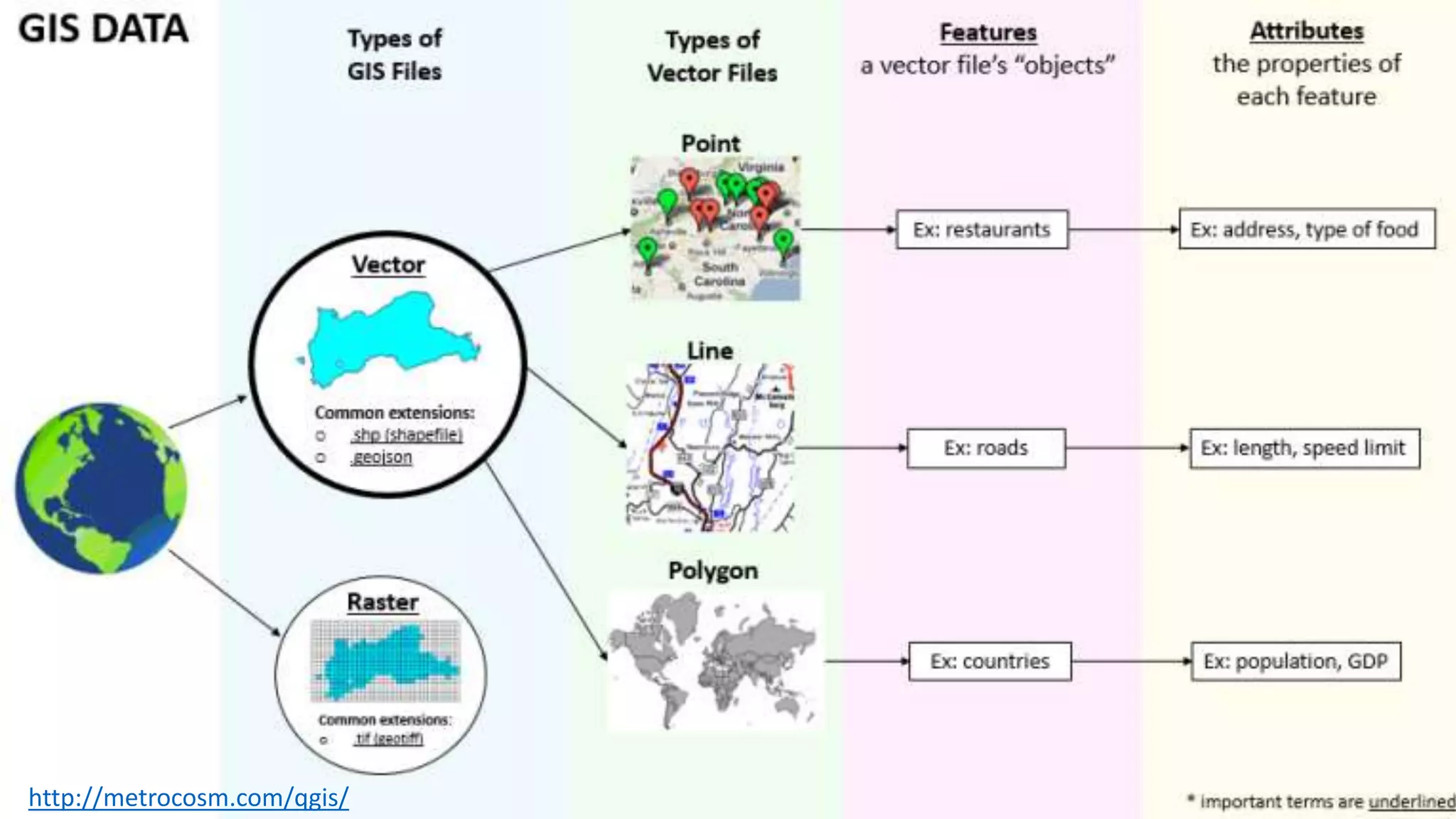
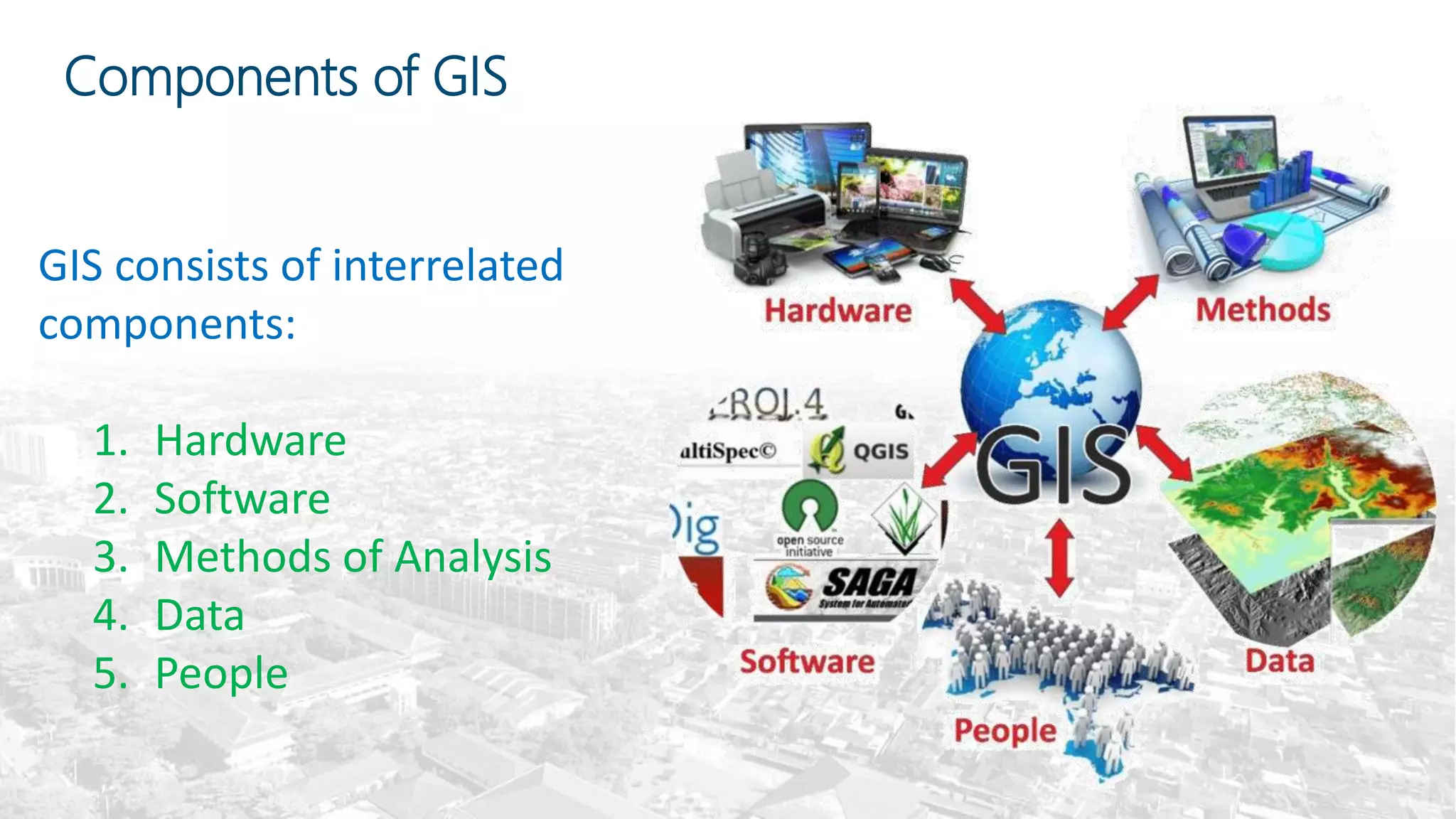
Components of GIS
http://metrocosm.com/qgis/
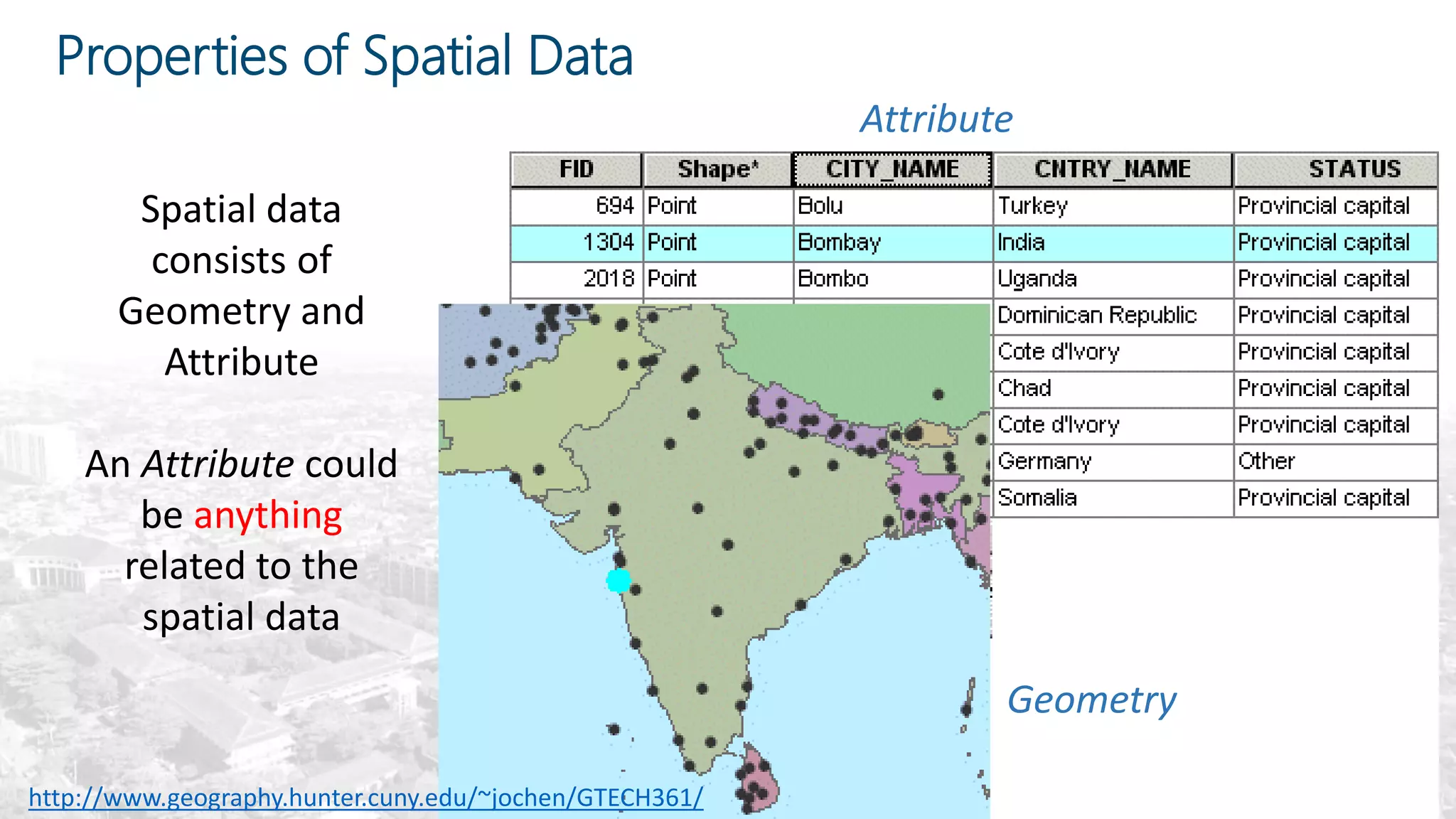
Properties of Spatial Data
Attribute
Geometry
http://www.geography.hunter.cuny.edu/~jochen/GTECH361/
Spatial data
consists of
Geometry and
Attribute
An Attribute could
be anything
related to the
spatial data
Components of GIS
GIS consists of interrelated
components:
1. Hardware
2. Software
3. Methods of Analysis
4. Data
5. People
UGM.AC.ID
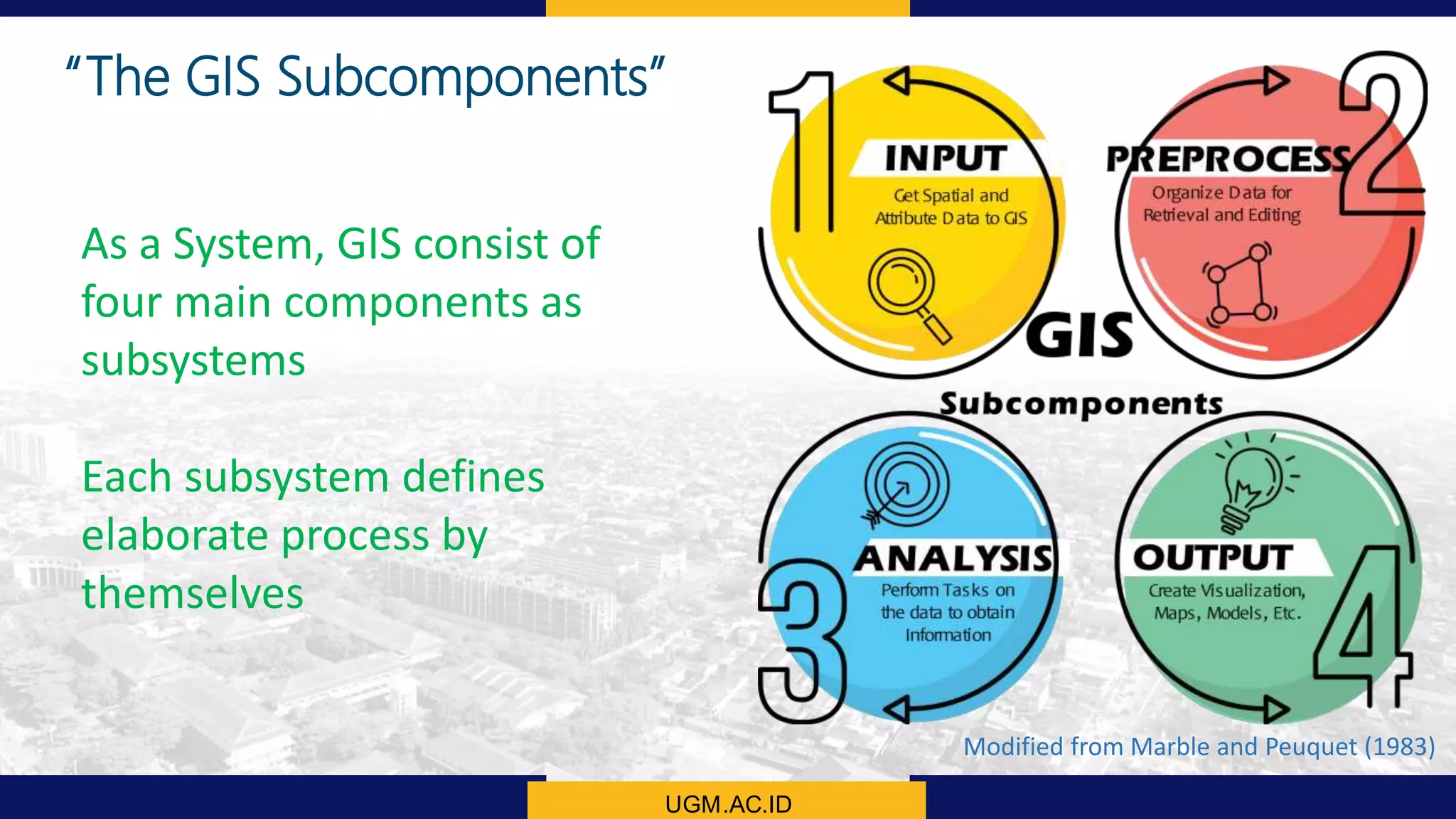
“The GIS Subcomponents”
Modified from Marble and Peuquet (1983)
As a System, GIS consist of
four main components as
subsystems
Each subsystem defines
elaborate process by
themselves
UGM.AC.ID
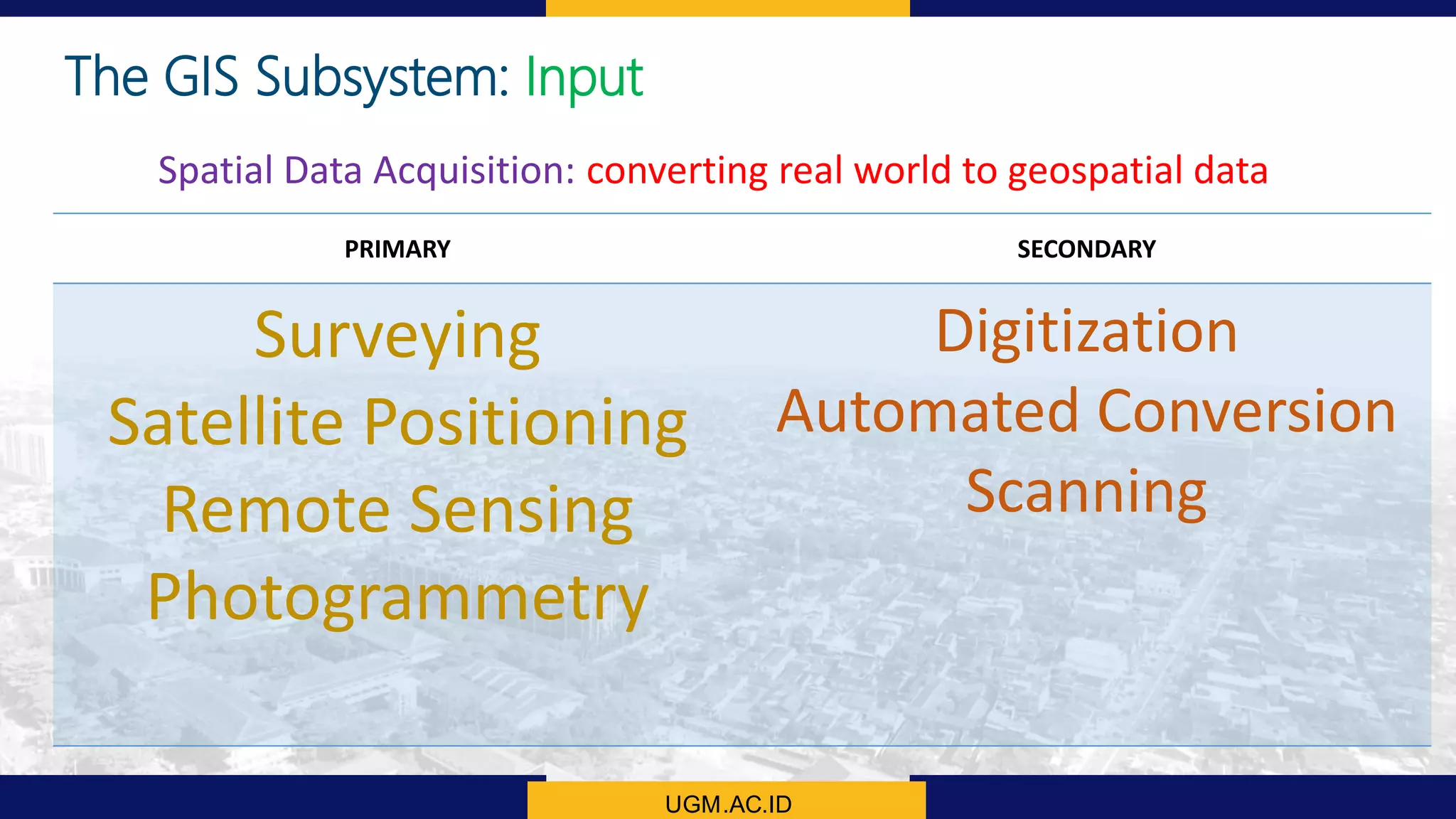
The GIS Subsystem: Input
Spatial Data Acquisition: converting real world to geospatial data
PRIMARY SECONDARY
Surveying
Satellite Positioning
Remote Sensing
Photogrammetry
Digitization
Automated Conversion
Scanning
UGM.AC.ID
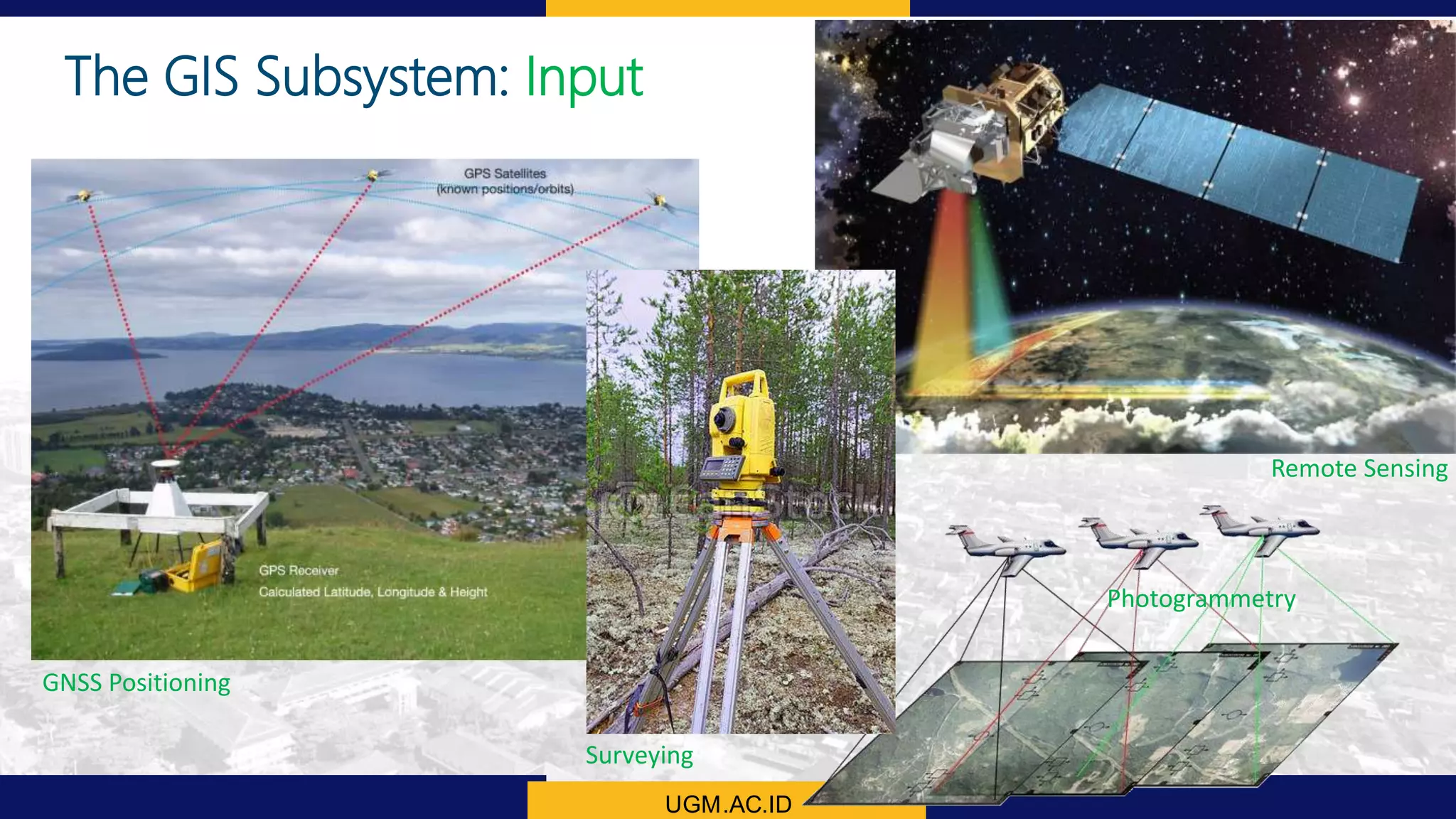
The GIS Subsystem: Input
GNSS Positioning
Surveying
Remote Sensing
Photogrammetry
UGM.AC.ID
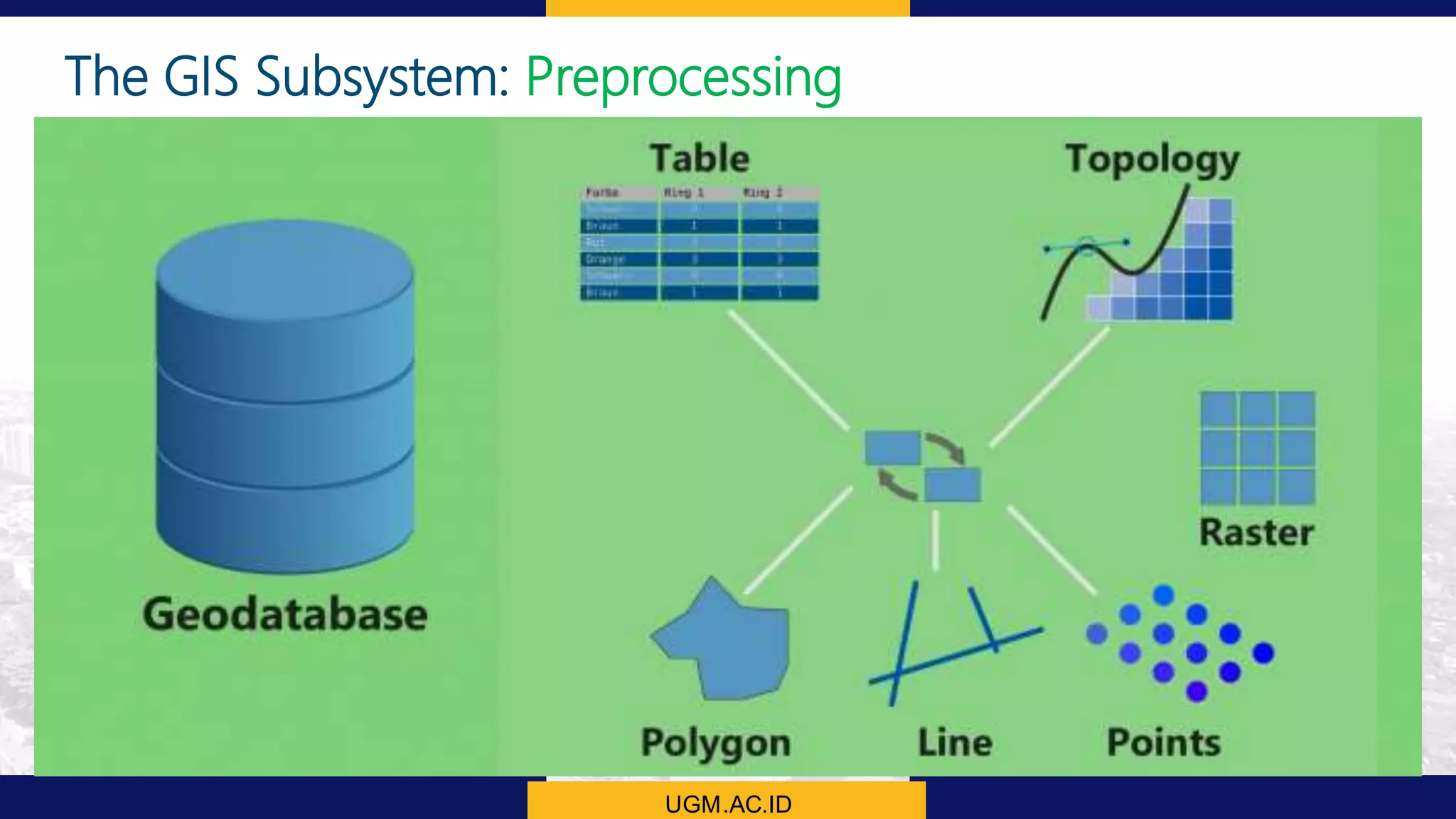
The GIS Subsystem: Preprocessing
Query: Asking the right questions
UGM.AC.ID
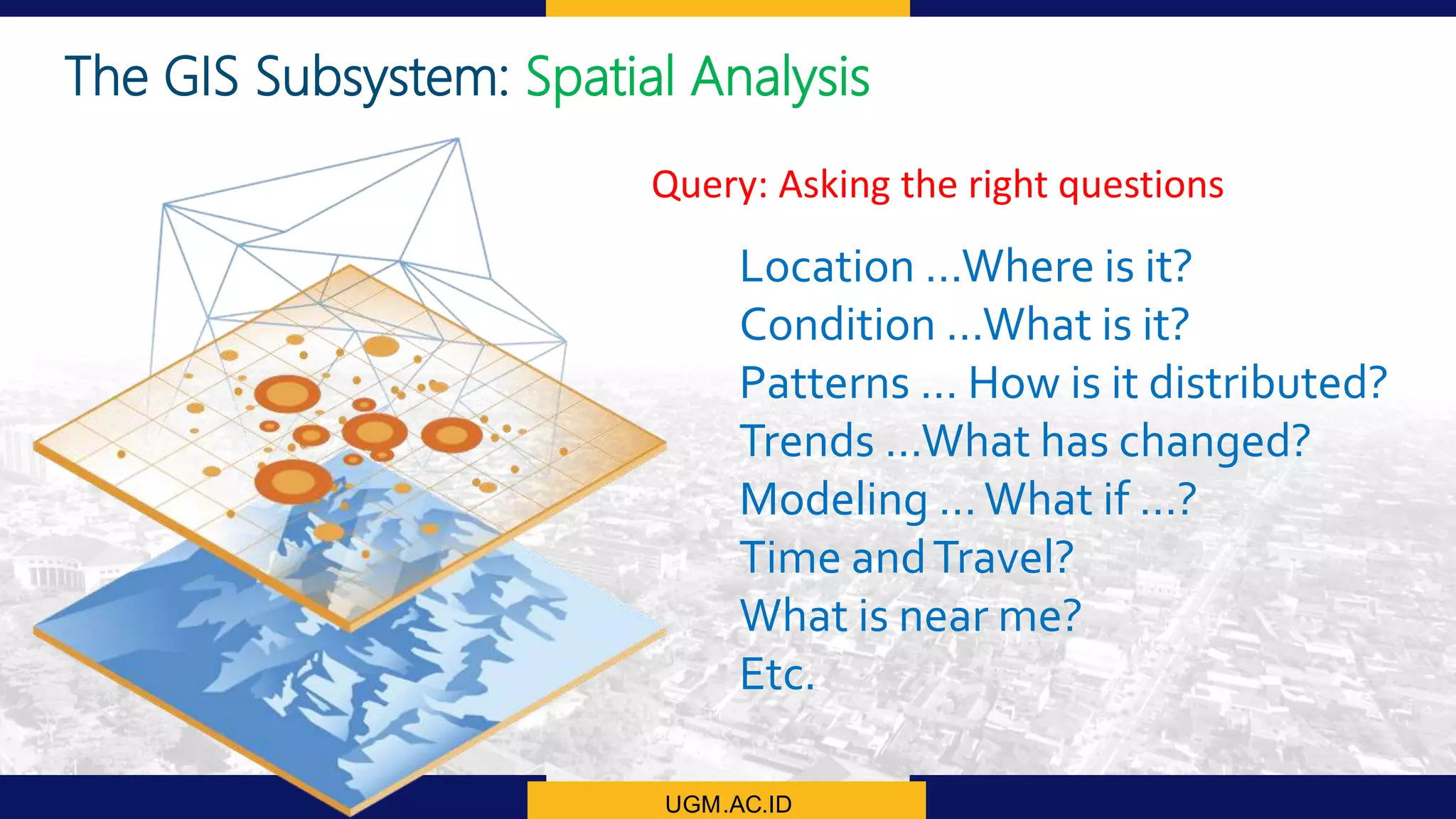
The GIS Subsystem: Spatial Analysis
Location …Where is it?
Condition …What is it?
Patterns … How is it distributed?
Trends …What has changed?
Modeling …What if …?
Time andTravel?
What is near me?
Etc.
Query: Asking the right questions
UGM.AC.ID
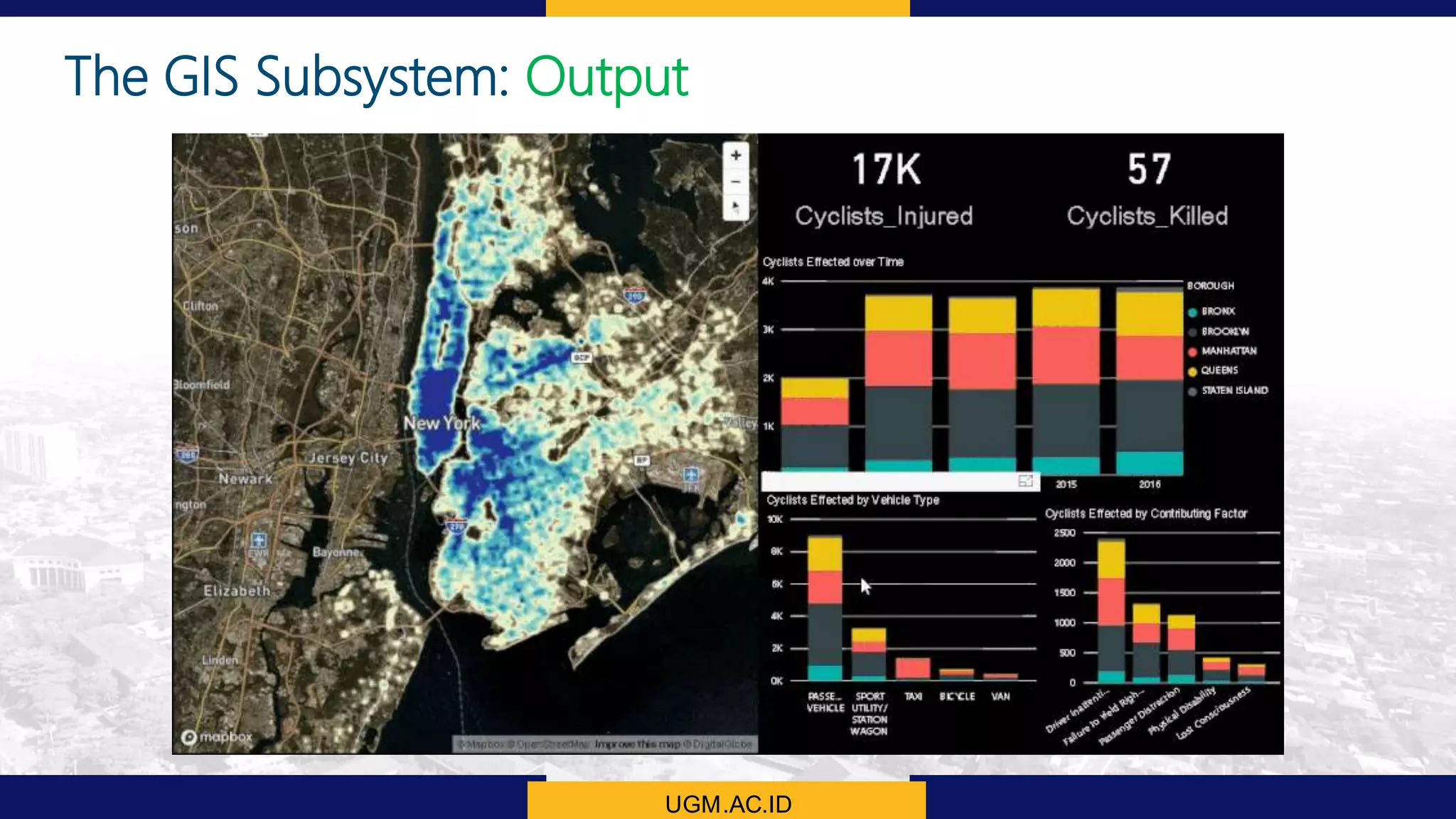
The GIS Subsystem: Output
UGM.AC.ID
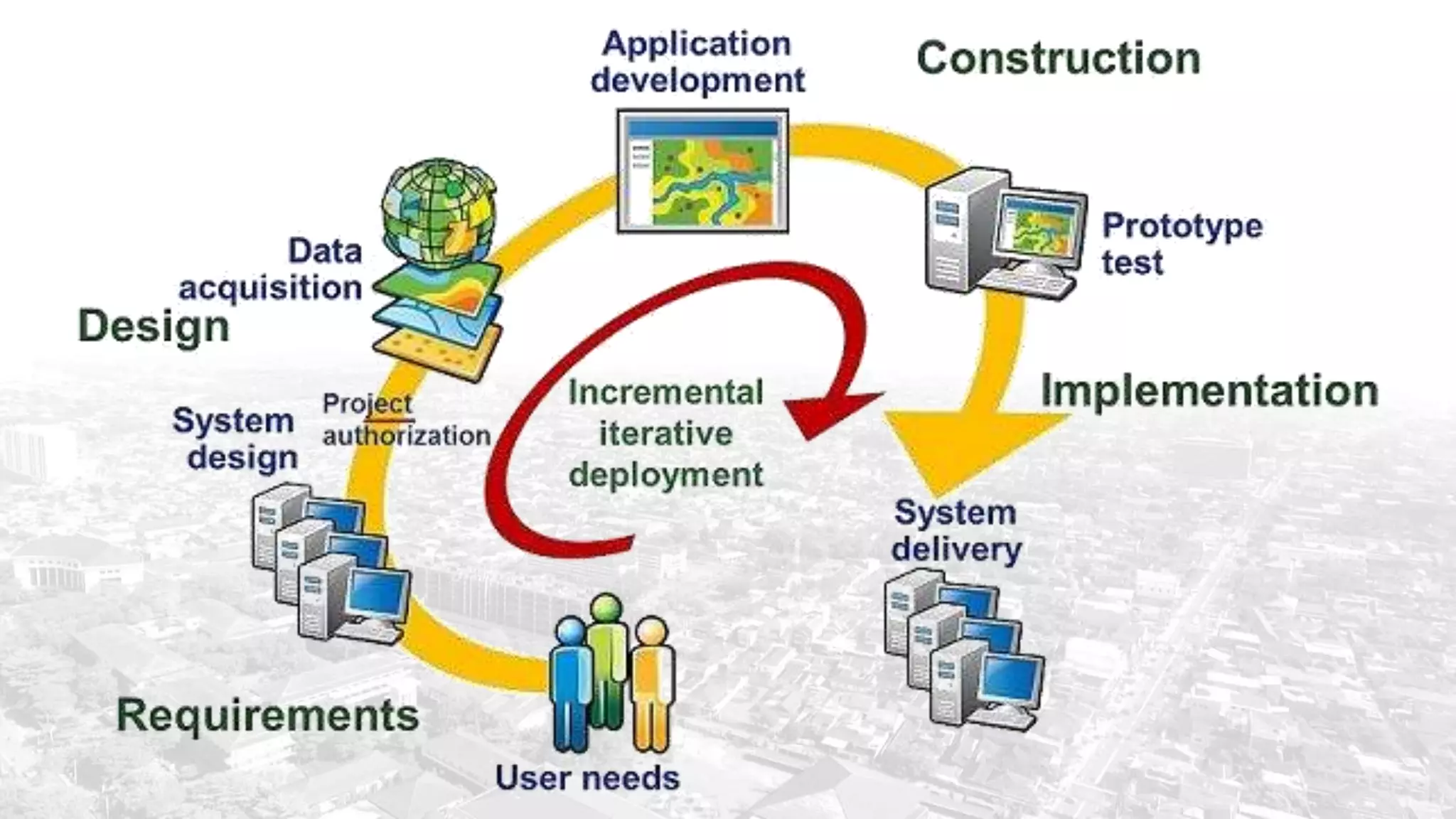
Implementing GIS
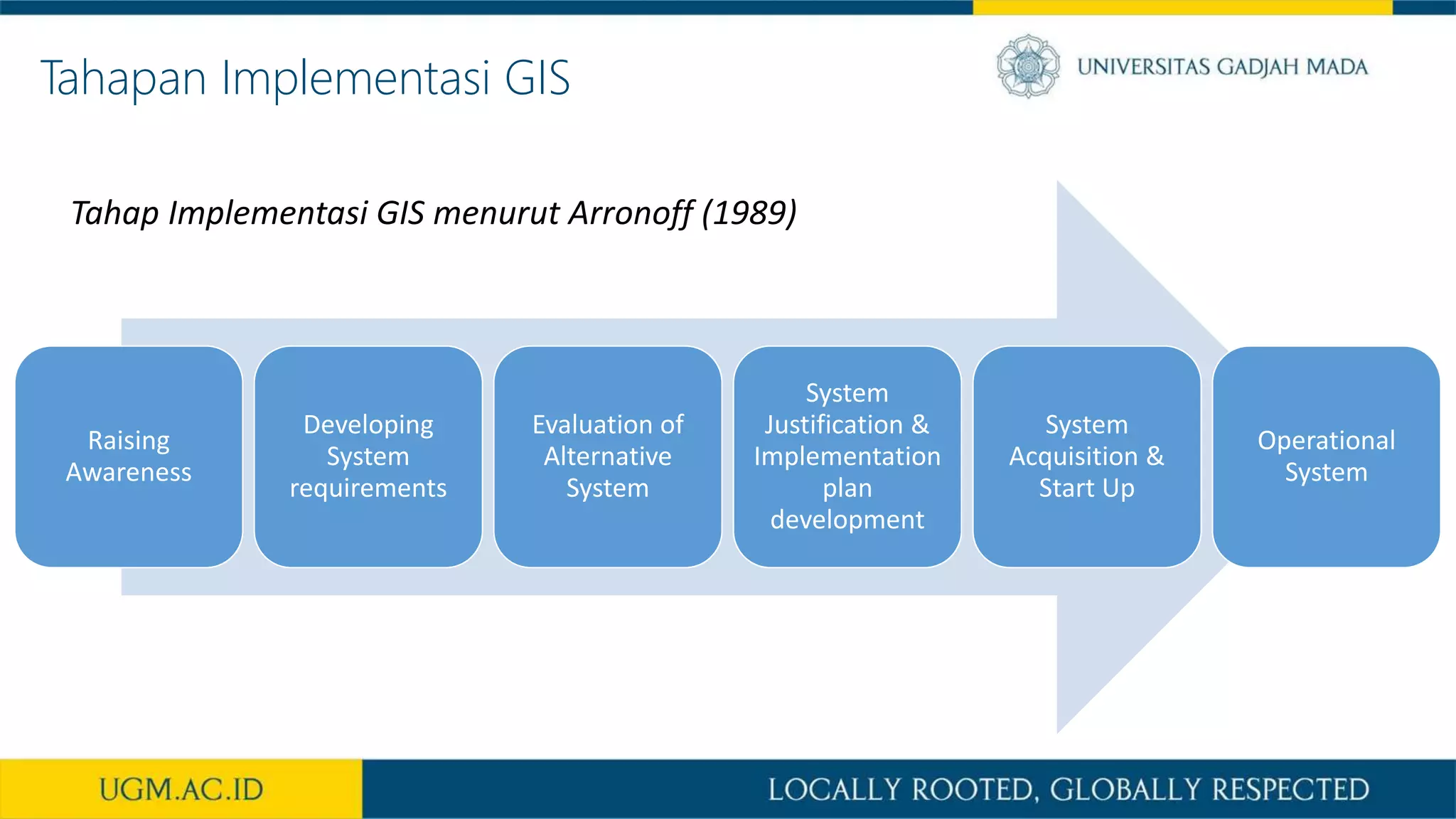
Tahapan Implementasi GIS
Raising
Awareness
Developing
System
requirements
Evaluation of
Alternative
System
System
Justification &
Implementation
plan
development
System
Acquisition &
Start Up
Operational
System
Tahap Implementasi GIS menurut Arronoff (1989)
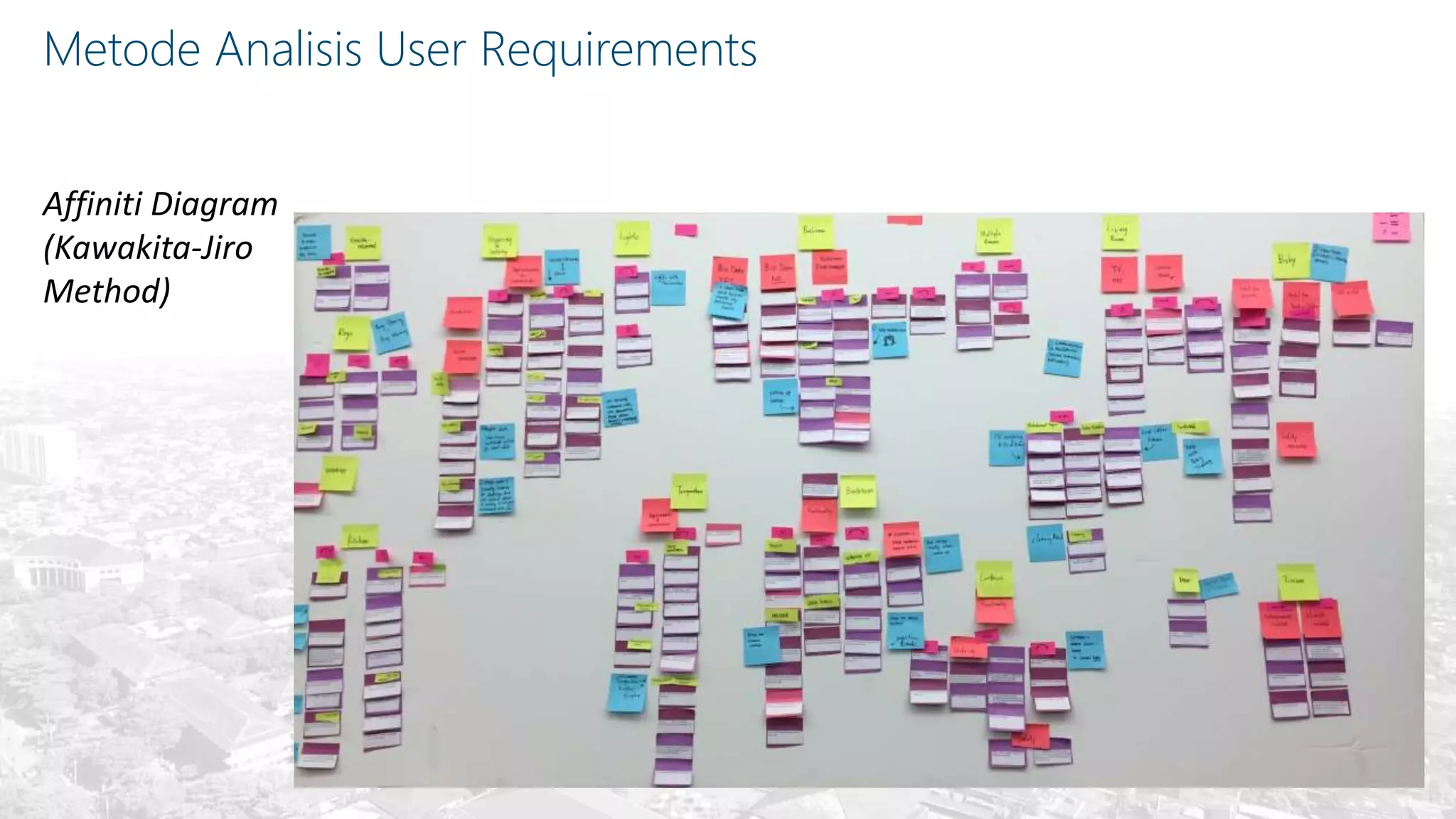
Metode Analisis User Requirements
Affiniti Diagram
(Kawakita-Jiro
Method)
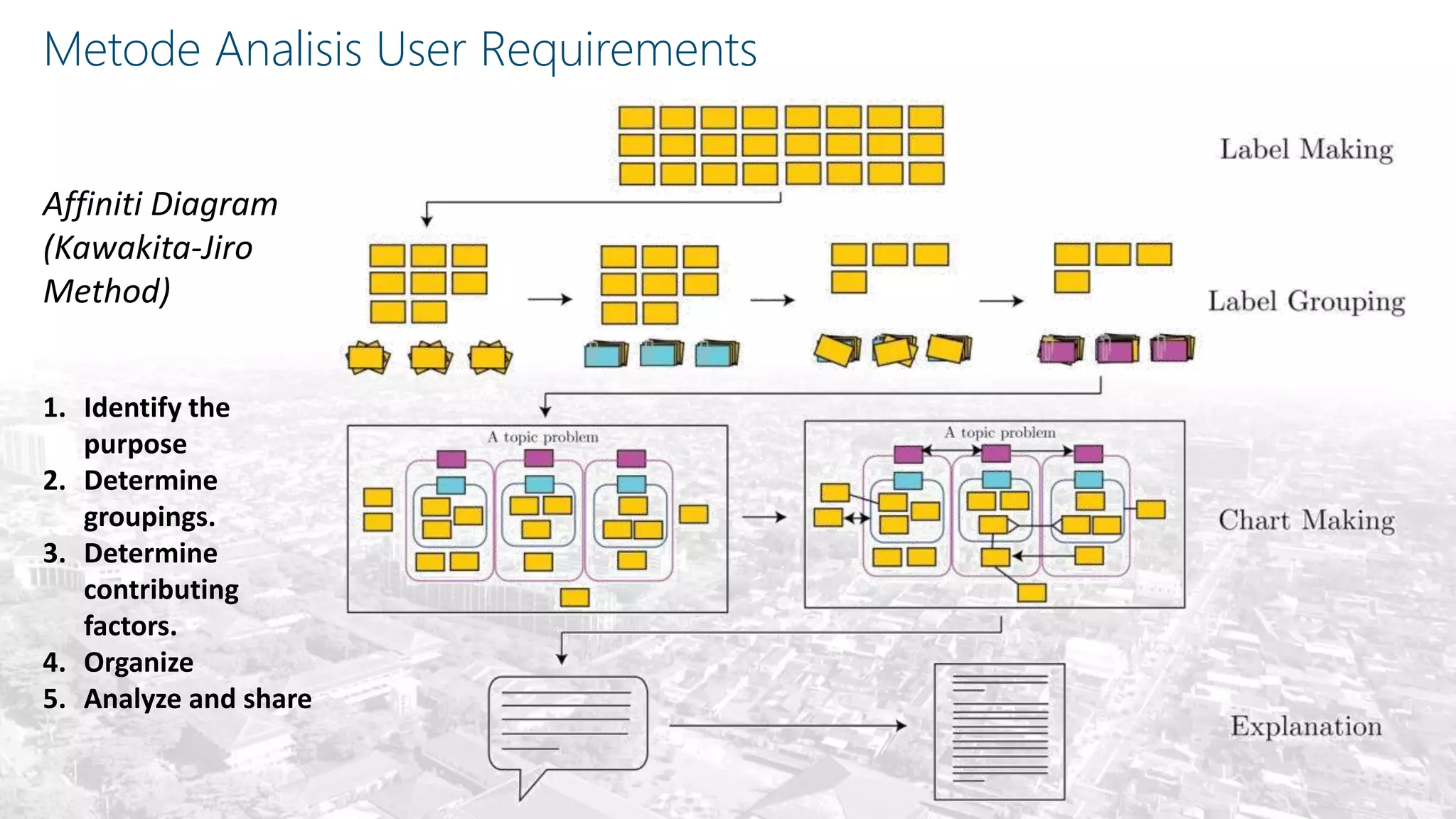
Metode Analisis User Requirements
Affiniti Diagram
(Kawakita-Jiro
Method)
1. Identify the
purpose
2. Determine
groupings.
3. Determine
contributing
factors.
4. Organize
5. Analyze and share
Metode Analisis User Requirements
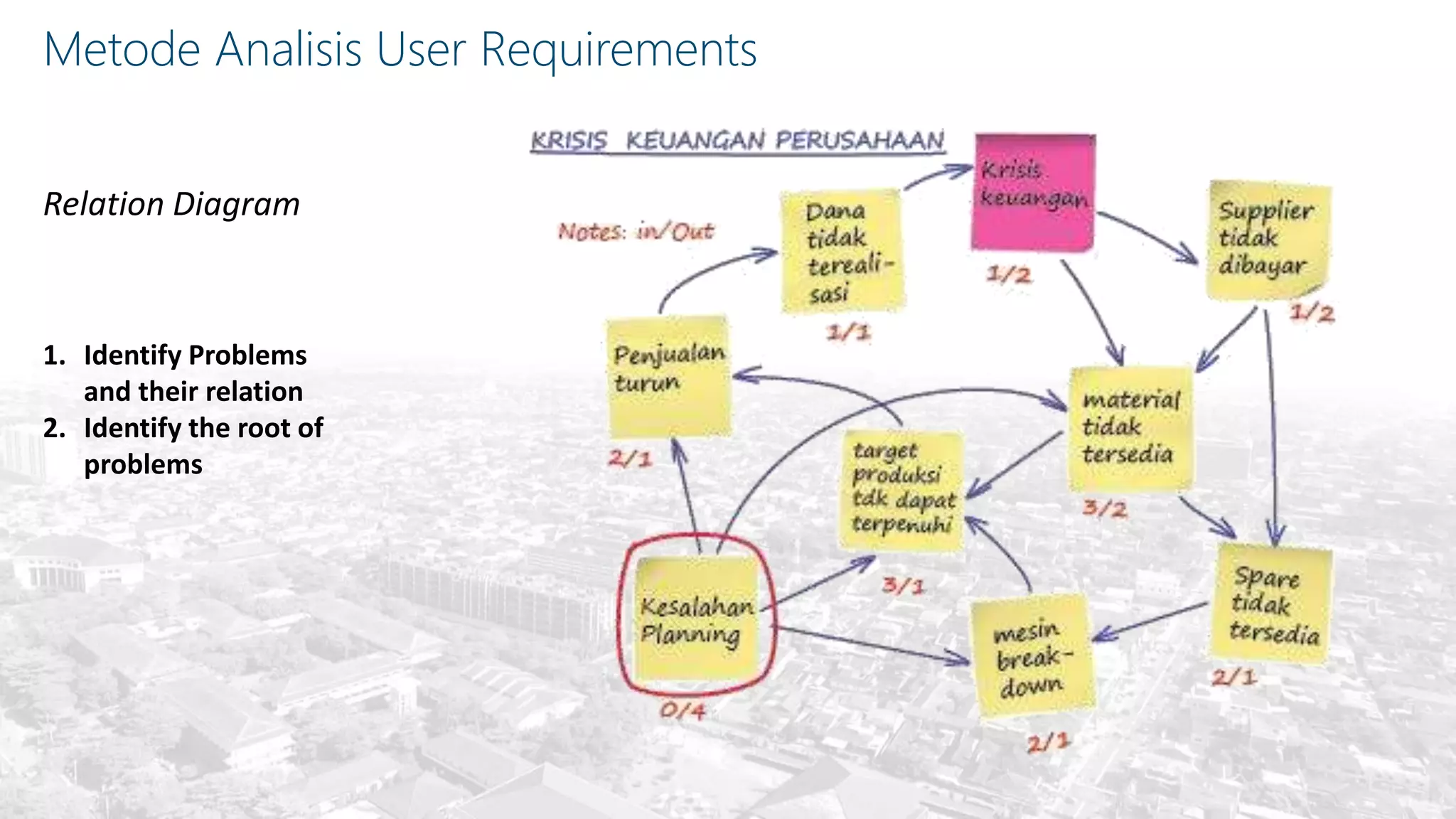
Relation Diagram
1. Identify Problems
and their relation
2. Identify the root of
problems
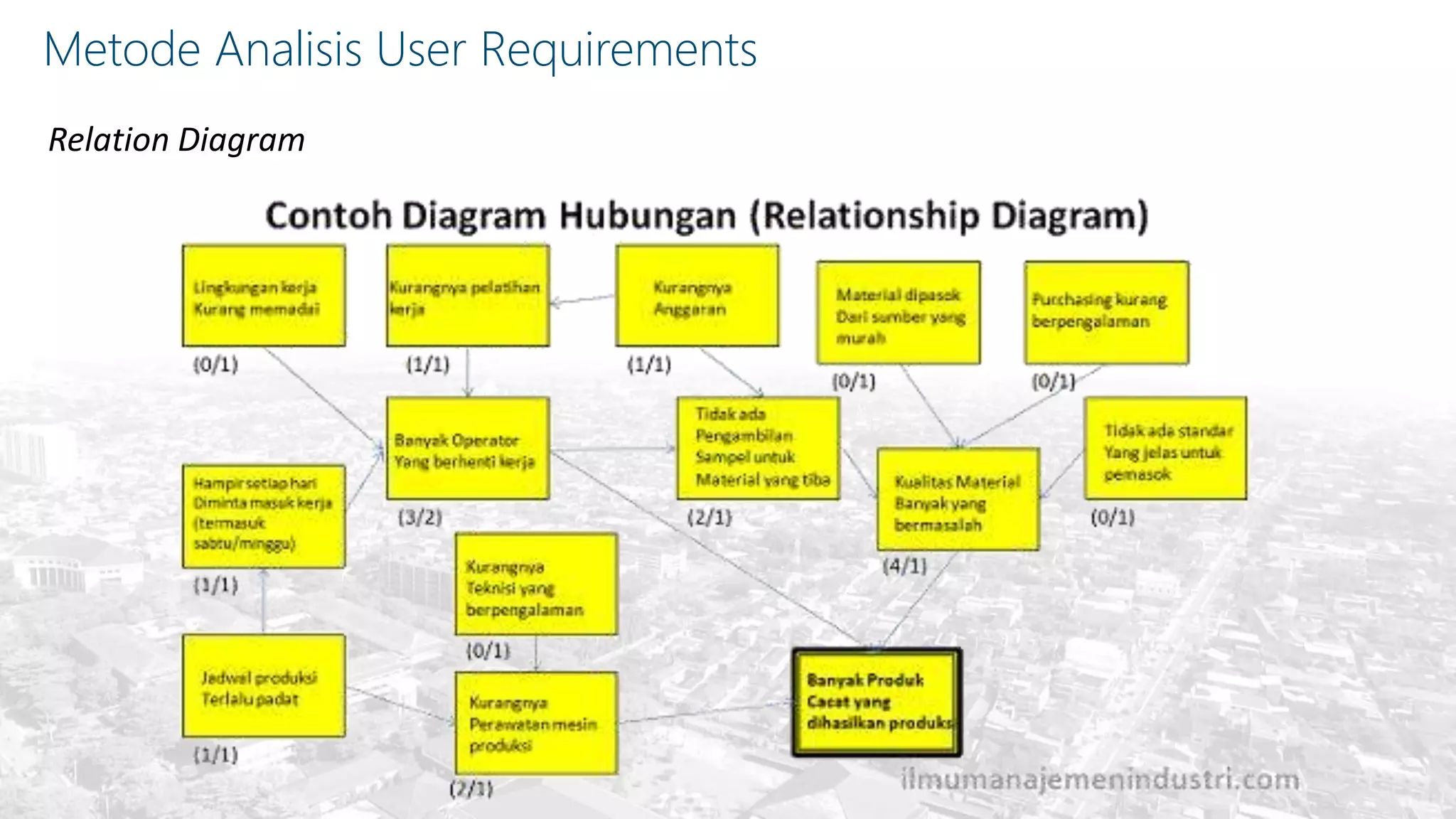
Metode Analisis User Requirements
Relation Diagram
Metode Analisis User
Requirements
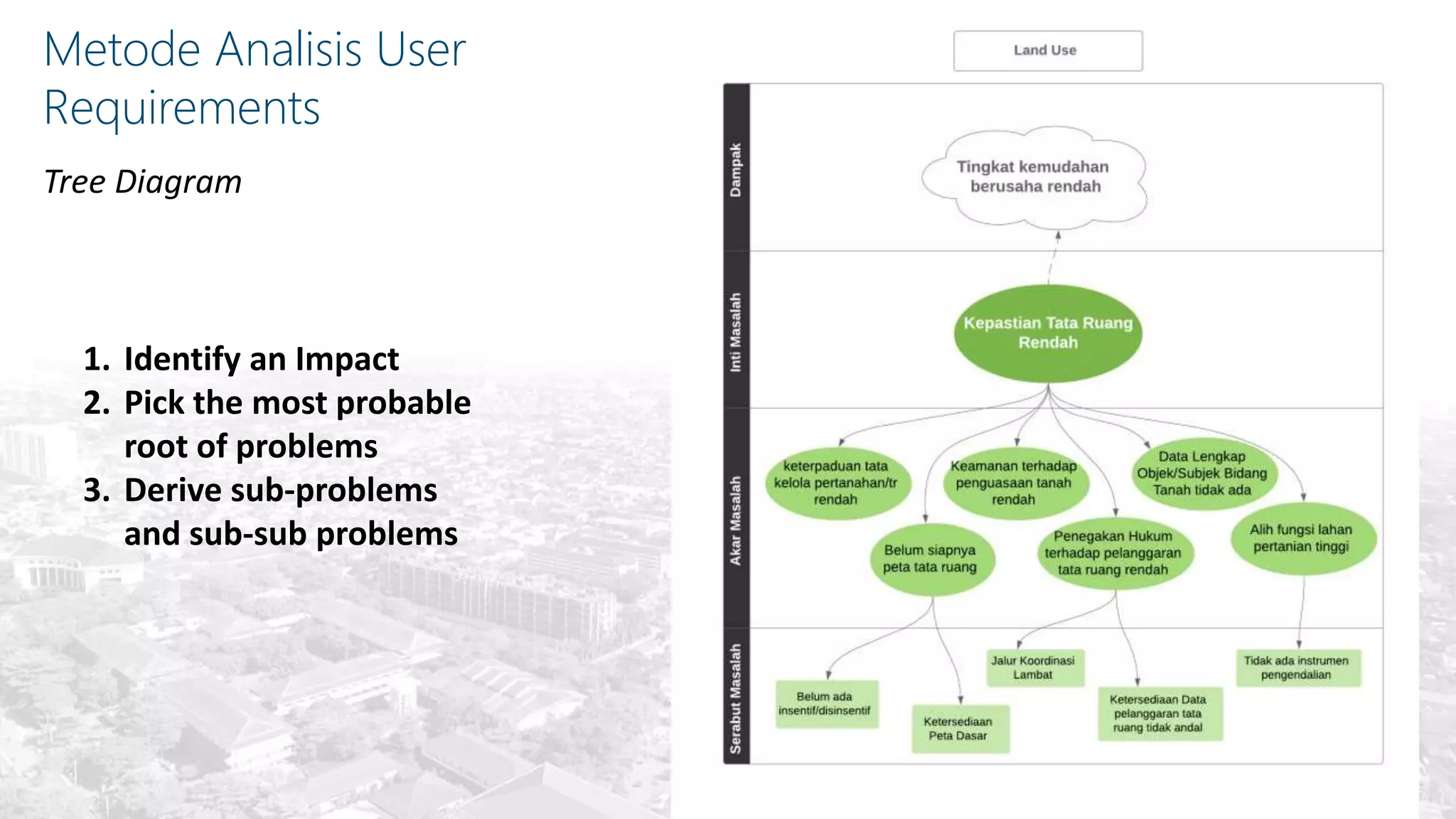
Tree Diagram
1. Identify an Impact
2. Pick the most probable
root of problems
3. Derive sub-problems
and sub-sub problems
UGM.AC.ID
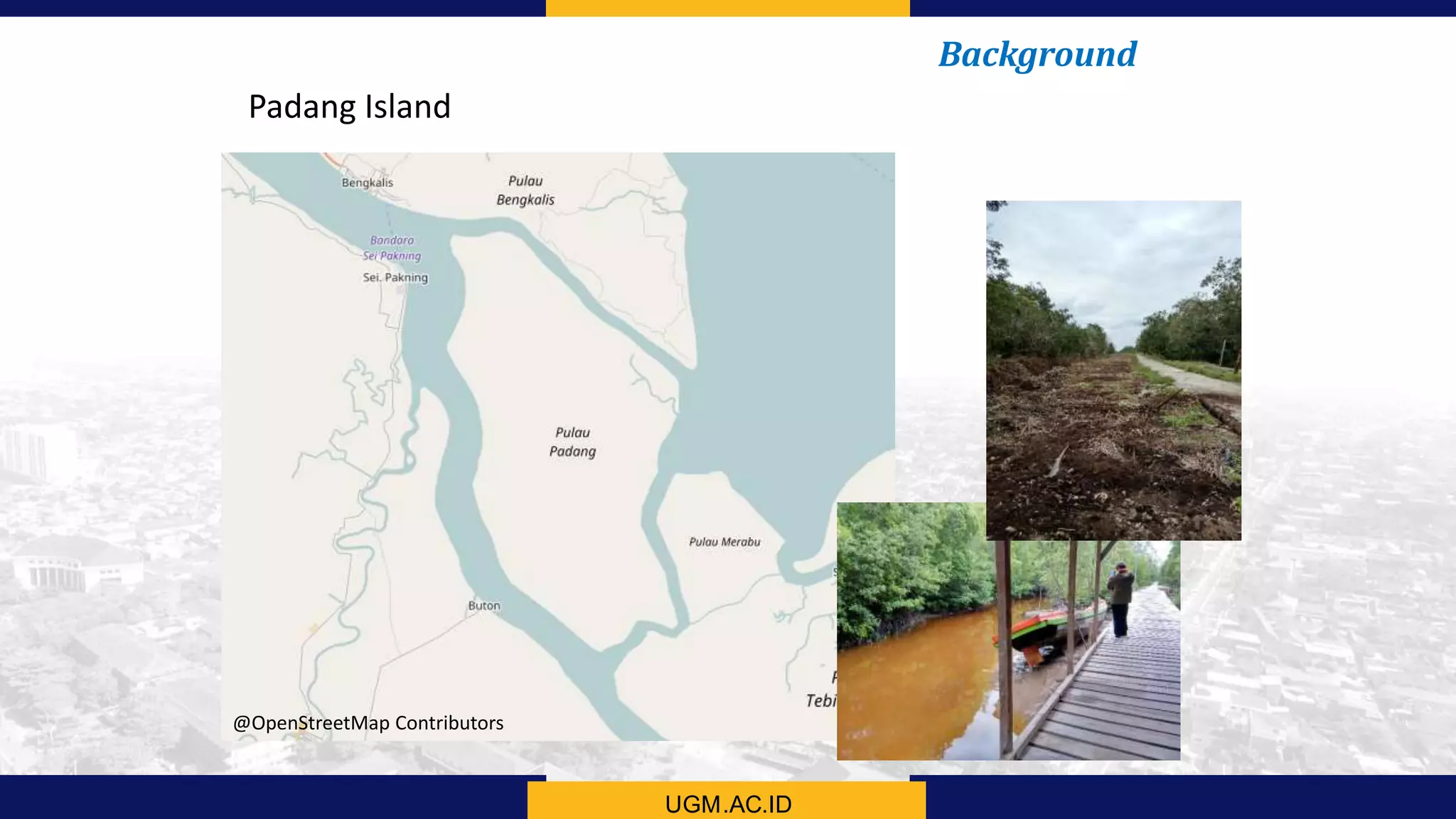
Background
Padang Island
@OpenStreetMap Contributors
UGM.AC.ID
Background
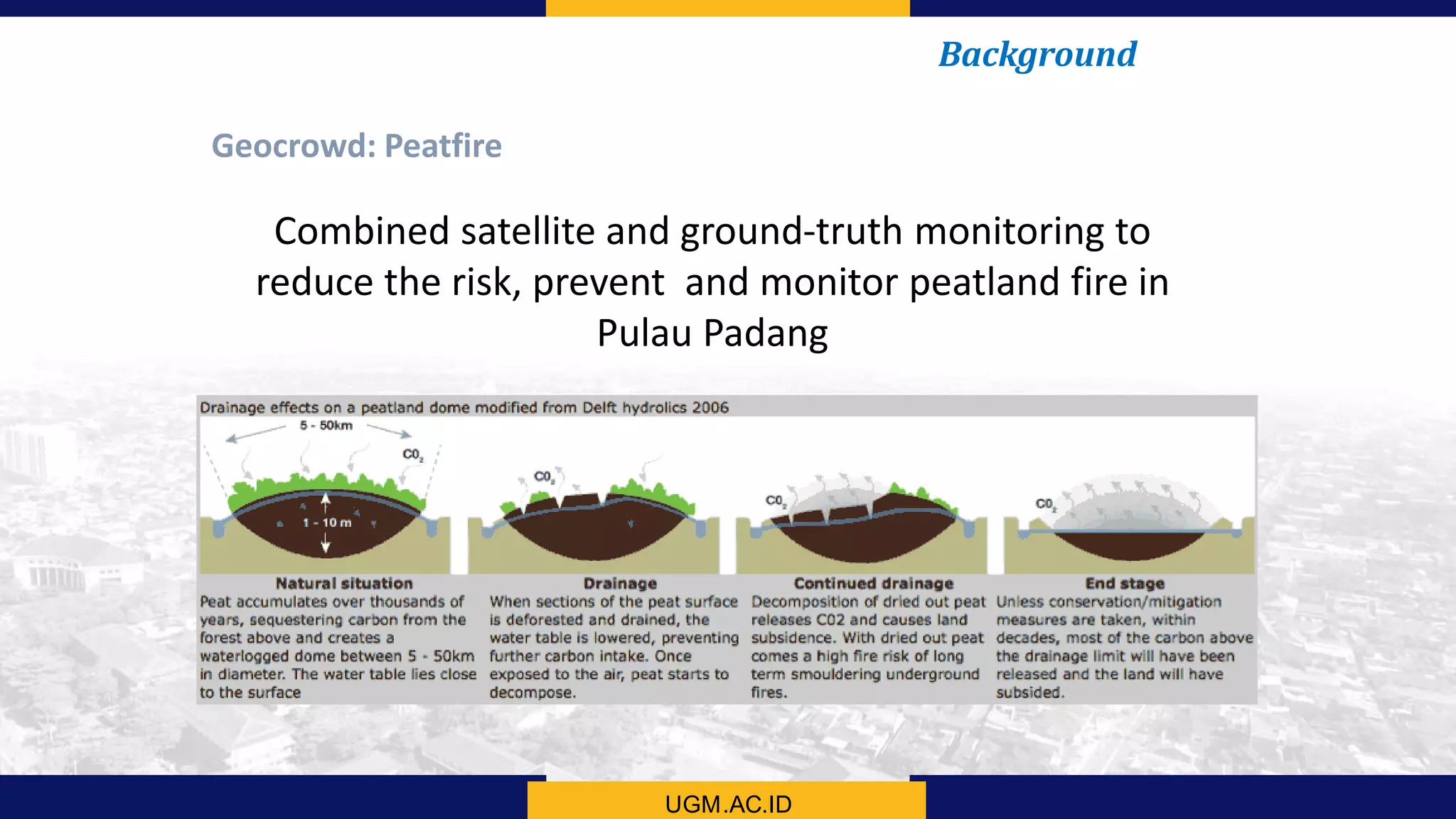
Combined satellite and ground-truth monitoring to
reduce the risk, prevent and monitor peatland fire in
Pulau Padang
Geocrowd: Peatfire
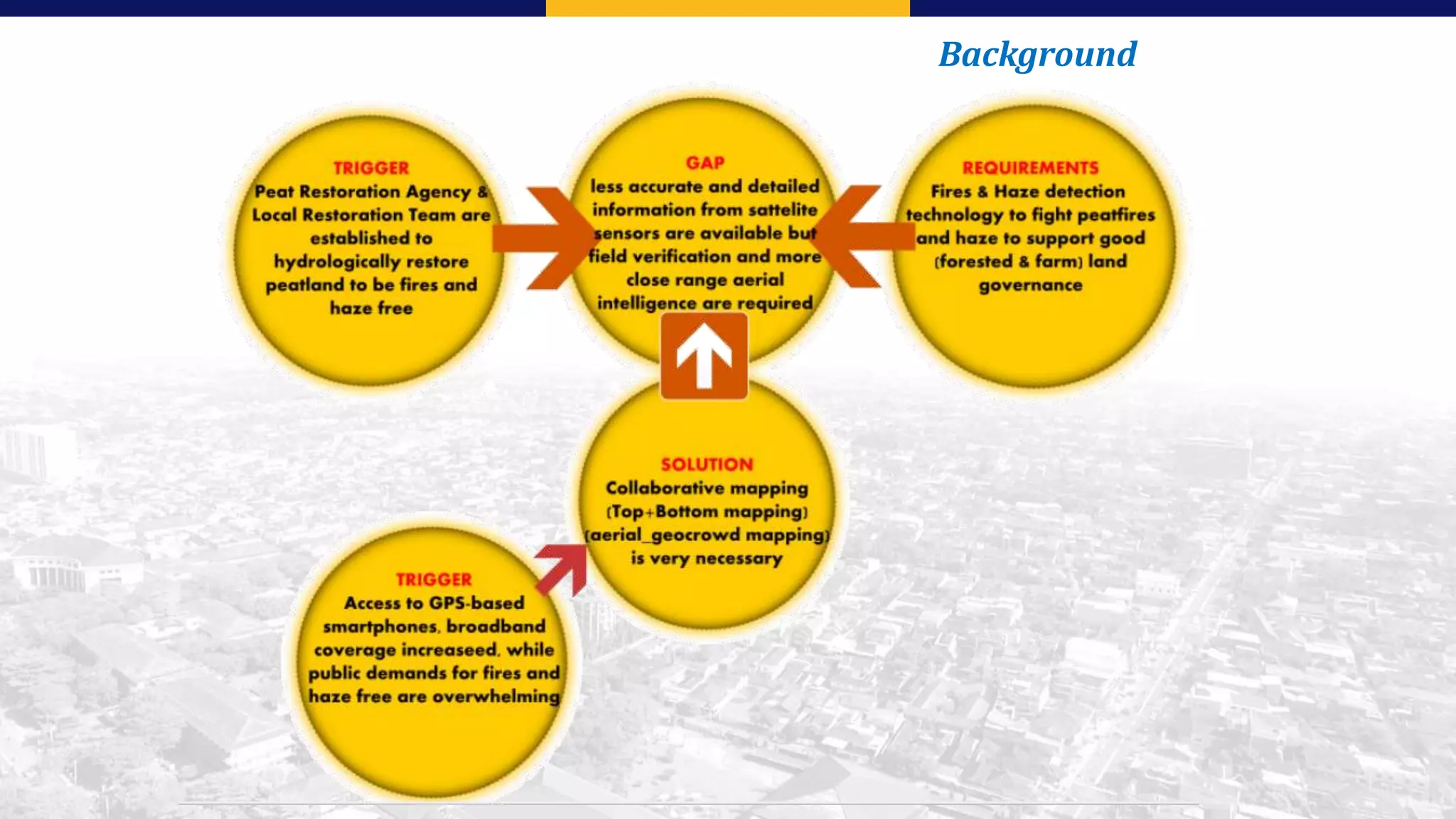
Background
Background
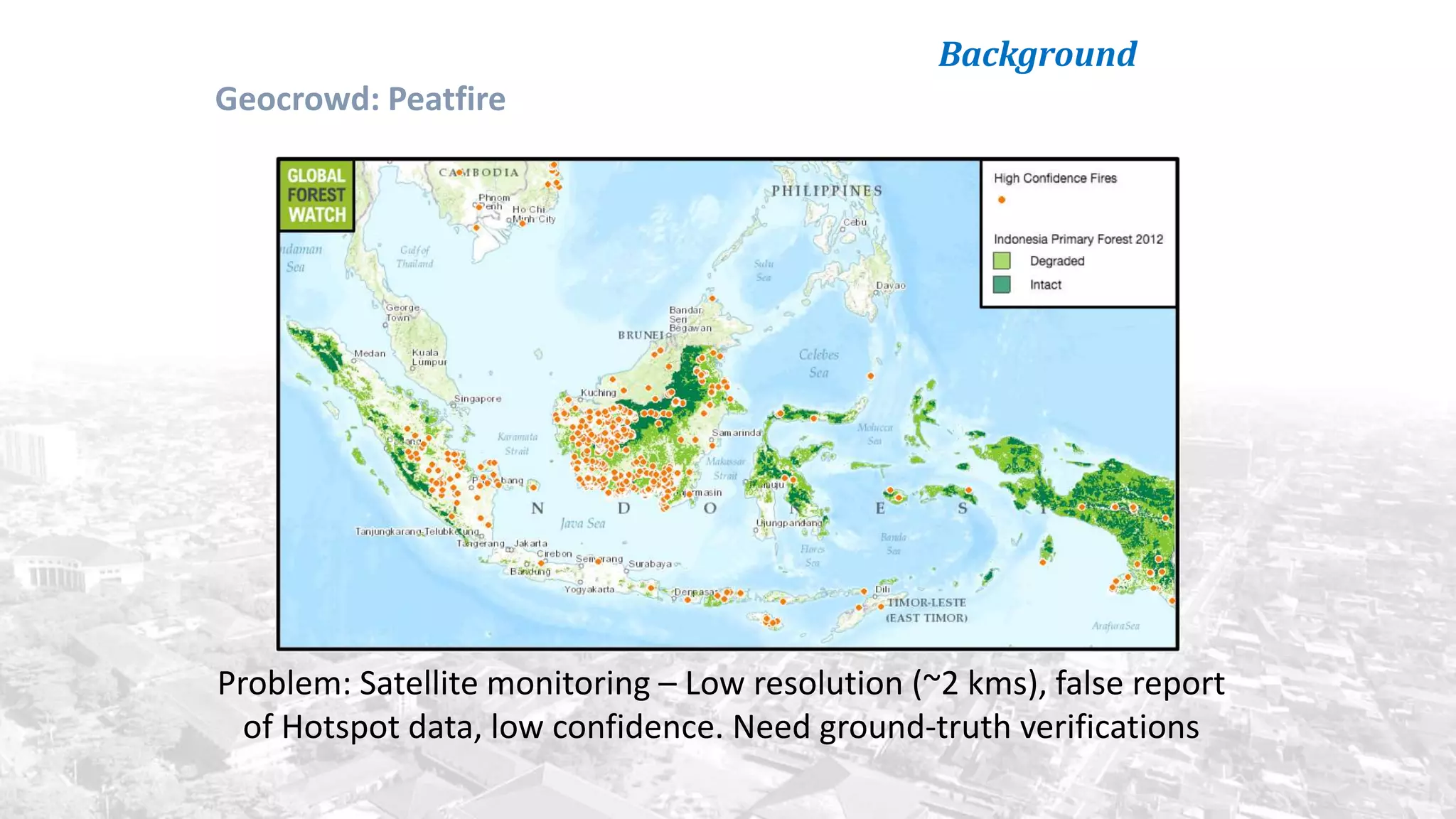
Problem: Satellite monitoring – Low resolution (~2 kms), false report
of Hotspot data, low confidence. Need ground-truth verifications
Geocrowd: Peatfire
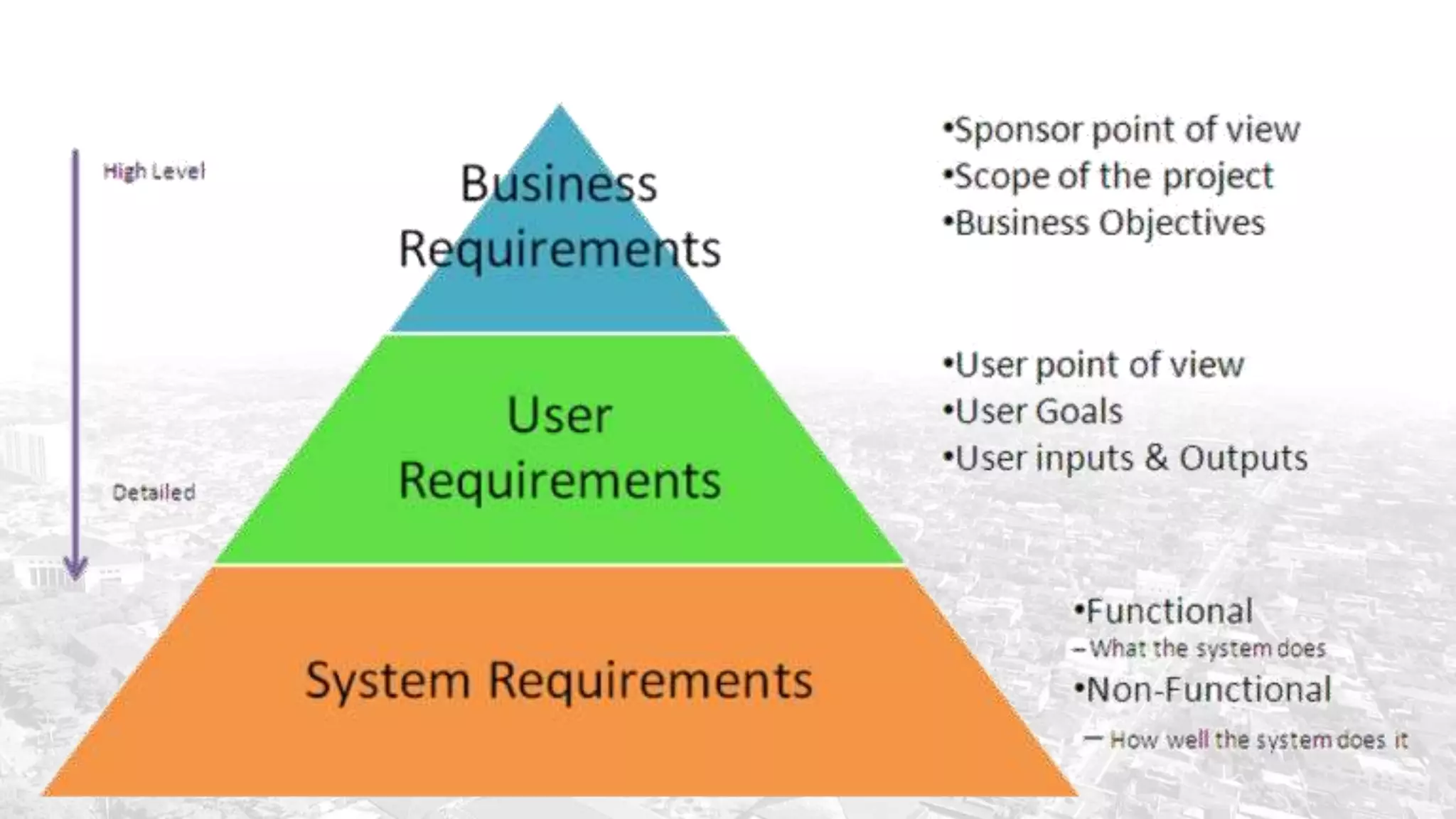
Business Requirement
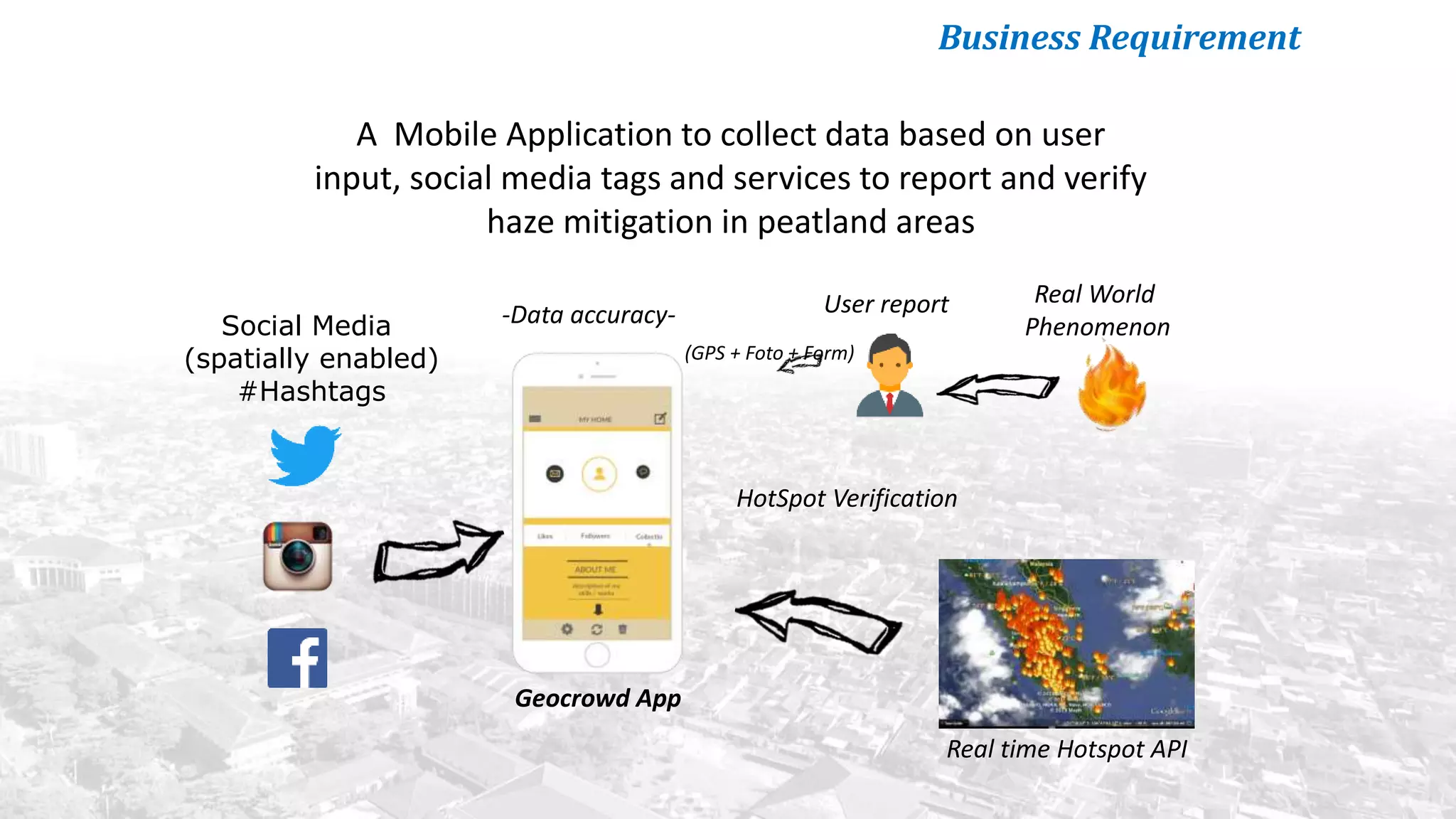
A Mobile Application to collect data based on user
input, social media tags and services to report and verify
haze mitigation in peatland areas
Social Media
(spatially enabled)
#Hashtags
Geocrowd App
User report Real World
Phenomenon
Real time Hotspot API
HotSpot Verification
(GPS + Foto + Form)
-Data accuracy-
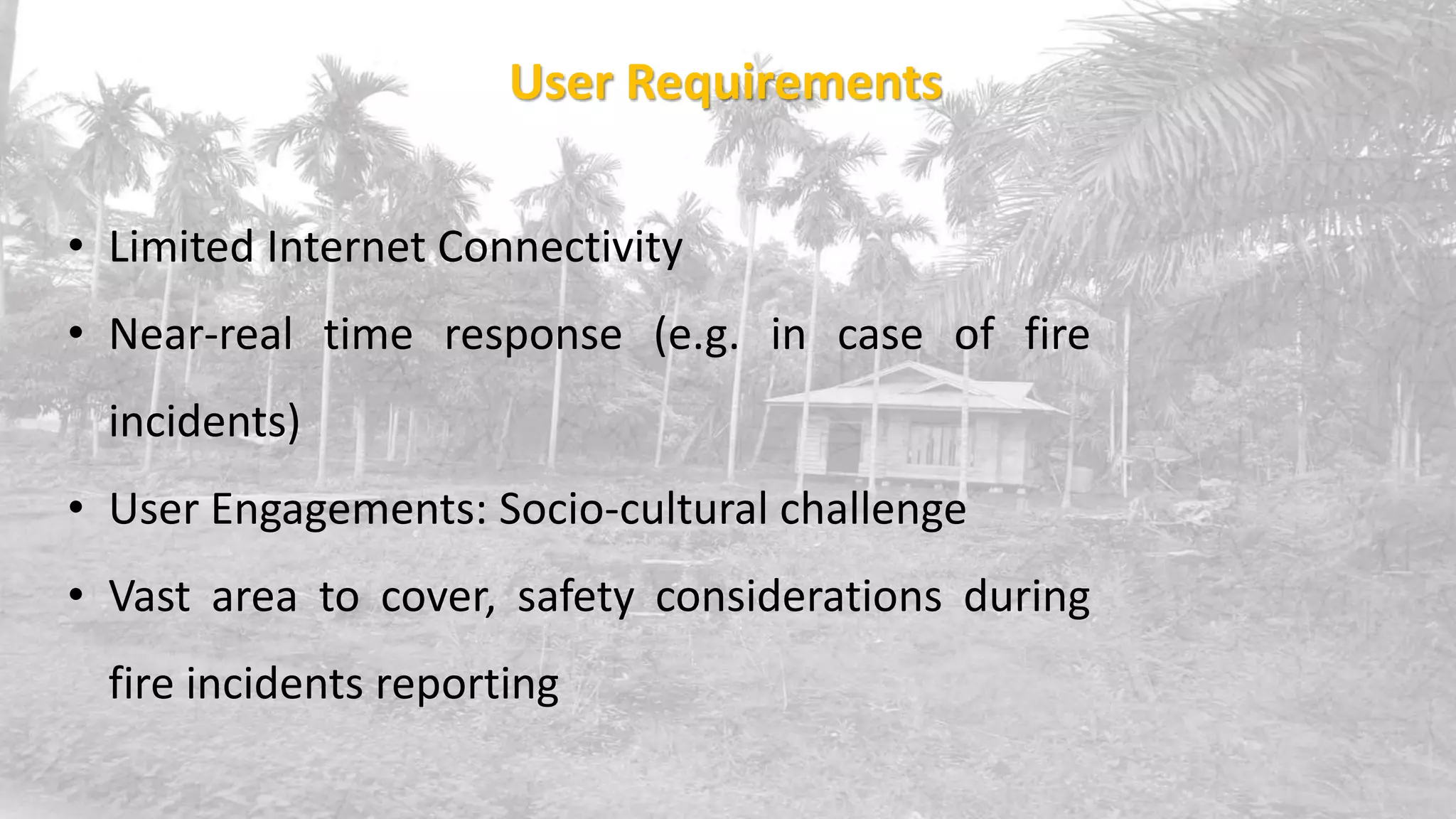
• Limited Internet Connectivity
• Near-real time response (e.g. in case of fire
incidents)
• User Engagements: Socio-cultural challenge
• Vast area to cover, safety considerations during
fire incidents reporting
User Requirements
UGM.AC.ID
Concept of Application
Strategies
• Frontend (App) - Backend (server) two-way communications
• Exit strategy for offline conditions: Switch to SMS Mode
• Offline mode: using local basemap while offline
• User report local data: Sync to server while online
• Intuitive and easy-to-use design
• User Estimation on Distance and Severity in the report Form
• Collaboration with Network Provider for signal availability

UGM.AC.ID
Concept of Application
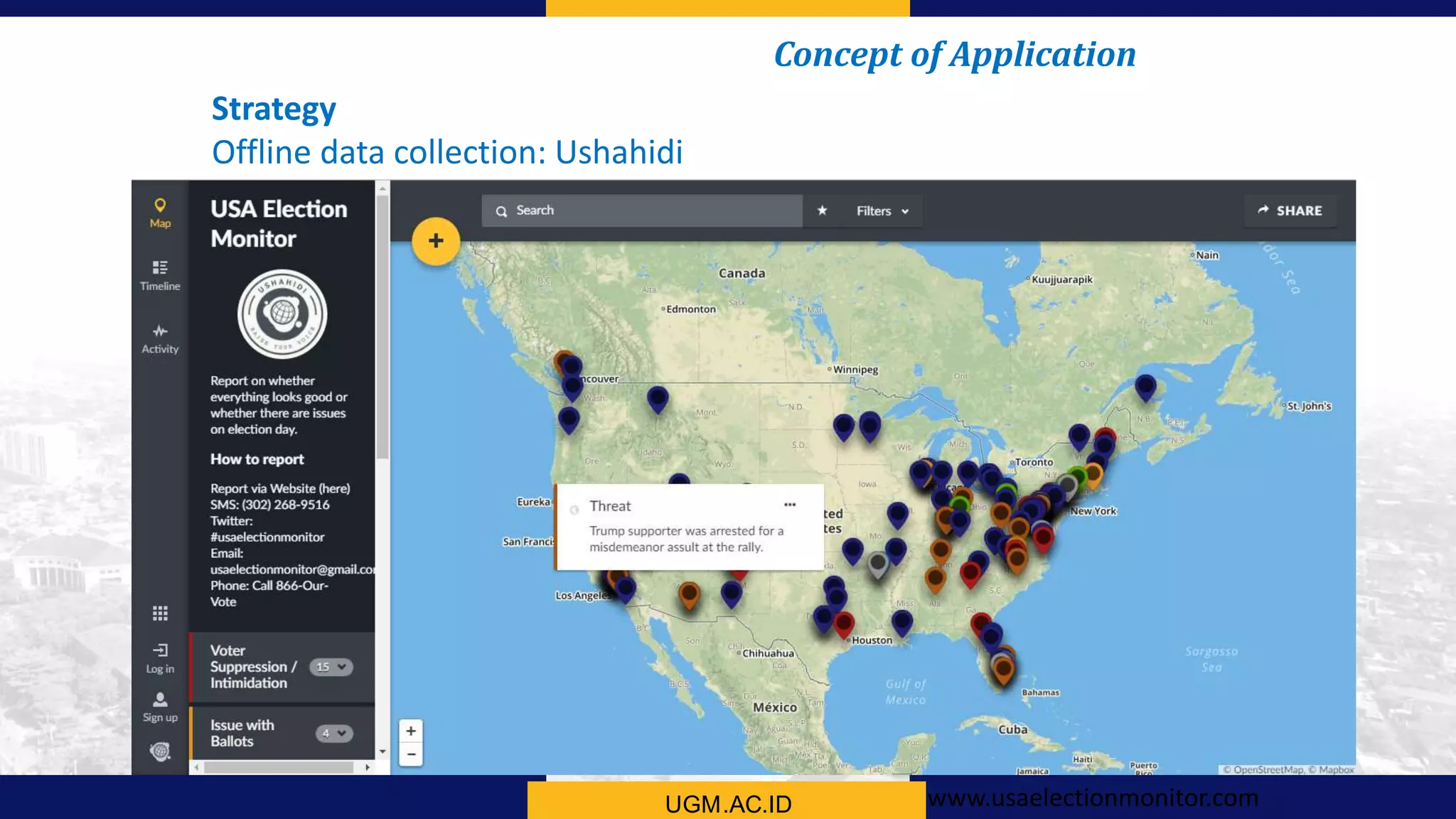
Strategy
Offline data collection: Ushahidi
www.usaelectionmonitor.com
System Requirements
Main Features:
a. Could be used while online/offline
b. Collect user input (e.g. photos) via app
c. Gather social media data (via hashtags)
d. Hotspot data services as basemap
e. User verification to hotspot data
f. Notification for hotspot(s) nearby
Other:
a. User Profiles and statistics
b. Dashboard for monitoring users and user inputs
c. Low data usage
d. Offline Data Sync (on no signal condition)
Geocrowd: Liput Gambut
App Features
Optional:
• Report from user: time and
magnitude of hazard
• Estimation on severity and
distance to fire
• Visual parameters regarding
to the fire
• Interact with the user (e.g.
text messages)
• Weather data
TERIMA KASIH

Analisis kebutuhan sistem web gis

  • 1.
    Analisis Kebutuhan Sistem DanyLaksono February 9, 2020 Mata Pelatihan WebGIS dan Transformasi Sistem Koordinat SKKNI Teknisi Utama – Analis Sistem Informasi Geografis
  • 2.
    Analisis Kebutuhan Sistem •Bagaimana internet bekerja? • Bahasa dan Protokol komunikasi inter-net • Bagaimana halaman web dibuat? • Praktek: HTML, CSS, JS
  • 5.
  • 6.
    GIS is aModel of the real World Abstraction Process Real World Spatial Data Model
  • 7.
    “ (it is)Impossible to map the world–we select and make graphics so that we can understand it” ~ Roger Tomlinson, note on an agenda, 1981. GIS is a Model of the real World
  • 8.
    GIS is aModel of the real World Spatial Data Model http://www.geography.hunter.cuny.edu/~jochen/GTECH361 Raster Vector
  • 9.
  • 10.
    Properties of SpatialData Attribute Geometry http://www.geography.hunter.cuny.edu/~jochen/GTECH361/ Spatial data consists of Geometry and Attribute An Attribute could be anything related to the spatial data
  • 11.
    Components of GIS GISconsists of interrelated components: 1. Hardware 2. Software 3. Methods of Analysis 4. Data 5. People
  • 12.
    UGM.AC.ID “The GIS Subcomponents” Modifiedfrom Marble and Peuquet (1983) As a System, GIS consist of four main components as subsystems Each subsystem defines elaborate process by themselves
  • 13.
    UGM.AC.ID The GIS Subsystem:Input Spatial Data Acquisition: converting real world to geospatial data PRIMARY SECONDARY Surveying Satellite Positioning Remote Sensing Photogrammetry Digitization Automated Conversion Scanning
  • 14.
    UGM.AC.ID The GIS Subsystem:Input GNSS Positioning Surveying Remote Sensing Photogrammetry
  • 15.
    UGM.AC.ID The GIS Subsystem:Preprocessing Query: Asking the right questions
  • 16.
    UGM.AC.ID The GIS Subsystem:Spatial Analysis Location …Where is it? Condition …What is it? Patterns … How is it distributed? Trends …What has changed? Modeling …What if …? Time andTravel? What is near me? Etc. Query: Asking the right questions
  • 17.
  • 18.
  • 19.
    Tahapan Implementasi GIS Raising Awareness Developing System requirements Evaluationof Alternative System System Justification & Implementation plan development System Acquisition & Start Up Operational System Tahap Implementasi GIS menurut Arronoff (1989)
  • 22.
    Metode Analisis UserRequirements Affiniti Diagram (Kawakita-Jiro Method)
  • 23.
    Metode Analisis UserRequirements Affiniti Diagram (Kawakita-Jiro Method) 1. Identify the purpose 2. Determine groupings. 3. Determine contributing factors. 4. Organize 5. Analyze and share
  • 24.
    Metode Analisis UserRequirements Relation Diagram 1. Identify Problems and their relation 2. Identify the root of problems
  • 25.
    Metode Analisis UserRequirements Relation Diagram
  • 26.
    Metode Analisis User Requirements TreeDiagram 1. Identify an Impact 2. Pick the most probable root of problems 3. Derive sub-problems and sub-sub problems
  • 27.
  • 28.
    UGM.AC.ID Background Combined satellite andground-truth monitoring to reduce the risk, prevent and monitor peatland fire in Pulau Padang Geocrowd: Peatfire
  • 29.
  • 30.
    Background Problem: Satellite monitoring– Low resolution (~2 kms), false report of Hotspot data, low confidence. Need ground-truth verifications Geocrowd: Peatfire
  • 31.
    Business Requirement A MobileApplication to collect data based on user input, social media tags and services to report and verify haze mitigation in peatland areas Social Media (spatially enabled) #Hashtags Geocrowd App User report Real World Phenomenon Real time Hotspot API HotSpot Verification (GPS + Foto + Form) -Data accuracy-
  • 32.
    • Limited InternetConnectivity • Near-real time response (e.g. in case of fire incidents) • User Engagements: Socio-cultural challenge • Vast area to cover, safety considerations during fire incidents reporting User Requirements
  • 33.
    UGM.AC.ID Concept of Application Strategies •Frontend (App) - Backend (server) two-way communications • Exit strategy for offline conditions: Switch to SMS Mode • Offline mode: using local basemap while offline • User report local data: Sync to server while online • Intuitive and easy-to-use design • User Estimation on Distance and Severity in the report Form • Collaboration with Network Provider for signal availability
  • 34.
    UGM.AC.ID Concept of Application Strategy Offlinedata collection: Ushahidi www.usaelectionmonitor.com
  • 35.
    System Requirements Main Features: a.Could be used while online/offline b. Collect user input (e.g. photos) via app c. Gather social media data (via hashtags) d. Hotspot data services as basemap e. User verification to hotspot data f. Notification for hotspot(s) nearby Other: a. User Profiles and statistics b. Dashboard for monitoring users and user inputs c. Low data usage d. Offline Data Sync (on no signal condition) Geocrowd: Liput Gambut App Features Optional: • Report from user: time and magnitude of hazard • Estimation on severity and distance to fire • Visual parameters regarding to the fire • Interact with the user (e.g. text messages) • Weather data
  • 36.

Editor's Notes

  • #28  Seberapa real-time? Perlu ditambahkan informasi cuaca – Weather API
  • #29  Seberapa real-time? Perlu ditambahkan informasi cuaca – Weather API
  • #30  Seberapa real-time? Perlu ditambahkan informasi cuaca – Weather API
  • #31  Seberapa real-time? Perlu ditambahkan informasi cuaca – Weather API
  • #32 Logic: kalau lokasi pengguna berada sekitar 1 km dari lokasi hotspot tercatat, muncul notifikasi untuk verifikasi
  • #33 Challenge: develop an app with low data usage Sync data between users and servers Seberapa real-time? Perlu ditambahkan informasi cuaca – Weather API
  • #35 Challenge: develop an app with low data usage Sync data between users and servers