Equity Audit: Are We Meeting the Needs of All Students in The Mercer Area School District?Timothy J. DadichMercer Area Middle SchoolMercer Area School DistrictGrades K-12
Equity DefinedEducation EquityThe educational policies, practices and programs necessary to (a) eliminate educational barriers based on gender, race/ethnicity, national origin, color, disability, age, or other protected group status; and (b) provide equal educational opportunities and ensure that historically underserved or underrepresented populations meet the same rigorous standard for academic performance expected of all children and youth. (Skrla, Mckenzie, & Scheurich, 2009. p. 3-4).Definition adapted from Wisconsin Department of InstructionSystemic EquityThe transformed ways in which systems and individuals habitually operate to ensure that every learner – in whatever learning environment that learner is found – has the greatest opportunity to learn enhanced by the resources and supports necessary to achieve competence, excellence, independence, responsibility, and self sufficiency for school and life ((Skrla, Mckenzie, & Scheurich, 2009. p. 6)
Why is Equity Important?We must work toward not limiting students based on the way they look, how much money they make, who they are related to ,or their placement in a program: these factors DO NOT determine ability to learn. Schools need to act as freeways for success – not roadblocks! The world we live in tomorrow belongs to the students in our classrooms today – our classrooms are diverse with students who are too often defined by the color of their skin, gender, or a label provided to them by an adult.Would any of us sit quietly if our child was one of a number of students who:Do not graduateAre not prepared to go to collegeAre underrepresented in advanced classesAre placed in lower level classesReceived less than the best teacher a school has to offer based on past practices.If it is not good enough for our child then why is it good enough for the child of a family we serve?
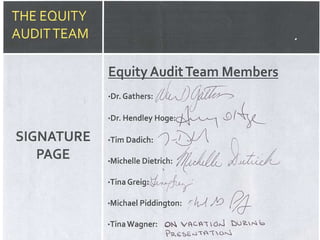
THE EQUITY AUDIT TEAMEquity Audit Team MembersDr. Gathers
Superintendent
Dr. Hendley Hoge
HS Principal
Tim Dadich
MS Principal
Michelle Dietrich
Special Ed. Director and Elementary Assistant Principal
Tina Greig
School Counselor and Leadership Team Member
Michael Piddington
Teacher and Leadership Team Member
Tina Wagner
Teacher and Leadership Team MemberDr. William Gathers, Superintendent of Schools, recommended people who have the ability to enact change within the district using the information/data retrieved from the equity audit. The team includes several key administrators, a school counselor, and two teacher leadership team members.
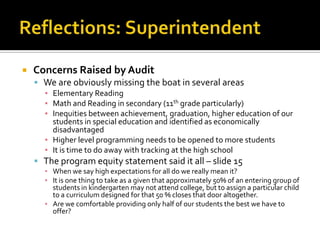
ConversationsConversation with the Superintendent, Dr. William Gathers, focused on his genuine concern for the discrepancy that exists between the academic achievement of our general population and those students who have been identified as economically disadvantaged or in need of special education services.  Dr. Gathers is genuinely aware of the situation, ready to take action to improve the situation, and is not afraid to have those conversations that could present other leaders and teachers with uncomfortable truths about their actions.One of the most critical pieces of advice that Dr. Gathers has given to me is to improve my patience – he believes I will be more successful if I become more deliberate and patient in my actions.We have also discussed the importance of “keeping the main thing the main thing” by maintaining focus – keep the Eye on the Goal!Initial discussion were held with the following members of the Mercer Area School District:The SuperintendentSeveral Members of the Audit Team: Administration and TeachersGroup of Teacher on the School Leadership TeamThe conversations that took place helped to guide the direction of research and suggestions for solution
ConversationsConversations with other audit members and the teachers on the leadership team demonstrated a slight awareness of the problem at hand; however, there seems to be a predominate belief among some members of both groups that all the roadblocks we face with our students are completely out of our control – it is the “fault” of the home, the parents, or the choices of the students.  Some are intent on maintaining the low level classes while others recognize the need to increase academic rigor for all students.  Regardless, one very promising element that has surfaced throughout conversations is the desire of the teachers and administrators to work together in addressing the disparities in the achievement of our students – the staff is excited to begin engaging in embedded professional development focused on collaboration and improving instruction for all students.  Initial discussion were held with the following members of the Mercer Area School District:The SuperintendentSeveral Members of the Audit Team: Administration and TeachersGroup of Teachers on the School Leadership TeamThe conversations that took place helped to guide the direction of research and suggestions for resolutions
Components of the Equity AuditTEACHER QUALITY – PROGRAM EQUITY - ACHIEVEMENTTeacher QualityEducationExperience (Years)Experience (Position)CertificationProgrammingDemographic DataGifted & AP/Adv Course EnrollmentSpecial EducationDisciplineAchievementPSSA ResultsGraduation RatesStudents Continuing on to Higher Education
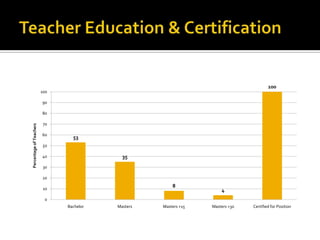
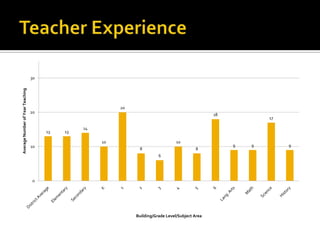
TEACHER EQUITY“Teacher Qualifications, teachers’ knowledge and skills, make more difference for student learning than any other single factor.” – Linda Darling HammondAre we making available, to EVERY student, a teacher with well-developed skill and knowledge?  Do we invest enough of our resources on improving the primary factor for student success – access to high quality instruction?The indicatorsidentified in this section – education, certification, years experience, and experience at the current position can provide a better understanding of how teachers are being utilized within a district and upon further investigation, can provide a pattern of how the best teachers are made accessible to the most needy students
Teacher Education & Certification
Teacher Experience
Experience at Current Position13 year – Dist. Avg.
Special Programming13 year – Dist. Avg.
Teacher Placement Practices….	Elementary – Many teacher placements are based on need (retirement, move).  Teachers have been reassigned based on necessity (more qualified teacher placed in specific grade levels). Secondary –Teachers typically receive the same schedule from year to year because they have always taught that course.  Many of our most experienced and rigorous teachers are working with our top students.
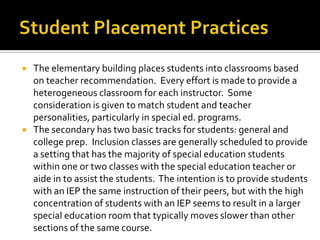
Student Placement PracticesThe elementary building places students into classrooms based on teacher recommendation.  Every effort is made to provide a heterogeneous classroom for each instructor.  Some consideration is given to match student and teacher personalities, particularly in special ed. programs.The secondary has two basic tracks for students: general and college prep.  Inclusion classes are generally scheduled to provide a setting that has the majority of special education students within one or two classes with the special education teacher or aide in to assist the students.  The intention is to provide students with an IEP the same instruction of their peers, but with the high concentration of students with an IEP seems to result in a larger special education room that typically moves slower than other sections of the same course.
Programmatic EquityWhen we say high expectations for all do we really mean it?It is one thing to take as a given that approximately 50% of an entering group of students in kindergarten may not attend college, but to assign a particular child to a curriculum designed for that 50 % closes that door altogether.  Are we comfortable providing only half of our students the best we have to offer?The indicators used identified in this section – Student Demographics, Gifted Education, Advanced Course Placement, Special Education Placement, and Discipline.
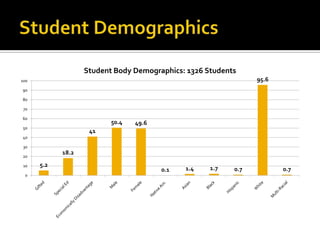
Student Demographics
Grade-by-Grade Demographics
PROGRAMS
Gifted Program Demographics
Advanced Math Classes
Advanced English
Advanced History
Advanced Sciences
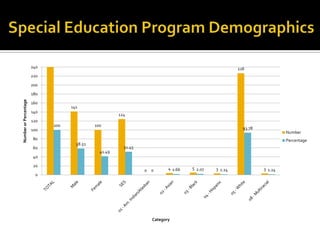
Special Education Program Demographics
DISCIPLINE
Students Receiving Detentions
Students Receiving Saturday Detention
Students Receiving In-School Suspension
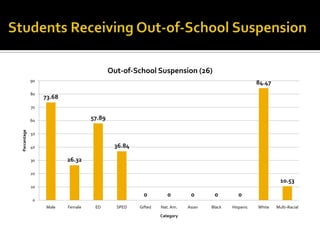
Students Receiving Out-of-School Suspension
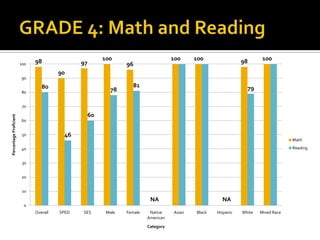
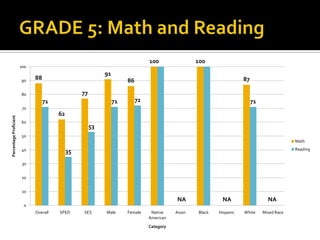
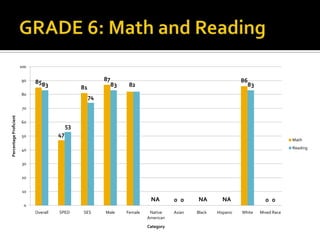
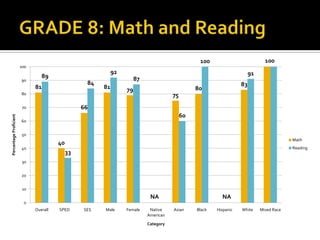
Achievement Equity“The strength of our nation depends on the strength of our schools.” – Eli BroadAre we comfortable graduating classes where only 60-70% of students are proficient or 50-60% go on to higher education? Would you see a doctor who only maintained a high quality of life for 60-70% of his/her patients? Is this the type of strength we want to provide for our nation and the world?The indicators used identified in this section – 2010 PSSA scores for grades 3-8, 11 in the area of math and reading.  Also included is a breakdown of the Class of 2010 in regard to graduation rate and percentage of students heading on to higher education.
PSSA Results
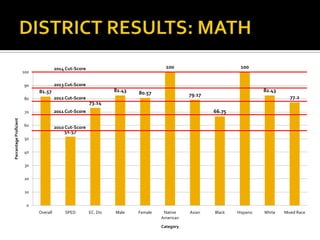
DISTRICT RESULTS: MATH2013 Cut-Score
DISTRICT RESULTS: READING2014 Cut-Score2012 Cut-Score2011 Cut-Score
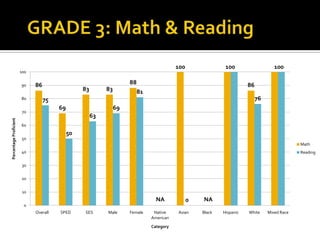
GRADE 3: Math & Reading
GRADE 4: Math and Reading
GRADE 5: Math and Reading
GRADE 6: Math and Reading
GRADE 7: Math and Reading
GRADE 8: Math and Reading
GRADE 11: Math and Reading
GRADUATION
Graduation Rate
HIGHER EDUCATION
Students Seeking Higher Education
STUDENT POLLWhat do our students have to say?
Student OpinionStudent Opinion Poll Conducted During the Last Few Weeks of the 2009-2010 School Year.
293 Secondary Students in Grades 7-12 Participated in the Poll.
Students Surveyed Include a Representative Sample of the Overall Demographics of the Entire School District.
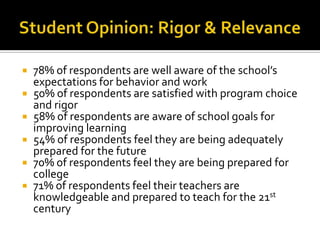
Students Were Asked Questions Regarding Climate, Rigor, Relevance, and Attitude Toward SchoolStudent Opinion: Rigor & Relevance78% of respondents are well aware of the school’s expectations for behavior and work50% of respondents are satisfied with program choice and rigor58% of respondents are aware of school goals for improving learning54% of respondents feel they are being adequately prepared for the future70% of respondents feel they are being prepared for college71% of respondents feel their teachers are knowledgeable and prepared to teach for the 21st century
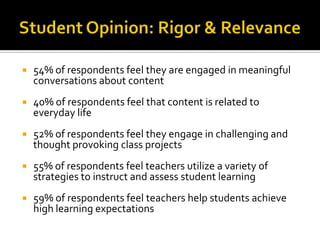
Student Opinion: Rigor & Relevance54% of respondents feel they are engaged in meaningful conversations about content40% of respondents feel that content is related to everyday life52% of respondents feel they engage in challenging and thought provoking class projects55% of respondents feel teachers utilize a variety of strategies to instruct and assess student learning59% of respondents feel teachers help students achieve high learning expectations
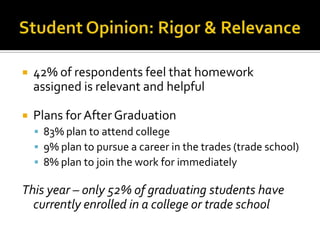
Student Opinion: Rigor & Relevance42% of respondents feel that homework assigned is relevant and helpfulPlans for After Graduation83% plan to attend college9% plan to pursue a career in the trades (trade school)8% plan to join the work for immediatelyThis year – only 52% of graduating students have currently enrolled in a college or trade school
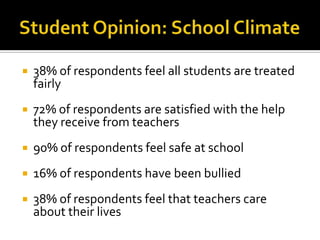
Student Opinion: School Climate38% of respondents feel all students are treated fairly72% of respondents are satisfied with the help they receive from teachers90% of respondents feel safe at school16% of respondents have been bullied38% of respondents feel that teachers care about their lives
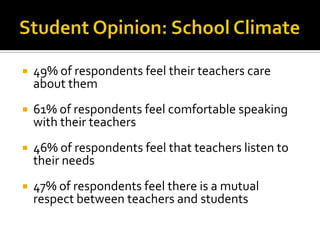
Student Opinion: School Climate49% of respondents feel their teachers care about them61% of respondents feel comfortable speaking with their teachers46% of respondents feel that teachers listen to their needs47% of respondents feel there is a mutual respect between teachers and students
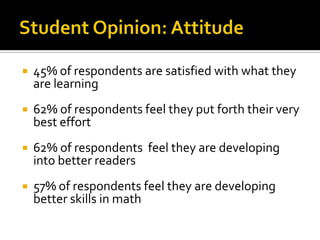
Student Opinion: Attitude45% of respondents are satisfied with what they are learning62% of respondents feel they put forth their very best effort62% of respondents  feel they are developing into better readers57% of respondents feel they are developing better skills in math
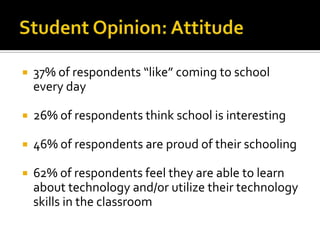
Student Opinion: Attitude37% of respondents “like” coming to school every day26% of respondents think school is interesting46% of respondents are proud of their schooling62% of respondents feel they are able to learn about technology and/or utilize their technology skills in the classroom
FINDINGSWhat does the data indicate?  What can we take from what we know?
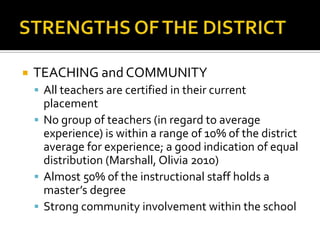
STRENGTHS OF THE DISTRICTTEACHING and COMMUNITYAll teachers are certified in their current placementNo group of teachers (in regard to average experience) is within a range of 10% of the district average for experience; a good indication of equal distribution (Marshall, Olivia 2010)Almost 50% of the instructional staff holds a master’s degreeStrong community involvement within the school
STRENGTHS OF THE DISTRICTPROGRAMMING and ACHIEVEMENTThe curriculum is currently being revised in K-12 through an effort of the assistant superintendent to achieve rigor and relevance in addition to alignmentThe district has completely upgraded its technology capabilities within the past four yearsThe Mercer Area School District is currently ranked in the top 20% of all districts within the Commonwealth of Pennsylvania in regard to student achievementScores across grade levels and subject areas have remained above required state levels for several years
Area for Improvement #1:Teachers and AdministrationTeacher Education : increase the number of teachers with masters degree or advanced preparationTeacher Professional Development: improve professional development to align more with our expectations for student learning (rigor, college readiness, inclusion and access for all)Evaluation Procedures: align procedures to focus on effective teaching FOR student learningTeacher Efficacy and Leadership: building level leadership needs to include teacher leaders and the development of self-efficacy for improving learning for all students
Area for Improvement #2 : ProgrammingHigh Level Coursework: Low representation of students identified as economically disadvantaged in advanced courses and gifted program.More male representation in higher level math and science courses and more female representation exists in English and history.Over Identification: According to the National Dept. of Education, 10-13% of students in the US are identified as needing special education programming.  Mercer is at 18.2%.  Economically disadvantaged students make up 41% of our student population, but make up over 50% of students identified as in need of special education services and only 8% of the gifted program.  Are we identifying students for remediation based on lack of resources at home?  Higher numbers of discipline referrals for: males and students identified as economically disadvantaged or in need of special education services.
Area for Improvement #3 : Student AchievementReading scores are not commensurate with math scores in the elementary schoolTrend reverses itself beginning in the 7th grade.  Math scores decline steadily from 6th grade through 11th gradeProficiency steadily declines as students progress through elementary into the secondary building: This is true for all students and for subgroups (special education and economically disadvantaged)An the secondary level, students identified as economically disadvantaged or in need of special education services consistently underperform on state assessments in  math and reading in comparison with their peers. This year, only 82% of the seniors who  have been receiving special education services since the beginning of the school year graduated in 2010.  Only 75% of students identified as economically disadvantaged since the beginning of the school year graduated in 2010Less than 60% of Mercer students attend higher education opportunities after graduation.  That percentage is significantly less for students classified in one of the two major subgroups
SUGGESTED SOLUTIONSWhat can we do?
SOLUTIONS FOR IMPROVEMENT AREA #1Utilize the district mission to establish a vision of teaching and learning based on relationships, resiliency, reflection, relevance, and rigor.
SOLUTIONS IMPROVEMENT AREA #11A - Develop Administrative and Teacher Efficacy Recent research points to teacher expectations, teacher quality, and teacher belief in having the ability to impact students. Research has continuously documented the higher achievement levels for students with highly efficacious teachers.  This is particularly true for students of low economic status (Hines, Kritsonis 2010)Establish building leadership teams to systematically review student achievement data and teaching practices in order to make recommendation for professional development (Milstein, Henry 2008)
SOLUTIONS IMPROVEMENT AREA #11A- Develop Administrative and Teacher Efficacy Establish individual SMART Goal setting to focus on specific achievement targets – teachers who take responsibility for student learning can improve student achievement. Control over targets and strategies to reach desired outcomes help develop the belief that teachers can make a difference. (Logerfo, 2006)Administration needs to provide time for teachers to collaborate on instructional teams or departments.  This shared responsibility provides a support system for the teachers and administration (Dweck, 2010; Anfara, 2010).
SOLUTIONS IMPROVEMENT AREA #11B- Develop Teacher Leadership and ExperienceOne of the most consistent findings in all research regarding the closing of the achievement gap points to one major element – experienced, knowledgeable, and qualified teachers (Tajalli, Opheim 2004)Improve incentives for teachers to earn a Master’s degree, especially in areas of high need (reading, math, science, and special education)
SOLUTIONS IMPROVEMENT AREA #11B- Develop Teacher Leadership and ExperienceDevelop incentives to encourage National Board Certification for teachers and administrationNational Board Certification Process is one of the most rigorous certification processes in existence for teachers.  Teachers seeking national board certification must pass a content area test and portfolio assessment requiring them to diagnose and develop remedies for student learning difficulties.  This is job embedded professional development at its best.
SOLUTIONS IMPROVEMENT AREA #11B- Develop Teacher Leadership and ExperienceNational Board Certification (Harris, Sass, 2009) Recent studies in Florida and North Carolina point to National Board Certification and the development of learning communities with board certified teachers as teacher leaders for the 4-5% increases in student achievement on standardized assessmentsNational Board Certification (Berry, Johnson, Montgomery 2005)North Carolina is currently the leader in board certified teachers with over 10% of its’ teachers achieving certification.The majority of schools in North Carolina have gone from emergency to School’s of Distinction within two years of establishing certification requirements.Adams Elementary went from 20-40% proficiency to 80% of students meeting grade level standards within four years of having 13 teachers receiving National Board Certification.
SOLUTIONS FOR IMPROVEMENT AREA #2Increase access to higher level programming and revitalize strategies used in special programming.
SOLUTIONS IMPROVEMENT AREA #22A – Close the Achievement Gap Utilizing Coursework and Principles from Gifted Education and Advanced/College Prep ProgrammingThe underrepresentation of minority students and students of low economic status in gifted programs and advanced/college prep courses is a major contributor to the achievement gap (Ford, 2006; Jones, Zirkel, Barrack)The rigor in the programs is a major concern in education programming.  The tracking of students into college prep or general courses sends a strong message of “We do not believe in you.”  The field of gifted education and the culture of advanced coursework prides itself on excellence and rigor; often having the most talented teachers. (Ford, 2006) The secondary building has recently begun the process of removing barriers to higher level math – the same should be done for English and science.  The potential also exists to eliminate special education programming altogether in the elementary students, utilizing special education teachers as co-teachers in the general classroom in primary grades. (Jones, Zirkel, Barrack…
SOLUTIONS IMPROVEMENT AREA #22B – Develop Co-Teaching Methods to Replace Traditional Pull Out ProgramsHigh stakes testing has increased the pressure on students to achieve grade level expectations – special education students do not thrive in this situation.  Furthermore, maintaining low level courses and filling them with students who have learning disabilities will seldom lead to higher levels of achievement (Fontana, 2005).Time spent in on collaboration between teachers of general education and special education has proven to contribute to student achievement for both ‘regular’ education students and students receiving special education services (Fontana, 2005; Patterson, Connolly, Ritter 2010) .Recent studies in middle schools implementing co-teaching methods show significant improvement in student achievement on state assessments in both math and reading (Fontana, 2005).Co-Teaching permits a partnership in where all students are served by two teachers working together to promote the success of all students with learning goals (Patterson, Connolly, Ritter 2010).
SOLUTIONS IMPROVEMENT AREA #22C – Change the Way Mercer Utilizes TimeThere is wide belief that many students lose up to a month or more of knowledge over long summer breaks.  This is particularly true for students of low economic status – where they are typically not able to afford summer programs or attend enrichment activities (Cooper, Valentine, Charlton, Melson 2003; Stewart 2010)
SOLUTIONS IMPROVEMENT AREA #22C – Change the Way Mercer Utilizes TimeNew Albany High School in New Albany, Ohio underwent a dramatic change in their schedule several years ago. In 1999 the principal of the school and his leadership team identified three key factors needed to improve student learning: (a) change the structure of the day for more professional collaboration, (b) create more time for student intervention, and (c) strengthen relationships between teachers and students.  The schedule that was created was remarkably different and is still in operation today.  The hybrid schedule increases time sent in a period from 42 to 50 minutes by cutting out one period in the day.  This schedule has helped New Albany High School become a model high achievement district in the state of Ohio.
SOLUTIONS IMPROVEMENT AREA #22C – Change the Way Mercer Utilizes TimeDevelop a hybrid schedule to allow for more teacher collaboration and contact time with students.Under the hybrid schedule at the secondary building, three sessions of a course per week increases from 43/45 minutes to no less than 50 minutes.  The course will meet an additional day for an extended period of time lasting 90 minutes.  This increase the amount of time spent in a course (per week) from 215/225 minutes to 240 minutes - this equates to an increase of approximately 500 – 1000 minutes per year from the current amount of time our students spend in classes.
SOLUTIONS IMPROVEMENT AREA #22C – Change the Way Mercer Utilizes TimeReading levels in the elementary are lower than math scores.  This is particularly true again for students of low economic status and students in identified for special education servicesTraditional summer school programs focus on remediation.  The district could develop a summer reading camp for students in the primary grades
SOLUTIONS IMPROVEMENT AREA #22C – Change the Way Mercer Utilizes TimeSummer reading camps for economically disadvantaged and special education students that focus on higher level comprehension, writing, and application to content areas have proven to increase and maintain reading comprehension ability through the next grade level (Borman, Goetz, Dowling 2009; Schacter, Jo 2005). Mercer could save on cost for the program by partnering with several local colleges and their primary education/master’s level reading certification programs.  The program, if successful, could develop to include summer math or science camps.Utilize current summer camps at Thiel College
SOLUTIONS FOR IMPROVEMENT AREA #3Create an Aligned System of High Expectations for Leadership, Teaching, and Learning
SOLUTIONS IMPROVEMENT AREA #33A – Instruction and SupervisionRobert Marzano (2010) recently produced his much anticipated White Paper: Creating an Aligned System To Develop Great Teachers Within the Federal Race To The Top Initiative. According to Marzano, schools should adopt a comprehensive professional learning system that: (a) reflects the complexity of the teaching and learning process(b) uses real-time data to fairly provide feedback to teachers regarding their effectiveness at promoting student learning(c) provides targeted, aligned, and differentiated professional development to help teachers collaborate and reflect on way to improve student learning.
SOLUTIONS IMPROVEMENT AREA #33A – Instruction and Supervision A philosophical and theoretical view of knowledge and learning centered on constructivism offers hope that educational processes that enable students to acquire deep understanding rather than superficial skills will eventually take hold in public education.  The hope is that students will experience and understand the power of their own mind (Blais, 1988, p. 2-7) Robert Marzano and Jane Pollock developed a list of 9 instructional strategies for differentiation in the classroom centered on the idea of students constructing knowledge through engagement and higher level thought process in their book Classroom Instruction That Works (2001)Principals evaluate only a tiny amount of teaching – if a teacher has 5 classes per day for 180 days that equates to 900 periods of teaching.  With this in mind,  observing only one period is equal to only .1% of the instruction taking place in the classroom. This is hardly adequate time to monitor the quality of instruction taking place (Marshall 2005).
SOLUTIONS IMPROVEMENT AREA #33A – Instruction and SupervisionThere are several key components common through highly effective school programs (Wei, Andree, Darling-Hammond, 2009): (a) time built into the day for professional development(b) embedded activities and accountability(c) a variety of options including online-learning(d) supportive induction programs for new staff (e) school governance procedures that sustain accountability for curriculum, instruction, and assessment
SOLUTIONS IMPROVEMENT AREA #33A – Instruction and SupervisionA critical component to accomplish the goal of improving instruction in the classroom is the establishment of a common vision, rigorous curriculum, and common model of instruction (Marzano, 2010; Blackburn & Williamson 2010; Riddile, 2010).Each building should develop a common framework for instruction that should (Marzano, 2010 and Pollock 2009)Require more student participation in goal setting and generalization of lesson objectivesRelate directly to prior knowledge or the lives of studentsDistinguish between declarative and procedural learning and align assessments to the specific learning typeProvide students an opportunity to transfer knowledge to new learning situations Reside in and not just visit the upper levels of Bloom’s Taxonomy of Learning.Each grade level and department should meet at the beginning of the year toAnalyze the district mission to define what it means for their grade or subject areaEstablish a set of common standards for instruction that emulates the district vision for a rigorous and relevant curriculumMeet regularly to align and evaluate practices to ensure the needs of all students are being met
SOLUTIONS IMPROVEMENT AREA #33A – Instruction and SupervisionThe elimination of general classes would require significant training of Mercer Area School District staff in the practice of Differentiated Instruction and Instructional Strategies that work – this would require a partnership between trained professionals, building principals, and teacher leaders.  Positive school gains over four years in schools that actively utilize differentiated instruction methods to challenge all learners with a highly relevant and rigorous curriculum have regularly been recorded in school research (Stanford, Reeves, 2009).  Administrators and teachers must learn to plan for student success rather than respond to instructional needs – differentiated instruction provides a framework for teachers to plan multiple strategies and assessments to meet the needs of students.Building Principals should work with teacher leader teams and central office to improve the quality of professional development to promote rigorous and relevant instruction that meets the needs of all students.
SOLUTIONS IMPROVEMENT AREA #33A – Instruction and SupervisionMarshall (2005) makes several recommendations for Supervision and Evaluation – All of these could be implemented in the current revision of the secondary buildings evaluation procedures.Make sure the basics are in place: time for teams to engage in common planning and establish crystal clear expectations for teaching and learningPrincipals should systematically visit classrooms: fifteen 10-15 minute observations should be made throughout the year focusing on the expectations established in partnership between teacher teams and administrationPrompt face-to-face feedback should be providedConsider encouraging teacher teams to develop common unit plans and evaluate the entire unit plan through lesson investigations and visits – better to observe an entire unit of teachers working together than each teacher once in isolationRequire teams of teachers to give interim assessments focusing on standards covered and include in evaluationsCreate a professional learning culture in the school – establish small cohorts of teachers to be trained through an embedded professional development program
SOLUTIONS IMPROVEMENT AREA #33B– From Hope to BeliefEffective leaders work with staff and students to accomplish several beliefs/practices:To ensure every student is known, cared about, and pushed to his or her full potentialTo create a culture where everyone feels connected and valuedTo establish an environment that encourages students to pursue and attain their dreams and aspirationsTo work with staff to create a culture where issues such as low parent involvement, low income, contracts, and learning concerns do not impede academic successTo reach beyond ‘what is’ to attain ‘what could be’
SOLUTIONS IMPROVEMENT AREA #33B– From Hope to BeliefMake higher education an option for all studentsProvide better access (earlier and more frequently) to information regarding student loans and financial aid opportunitiesDevelop a scholarship program focused specifically on providing resources to low-income and special education studentsIncrease Opportunities for Early College Enrollment for All StudentsExpose students as early as middle school to college programs through visitations and college fairsJ.B Thomas Middle School currently operates a college visitation program with local universities specifically for low-income and special education students – it has been an absolute success.  One low-income student recently stated, “I always thought about going to college.  Now I really want to go.”As a result of this program, there has since been an increase in the number of students taking college prep courses and students pursuing higher education after graduation. (Burgess , 2009).
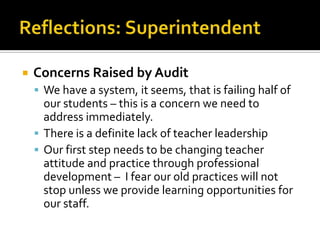
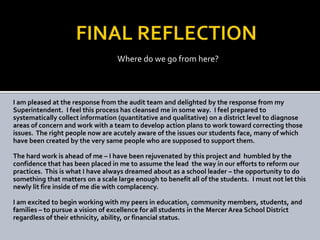
REFLECTIONSI asked my secretary to join the audit meeting to record comments from the audit members – most of these are summarized.  The Superintendent’s comments have been organized separate of other members of the audit team – I wanted to highlight the thoughts of the leader of the district.
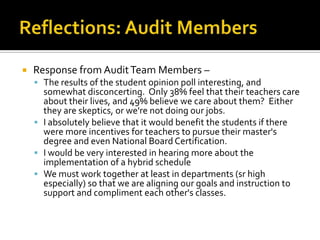
Reflections: Audit MembersResponse from Audit Team Members –It is important that the more experienced teachers share their knowledge and expertise with the newer teachers who in turn need to share new methodologies and advancements.  Why are there so many less students in advanced English?  It is vital for students to be aware of the variety of writing genres, to develop better writing skills, and to gain experience in public speaking whether or not they choose to join forensics.Is there really that much of a difference between their behaviors, or are our expectations and tolerances for/between the genders justified?  I think we should put more emphasis in increasing our efforts to encourage more girls to participate in these courses, which have historically been dominated by the male gender.

Final copy equity audit

  • 1.
    Equity Audit: AreWe Meeting the Needs of All Students in The Mercer Area School District?Timothy J. DadichMercer Area Middle SchoolMercer Area School DistrictGrades K-12
  • 2.
    Equity DefinedEducation EquityTheeducational policies, practices and programs necessary to (a) eliminate educational barriers based on gender, race/ethnicity, national origin, color, disability, age, or other protected group status; and (b) provide equal educational opportunities and ensure that historically underserved or underrepresented populations meet the same rigorous standard for academic performance expected of all children and youth. (Skrla, Mckenzie, & Scheurich, 2009. p. 3-4).Definition adapted from Wisconsin Department of InstructionSystemic EquityThe transformed ways in which systems and individuals habitually operate to ensure that every learner – in whatever learning environment that learner is found – has the greatest opportunity to learn enhanced by the resources and supports necessary to achieve competence, excellence, independence, responsibility, and self sufficiency for school and life ((Skrla, Mckenzie, & Scheurich, 2009. p. 6)
  • 3.
    Why is EquityImportant?We must work toward not limiting students based on the way they look, how much money they make, who they are related to ,or their placement in a program: these factors DO NOT determine ability to learn. Schools need to act as freeways for success – not roadblocks! The world we live in tomorrow belongs to the students in our classrooms today – our classrooms are diverse with students who are too often defined by the color of their skin, gender, or a label provided to them by an adult.Would any of us sit quietly if our child was one of a number of students who:Do not graduateAre not prepared to go to collegeAre underrepresented in advanced classesAre placed in lower level classesReceived less than the best teacher a school has to offer based on past practices.If it is not good enough for our child then why is it good enough for the child of a family we serve?
  • 4.
    THE EQUITY AUDITTEAMEquity Audit Team MembersDr. Gathers
  • 5.
  • 6.
  • 7.
  • 8.
  • 9.
  • 10.
  • 11.
    Special Ed. Directorand Elementary Assistant Principal
  • 12.
  • 13.
    School Counselor andLeadership Team Member
  • 14.
  • 15.
  • 16.
  • 17.
    Teacher and LeadershipTeam MemberDr. William Gathers, Superintendent of Schools, recommended people who have the ability to enact change within the district using the information/data retrieved from the equity audit. The team includes several key administrators, a school counselor, and two teacher leadership team members.
  • 18.
    ConversationsConversation with theSuperintendent, Dr. William Gathers, focused on his genuine concern for the discrepancy that exists between the academic achievement of our general population and those students who have been identified as economically disadvantaged or in need of special education services. Dr. Gathers is genuinely aware of the situation, ready to take action to improve the situation, and is not afraid to have those conversations that could present other leaders and teachers with uncomfortable truths about their actions.One of the most critical pieces of advice that Dr. Gathers has given to me is to improve my patience – he believes I will be more successful if I become more deliberate and patient in my actions.We have also discussed the importance of “keeping the main thing the main thing” by maintaining focus – keep the Eye on the Goal!Initial discussion were held with the following members of the Mercer Area School District:The SuperintendentSeveral Members of the Audit Team: Administration and TeachersGroup of Teacher on the School Leadership TeamThe conversations that took place helped to guide the direction of research and suggestions for solution
  • 19.
    ConversationsConversations with otheraudit members and the teachers on the leadership team demonstrated a slight awareness of the problem at hand; however, there seems to be a predominate belief among some members of both groups that all the roadblocks we face with our students are completely out of our control – it is the “fault” of the home, the parents, or the choices of the students. Some are intent on maintaining the low level classes while others recognize the need to increase academic rigor for all students. Regardless, one very promising element that has surfaced throughout conversations is the desire of the teachers and administrators to work together in addressing the disparities in the achievement of our students – the staff is excited to begin engaging in embedded professional development focused on collaboration and improving instruction for all students. Initial discussion were held with the following members of the Mercer Area School District:The SuperintendentSeveral Members of the Audit Team: Administration and TeachersGroup of Teachers on the School Leadership TeamThe conversations that took place helped to guide the direction of research and suggestions for resolutions
  • 20.
    Components of theEquity AuditTEACHER QUALITY – PROGRAM EQUITY - ACHIEVEMENTTeacher QualityEducationExperience (Years)Experience (Position)CertificationProgrammingDemographic DataGifted & AP/Adv Course EnrollmentSpecial EducationDisciplineAchievementPSSA ResultsGraduation RatesStudents Continuing on to Higher Education
  • 21.
    TEACHER EQUITY“Teacher Qualifications,teachers’ knowledge and skills, make more difference for student learning than any other single factor.” – Linda Darling HammondAre we making available, to EVERY student, a teacher with well-developed skill and knowledge? Do we invest enough of our resources on improving the primary factor for student success – access to high quality instruction?The indicatorsidentified in this section – education, certification, years experience, and experience at the current position can provide a better understanding of how teachers are being utilized within a district and upon further investigation, can provide a pattern of how the best teachers are made accessible to the most needy students
  • 22.
    Teacher Education &Certification
  • 23.
  • 24.
    Experience at CurrentPosition13 year – Dist. Avg.
  • 25.
  • 26.
    Teacher Placement Practices…. Elementary– Many teacher placements are based on need (retirement, move). Teachers have been reassigned based on necessity (more qualified teacher placed in specific grade levels). Secondary –Teachers typically receive the same schedule from year to year because they have always taught that course. Many of our most experienced and rigorous teachers are working with our top students.
  • 27.
    Student Placement PracticesTheelementary building places students into classrooms based on teacher recommendation. Every effort is made to provide a heterogeneous classroom for each instructor. Some consideration is given to match student and teacher personalities, particularly in special ed. programs.The secondary has two basic tracks for students: general and college prep. Inclusion classes are generally scheduled to provide a setting that has the majority of special education students within one or two classes with the special education teacher or aide in to assist the students. The intention is to provide students with an IEP the same instruction of their peers, but with the high concentration of students with an IEP seems to result in a larger special education room that typically moves slower than other sections of the same course.
  • 28.
    Programmatic EquityWhen wesay high expectations for all do we really mean it?It is one thing to take as a given that approximately 50% of an entering group of students in kindergarten may not attend college, but to assign a particular child to a curriculum designed for that 50 % closes that door altogether. Are we comfortable providing only half of our students the best we have to offer?The indicators used identified in this section – Student Demographics, Gifted Education, Advanced Course Placement, Special Education Placement, and Discipline.
  • 29.
  • 30.
  • 31.
  • 32.
  • 33.
  • 34.
  • 35.
  • 36.
  • 37.
  • 38.
  • 39.
  • 40.
  • 41.
  • 42.
  • 43.
    Achievement Equity“The strengthof our nation depends on the strength of our schools.” – Eli BroadAre we comfortable graduating classes where only 60-70% of students are proficient or 50-60% go on to higher education? Would you see a doctor who only maintained a high quality of life for 60-70% of his/her patients? Is this the type of strength we want to provide for our nation and the world?The indicators used identified in this section – 2010 PSSA scores for grades 3-8, 11 in the area of math and reading. Also included is a breakdown of the Class of 2010 in regard to graduation rate and percentage of students heading on to higher education.
  • 44.
  • 45.
  • 46.
    DISTRICT RESULTS: READING2014Cut-Score2012 Cut-Score2011 Cut-Score
  • 47.
    GRADE 3: Math& Reading
  • 48.
    GRADE 4: Mathand Reading
  • 49.
    GRADE 5: Mathand Reading
  • 50.
    GRADE 6: Mathand Reading
  • 51.
    GRADE 7: Mathand Reading
  • 52.
    GRADE 8: Mathand Reading
  • 53.
    GRADE 11: Mathand Reading
  • 54.
  • 55.
  • 56.
  • 57.
  • 58.
    STUDENT POLLWhat doour students have to say?
  • 59.
    Student OpinionStudent OpinionPoll Conducted During the Last Few Weeks of the 2009-2010 School Year.
  • 60.
    293 Secondary Studentsin Grades 7-12 Participated in the Poll.
  • 61.
    Students Surveyed Includea Representative Sample of the Overall Demographics of the Entire School District.
  • 62.
    Students Were AskedQuestions Regarding Climate, Rigor, Relevance, and Attitude Toward SchoolStudent Opinion: Rigor & Relevance78% of respondents are well aware of the school’s expectations for behavior and work50% of respondents are satisfied with program choice and rigor58% of respondents are aware of school goals for improving learning54% of respondents feel they are being adequately prepared for the future70% of respondents feel they are being prepared for college71% of respondents feel their teachers are knowledgeable and prepared to teach for the 21st century
  • 63.
    Student Opinion: Rigor& Relevance54% of respondents feel they are engaged in meaningful conversations about content40% of respondents feel that content is related to everyday life52% of respondents feel they engage in challenging and thought provoking class projects55% of respondents feel teachers utilize a variety of strategies to instruct and assess student learning59% of respondents feel teachers help students achieve high learning expectations
  • 64.
    Student Opinion: Rigor& Relevance42% of respondents feel that homework assigned is relevant and helpfulPlans for After Graduation83% plan to attend college9% plan to pursue a career in the trades (trade school)8% plan to join the work for immediatelyThis year – only 52% of graduating students have currently enrolled in a college or trade school
  • 65.
    Student Opinion: SchoolClimate38% of respondents feel all students are treated fairly72% of respondents are satisfied with the help they receive from teachers90% of respondents feel safe at school16% of respondents have been bullied38% of respondents feel that teachers care about their lives
  • 66.
    Student Opinion: SchoolClimate49% of respondents feel their teachers care about them61% of respondents feel comfortable speaking with their teachers46% of respondents feel that teachers listen to their needs47% of respondents feel there is a mutual respect between teachers and students
  • 67.
    Student Opinion: Attitude45%of respondents are satisfied with what they are learning62% of respondents feel they put forth their very best effort62% of respondents feel they are developing into better readers57% of respondents feel they are developing better skills in math
  • 68.
    Student Opinion: Attitude37%of respondents “like” coming to school every day26% of respondents think school is interesting46% of respondents are proud of their schooling62% of respondents feel they are able to learn about technology and/or utilize their technology skills in the classroom
  • 69.
    FINDINGSWhat does thedata indicate? What can we take from what we know?
  • 70.
    STRENGTHS OF THEDISTRICTTEACHING and COMMUNITYAll teachers are certified in their current placementNo group of teachers (in regard to average experience) is within a range of 10% of the district average for experience; a good indication of equal distribution (Marshall, Olivia 2010)Almost 50% of the instructional staff holds a master’s degreeStrong community involvement within the school
  • 71.
    STRENGTHS OF THEDISTRICTPROGRAMMING and ACHIEVEMENTThe curriculum is currently being revised in K-12 through an effort of the assistant superintendent to achieve rigor and relevance in addition to alignmentThe district has completely upgraded its technology capabilities within the past four yearsThe Mercer Area School District is currently ranked in the top 20% of all districts within the Commonwealth of Pennsylvania in regard to student achievementScores across grade levels and subject areas have remained above required state levels for several years
  • 72.
    Area for Improvement#1:Teachers and AdministrationTeacher Education : increase the number of teachers with masters degree or advanced preparationTeacher Professional Development: improve professional development to align more with our expectations for student learning (rigor, college readiness, inclusion and access for all)Evaluation Procedures: align procedures to focus on effective teaching FOR student learningTeacher Efficacy and Leadership: building level leadership needs to include teacher leaders and the development of self-efficacy for improving learning for all students
  • 73.
    Area for Improvement#2 : ProgrammingHigh Level Coursework: Low representation of students identified as economically disadvantaged in advanced courses and gifted program.More male representation in higher level math and science courses and more female representation exists in English and history.Over Identification: According to the National Dept. of Education, 10-13% of students in the US are identified as needing special education programming. Mercer is at 18.2%. Economically disadvantaged students make up 41% of our student population, but make up over 50% of students identified as in need of special education services and only 8% of the gifted program. Are we identifying students for remediation based on lack of resources at home? Higher numbers of discipline referrals for: males and students identified as economically disadvantaged or in need of special education services.
  • 74.
    Area for Improvement#3 : Student AchievementReading scores are not commensurate with math scores in the elementary schoolTrend reverses itself beginning in the 7th grade. Math scores decline steadily from 6th grade through 11th gradeProficiency steadily declines as students progress through elementary into the secondary building: This is true for all students and for subgroups (special education and economically disadvantaged)An the secondary level, students identified as economically disadvantaged or in need of special education services consistently underperform on state assessments in math and reading in comparison with their peers. This year, only 82% of the seniors who have been receiving special education services since the beginning of the school year graduated in 2010. Only 75% of students identified as economically disadvantaged since the beginning of the school year graduated in 2010Less than 60% of Mercer students attend higher education opportunities after graduation. That percentage is significantly less for students classified in one of the two major subgroups
  • 75.
  • 76.
    SOLUTIONS FOR IMPROVEMENTAREA #1Utilize the district mission to establish a vision of teaching and learning based on relationships, resiliency, reflection, relevance, and rigor.
  • 77.
    SOLUTIONS IMPROVEMENT AREA#11A - Develop Administrative and Teacher Efficacy Recent research points to teacher expectations, teacher quality, and teacher belief in having the ability to impact students. Research has continuously documented the higher achievement levels for students with highly efficacious teachers. This is particularly true for students of low economic status (Hines, Kritsonis 2010)Establish building leadership teams to systematically review student achievement data and teaching practices in order to make recommendation for professional development (Milstein, Henry 2008)
  • 78.
    SOLUTIONS IMPROVEMENT AREA#11A- Develop Administrative and Teacher Efficacy Establish individual SMART Goal setting to focus on specific achievement targets – teachers who take responsibility for student learning can improve student achievement. Control over targets and strategies to reach desired outcomes help develop the belief that teachers can make a difference. (Logerfo, 2006)Administration needs to provide time for teachers to collaborate on instructional teams or departments. This shared responsibility provides a support system for the teachers and administration (Dweck, 2010; Anfara, 2010).
  • 79.
    SOLUTIONS IMPROVEMENT AREA#11B- Develop Teacher Leadership and ExperienceOne of the most consistent findings in all research regarding the closing of the achievement gap points to one major element – experienced, knowledgeable, and qualified teachers (Tajalli, Opheim 2004)Improve incentives for teachers to earn a Master’s degree, especially in areas of high need (reading, math, science, and special education)
  • 80.
    SOLUTIONS IMPROVEMENT AREA#11B- Develop Teacher Leadership and ExperienceDevelop incentives to encourage National Board Certification for teachers and administrationNational Board Certification Process is one of the most rigorous certification processes in existence for teachers. Teachers seeking national board certification must pass a content area test and portfolio assessment requiring them to diagnose and develop remedies for student learning difficulties. This is job embedded professional development at its best.
  • 81.
    SOLUTIONS IMPROVEMENT AREA#11B- Develop Teacher Leadership and ExperienceNational Board Certification (Harris, Sass, 2009) Recent studies in Florida and North Carolina point to National Board Certification and the development of learning communities with board certified teachers as teacher leaders for the 4-5% increases in student achievement on standardized assessmentsNational Board Certification (Berry, Johnson, Montgomery 2005)North Carolina is currently the leader in board certified teachers with over 10% of its’ teachers achieving certification.The majority of schools in North Carolina have gone from emergency to School’s of Distinction within two years of establishing certification requirements.Adams Elementary went from 20-40% proficiency to 80% of students meeting grade level standards within four years of having 13 teachers receiving National Board Certification.
  • 82.
    SOLUTIONS FOR IMPROVEMENTAREA #2Increase access to higher level programming and revitalize strategies used in special programming.
  • 83.
    SOLUTIONS IMPROVEMENT AREA#22A – Close the Achievement Gap Utilizing Coursework and Principles from Gifted Education and Advanced/College Prep ProgrammingThe underrepresentation of minority students and students of low economic status in gifted programs and advanced/college prep courses is a major contributor to the achievement gap (Ford, 2006; Jones, Zirkel, Barrack)The rigor in the programs is a major concern in education programming. The tracking of students into college prep or general courses sends a strong message of “We do not believe in you.” The field of gifted education and the culture of advanced coursework prides itself on excellence and rigor; often having the most talented teachers. (Ford, 2006) The secondary building has recently begun the process of removing barriers to higher level math – the same should be done for English and science. The potential also exists to eliminate special education programming altogether in the elementary students, utilizing special education teachers as co-teachers in the general classroom in primary grades. (Jones, Zirkel, Barrack…
  • 84.
    SOLUTIONS IMPROVEMENT AREA#22B – Develop Co-Teaching Methods to Replace Traditional Pull Out ProgramsHigh stakes testing has increased the pressure on students to achieve grade level expectations – special education students do not thrive in this situation. Furthermore, maintaining low level courses and filling them with students who have learning disabilities will seldom lead to higher levels of achievement (Fontana, 2005).Time spent in on collaboration between teachers of general education and special education has proven to contribute to student achievement for both ‘regular’ education students and students receiving special education services (Fontana, 2005; Patterson, Connolly, Ritter 2010) .Recent studies in middle schools implementing co-teaching methods show significant improvement in student achievement on state assessments in both math and reading (Fontana, 2005).Co-Teaching permits a partnership in where all students are served by two teachers working together to promote the success of all students with learning goals (Patterson, Connolly, Ritter 2010).
  • 85.
    SOLUTIONS IMPROVEMENT AREA#22C – Change the Way Mercer Utilizes TimeThere is wide belief that many students lose up to a month or more of knowledge over long summer breaks. This is particularly true for students of low economic status – where they are typically not able to afford summer programs or attend enrichment activities (Cooper, Valentine, Charlton, Melson 2003; Stewart 2010)
  • 86.
    SOLUTIONS IMPROVEMENT AREA#22C – Change the Way Mercer Utilizes TimeNew Albany High School in New Albany, Ohio underwent a dramatic change in their schedule several years ago. In 1999 the principal of the school and his leadership team identified three key factors needed to improve student learning: (a) change the structure of the day for more professional collaboration, (b) create more time for student intervention, and (c) strengthen relationships between teachers and students. The schedule that was created was remarkably different and is still in operation today. The hybrid schedule increases time sent in a period from 42 to 50 minutes by cutting out one period in the day. This schedule has helped New Albany High School become a model high achievement district in the state of Ohio.
  • 87.
    SOLUTIONS IMPROVEMENT AREA#22C – Change the Way Mercer Utilizes TimeDevelop a hybrid schedule to allow for more teacher collaboration and contact time with students.Under the hybrid schedule at the secondary building, three sessions of a course per week increases from 43/45 minutes to no less than 50 minutes. The course will meet an additional day for an extended period of time lasting 90 minutes. This increase the amount of time spent in a course (per week) from 215/225 minutes to 240 minutes - this equates to an increase of approximately 500 – 1000 minutes per year from the current amount of time our students spend in classes.
  • 88.
    SOLUTIONS IMPROVEMENT AREA#22C – Change the Way Mercer Utilizes TimeReading levels in the elementary are lower than math scores. This is particularly true again for students of low economic status and students in identified for special education servicesTraditional summer school programs focus on remediation. The district could develop a summer reading camp for students in the primary grades
  • 89.
    SOLUTIONS IMPROVEMENT AREA#22C – Change the Way Mercer Utilizes TimeSummer reading camps for economically disadvantaged and special education students that focus on higher level comprehension, writing, and application to content areas have proven to increase and maintain reading comprehension ability through the next grade level (Borman, Goetz, Dowling 2009; Schacter, Jo 2005). Mercer could save on cost for the program by partnering with several local colleges and their primary education/master’s level reading certification programs. The program, if successful, could develop to include summer math or science camps.Utilize current summer camps at Thiel College
  • 90.
    SOLUTIONS FOR IMPROVEMENTAREA #3Create an Aligned System of High Expectations for Leadership, Teaching, and Learning
  • 91.
    SOLUTIONS IMPROVEMENT AREA#33A – Instruction and SupervisionRobert Marzano (2010) recently produced his much anticipated White Paper: Creating an Aligned System To Develop Great Teachers Within the Federal Race To The Top Initiative. According to Marzano, schools should adopt a comprehensive professional learning system that: (a) reflects the complexity of the teaching and learning process(b) uses real-time data to fairly provide feedback to teachers regarding their effectiveness at promoting student learning(c) provides targeted, aligned, and differentiated professional development to help teachers collaborate and reflect on way to improve student learning.
  • 92.
    SOLUTIONS IMPROVEMENT AREA#33A – Instruction and Supervision A philosophical and theoretical view of knowledge and learning centered on constructivism offers hope that educational processes that enable students to acquire deep understanding rather than superficial skills will eventually take hold in public education. The hope is that students will experience and understand the power of their own mind (Blais, 1988, p. 2-7) Robert Marzano and Jane Pollock developed a list of 9 instructional strategies for differentiation in the classroom centered on the idea of students constructing knowledge through engagement and higher level thought process in their book Classroom Instruction That Works (2001)Principals evaluate only a tiny amount of teaching – if a teacher has 5 classes per day for 180 days that equates to 900 periods of teaching. With this in mind, observing only one period is equal to only .1% of the instruction taking place in the classroom. This is hardly adequate time to monitor the quality of instruction taking place (Marshall 2005).
  • 93.
    SOLUTIONS IMPROVEMENT AREA#33A – Instruction and SupervisionThere are several key components common through highly effective school programs (Wei, Andree, Darling-Hammond, 2009): (a) time built into the day for professional development(b) embedded activities and accountability(c) a variety of options including online-learning(d) supportive induction programs for new staff (e) school governance procedures that sustain accountability for curriculum, instruction, and assessment
  • 94.
    SOLUTIONS IMPROVEMENT AREA#33A – Instruction and SupervisionA critical component to accomplish the goal of improving instruction in the classroom is the establishment of a common vision, rigorous curriculum, and common model of instruction (Marzano, 2010; Blackburn & Williamson 2010; Riddile, 2010).Each building should develop a common framework for instruction that should (Marzano, 2010 and Pollock 2009)Require more student participation in goal setting and generalization of lesson objectivesRelate directly to prior knowledge or the lives of studentsDistinguish between declarative and procedural learning and align assessments to the specific learning typeProvide students an opportunity to transfer knowledge to new learning situations Reside in and not just visit the upper levels of Bloom’s Taxonomy of Learning.Each grade level and department should meet at the beginning of the year toAnalyze the district mission to define what it means for their grade or subject areaEstablish a set of common standards for instruction that emulates the district vision for a rigorous and relevant curriculumMeet regularly to align and evaluate practices to ensure the needs of all students are being met
  • 95.
    SOLUTIONS IMPROVEMENT AREA#33A – Instruction and SupervisionThe elimination of general classes would require significant training of Mercer Area School District staff in the practice of Differentiated Instruction and Instructional Strategies that work – this would require a partnership between trained professionals, building principals, and teacher leaders. Positive school gains over four years in schools that actively utilize differentiated instruction methods to challenge all learners with a highly relevant and rigorous curriculum have regularly been recorded in school research (Stanford, Reeves, 2009). Administrators and teachers must learn to plan for student success rather than respond to instructional needs – differentiated instruction provides a framework for teachers to plan multiple strategies and assessments to meet the needs of students.Building Principals should work with teacher leader teams and central office to improve the quality of professional development to promote rigorous and relevant instruction that meets the needs of all students.
  • 96.
    SOLUTIONS IMPROVEMENT AREA#33A – Instruction and SupervisionMarshall (2005) makes several recommendations for Supervision and Evaluation – All of these could be implemented in the current revision of the secondary buildings evaluation procedures.Make sure the basics are in place: time for teams to engage in common planning and establish crystal clear expectations for teaching and learningPrincipals should systematically visit classrooms: fifteen 10-15 minute observations should be made throughout the year focusing on the expectations established in partnership between teacher teams and administrationPrompt face-to-face feedback should be providedConsider encouraging teacher teams to develop common unit plans and evaluate the entire unit plan through lesson investigations and visits – better to observe an entire unit of teachers working together than each teacher once in isolationRequire teams of teachers to give interim assessments focusing on standards covered and include in evaluationsCreate a professional learning culture in the school – establish small cohorts of teachers to be trained through an embedded professional development program
  • 97.
    SOLUTIONS IMPROVEMENT AREA#33B– From Hope to BeliefEffective leaders work with staff and students to accomplish several beliefs/practices:To ensure every student is known, cared about, and pushed to his or her full potentialTo create a culture where everyone feels connected and valuedTo establish an environment that encourages students to pursue and attain their dreams and aspirationsTo work with staff to create a culture where issues such as low parent involvement, low income, contracts, and learning concerns do not impede academic successTo reach beyond ‘what is’ to attain ‘what could be’
  • 98.
    SOLUTIONS IMPROVEMENT AREA#33B– From Hope to BeliefMake higher education an option for all studentsProvide better access (earlier and more frequently) to information regarding student loans and financial aid opportunitiesDevelop a scholarship program focused specifically on providing resources to low-income and special education studentsIncrease Opportunities for Early College Enrollment for All StudentsExpose students as early as middle school to college programs through visitations and college fairsJ.B Thomas Middle School currently operates a college visitation program with local universities specifically for low-income and special education students – it has been an absolute success. One low-income student recently stated, “I always thought about going to college. Now I really want to go.”As a result of this program, there has since been an increase in the number of students taking college prep courses and students pursuing higher education after graduation. (Burgess , 2009).
  • 99.
    REFLECTIONSI asked mysecretary to join the audit meeting to record comments from the audit members – most of these are summarized. The Superintendent’s comments have been organized separate of other members of the audit team – I wanted to highlight the thoughts of the leader of the district.
  • 100.
    Reflections: Audit MembersResponsefrom Audit Team Members –It is important that the more experienced teachers share their knowledge and expertise with the newer teachers who in turn need to share new methodologies and advancements.  Why are there so many less students in advanced English?  It is vital for students to be aware of the variety of writing genres, to develop better writing skills, and to gain experience in public speaking whether or not they choose to join forensics.Is there really that much of a difference between their behaviors, or are our expectations and tolerances for/between the genders justified?  I think we should put more emphasis in increasing our efforts to encourage more girls to participate in these courses, which have historically been dominated by the male gender.