PALAYAN CITY NATIONAL HIGH SCHOOL 
Atate, Palayan City 
INVESTIGATION OF SELECTED PHYSICAL PROPERTIES 
OF TALISAY (Terminalia catappa L.) SEED OIL 
An Investigatory Project Report presented to the Regional Scientific Review 
Committee as official entry to the Science and Technology Fair 2011-2012 
RAMOS, Maria Elaine F. 
CORTEZ, Niña Jemia D. 
RIAZA, Rizza Mae A. 
JOEL R. GALLARDE 
Adult Sponsor 
September 2011
Table of Contents 
Abstract 
Chapter I. Research Plan 
Materials 
Equipment 
Method 
Testing 
Statistical Analysis 
Chapter II. Introduction 
Background 
Statement of the Problem 
Hypothesis 
Significance of the Study 
Scope and Delimitations 
Review of Literature and Studies 
Chapter III. Results and Discussion 
Chapter IV. Conclusions 
Chapter V. Recommendations 
Bibliography / References 
Acknowledgement
ABSTRACT 
This study aims to make use of Talisay nuts as an alternative source of cooking 
oil. The Talisay fruits used were from different locations in Palayan City, Nueva Ecija. 
The gathered talisay fruits were mature. The talisay fruit pulp were removed using a 
hammer. Out of 2kg of mature talisay fruit 200g of nuts were obtained. To produce oil 
out of talisay nuts, the researchers directly dried the collected talisay nuts under the sun. 
After sun drying the nuts became 175g. The nuts were pressed using G-clamp in 10g 
packs. Based on the procedure that the researchers conducted, it yields 42.86 % of oil 
from 175 g of dried talisay nuts. Smoke point was measured and found out that talisay 
oil reaches a smoke point of 230°C. Viscosity test results showed that the talisay oil have 
no significant difference with that of the high and low valued palm oils. 
With the use of statistical tools, the researchers then concluded that there were no 
significant difference between talisay (Terminalia catappa) nuts, high quality and low 
quality cooking oil in terms of color, viscosity and smoke point.
RESEARCH PLAN 
Materials 
This study was conducted in the Science Laboratory of Palayan City National 
High School, Brgy. Atate, Palayan City, for the period of June 20, 2011 to September 1, 
2011. 
The talisay fruits were collected under the talisay trees in Palayan City. Only 
mature fruits were collected since these brown colored fruits have mature nuts 
appropriate for the purpose of the study. Two kilograms of mature talisay fruit were 
obtained, cleaned and husked. A hammer was used to collect the seeds/nuts from the 
mature talisay fruit. 
The researcher weighed the obtained nuts from mature talisay fruits. Two 
hundred grams of clean nuts were then scattered in a perforated tray and was dried under 
direct sunlight for 3 days at 6 hours per day. 
Oil Extraction 
Oil extraction from nuts can be done using a number of methods: manual press, 
expeller, and solvent extraction (practical action, 2011). This study utilized the manual 
press system. 
In making talisay oil the materials used are 200g of fresh mature talisay nuts, G-clamp, 
sterile container, perforated tray, glass funnel, beaker, test tube rack, filter paper, 
graduated cylinder and an improvised sample bag made of mosquito net. 
Ten grams of dried talisay nuts were placed in an improvised sample bag. Each of
the bags were then subjected to pressure using a G-Clamp. The oil was then collected 
using a sterile container as a catch basin. This process was repeated until all samples are 
used up. 
Oil Filtration 
The extracted oil was filtered in a glass funnel using a filter paper No. 102. The 
filtration set up was simply composed of a test tube rack, beaker, funnel and filter paper. 
The researchers let the oil drip for 24 hours and the resulting filtrate volume was then 
measured using a graduated cylinder, and was weighed using a gram scale. 
Testing 
Visual Evaluation 
The color and the clarity of the oils were observed by placing 20mL of the three 
oil samples in three test tubes placed in a test tube rack. The treatment labels are as 
follows: 
T1- talisay cooking oil 
T2- low quality cooking oil (palm oil) 
T3- high quality cooking oil (pure palm oil) 
The qualities observed were ranked by the range of 1-3 with 1 being the highest 
and 3 being the lowest.
Smoke Point 
Twenty millilitres of each oil samples were placed in a 100mL beaker and 
subjected to heat using electric hot plate. The highest temperature is taken and recorded. 
The treatment labels are as follows: 
T1- talisay cooking oil 
T2- low quality cooking oil (palm oil) 
T3- high quality cooking oil (pure palm oil) 
Viscosity 
In getting the viscosity of the talisay cooking oil, the researchers used an electric 
stove in heating 200 mL of water in a pyrex beaker and they let the water reached its 
smoke point. 
The researchers poured 10 mL of talisay oil with 11 cm height in a test tube before 
heating and dropping the metal ball. 
Using test tube holder, the talisay oil was placed in the beaker with boiling water. 
Alcohol thermometer was used to measure the temperature of the talisay oil. 
When the temperature of the oil reached 100°C, the metal ball metal ball was 
released. Using the stopwatch, the time that the metal ball was released and touched the 
bottom of the test tube was recorded. The measurement was performed three times. A 
tong was used to remove the metal ball. The talisay oil was cooled by placing the test 
tube in an ice bath. The talisay oil was stirred to insure uniform temperature. The 
temperature of the oil was checked in every ten minutes. The talisay oil was recorded 
when it was no longer changed.
In getting the viscosity of the low and high quality cooking oil, the same 
procedures were performed. 
Statistical Analysis 
Data were presented using tables and computing means. Using the means from 
the data obtained, the t-test was used to compare if there is a significant difference 
between the means. 
Hypothesis 
There is no significant difference between cooking oil from talisay (Terminalia 
catappa) nuts and commercial one on the physical properties being investigated.
INTRODUCTION 
Background of the study 
Prices of cooking oil for the past years have significantly increased. Price of 
cooking oil per liter has been significantly higher than prices of petroleum products. 
Cooking oil have been part of our modern day living. The demand for cooking oil 
is too high, we used it for our basic necessities such as frying, baking, flavoring, sauces, 
and margarine among others. People want to make sure that the cooking oil they are 
using has high quality and at the same time economical and low cost. 
That's why the researchers desire to produce cooking oil out of talisay (Terminalia 
catappa ) nuts. 
Statement of the Problem 
Due to inevitable increase in the price of commodities, the demand on cooking oil 
has been the main concern of the society and it has become a highly visible issue in our 
country. 
This study was conducted to determine the physical properties of talisay 
(Terminalia catappa) nuts for the production of quality cooking oil. 
Specifically, it sought to answer the following: 
1. How much oil can be extracted from talisay nuts using manual press 
system expressed in percent yield?
2. How could cooking oil from talisay (Terminalia catappa) nuts compared 
to low quality and high quality palm oils in terms of some physical 
properties: 
a. Color 
b. Clarity 
c. Boiling or Smoke Point 
d. Viscosity 
Significance of the Study 
The aim of this study is to produce and to prove the feasibility of talisay 
(Terminalia catappa) nuts for the production of cooking oil based on the physical 
properties being invesigated. Specifically this study will be significant and helpful to the 
following: 
Food vendors. They can have good quality of cooking oil at low price. 
Households. They can avoid the use of low quality cooking oil and they can assure that 
the cooking oil they are using is safe and healthy for their family and also can lessen their 
expenses. 
Farmers. They can start planting talisay tree as their another source of income.
Environment. Planting talisay trees can help lessen the air pollution and prevent floods 
and landslides. 
Researcher. It can serve as a basis for further development. This study will enhance their 
skill and knowledge in conducting experiments which they can use for personal and even 
for income generation. 
Students. This may serve as an eye opener and encourage them to undertake product 
development. 
Scope and Delimitations of the Study 
This study using talisay (Terminalia catappa) nuts was conducted to identify a 
feasible source of edible oil. Physical properties are limited to the following: color, 
clarity, smoke point, and viscosity. 
The research was conducted from June 20, 2011 to September 1, 2011. 
Preparation of the samples and conduct of different tests were held at the Science 
Laboratory Room, Palayan City National High School at Atate, Palayan City. 
Operational Definition of Terms 
Words which are used extensively in this study have been defined for better 
understanding of prospective readers. These terms are as follows:
G-clamp- a simple device used to press the dried talisay nuts in order to get the oil. 
Pound- a process of removing the pericarp of the talisay fruits with the use of hammer. 
Perforated tray- a container in which the talisay nuts were place during the sundrying 
process. 
Mature fruit- is the ripe fruit of talisay that had fallen off and was collected in the feet of 
the tree. 
Smoke point- the highest temperature that the liquid applied with heat at room 
temperature. 
Review of Related Literature 
Cooking Oil 
Cooking oil is purified fat of plant origin, which is usually liquid at room 
temperature (saturated oils such as coconut and palm are more solid at room temperature 
than other oils).
Some of the many different kinds of edible vegetable oils include: olive oil, palm 
oil, soybean oil, canola oil, pumpkin seed oil, corn oil, sunflower oil, safflower oil, 
peanut oil, grape seed oil, sesame oil, argan oil and rice bran oil 
Early peoples learned to use the sun, a fire, or an oven to heat oily plant products 
until the plants exuded oil that could then be collected. The Chinese and Japanese 
produced soy oil as early as 2000 B.C. , while southern Europeans had begun to produce 
olive oil by 3000 B.C. In Mexico and North America, peanuts and sunflower seeds were 
roasted and beaten into a paste before being boiled in water; the oil that rose to the 
surface was then skimmed off. Africans also grated and beat palm kernels and coconut 
meat and then boiled the resulting pulp, skimming the hot oil off the water. Some oils 
have become available only recently, as extraction technology has improved. Corn oil 
first became available in the 1960s. 
A stamper press that was invented in Holland in the 1600s and used until the 
1800s to extract oil, a roll mill invented by English engineer John Smeaton in 1750 to 
crush vegetable matter more efficiently, and the hydraulic press, invented by Joseph 
Bramah in England. The first improved screw press was invented by V. D. Anderson in 
the United States in 1876. His Expeller (a trade name) continuously operated a cage 
press. When vegetable matter was placed in Anderson's closed press, the resultant oil 
drained out of slots in the side. A screw increased the pressure through the cage toward a 
restricted opening. 
Enhancements in grinding and pressing plant matter were followed by
improvements in extracting the oil. In 1856, Deiss of England obtained the first patent for 
extraction of oil using solvents, following experiments by Jesse Fisher in 1843. At first, 
solvents such as benzene were pumped through the material and drained through false 
perforated bottoms. Later, Bollman and Hildebrandt of Germany independently 
developed continuous systems that sprayed the material with solvent. Both methods were 
eventually improved, and today solvent extraction is standard in the vegetable oil 
industry. 
Related Studies 
Oil Extraction 
In a study conducted by Haque M.A. and others (2009), oil from the seeds are 
extracted through pressure. Before subjecting the seeds to pressure, the seeds were sun-dried 
for several hours. It is also noted that in the absence of direct sunlight, the seeds 
may be roasted in an oven for 10 minutes. 
Likewise, in an article published in practical action, oil extraction process can be 
done by using presses or simply by directly applying pressure. Soft nuts and seeds can be 
pressed while hard nuts need the use of solvents in the extraction process.
Percent Yield 
In a study conducted by Matos and others, in 2009 the yield percentage is 
computed to approximate the production efficiency of the nuts in terms of the amount of 
oil produced from the nuts. Shown below is the equation in solving the percentage yield: 
% yield of oil = weight of extracted oil x 100 
weight of seed (dried) 
Measurement of Viscosity 
Based on an online article published by the Hawaii Space Grant Consortium 
(1996) Viscosity of liquids can be measured with a special piece of glassware called 
a viscometer. Fluid is drawn up from the cup on the lower left into the tube on the right, 
using a suction bulb. The suction is removed, and the time it takes for the fluid to drain 
out is measured. The higher the viscosity, the longer it will take the fluid to drain through 
the tube. To measure viscosity at different temperatures, the viscometer is placed in a 
water bath. 
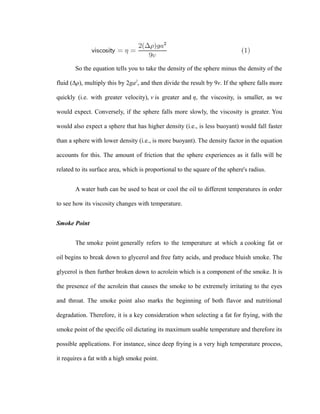
The equation below (Equation 1) shows you how to calculate the viscosity from 
your measurements. It may look intimidating at first, because it has some Greek letters in 
it, but don't let that scare you. The variable commonly used to represent viscosity is the 
Greek letter "eta" (η). The variable commonly used to represent density is the Greek letter 
"rho" (ρ). The capital Greek letter "delta" (Δ) is often used as shorthand for taking the 
difference of something. The other variables in the equation are g, for the accleration due 
to gravity (980 cm/s2), a for the radius of the sphere (in cm), and v for the average 
velocity of the sphere as it falls through the fluid (in cm/s). The result is in units 
of poise (g/cm·s).
So the equation tells you to take the density of the sphere minus the density of the 
fluid (Δρ), multiply this by 2ga2, and then divide the result by 9v. If the sphere falls more 
quickly (i.e. with greater velocity), v is greater and η, the viscosity, is smaller, as we 
would expect. Conversely, if the sphere falls more slowly, the viscosity is greater. You 
would also expect a sphere that has higher density (i.e., is less buoyant) would fall faster 
than a sphere with lower density (i.e., is more buoyant). The density factor in the equation 
accounts for this. The amount of friction that the sphere experiences as it falls will be 
related to its surface area, which is proportional to the square of the sphere's radius. 
A water bath can be used to heat or cool the oil to different temperatures in order 
to see how its viscosity changes with temperature. 
Smoke Point 
The smoke point generally refers to the temperature at which a cooking fat or 
oil begins to break down to glycerol and free fatty acids, and produce bluish smoke. The 
glycerol is then further broken down to acrolein which is a component of the smoke. It is 
the presence of the acrolein that causes the smoke to be extremely irritating to the eyes 
and throat. The smoke point also marks the beginning of both flavor and nutritional 
degradation. Therefore, it is a key consideration when selecting a fat for frying, with the 
smoke point of the specific oil dictating its maximum usable temperature and therefore its 
possible applications. For instance, since deep frying is a very high temperature process, 
it requires a fat with a high smoke point.
Hence, smoke point is one of the important characteristics to consider an edible 
oil suitable for cooking. 
Talisay 
In a study conducted by Matos(2007) as published in Advance Journal of Food 
Science and Technology(2009). Proximate analyses showed that the seed contained 
4.13% moisture, 23.78% crude protein, 4.27% ash, 4.94% crude fiber, 51.80% fat, 
16.02% carbohydrate and 548.78 Kcal Calorific value.The seeds were found to be good 
sources of minerals. Potassium (9280 ± 0.14 mg/100g) was the highest, followed in 
descending order by Calcium (827.20±2.18 mg/100g), Magnesium (798.6 ± 0.32 
mg/100g) and Sodium (27.89± 0.42 mg/100g). 
The physical properties of the oil extracts showed the state to be liquid at room 
temperature. The oil was found to contain high levels of unsaturated fatty acids, 
especially oleic (up to 31. 48%) and linoleic (up to 28.93%). 
Terminalia catappa oil can be classified in the oleic-linoleic acid group. The 
dominant saturated acids were palmitic (up to 35.96%) and stearic (up to 4.13%). The oil 
extracts exhibited good physical properties and could be useful as edible oils and for 
industrial applications. 
Likewise, in a study conducted by Ibironke and others (2007), proves that talisay 
nuts and oil is not toxic in any amounts as compared to other oils being investigated. 
Fatty acid analysis of the oils showed that they have high amounts of unsaturated fatty 
acids with linoleic and oleic acids as the major ones.
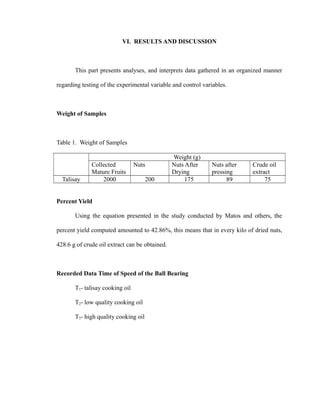
VI. RESULTS AND DISCUSSION 
This part presents analyses, and interprets data gathered in an organized manner 
regarding testing of the experimental variable and control variables. 
Weight of Samples 
Table 1. Weight of Samples 
Weight (g) 
Collected 
Mature Fruits 
Nuts Nuts After 
Drying 
Nuts after 
pressing 
Crude oil 
extract 
Talisay 2000 200 175 89 75 
Percent Yield 
Using the equation presented in the study conducted by Matos and others, the 
percent yield computed amounted to 42.86%, this means that in every kilo of dried nuts, 
428.6 g of crude oil extract can be obtained. 
Recorded Data Time of Speed of the Ball Bearing 
T1- talisay cooking oil 
T2- low quality cooking oil 
T3- high quality cooking oil
Table 2. Time it takes for the ball bearing to reach the bottom of the test tube at room 
temperature. 
Treatment Replication (s) Total Average 
1 2 3 
T1 19.88 20.17 19.31 59.36 19.79 
T2 21.56 20.97 21.24 63.77 21.26 
T3 20.04 19.26 18.13 57.43 19.14 
At room temperature the oil remains in liquid state. During the tests conducted, 
the metal ball at treatment 3 reached the bottom of the test tube in the fastest time with an 
average of 19.14s. While, treatment 2 showed the slowest time to reach the bottom of the 
test tube with an average of 21.26s. 
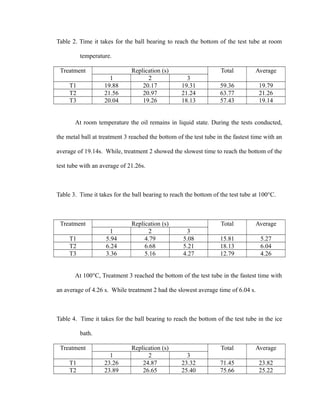
Table 3. Time it takes for the ball bearing to reach the bottom of the test tube at 100°C. 
Treatment Replication (s) Total Average 
1 2 3 
T1 5.94 4.79 5.08 15.81 5.27 
T2 6.24 6.68 5.21 18.13 6.04 
T3 3.36 5.16 4.27 12.79 4.26 
At 100°C, Treatment 3 reached the bottom of the test tube in the fastest time with 
an average of 4.26 s. While treatment 2 had the slowest average time of 6.04 s. 
Table 4. Time it takes for the ball bearing to reach the bottom of the test tube in the ice 
bath. 
Treatment Replication (s) Total Average 
1 2 3 
T1 23.26 24.87 23.32 71.45 23.82 
T2 23.89 26.65 25.40 75.66 25.22
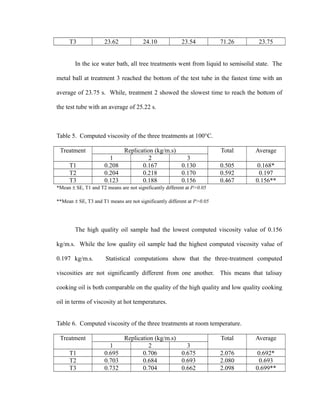
T3 23.62 24.10 23.54 71.26 23.75 
In the ice water bath, all tree treatments went from liquid to semisolid state. The 
metal ball at treatment 3 reached the bottom of the test tube in the fastest time with an 
average of 23.75 s. While, treatment 2 showed the slowest time to reach the bottom of 
the test tube with an average of 25.22 s. 
Table 5. Computed viscosity of the three treatments at 100°C. 
Treatment Replication (kg/m.s) Total Average 
1 2 3 
T1 0.208 0.167 0.130 0.505 0.168* 
T2 0.204 0.218 0.170 0.592 0.197 
T3 0.123 0.188 0.156 0.467 0.156** 
*Mean ± SE, T1 and T2 means are not significantly different at P>0.05 
**Mean ± SE, T3 and T1 means are not significantly different at P>0.05 
The high quality oil sample had the lowest computed viscosity value of 0.156 
kg/m.s. While the low quality oil sample had the highest computed viscosity value of 
0.197 kg/m.s. Statistical computations show that the three-treatment computed 
viscosities are not significantly different from one another. This means that talisay 
cooking oil is both comparable on the quality of the high quality and low quality cooking 
oil in terms of viscosity at hot temperatures. 
Table 6. Computed viscosity of the three treatments at room temperature. 
Treatment Replication (kg/m.s) Total Average 
1 2 3 
T1 0.695 0.706 0.675 2.076 0.692* 
T2 0.703 0.684 0.693 2.080 0.693 
T3 0.732 0.704 0.662 2.098 0.699**
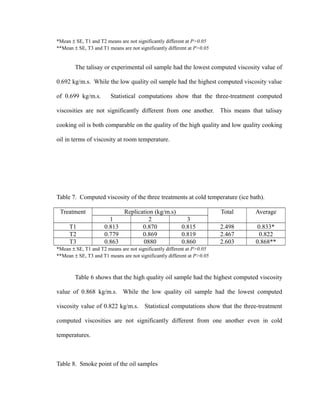
*Mean ± SE, T1 and T2 means are not significantly different at P>0.05 
**Mean ± SE, T3 and T1 means are not significantly different at P>0.05 
The talisay or experimental oil sample had the lowest computed viscosity value of 
0.692 kg/m.s. While the low quality oil sample had the highest computed viscosity value 
of 0.699 kg/m.s. Statistical computations show that the three-treatment computed 
viscosities are not significantly different from one another. This means that talisay 
cooking oil is both comparable on the quality of the high quality and low quality cooking 
oil in terms of viscosity at room temperature. 
Table 7. Computed viscosity of the three treatments at cold temperature (ice bath). 
Treatment Replication (kg/m.s) Total Average 
1 2 3 
T1 0.813 0.870 0.815 2.498 0.833* 
T2 0.779 0.869 0.819 2.467 0.822 
T3 0.863 0880 0.860 2.603 0.868** 
*Mean ± SE, T1 and T2 means are not significantly different at P>0.05 
**Mean ± SE, T3 and T1 means are not significantly different at P>0.05 
Table 6 shows that the high quality oil sample had the highest computed viscosity 
value of 0.868 kg/m.s. While the low quality oil sample had the lowest computed 
viscosity value of 0.822 kg/m.s. Statistical computations show that the three-treatment 
computed viscosities are not significantly different from one another even in cold 
temperatures. 
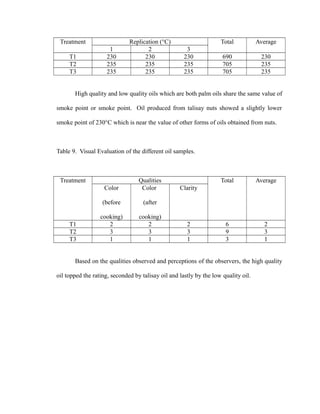
Table 8. Smoke point of the oil samples
Treatment Replication (°C) Total Average 
1 2 3 
T1 230 230 230 690 230 
T2 235 235 235 705 235 
T3 235 235 235 705 235 
High quality and low quality oils which are both palm oils share the same value of 
smoke point or smoke point. Oil produced from talisay nuts showed a slightly lower 
smoke point of 230°C which is near the value of other forms of oils obtained from nuts. 
Table 9. Visual Evaluation of the different oil samples. 
Treatment Qualities Total Average 
Color 
(before 
cooking) 
Color 
(after 
cooking) 
Clarity 
T1 2 2 2 6 2 
T2 3 3 3 9 3 
T3 1 1 1 3 1 
Based on the qualities observed and perceptions of the observers, the high quality 
oil topped the rating, seconded by talisay oil and lastly by the low quality oil.
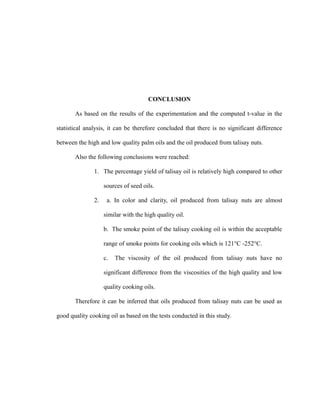
CONCLUSION 
As based on the results of the experimentation and the computed t-value in the 
statistical analysis, it can be therefore concluded that there is no significant difference 
between the high and low quality palm oils and the oil produced from talisay nuts. 
Also the following conclusions were reached: 
1. The percentage yield of talisay oil is relatively high compared to other 
sources of seed oils. 
2. a. In color and clarity, oil produced from talisay nuts are almost 
similar with the high quality oil. 
b. The smoke point of the talisay cooking oil is within the acceptable 
range of smoke points for cooking oils which is 121°C -252°C. 
c. The viscosity of the oil produced from talisay nuts have no 
significant difference from the viscosities of the high quality and low 
quality cooking oils. 
Therefore it can be inferred that oils produced from talisay nuts can be used as 
good quality cooking oil as based on the tests conducted in this study.
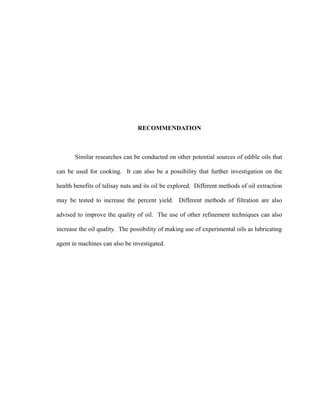
RECOMMENDATION 
Similar researches can be conducted on other potential sources of edible oils that 
can be used for cooking. It can also be a possibility that further investigation on the 
health benefits of talisay nuts and its oil be explored. Different methods of oil extraction 
may be tested to increase the percent yield. Different methods of filtration are also 
advised to improve the quality of oil. The use of other refinement techniques can also 
increase the oil quality. The possibility of making use of experimental oils as lubricating 
agent in machines can also be investigated.
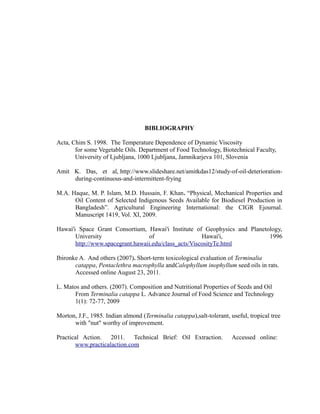
BIBLIOGRAPHY 
Acta, Chim S. 1998. The Temperature Dependence of Dynamic Viscosity 
for some Vegetable Oils. Department of Food Technology, Biotechnical Faculty, 
University of Ljubljana, 1000 Ljubljana, Jamnikarjeva 101, Slovenia 
Amit K. Das, et al, http://www.slideshare.net/amitkdas12/study-of-oil-deterioration-during- 
continuous-and-intermittent-frying 
M.A. Haque, M. P. Islam, M.D. Hussain, F. Khan. “Physical, Mechanical Properties and 
Oil Content of Selected Indigenous Seeds Available for Biodiesel Production in 
Bangladesh”. Agricultural Engineering International: the CIGR Ejournal. 
Manuscript 1419, Vol. XI, 2009. 
Hawai'i Space Grant Consortium, Hawai'i Institute of Geophysics and Planetology, 
University of Hawai'i, 1996 
http://www.spacegrant.hawaii.edu/class_acts/ViscosityTe.html 
Ibironke A. And others (2007). Short-term toxicological evaluation of Terminalia 
catappa, Pentaclethra macrophylla andCalophyllum inophyllum seed oils in rats. 
Accessed online August 23, 2011. 
L. Matos and others. (2007). Composition and Nutritional Properties of Seeds and Oil 
From Terminalia catappa L. Advance Journal of Food Science and Technology 
1(1): 72-77, 2009 
Morton, J.F., 1985. Indian almond (Terminalia catappa),salt-tolerant, useful, tropical tree 
with "nut" worthy of improvement. 
Practical Action. 2011. Technical Brief: Oil Extraction. Accessed online: 
www.practicalaction.com
Vles, R.O. And J.J. Gottenbos, 1989. Nutritional Characteristics and Food Uses of 
Vegetable Oils. In:Oil crops of the world. G. Robblen, R.K. Downeyand A. Ashri, 
(Eds.). Accessed Online: August 23, 2011. 
ACKNOWLEDGEMENT 
It is the researcher’s honor to acknowledge the persons who joined their hands 
and exerted their efforts in making this study successful one. 
To their research teacher, Joel R. Gallarde, for his full supervision and 
guidance just to make this research study a very successful one. 
The researchers would also like to express their deepest gratitude to Madam 
Paula A. Panggalangan, school principal, Ma’am Gloria N. Lising, Head teacher in 
Science. 
The Science Laboratory Manager, Mrs. Vergie A. Nueda, who allowed the 
researchers to use the facilities and equipments in the laboratory. Also thank Mrs. Fermin, 
Mrs. Ronalyn Paulino and Mrs. Cristine Umali for pieces of advice and assistance. 
To their beloved and ever supportive parents for providing them moral and 
financial supports, whose undying love and sacrifices serve as an inspiration in all their 
undertakings.
Most of all, to the creator of heaven and earth who united the researchers and 
gave them enough strength, courage and wisdom to finish this study. 
To God be the glory.

Investigatory Project- TALISAY

  • 1.
    PALAYAN CITY NATIONALHIGH SCHOOL Atate, Palayan City INVESTIGATION OF SELECTED PHYSICAL PROPERTIES OF TALISAY (Terminalia catappa L.) SEED OIL An Investigatory Project Report presented to the Regional Scientific Review Committee as official entry to the Science and Technology Fair 2011-2012 RAMOS, Maria Elaine F. CORTEZ, Niña Jemia D. RIAZA, Rizza Mae A. JOEL R. GALLARDE Adult Sponsor September 2011
  • 2.
    Table of Contents Abstract Chapter I. Research Plan Materials Equipment Method Testing Statistical Analysis Chapter II. Introduction Background Statement of the Problem Hypothesis Significance of the Study Scope and Delimitations Review of Literature and Studies Chapter III. Results and Discussion Chapter IV. Conclusions Chapter V. Recommendations Bibliography / References Acknowledgement
  • 3.
    ABSTRACT This studyaims to make use of Talisay nuts as an alternative source of cooking oil. The Talisay fruits used were from different locations in Palayan City, Nueva Ecija. The gathered talisay fruits were mature. The talisay fruit pulp were removed using a hammer. Out of 2kg of mature talisay fruit 200g of nuts were obtained. To produce oil out of talisay nuts, the researchers directly dried the collected talisay nuts under the sun. After sun drying the nuts became 175g. The nuts were pressed using G-clamp in 10g packs. Based on the procedure that the researchers conducted, it yields 42.86 % of oil from 175 g of dried talisay nuts. Smoke point was measured and found out that talisay oil reaches a smoke point of 230°C. Viscosity test results showed that the talisay oil have no significant difference with that of the high and low valued palm oils. With the use of statistical tools, the researchers then concluded that there were no significant difference between talisay (Terminalia catappa) nuts, high quality and low quality cooking oil in terms of color, viscosity and smoke point.
  • 4.
    RESEARCH PLAN Materials This study was conducted in the Science Laboratory of Palayan City National High School, Brgy. Atate, Palayan City, for the period of June 20, 2011 to September 1, 2011. The talisay fruits were collected under the talisay trees in Palayan City. Only mature fruits were collected since these brown colored fruits have mature nuts appropriate for the purpose of the study. Two kilograms of mature talisay fruit were obtained, cleaned and husked. A hammer was used to collect the seeds/nuts from the mature talisay fruit. The researcher weighed the obtained nuts from mature talisay fruits. Two hundred grams of clean nuts were then scattered in a perforated tray and was dried under direct sunlight for 3 days at 6 hours per day. Oil Extraction Oil extraction from nuts can be done using a number of methods: manual press, expeller, and solvent extraction (practical action, 2011). This study utilized the manual press system. In making talisay oil the materials used are 200g of fresh mature talisay nuts, G-clamp, sterile container, perforated tray, glass funnel, beaker, test tube rack, filter paper, graduated cylinder and an improvised sample bag made of mosquito net. Ten grams of dried talisay nuts were placed in an improvised sample bag. Each of
  • 5.
    the bags werethen subjected to pressure using a G-Clamp. The oil was then collected using a sterile container as a catch basin. This process was repeated until all samples are used up. Oil Filtration The extracted oil was filtered in a glass funnel using a filter paper No. 102. The filtration set up was simply composed of a test tube rack, beaker, funnel and filter paper. The researchers let the oil drip for 24 hours and the resulting filtrate volume was then measured using a graduated cylinder, and was weighed using a gram scale. Testing Visual Evaluation The color and the clarity of the oils were observed by placing 20mL of the three oil samples in three test tubes placed in a test tube rack. The treatment labels are as follows: T1- talisay cooking oil T2- low quality cooking oil (palm oil) T3- high quality cooking oil (pure palm oil) The qualities observed were ranked by the range of 1-3 with 1 being the highest and 3 being the lowest.
  • 6.
    Smoke Point Twentymillilitres of each oil samples were placed in a 100mL beaker and subjected to heat using electric hot plate. The highest temperature is taken and recorded. The treatment labels are as follows: T1- talisay cooking oil T2- low quality cooking oil (palm oil) T3- high quality cooking oil (pure palm oil) Viscosity In getting the viscosity of the talisay cooking oil, the researchers used an electric stove in heating 200 mL of water in a pyrex beaker and they let the water reached its smoke point. The researchers poured 10 mL of talisay oil with 11 cm height in a test tube before heating and dropping the metal ball. Using test tube holder, the talisay oil was placed in the beaker with boiling water. Alcohol thermometer was used to measure the temperature of the talisay oil. When the temperature of the oil reached 100°C, the metal ball metal ball was released. Using the stopwatch, the time that the metal ball was released and touched the bottom of the test tube was recorded. The measurement was performed three times. A tong was used to remove the metal ball. The talisay oil was cooled by placing the test tube in an ice bath. The talisay oil was stirred to insure uniform temperature. The temperature of the oil was checked in every ten minutes. The talisay oil was recorded when it was no longer changed.
  • 7.
    In getting theviscosity of the low and high quality cooking oil, the same procedures were performed. Statistical Analysis Data were presented using tables and computing means. Using the means from the data obtained, the t-test was used to compare if there is a significant difference between the means. Hypothesis There is no significant difference between cooking oil from talisay (Terminalia catappa) nuts and commercial one on the physical properties being investigated.
  • 8.
    INTRODUCTION Background ofthe study Prices of cooking oil for the past years have significantly increased. Price of cooking oil per liter has been significantly higher than prices of petroleum products. Cooking oil have been part of our modern day living. The demand for cooking oil is too high, we used it for our basic necessities such as frying, baking, flavoring, sauces, and margarine among others. People want to make sure that the cooking oil they are using has high quality and at the same time economical and low cost. That's why the researchers desire to produce cooking oil out of talisay (Terminalia catappa ) nuts. Statement of the Problem Due to inevitable increase in the price of commodities, the demand on cooking oil has been the main concern of the society and it has become a highly visible issue in our country. This study was conducted to determine the physical properties of talisay (Terminalia catappa) nuts for the production of quality cooking oil. Specifically, it sought to answer the following: 1. How much oil can be extracted from talisay nuts using manual press system expressed in percent yield?
  • 9.
    2. How couldcooking oil from talisay (Terminalia catappa) nuts compared to low quality and high quality palm oils in terms of some physical properties: a. Color b. Clarity c. Boiling or Smoke Point d. Viscosity Significance of the Study The aim of this study is to produce and to prove the feasibility of talisay (Terminalia catappa) nuts for the production of cooking oil based on the physical properties being invesigated. Specifically this study will be significant and helpful to the following: Food vendors. They can have good quality of cooking oil at low price. Households. They can avoid the use of low quality cooking oil and they can assure that the cooking oil they are using is safe and healthy for their family and also can lessen their expenses. Farmers. They can start planting talisay tree as their another source of income.
  • 10.
    Environment. Planting talisaytrees can help lessen the air pollution and prevent floods and landslides. Researcher. It can serve as a basis for further development. This study will enhance their skill and knowledge in conducting experiments which they can use for personal and even for income generation. Students. This may serve as an eye opener and encourage them to undertake product development. Scope and Delimitations of the Study This study using talisay (Terminalia catappa) nuts was conducted to identify a feasible source of edible oil. Physical properties are limited to the following: color, clarity, smoke point, and viscosity. The research was conducted from June 20, 2011 to September 1, 2011. Preparation of the samples and conduct of different tests were held at the Science Laboratory Room, Palayan City National High School at Atate, Palayan City. Operational Definition of Terms Words which are used extensively in this study have been defined for better understanding of prospective readers. These terms are as follows:
  • 11.
    G-clamp- a simpledevice used to press the dried talisay nuts in order to get the oil. Pound- a process of removing the pericarp of the talisay fruits with the use of hammer. Perforated tray- a container in which the talisay nuts were place during the sundrying process. Mature fruit- is the ripe fruit of talisay that had fallen off and was collected in the feet of the tree. Smoke point- the highest temperature that the liquid applied with heat at room temperature. Review of Related Literature Cooking Oil Cooking oil is purified fat of plant origin, which is usually liquid at room temperature (saturated oils such as coconut and palm are more solid at room temperature than other oils).
  • 12.
    Some of themany different kinds of edible vegetable oils include: olive oil, palm oil, soybean oil, canola oil, pumpkin seed oil, corn oil, sunflower oil, safflower oil, peanut oil, grape seed oil, sesame oil, argan oil and rice bran oil Early peoples learned to use the sun, a fire, or an oven to heat oily plant products until the plants exuded oil that could then be collected. The Chinese and Japanese produced soy oil as early as 2000 B.C. , while southern Europeans had begun to produce olive oil by 3000 B.C. In Mexico and North America, peanuts and sunflower seeds were roasted and beaten into a paste before being boiled in water; the oil that rose to the surface was then skimmed off. Africans also grated and beat palm kernels and coconut meat and then boiled the resulting pulp, skimming the hot oil off the water. Some oils have become available only recently, as extraction technology has improved. Corn oil first became available in the 1960s. A stamper press that was invented in Holland in the 1600s and used until the 1800s to extract oil, a roll mill invented by English engineer John Smeaton in 1750 to crush vegetable matter more efficiently, and the hydraulic press, invented by Joseph Bramah in England. The first improved screw press was invented by V. D. Anderson in the United States in 1876. His Expeller (a trade name) continuously operated a cage press. When vegetable matter was placed in Anderson's closed press, the resultant oil drained out of slots in the side. A screw increased the pressure through the cage toward a restricted opening. Enhancements in grinding and pressing plant matter were followed by
  • 13.
    improvements in extractingthe oil. In 1856, Deiss of England obtained the first patent for extraction of oil using solvents, following experiments by Jesse Fisher in 1843. At first, solvents such as benzene were pumped through the material and drained through false perforated bottoms. Later, Bollman and Hildebrandt of Germany independently developed continuous systems that sprayed the material with solvent. Both methods were eventually improved, and today solvent extraction is standard in the vegetable oil industry. Related Studies Oil Extraction In a study conducted by Haque M.A. and others (2009), oil from the seeds are extracted through pressure. Before subjecting the seeds to pressure, the seeds were sun-dried for several hours. It is also noted that in the absence of direct sunlight, the seeds may be roasted in an oven for 10 minutes. Likewise, in an article published in practical action, oil extraction process can be done by using presses or simply by directly applying pressure. Soft nuts and seeds can be pressed while hard nuts need the use of solvents in the extraction process.
  • 14.
    Percent Yield Ina study conducted by Matos and others, in 2009 the yield percentage is computed to approximate the production efficiency of the nuts in terms of the amount of oil produced from the nuts. Shown below is the equation in solving the percentage yield: % yield of oil = weight of extracted oil x 100 weight of seed (dried) Measurement of Viscosity Based on an online article published by the Hawaii Space Grant Consortium (1996) Viscosity of liquids can be measured with a special piece of glassware called a viscometer. Fluid is drawn up from the cup on the lower left into the tube on the right, using a suction bulb. The suction is removed, and the time it takes for the fluid to drain out is measured. The higher the viscosity, the longer it will take the fluid to drain through the tube. To measure viscosity at different temperatures, the viscometer is placed in a water bath. The equation below (Equation 1) shows you how to calculate the viscosity from your measurements. It may look intimidating at first, because it has some Greek letters in it, but don't let that scare you. The variable commonly used to represent viscosity is the Greek letter "eta" (η). The variable commonly used to represent density is the Greek letter "rho" (ρ). The capital Greek letter "delta" (Δ) is often used as shorthand for taking the difference of something. The other variables in the equation are g, for the accleration due to gravity (980 cm/s2), a for the radius of the sphere (in cm), and v for the average velocity of the sphere as it falls through the fluid (in cm/s). The result is in units of poise (g/cm·s).
  • 15.
    So the equationtells you to take the density of the sphere minus the density of the fluid (Δρ), multiply this by 2ga2, and then divide the result by 9v. If the sphere falls more quickly (i.e. with greater velocity), v is greater and η, the viscosity, is smaller, as we would expect. Conversely, if the sphere falls more slowly, the viscosity is greater. You would also expect a sphere that has higher density (i.e., is less buoyant) would fall faster than a sphere with lower density (i.e., is more buoyant). The density factor in the equation accounts for this. The amount of friction that the sphere experiences as it falls will be related to its surface area, which is proportional to the square of the sphere's radius. A water bath can be used to heat or cool the oil to different temperatures in order to see how its viscosity changes with temperature. Smoke Point The smoke point generally refers to the temperature at which a cooking fat or oil begins to break down to glycerol and free fatty acids, and produce bluish smoke. The glycerol is then further broken down to acrolein which is a component of the smoke. It is the presence of the acrolein that causes the smoke to be extremely irritating to the eyes and throat. The smoke point also marks the beginning of both flavor and nutritional degradation. Therefore, it is a key consideration when selecting a fat for frying, with the smoke point of the specific oil dictating its maximum usable temperature and therefore its possible applications. For instance, since deep frying is a very high temperature process, it requires a fat with a high smoke point.
  • 16.
    Hence, smoke pointis one of the important characteristics to consider an edible oil suitable for cooking. Talisay In a study conducted by Matos(2007) as published in Advance Journal of Food Science and Technology(2009). Proximate analyses showed that the seed contained 4.13% moisture, 23.78% crude protein, 4.27% ash, 4.94% crude fiber, 51.80% fat, 16.02% carbohydrate and 548.78 Kcal Calorific value.The seeds were found to be good sources of minerals. Potassium (9280 ± 0.14 mg/100g) was the highest, followed in descending order by Calcium (827.20±2.18 mg/100g), Magnesium (798.6 ± 0.32 mg/100g) and Sodium (27.89± 0.42 mg/100g). The physical properties of the oil extracts showed the state to be liquid at room temperature. The oil was found to contain high levels of unsaturated fatty acids, especially oleic (up to 31. 48%) and linoleic (up to 28.93%). Terminalia catappa oil can be classified in the oleic-linoleic acid group. The dominant saturated acids were palmitic (up to 35.96%) and stearic (up to 4.13%). The oil extracts exhibited good physical properties and could be useful as edible oils and for industrial applications. Likewise, in a study conducted by Ibironke and others (2007), proves that talisay nuts and oil is not toxic in any amounts as compared to other oils being investigated. Fatty acid analysis of the oils showed that they have high amounts of unsaturated fatty acids with linoleic and oleic acids as the major ones.
  • 17.
    VI. RESULTS ANDDISCUSSION This part presents analyses, and interprets data gathered in an organized manner regarding testing of the experimental variable and control variables. Weight of Samples Table 1. Weight of Samples Weight (g) Collected Mature Fruits Nuts Nuts After Drying Nuts after pressing Crude oil extract Talisay 2000 200 175 89 75 Percent Yield Using the equation presented in the study conducted by Matos and others, the percent yield computed amounted to 42.86%, this means that in every kilo of dried nuts, 428.6 g of crude oil extract can be obtained. Recorded Data Time of Speed of the Ball Bearing T1- talisay cooking oil T2- low quality cooking oil T3- high quality cooking oil
  • 18.
    Table 2. Timeit takes for the ball bearing to reach the bottom of the test tube at room temperature. Treatment Replication (s) Total Average 1 2 3 T1 19.88 20.17 19.31 59.36 19.79 T2 21.56 20.97 21.24 63.77 21.26 T3 20.04 19.26 18.13 57.43 19.14 At room temperature the oil remains in liquid state. During the tests conducted, the metal ball at treatment 3 reached the bottom of the test tube in the fastest time with an average of 19.14s. While, treatment 2 showed the slowest time to reach the bottom of the test tube with an average of 21.26s. Table 3. Time it takes for the ball bearing to reach the bottom of the test tube at 100°C. Treatment Replication (s) Total Average 1 2 3 T1 5.94 4.79 5.08 15.81 5.27 T2 6.24 6.68 5.21 18.13 6.04 T3 3.36 5.16 4.27 12.79 4.26 At 100°C, Treatment 3 reached the bottom of the test tube in the fastest time with an average of 4.26 s. While treatment 2 had the slowest average time of 6.04 s. Table 4. Time it takes for the ball bearing to reach the bottom of the test tube in the ice bath. Treatment Replication (s) Total Average 1 2 3 T1 23.26 24.87 23.32 71.45 23.82 T2 23.89 26.65 25.40 75.66 25.22
  • 19.
    T3 23.62 24.1023.54 71.26 23.75 In the ice water bath, all tree treatments went from liquid to semisolid state. The metal ball at treatment 3 reached the bottom of the test tube in the fastest time with an average of 23.75 s. While, treatment 2 showed the slowest time to reach the bottom of the test tube with an average of 25.22 s. Table 5. Computed viscosity of the three treatments at 100°C. Treatment Replication (kg/m.s) Total Average 1 2 3 T1 0.208 0.167 0.130 0.505 0.168* T2 0.204 0.218 0.170 0.592 0.197 T3 0.123 0.188 0.156 0.467 0.156** *Mean ± SE, T1 and T2 means are not significantly different at P>0.05 **Mean ± SE, T3 and T1 means are not significantly different at P>0.05 The high quality oil sample had the lowest computed viscosity value of 0.156 kg/m.s. While the low quality oil sample had the highest computed viscosity value of 0.197 kg/m.s. Statistical computations show that the three-treatment computed viscosities are not significantly different from one another. This means that talisay cooking oil is both comparable on the quality of the high quality and low quality cooking oil in terms of viscosity at hot temperatures. Table 6. Computed viscosity of the three treatments at room temperature. Treatment Replication (kg/m.s) Total Average 1 2 3 T1 0.695 0.706 0.675 2.076 0.692* T2 0.703 0.684 0.693 2.080 0.693 T3 0.732 0.704 0.662 2.098 0.699**
  • 20.
    *Mean ± SE,T1 and T2 means are not significantly different at P>0.05 **Mean ± SE, T3 and T1 means are not significantly different at P>0.05 The talisay or experimental oil sample had the lowest computed viscosity value of 0.692 kg/m.s. While the low quality oil sample had the highest computed viscosity value of 0.699 kg/m.s. Statistical computations show that the three-treatment computed viscosities are not significantly different from one another. This means that talisay cooking oil is both comparable on the quality of the high quality and low quality cooking oil in terms of viscosity at room temperature. Table 7. Computed viscosity of the three treatments at cold temperature (ice bath). Treatment Replication (kg/m.s) Total Average 1 2 3 T1 0.813 0.870 0.815 2.498 0.833* T2 0.779 0.869 0.819 2.467 0.822 T3 0.863 0880 0.860 2.603 0.868** *Mean ± SE, T1 and T2 means are not significantly different at P>0.05 **Mean ± SE, T3 and T1 means are not significantly different at P>0.05 Table 6 shows that the high quality oil sample had the highest computed viscosity value of 0.868 kg/m.s. While the low quality oil sample had the lowest computed viscosity value of 0.822 kg/m.s. Statistical computations show that the three-treatment computed viscosities are not significantly different from one another even in cold temperatures. Table 8. Smoke point of the oil samples
  • 21.
    Treatment Replication (°C)Total Average 1 2 3 T1 230 230 230 690 230 T2 235 235 235 705 235 T3 235 235 235 705 235 High quality and low quality oils which are both palm oils share the same value of smoke point or smoke point. Oil produced from talisay nuts showed a slightly lower smoke point of 230°C which is near the value of other forms of oils obtained from nuts. Table 9. Visual Evaluation of the different oil samples. Treatment Qualities Total Average Color (before cooking) Color (after cooking) Clarity T1 2 2 2 6 2 T2 3 3 3 9 3 T3 1 1 1 3 1 Based on the qualities observed and perceptions of the observers, the high quality oil topped the rating, seconded by talisay oil and lastly by the low quality oil.
  • 22.
    CONCLUSION As basedon the results of the experimentation and the computed t-value in the statistical analysis, it can be therefore concluded that there is no significant difference between the high and low quality palm oils and the oil produced from talisay nuts. Also the following conclusions were reached: 1. The percentage yield of talisay oil is relatively high compared to other sources of seed oils. 2. a. In color and clarity, oil produced from talisay nuts are almost similar with the high quality oil. b. The smoke point of the talisay cooking oil is within the acceptable range of smoke points for cooking oils which is 121°C -252°C. c. The viscosity of the oil produced from talisay nuts have no significant difference from the viscosities of the high quality and low quality cooking oils. Therefore it can be inferred that oils produced from talisay nuts can be used as good quality cooking oil as based on the tests conducted in this study.
  • 23.
    RECOMMENDATION Similar researchescan be conducted on other potential sources of edible oils that can be used for cooking. It can also be a possibility that further investigation on the health benefits of talisay nuts and its oil be explored. Different methods of oil extraction may be tested to increase the percent yield. Different methods of filtration are also advised to improve the quality of oil. The use of other refinement techniques can also increase the oil quality. The possibility of making use of experimental oils as lubricating agent in machines can also be investigated.
  • 24.
    BIBLIOGRAPHY Acta, ChimS. 1998. The Temperature Dependence of Dynamic Viscosity for some Vegetable Oils. Department of Food Technology, Biotechnical Faculty, University of Ljubljana, 1000 Ljubljana, Jamnikarjeva 101, Slovenia Amit K. Das, et al, http://www.slideshare.net/amitkdas12/study-of-oil-deterioration-during- continuous-and-intermittent-frying M.A. Haque, M. P. Islam, M.D. Hussain, F. Khan. “Physical, Mechanical Properties and Oil Content of Selected Indigenous Seeds Available for Biodiesel Production in Bangladesh”. Agricultural Engineering International: the CIGR Ejournal. Manuscript 1419, Vol. XI, 2009. Hawai'i Space Grant Consortium, Hawai'i Institute of Geophysics and Planetology, University of Hawai'i, 1996 http://www.spacegrant.hawaii.edu/class_acts/ViscosityTe.html Ibironke A. And others (2007). Short-term toxicological evaluation of Terminalia catappa, Pentaclethra macrophylla andCalophyllum inophyllum seed oils in rats. Accessed online August 23, 2011. L. Matos and others. (2007). Composition and Nutritional Properties of Seeds and Oil From Terminalia catappa L. Advance Journal of Food Science and Technology 1(1): 72-77, 2009 Morton, J.F., 1985. Indian almond (Terminalia catappa),salt-tolerant, useful, tropical tree with "nut" worthy of improvement. Practical Action. 2011. Technical Brief: Oil Extraction. Accessed online: www.practicalaction.com
  • 25.
    Vles, R.O. AndJ.J. Gottenbos, 1989. Nutritional Characteristics and Food Uses of Vegetable Oils. In:Oil crops of the world. G. Robblen, R.K. Downeyand A. Ashri, (Eds.). Accessed Online: August 23, 2011. ACKNOWLEDGEMENT It is the researcher’s honor to acknowledge the persons who joined their hands and exerted their efforts in making this study successful one. To their research teacher, Joel R. Gallarde, for his full supervision and guidance just to make this research study a very successful one. The researchers would also like to express their deepest gratitude to Madam Paula A. Panggalangan, school principal, Ma’am Gloria N. Lising, Head teacher in Science. The Science Laboratory Manager, Mrs. Vergie A. Nueda, who allowed the researchers to use the facilities and equipments in the laboratory. Also thank Mrs. Fermin, Mrs. Ronalyn Paulino and Mrs. Cristine Umali for pieces of advice and assistance. To their beloved and ever supportive parents for providing them moral and financial supports, whose undying love and sacrifices serve as an inspiration in all their undertakings.
  • 26.
    Most of all,to the creator of heaven and earth who united the researchers and gave them enough strength, courage and wisdom to finish this study. To God be the glory.