SINUSES & FISTULAE
DR. NEERAJ K JAIN
DEPARTMENT OF GENERAL
SURGERY
SINUS & FISTULA
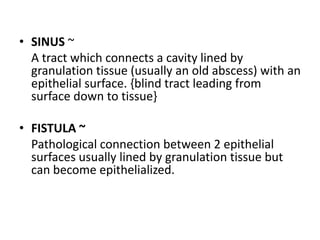
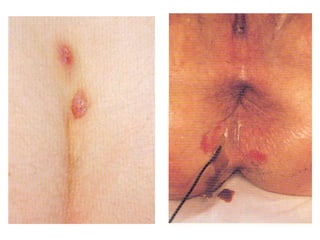
• SINUS ~
A tract which connects a cavity lined by
granulation tissue (usually an old abscess) with an
epithelial surface. {blind tract leading from
surface down to tissue}
• FISTULA ~
Pathological connection between 2 epithelial
surfaces usually lined by granulation tissue but
can become epithelialized.
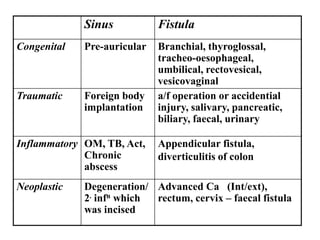
Sinus Fistula
Congenital Pre-auricular Branchial, thyroglossal,
tracheo-oesophageal,
umbilical, rectovesical,
vesicovaginal
Traumatic Foreign body
implantation
a/f operation or accidential
injury, salivary, pancreatic,
biliary, faecal, urinary
Inflammatory OM, TB, Act,
Chronic
abscess
Appendicular fistula,
diverticulitis of colon
Neoplastic Degeneration/
2. infn which
was incised
Advanced Ca (Int/ext),
rectum, cervix – faecal fistula
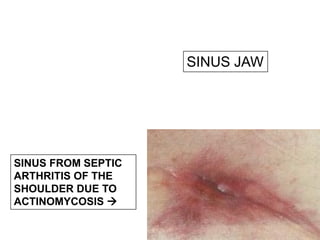
SINUS JAW
SINUS FROM SEPTIC
ARTHRITIS OF THE
SHOULDER DUE TO
ACTINOMYCOSIS 
• History
Since birth - preauricular sinus;
due to Osteomyelitis(high fever + swelling + bone pain)
TB -lymph node enlargement or TB bone or joints
Perianal- h/o perianal/ischiorectal abscess (intermittent
contraction of anal sphincter prevent proper rest)
[Pain + inflammatory/blockage; Fever/redness of
surrounding skin inflammatory]
• Past history TB, Crohn’s, U.colitis, actinomycosis,
colloid Ca, operation complication
• Family history TB, Crohn’s, U.colitis
INSPECTION
• 1.Number – Single/Multiple (watering can perineum –
Crohn’s rectum/anal canal, U.Colitis – fistulae; actinomycosis
(multiple sinueses)
• 2. Site – Preauricular (failure of fusion of ear tubercles - at
root of helix or on tragus of pinna; direction – upwards and
backwards)
Branchial (2nd & 5th branchial arch) at the lower 3rd of
the neck in front of sternomastoid muscle
Pilonidal – in the middle behind, finger webs
Actinomycosis – multiple indurated sinuses in upper
part of the neck
A single sinus over the lower irregular jaw – due to
osteomyelitis OM
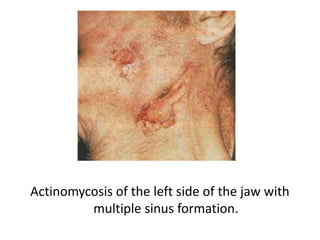
Actinomycosis of the left side of the jaw with
multiple sinus formation.
3. Opening of sinus
Sprouting granulation tissue - + of FB (stitch,
sequestrum, bullet)
Wide margin, thin blue undermined edge – TB
Sinus
4. Discharge
OM  plus; TB  serosanguinous;
Actinomycosis  sulphur granule Urine,
faeces, bile
5. Surrounding skin
Scar indicating Chr. OM or previously healed
TB.
Dermatitis with pigmentation  Chron’s /
Actinomycosis
PALPATION
1. Tenderness  Inflammatory source OM
2. Wall of sinus thickening –fibrosis– chronicity
3. Mobility Sinuses resulting from OM is fixed to
bone (irregular, thickened, tender)
4. Lump  + in neighbourhood  TB adenitis
5. Examination of draining lymph nodes
Examination with a probe (with due
precaution)
• direction and depth of sinus
• presence of F/B (sequestrum),
moveable at wound depth
• fistula communicated with a hollow
viscus or not
• whether fresh discharge comes out on
withdrawal of the probe or not.
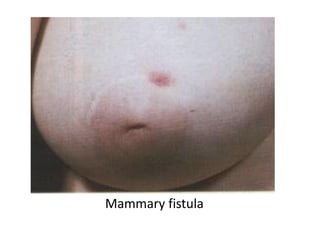
Mammary fistula
General Examination
• Depends on site and cause – particular system
• Sinus in loin - spine, ribs, kidneys
• Chronic empyema - chest
• Osteomyelitis- bone
• Around anus- PR/proctoscopy, sigmoid
scope, whole abdomen
• Multiples in perineum/scrotum lower urinary tract
• Groin sinus hip joint/spine (bursting of cold abscess)
Investigatons
• Examination of discharge –
marcro/physical/chemical/microscopy
• X-rays - sequestrum, opaque foreign
bodies/ sino/fistulogram
Failure to close
• Inadequate drainage
• Specific infection (actinomycosis, TB,
syphilis)
• Foregin body (stitch)
• Epitheliazation of cavity
• Malignant change in the cavity
• Dense fibrosis around the wall of the
tract preventing collapse (empyema)
• Absence of rest
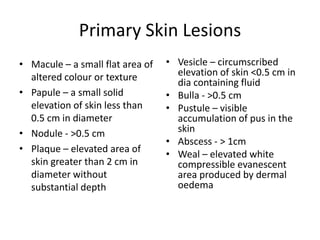
Primary Skin Lesions
• Macule – a small flat area of
altered colour or texture
• Papule – a small solid
elevation of skin less than
0.5 cm in diameter
• Nodule - >0.5 cm
• Plaque – elevated area of
skin greater than 2 cm in
diameter without
substantial depth
• Vesicle – circumscribed
elevation of skin <0.5 cm in
dia containing fluid
• Bulla - >0.5 cm
• Pustule – visible
accumulation of pus in the
skin
• Abscess - > 1cm
• Weal – elevated white
compressible evanescent
area produced by dermal
oedema
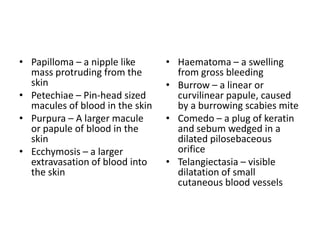
• Papilloma – a nipple like
mass protruding from the
skin
• Petechiae – Pin-head sized
macules of blood in the skin
• Purpura – A larger macule
or papule of blood in the
skin
• Ecchymosis – a larger
extravasation of blood into
the skin
• Haematoma – a swelling
from gross bleeding
• Burrow – a linear or
curvilinear papule, caused
by a burrowing scabies mite
• Comedo – a plug of keratin
and sebum wedged in a
dilated pilosebaceous
orifice
• Telangiectasia – visible
dilatation of small
cutaneous blood vessels
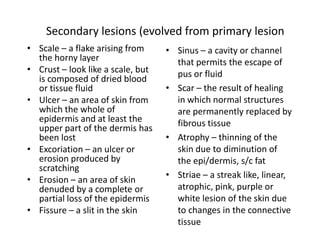
Secondary lesions (evolved from primary lesion
• Scale – a flake arising from
the horny layer
• Crust – look like a scale, but
is composed of dried blood
or tissue fluid
• Ulcer – an area of skin from
which the whole of
epidermis and at least the
upper part of the dermis has
been lost
• Excoriation – an ulcer or
erosion produced by
scratching
• Erosion – an area of skin
denuded by a complete or
partial loss of the epidermis
• Fissure – a slit in the skin
• Sinus – a cavity or channel
that permits the escape of
pus or fluid
• Scar – the result of healing
in which normal structures
are permanently replaced by
fibrous tissue
• Atrophy – thinning of the
skin due to diminution of
the epi/dermis, s/c fat
• Striae – a streak like, linear,
atrophic, pink, purple or
white lesion of the skin due
to changes in the connective
tissue

Sinus fistulae drneerajjain

  • 1.
    SINUSES & FISTULAE DR.NEERAJ K JAIN DEPARTMENT OF GENERAL SURGERY
  • 2.
  • 3.
    • SINUS ~ Atract which connects a cavity lined by granulation tissue (usually an old abscess) with an epithelial surface. {blind tract leading from surface down to tissue} • FISTULA ~ Pathological connection between 2 epithelial surfaces usually lined by granulation tissue but can become epithelialized.
  • 4.
    Sinus Fistula Congenital Pre-auricularBranchial, thyroglossal, tracheo-oesophageal, umbilical, rectovesical, vesicovaginal Traumatic Foreign body implantation a/f operation or accidential injury, salivary, pancreatic, biliary, faecal, urinary Inflammatory OM, TB, Act, Chronic abscess Appendicular fistula, diverticulitis of colon Neoplastic Degeneration/ 2. infn which was incised Advanced Ca (Int/ext), rectum, cervix – faecal fistula
  • 5.
    SINUS JAW SINUS FROMSEPTIC ARTHRITIS OF THE SHOULDER DUE TO ACTINOMYCOSIS 
  • 6.
    • History Since birth- preauricular sinus; due to Osteomyelitis(high fever + swelling + bone pain) TB -lymph node enlargement or TB bone or joints Perianal- h/o perianal/ischiorectal abscess (intermittent contraction of anal sphincter prevent proper rest) [Pain + inflammatory/blockage; Fever/redness of surrounding skin inflammatory] • Past history TB, Crohn’s, U.colitis, actinomycosis, colloid Ca, operation complication • Family history TB, Crohn’s, U.colitis
  • 7.
    INSPECTION • 1.Number –Single/Multiple (watering can perineum – Crohn’s rectum/anal canal, U.Colitis – fistulae; actinomycosis (multiple sinueses) • 2. Site – Preauricular (failure of fusion of ear tubercles - at root of helix or on tragus of pinna; direction – upwards and backwards) Branchial (2nd & 5th branchial arch) at the lower 3rd of the neck in front of sternomastoid muscle Pilonidal – in the middle behind, finger webs Actinomycosis – multiple indurated sinuses in upper part of the neck A single sinus over the lower irregular jaw – due to osteomyelitis OM
  • 8.
    Actinomycosis of theleft side of the jaw with multiple sinus formation.
  • 9.
    3. Opening ofsinus Sprouting granulation tissue - + of FB (stitch, sequestrum, bullet) Wide margin, thin blue undermined edge – TB Sinus 4. Discharge OM  plus; TB  serosanguinous; Actinomycosis  sulphur granule Urine, faeces, bile
  • 10.
    5. Surrounding skin Scarindicating Chr. OM or previously healed TB. Dermatitis with pigmentation  Chron’s / Actinomycosis
  • 11.
    PALPATION 1. Tenderness Inflammatory source OM 2. Wall of sinus thickening –fibrosis– chronicity 3. Mobility Sinuses resulting from OM is fixed to bone (irregular, thickened, tender) 4. Lump  + in neighbourhood  TB adenitis 5. Examination of draining lymph nodes
  • 12.
    Examination with aprobe (with due precaution) • direction and depth of sinus • presence of F/B (sequestrum), moveable at wound depth • fistula communicated with a hollow viscus or not • whether fresh discharge comes out on withdrawal of the probe or not.
  • 13.
  • 15.
    General Examination • Dependson site and cause – particular system • Sinus in loin - spine, ribs, kidneys • Chronic empyema - chest • Osteomyelitis- bone • Around anus- PR/proctoscopy, sigmoid scope, whole abdomen • Multiples in perineum/scrotum lower urinary tract • Groin sinus hip joint/spine (bursting of cold abscess)
  • 16.
    Investigatons • Examination ofdischarge – marcro/physical/chemical/microscopy • X-rays - sequestrum, opaque foreign bodies/ sino/fistulogram
  • 17.
    Failure to close •Inadequate drainage • Specific infection (actinomycosis, TB, syphilis) • Foregin body (stitch) • Epitheliazation of cavity • Malignant change in the cavity • Dense fibrosis around the wall of the tract preventing collapse (empyema) • Absence of rest
  • 19.
    Primary Skin Lesions •Macule – a small flat area of altered colour or texture • Papule – a small solid elevation of skin less than 0.5 cm in diameter • Nodule - >0.5 cm • Plaque – elevated area of skin greater than 2 cm in diameter without substantial depth • Vesicle – circumscribed elevation of skin <0.5 cm in dia containing fluid • Bulla - >0.5 cm • Pustule – visible accumulation of pus in the skin • Abscess - > 1cm • Weal – elevated white compressible evanescent area produced by dermal oedema
  • 20.
    • Papilloma –a nipple like mass protruding from the skin • Petechiae – Pin-head sized macules of blood in the skin • Purpura – A larger macule or papule of blood in the skin • Ecchymosis – a larger extravasation of blood into the skin • Haematoma – a swelling from gross bleeding • Burrow – a linear or curvilinear papule, caused by a burrowing scabies mite • Comedo – a plug of keratin and sebum wedged in a dilated pilosebaceous orifice • Telangiectasia – visible dilatation of small cutaneous blood vessels
  • 21.
    Secondary lesions (evolvedfrom primary lesion • Scale – a flake arising from the horny layer • Crust – look like a scale, but is composed of dried blood or tissue fluid • Ulcer – an area of skin from which the whole of epidermis and at least the upper part of the dermis has been lost • Excoriation – an ulcer or erosion produced by scratching • Erosion – an area of skin denuded by a complete or partial loss of the epidermis • Fissure – a slit in the skin • Sinus – a cavity or channel that permits the escape of pus or fluid • Scar – the result of healing in which normal structures are permanently replaced by fibrous tissue • Atrophy – thinning of the skin due to diminution of the epi/dermis, s/c fat • Striae – a streak like, linear, atrophic, pink, purple or white lesion of the skin due to changes in the connective tissue