MANAGEMENT OF METASTATIC SOFT
TISSUE SARCOMA AND RECENT
ADVANCES
ADVANCES
Dr. G. Anitha
Dr. G. Anitha
PG in Surgical oncology
Department of Surgical oncology
Government Royapettah Hospital
PROF R. RAJARAMAN UNIT
METASTATIC STS
METASTATIC STS
 50% develop metastases
50% develop metastases
 Most common Site of
Most common Site of
metastases: lung
metastases: lung
 Other sites: liver, lymph nodes
Other sites: liver, lymph nodes
 Myxoid liposarcoma
Myxoid liposarcoma is an exception
is an exception
which metastatize to areas containing
fat
fat
 Isolated soft tissue masses in pelvis,
Isolated soft tissue masses in pelvis,
retroperitoneum, mediastinum,
paraspinal and subcutaneous soft
tissue and bone marrow
tissue and bone marrow are hallmark
are hallmark
of this subtype
of this subtype
Soft tissue sarcomas with
predilection for
predilection for lymph node
lymph node
mets
mets
 Rhabdomyosarcoma
Rhabdomyosarcoma
 Clear cell sarcoma
Clear cell sarcoma
 Epitheloid sarcoma
Epitheloid sarcoma
 Synovial sarcoma
Synovial sarcoma
 Angiosarcoma
Angiosarcoma
Incidence of nodal metastases is < 3%
PRESENTATION
PRESENTATION
 Synchronous in 30%
Synchronous in 30%
 80% present within 2 years
80% present within 2 years
 Usually asymptomatic until imaging
Usually asymptomatic until imaging
reveals metastases
reveals metastases
 Occasionally endobronchial involvement
Occasionally endobronchial involvement
leads to stridor, atelectasis or
postobstructive pneumonia
 Median survival : 12 months
Median survival : 12 months
 2yr survival: 20%- 25%
2yr survival: 20%- 25%
 Exception is
Exception is alveolar soft part
alveolar soft part
sarcoma
sarcoma where the survival is
where the survival is
prolonged even with metastases
Treatment is individualised
based on
based on
patient factors
patient factors
disease factors
disease factors
limitations imposed by prior treatment
NCCN GUIDELINES
NCCN GUIDELINES
SURGICAL RESECTION OF PULMONARY METS
 Surgical resection is the
Surgical resection is the
cornerstone of treatment
 3yr overall survival rate of 30%- 54%
3yr overall survival rate of 30%- 54%
 5yr overall survival rate of 25% -
5yr overall survival rate of 25% -
38%
38%
 40%- 80% will have recurrence
40%- 80% will have recurrence after
after
resection
resection
 Repeat resection can be done
Repeat resection can be done
 Chemotherapy has no survival benefit
Chemotherapy has no survival benefit
in patients with pulmonary mets
irrespective of resection
CRITEREA FOR PATIENT SELECTION
 The primary tumour is controlled
The primary tumour is controlled
or controllable
or controllable
 There is no extrathoracic disease
There is no extrathoracic disease
 Adequate predicted postoperative
Adequate predicted postoperative
pulmonary reserve
pulmonary reserve
 Complete resection of all disease
Complete resection of all disease
appears possible
appears possible
Resection can be done even if there are
multiple ipsilateral or bilateral mets
CONTRAINDICATIONS FOR RESECTION
 Poor pulmonary reserve indicated by
Poor pulmonary reserve indicated by
predicted postop FEV1 <0.8L or <35%
predicted postop DLCO <40%
hypercarbia >45mm
hypercarbia >45mm
hypoxemia <60mm
hypoxemia <60mm
 Presence of hilar and mediastinal
Presence of hilar and mediastinal
lymphadennopathy
lymphadennopathy
 Presence of malignant pleural effusion
Presence of malignant pleural effusion
PROGNOSTIC FACTORS
PROGNOSTIC FACTORS
 Disease free interval > 1 year
Disease free interval > 1 year
 Number of nodules < 3 nodules
Number of nodules < 3 nodules
 Low grade histology
Low grade histology
 Complete resection
Complete resection
Favourable
factors
Unfavourable factors
 Age > 50yrs
 Histologies like liposarcoma, MPNST
TYPE OF SURGICAL RESECTION
 Wedge excision with
Wedge excision with
negative margin
negative margin
adequate for isolated
pulmonary mets
pulmonary mets
 Lobectomy or
Lobectomy or
pneumonectomy if mets
is adjacent to
is adjacent to
pulmonary artery , vein,
or major bronchus
or major bronchus
APPROACHES FOR UNLATERAL METS
 VATS Vs Thoracotomy
VATS Vs Thoracotomy
 Advantages of VATS
Advantages of VATS: less pain
: less pain
short hospital stay
short hospital stay
reoperation is
reoperation is
easi
easier
er
Dis advantages:
lesions < 5mm will be
missed
Only solitary
peripheral lesions
are amenable
APPROACHES FOR BILATERAL METS
 Staged thoracotomy
Staged thoracotomy
(4-8 weeks interval)
 Median sternotomy
Median sternotomy
Adv: Less postop pain
Dis adv: Exposure
Dis adv: Exposure
suboptimal
suboptimal
 Clamshell approach
Clamshell approach
Adv: execellent exposure
Disadv: more postop pain
RADIOFREQUENCY
RADIOFREQUENCY
ABLATION
ABLATION
Probe is introduced into the tumour under
image guidance
High frequency alternating current
is transmitted through tip
Excitation of molecules
Heating of tissues
Coagulative necrosis
INDICATIONS FOR RFA
INDICATIONS FOR RFA
 Elderly patients
Elderly patients
 Poor surgical candidates
Poor surgical candidates
 Other options have been
Other options have been
exhausted
exhausted
PRE REQUISITES
PRE REQUISITES
 Number of lesions should be < 4
Number of lesions should be < 4
 Size of lesion should be < 3cm in diameter
Size of lesion should be < 3cm in diameter
 Lesion should not be adjacent to hilar or
Lesion should not be adjacent to hilar or
vascular structures
vascular structures
 Emphysematous blebs should not be
Emphysematous blebs should not be
present around the lesion
COMPLICATIONS
COMPLICATIONS
 Pneumothorax (most significant)
Pneumothorax (most significant)
 Pleurisy
Pleurisy
 Hemorrhage
Hemorrhage
 Fistula
Fistula
 Infection
Infection
 Effusion
Effusion
STEREOTACTIC BODY RADIOTHERAPY
 Focussed radiation beams are delivered
Focussed radiation beams are delivered
exclusively around tumour nidus
 High dose RT in single session or few
High dose RT in single session or few
fractionated sessions
 Can be given both with curative and
Can be given both with curative and
palliative intent
palliative intent
 Indicated in tumours < 5 cm and in
Indicated in tumours < 5 cm and in
patients who are poor candidates for
surgery
surgery
CONTRAINDICATIONS
CONTRAINDICATIONS
 Lesions close to airways
Lesions close to airways
 Centrally located tumours
Centrally located tumours
 Lesions close to mediastinal
Lesions close to mediastinal
structures
structures
A high potent biological dose of
radiation is delivered to the tumor.
Multiple radiation beams directed to the
tumor.
Fiducial markers implanted into the tumor.
Respiratory gating technology
Fiducials act as localizing and tracking
devices.
Accurate and precise tumor
localization at the time of
radiation simulation.
ADVANTAGES
ADVANTAGES
 Can be used in patients with
Can be used in patients with
emphysema and COPD
emphysema and COPD
 Patients who are extensively
Patients who are extensively
pretreated with chemotherapy which
affects the pulmonary reserve
 High local control rate is achieved
High local control rate is achieved
 Minimal complications
Minimal complications
 There is no current consensus
There is no current consensus
about the optimal dosage
 Though better local control and
Though better local control and
low toxicity are observed in various
trials, assessment of survival is
not well studied
not well studied
 Future trials are expected in this
Future trials are expected in this
regard
regard
CHEMOTHERAPY
CHEMOTHERAPY
 Single agent
Single agent doxorubicin
doxorubicin is the reasonable
is the reasonable
first line option for palliative chemo
 For patients who progress or relapse after
For patients who progress or relapse after
response to doxorubicin,
response to doxorubicin, ifosfamide
ifosfamide is
is
indicated as 2
indicated as 2nd
nd
line drug
line drug
 Single agent chemo is better than
Single agent chemo is better than
combination chemo
combination chemo
 Various trials revealed no survival benefit
Various trials revealed no survival benefit
with combination chemo
 Gemcitabine
Gemcitabine and
and docetaxel
docetaxel combination
combination
is useful in leiomyosarcomas
OTHER PALLIATIVE MEASURES
 Endobronchial laser debulking to
Endobronchial laser debulking to
establish airway patency in tumours
obstructing main stem bronchus
 EBRT for low grade hemoptysis
EBRT for low grade hemoptysis
 Bronchial artery embolization for
Bronchial artery embolization for
severe hemoptysis
severe hemoptysis
RECENT ADVANCES
RECENT ADVANCES
NEWER DIAGNOSTIC MODALITIES
 Molecular genetic testing
Molecular genetic testing
Conventional cytogenetic analysis
FISH
FISH
RT-PCR
RT-PCR
 Molecular imaging
Molecular imaging
 Optical imaging
Optical imaging
MOLECULAR GENETIC TESTING
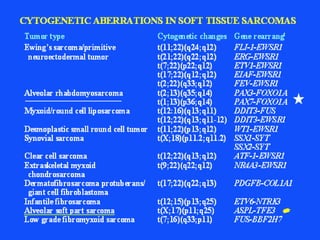
 Sarcomas with specific genetic alterations
Sarcomas with specific genetic alterations
(simple karyotype)
(simple karyotype)
chromosomal translocations
point mutations
point mutations
 Sarcomas with non specific genetic
Sarcomas with non specific genetic
alterations
alterations
(complex unbalanced karyotypes)
 Useful in diagnosis of certain
Useful in diagnosis of certain
subtypes of STS where morphological
and IHC findings are equivocal
 To predict prognosis
To predict prognosis
 Identification of fusion genes aid in
Identification of fusion genes aid in
developing targeted therapies
MOLECULAR IMAGING
MOLECULAR IMAGING
 Imaging the key molecules and molecular
Imaging the key molecules and molecular
events that are fundamental to the
development and progression of cancer
 Nuclear based imaging techniques are
Nuclear based imaging techniques are
used mainly PET scan
 F18 labelled FLT (deoxy fluoro thymidine)
F18 labelled FLT (deoxy fluoro thymidine)
PET is currently under investigation for
STS
STS
F18 FLUORO DEOXY THYMIDINE PET SCAN
 F18 labelled FLT
F18 labelled FLT
FLT monophosphate
FLT monophosphate
 Thymidine kinase activity is more in
Thymidine kinase activity is more in
malignant cells
malignant cells
 Uptake corresponds to proliferation index
Uptake corresponds to proliferation index
 Useful in evaluating response to therapy
Useful in evaluating response to therapy
rather than in diagnosis
Thymidine kinase
Useful in evaluating response to
therapy rather than in diagnosis
FLUORESCENT TOMOGRAPHY
OPTICAL PROBE
OPTICAL PROBE
Fluorochromes can be
fluorescent proteins
or
Quantum dots which are
nanoparticles
NEAR INFRA RED OPTICAL IMAGING
Consists of imaging hardware for visualisation
if near infrared light couple with iv injected
chemical probes that allow in vivo detection of
specific protease activity
OPTICAL IMAGING
OPTICAL IMAGING
 Useful to detect micrometastases
Useful to detect micrometastases
 Response assessment after
Response assessment after
chemotherapy
chemotherapy
 Aids in developing targeted therapies
Aids in developing targeted therapies
 Recently tried in detection of
Recently tried in detection of
microscopic residual sarcoma during
surgery
surgery
Currently this modality is under trial in
mouse model
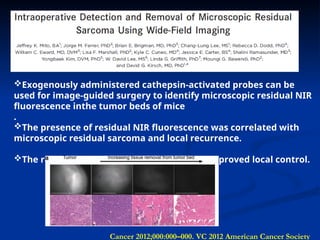
Cancer 2012;000:000–000. VC 2012 American Cancer Society
Exogenously administered cathepsin-activated probes can be
used for image-guided surgery to identify microscopic residual NIR
fluorescence inthe tumor beds of mice
.
The presence of residual NIR fluorescence was correlated with
microscopic residual sarcoma and local recurrence.
The removal of residual NIR fluorescence improved local control.
TARGETED
TARGETED
THERAPIES
THERAPIES
TRABECTEDIN
TRABECTEDIN
 ET743, Ecteinascidin 743
ET743, Ecteinascidin 743
 DNA guanine specific
DNA guanine specific minor groove
minor groove
binding agent
binding agent
 Proved to be effective in phase I and II
Proved to be effective in phase I and II
trials in advanced STS
 Approved 2
Approved 2nd
nd
line agent in
line agent in myxoid
myxoid
round cell liposarcomas
 Side effect: increase in LFT occasionally
Side effect: increase in LFT occasionally
ANGIOGENESIS INHIBITORS
 Angiogenic drive (VEGF)correlates with tumour
Angiogenic drive (VEGF)correlates with tumour
grade
grade
 Anecdotal reports of activity with VEGFR inhibitors,
Anecdotal reports of activity with VEGFR inhibitors,
including sorafenib, cediranib
 Tumour shrinkage observed in patients with
Tumour shrinkage observed in patients with
alveolar soft part sarcoma (ASPS
alveolar soft part sarcoma (ASPS), a rare disease
), a rare disease
unresponsive to chemotherapy
 VEGFR inhibitor
VEGFR inhibitor pazopanib
pazopanib active against sarcomas
active against sarcomas
in EORTC trial, with exception of liposarcomas
MDM 2 ANTAGONISTS
MDM 2 ANTAGONISTS
 MDM2 amplification + in well differentiated and
MDM2 amplification + in well differentiated and
dedifferentiated liposarcomas
 Nutlin –a prototype had only invitro effectiveness
Nutlin –a prototype had only invitro effectiveness
 Spiro oxindoles
Spiro oxindoles (MI-219) binds to MDM2 with high
(MI-219) binds to MDM2 with high
affinity ; under phase I trial
CDK 4 ANTAGONISTS
CDK 4 ANTAGONISTS
CDK4amplification is present in well
differentiated and dedifferentiated
liposarcomas
Flavopiridol, seleciclib ( pan CDK inhibitors )
PD0332991 (selective for CDK4,6 ), PI446A05 (Only available
CDK4 selective inhibitor) are under phase I trial
PPAR –
PPAR – γ
γ AGONISTS
AGONISTS
 Peroxisome proliferator activated
Peroxisome proliferator activated
receptor
receptor γ
γ regulates the terminal
regulates the terminal
differentiation of adipocytic lineage
 Troglitazone, rosiglitazone used in
Troglitazone, rosiglitazone used in
phase II trial in high grade liposarcoma
 There is no convincing evidence
There is no convincing evidence
RECEPTOR TYROSINE KINASE PATHWAY
INHIBITORS
INHIBITORS
MYXOID LIPOSARCOMA
EVEROLIMUS
FORETINIB
FORETINIB
EVEROLIMUS
CONCLUSION
CONCLUSION
 Lung is the most common site of metastasis
Lung is the most common site of metastasis
 Pulmonary metastatectomy can be done with
Pulmonary metastatectomy can be done with
curative intent if the primary is controllable
 RFA, stereotactic radiotherapy are
RFA, stereotactic radiotherapy are
alternatives to surgery
 Single agent chemotherapy is better in the
Single agent chemotherapy is better in the
palliative setting
palliative setting
 Trabectedin is the approved 2
Trabectedin is the approved 2nd
nd
line agent in
line agent in
myxoid liposarcoma
myxoid liposarcoma
THANK YOU
THANK YOU

6. Recent Advances. in soft tissue sarcoma

  • 1.
    MANAGEMENT OF METASTATICSOFT MANAGEMENT OF METASTATIC SOFT TISSUE SARCOMA AND RECENT TISSUE SARCOMA AND RECENT ADVANCES ADVANCES Dr. G. Anitha Dr. G. Anitha PG in Surgical oncology PG in Surgical oncology Department of Surgical oncology Department of Surgical oncology Government Royapettah Hospital Government Royapettah Hospital PROF R. RAJARAMAN UNIT
  • 2.
    METASTATIC STS METASTATIC STS 50% develop metastases 50% develop metastases  Most common Site of Most common Site of metastases: lung metastases: lung  Other sites: liver, lymph nodes Other sites: liver, lymph nodes
  • 3.
     Myxoid liposarcoma Myxoidliposarcoma is an exception is an exception which metastatize to areas containing which metastatize to areas containing fat fat  Isolated soft tissue masses in pelvis, Isolated soft tissue masses in pelvis, retroperitoneum, mediastinum, retroperitoneum, mediastinum, paraspinal and subcutaneous soft paraspinal and subcutaneous soft tissue and bone marrow tissue and bone marrow are hallmark are hallmark of this subtype of this subtype
  • 4.
    Soft tissue sarcomaswith Soft tissue sarcomas with predilection for predilection for lymph node lymph node mets mets  Rhabdomyosarcoma Rhabdomyosarcoma  Clear cell sarcoma Clear cell sarcoma  Epitheloid sarcoma Epitheloid sarcoma  Synovial sarcoma Synovial sarcoma  Angiosarcoma Angiosarcoma Incidence of nodal metastases is < 3%
  • 5.
    PRESENTATION PRESENTATION  Synchronous in30% Synchronous in 30%  80% present within 2 years 80% present within 2 years  Usually asymptomatic until imaging Usually asymptomatic until imaging reveals metastases reveals metastases  Occasionally endobronchial involvement Occasionally endobronchial involvement leads to stridor, atelectasis or leads to stridor, atelectasis or postobstructive pneumonia postobstructive pneumonia
  • 6.
     Median survival: 12 months Median survival : 12 months  2yr survival: 20%- 25% 2yr survival: 20%- 25%  Exception is Exception is alveolar soft part alveolar soft part sarcoma sarcoma where the survival is where the survival is prolonged even with metastases prolonged even with metastases
  • 7.
    Treatment is individualised Treatmentis individualised based on based on patient factors patient factors disease factors disease factors limitations imposed by prior treatment limitations imposed by prior treatment
  • 8.
  • 9.
    SURGICAL RESECTION OFPULMONARY METS SURGICAL RESECTION OF PULMONARY METS  Surgical resection is the Surgical resection is the cornerstone of treatment cornerstone of treatment  3yr overall survival rate of 30%- 54% 3yr overall survival rate of 30%- 54%  5yr overall survival rate of 25% - 5yr overall survival rate of 25% - 38% 38%
  • 10.
     40%- 80%will have recurrence 40%- 80% will have recurrence after after resection resection  Repeat resection can be done Repeat resection can be done  Chemotherapy has no survival benefit Chemotherapy has no survival benefit in patients with pulmonary mets in patients with pulmonary mets irrespective of resection irrespective of resection
  • 11.
    CRITEREA FOR PATIENTSELECTION CRITEREA FOR PATIENT SELECTION  The primary tumour is controlled The primary tumour is controlled or controllable or controllable  There is no extrathoracic disease There is no extrathoracic disease  Adequate predicted postoperative Adequate predicted postoperative pulmonary reserve pulmonary reserve  Complete resection of all disease Complete resection of all disease appears possible appears possible Resection can be done even if there are multiple ipsilateral or bilateral mets
  • 12.
    CONTRAINDICATIONS FOR RESECTION CONTRAINDICATIONSFOR RESECTION  Poor pulmonary reserve indicated by Poor pulmonary reserve indicated by predicted postop FEV1 <0.8L or <35% predicted postop FEV1 <0.8L or <35% predicted postop DLCO <40% predicted postop DLCO <40% hypercarbia >45mm hypercarbia >45mm hypoxemia <60mm hypoxemia <60mm  Presence of hilar and mediastinal Presence of hilar and mediastinal lymphadennopathy lymphadennopathy  Presence of malignant pleural effusion Presence of malignant pleural effusion
  • 13.
    PROGNOSTIC FACTORS PROGNOSTIC FACTORS Disease free interval > 1 year Disease free interval > 1 year  Number of nodules < 3 nodules Number of nodules < 3 nodules  Low grade histology Low grade histology  Complete resection Complete resection Favourable factors Unfavourable factors  Age > 50yrs  Histologies like liposarcoma, MPNST
  • 14.
    TYPE OF SURGICALRESECTION TYPE OF SURGICAL RESECTION  Wedge excision with Wedge excision with negative margin negative margin adequate for isolated adequate for isolated pulmonary mets pulmonary mets  Lobectomy or Lobectomy or pneumonectomy if mets pneumonectomy if mets is adjacent to is adjacent to pulmonary artery , vein, pulmonary artery , vein, or major bronchus or major bronchus
  • 15.
    APPROACHES FOR UNLATERALMETS APPROACHES FOR UNLATERAL METS  VATS Vs Thoracotomy VATS Vs Thoracotomy  Advantages of VATS Advantages of VATS: less pain : less pain short hospital stay short hospital stay reoperation is reoperation is easi easier er Dis advantages: lesions < 5mm will be missed Only solitary peripheral lesions are amenable
  • 16.
    APPROACHES FOR BILATERALMETS APPROACHES FOR BILATERAL METS  Staged thoracotomy Staged thoracotomy (4-8 weeks interval) (4-8 weeks interval)  Median sternotomy Median sternotomy Adv: Less postop pain Adv: Less postop pain Dis adv: Exposure Dis adv: Exposure suboptimal suboptimal  Clamshell approach Clamshell approach Adv: execellent exposure Adv: execellent exposure Disadv: more postop pain Disadv: more postop pain
  • 17.
  • 18.
    Probe is introducedinto the tumour under image guidance High frequency alternating current is transmitted through tip Excitation of molecules Heating of tissues Coagulative necrosis
  • 20.
    INDICATIONS FOR RFA INDICATIONSFOR RFA  Elderly patients Elderly patients  Poor surgical candidates Poor surgical candidates  Other options have been Other options have been exhausted exhausted
  • 21.
    PRE REQUISITES PRE REQUISITES Number of lesions should be < 4 Number of lesions should be < 4  Size of lesion should be < 3cm in diameter Size of lesion should be < 3cm in diameter  Lesion should not be adjacent to hilar or Lesion should not be adjacent to hilar or vascular structures vascular structures  Emphysematous blebs should not be Emphysematous blebs should not be present around the lesion present around the lesion
  • 22.
    COMPLICATIONS COMPLICATIONS  Pneumothorax (mostsignificant) Pneumothorax (most significant)  Pleurisy Pleurisy  Hemorrhage Hemorrhage  Fistula Fistula  Infection Infection  Effusion Effusion
  • 23.
    STEREOTACTIC BODY RADIOTHERAPY STEREOTACTICBODY RADIOTHERAPY  Focussed radiation beams are delivered Focussed radiation beams are delivered exclusively around tumour nidus exclusively around tumour nidus  High dose RT in single session or few High dose RT in single session or few fractionated sessions fractionated sessions  Can be given both with curative and Can be given both with curative and palliative intent palliative intent  Indicated in tumours < 5 cm and in Indicated in tumours < 5 cm and in patients who are poor candidates for patients who are poor candidates for surgery surgery
  • 24.
    CONTRAINDICATIONS CONTRAINDICATIONS  Lesions closeto airways Lesions close to airways  Centrally located tumours Centrally located tumours  Lesions close to mediastinal Lesions close to mediastinal structures structures
  • 26.
    A high potentbiological dose of radiation is delivered to the tumor. Multiple radiation beams directed to the tumor.
  • 27.
  • 28.
    Respiratory gating technology Respiratorygating technology Fiducials act as localizing and tracking devices. Accurate and precise tumor localization at the time of radiation simulation.
  • 29.
    ADVANTAGES ADVANTAGES  Can beused in patients with Can be used in patients with emphysema and COPD emphysema and COPD  Patients who are extensively Patients who are extensively pretreated with chemotherapy which pretreated with chemotherapy which affects the pulmonary reserve affects the pulmonary reserve  High local control rate is achieved High local control rate is achieved  Minimal complications Minimal complications
  • 30.
     There isno current consensus There is no current consensus about the optimal dosage about the optimal dosage  Though better local control and Though better local control and low toxicity are observed in various low toxicity are observed in various trials, assessment of survival is trials, assessment of survival is not well studied not well studied  Future trials are expected in this Future trials are expected in this regard regard
  • 31.
    CHEMOTHERAPY CHEMOTHERAPY  Single agent Singleagent doxorubicin doxorubicin is the reasonable is the reasonable first line option for palliative chemo first line option for palliative chemo  For patients who progress or relapse after For patients who progress or relapse after response to doxorubicin, response to doxorubicin, ifosfamide ifosfamide is is indicated as 2 indicated as 2nd nd line drug line drug  Single agent chemo is better than Single agent chemo is better than combination chemo combination chemo  Various trials revealed no survival benefit Various trials revealed no survival benefit with combination chemo with combination chemo  Gemcitabine Gemcitabine and and docetaxel docetaxel combination combination is useful in leiomyosarcomas is useful in leiomyosarcomas
  • 32.
    OTHER PALLIATIVE MEASURES OTHERPALLIATIVE MEASURES  Endobronchial laser debulking to Endobronchial laser debulking to establish airway patency in tumours establish airway patency in tumours obstructing main stem bronchus obstructing main stem bronchus  EBRT for low grade hemoptysis EBRT for low grade hemoptysis  Bronchial artery embolization for Bronchial artery embolization for severe hemoptysis severe hemoptysis
  • 33.
  • 34.
    NEWER DIAGNOSTIC MODALITIES NEWERDIAGNOSTIC MODALITIES  Molecular genetic testing Molecular genetic testing Conventional cytogenetic analysis Conventional cytogenetic analysis FISH FISH RT-PCR RT-PCR  Molecular imaging Molecular imaging  Optical imaging Optical imaging
  • 35.
    MOLECULAR GENETIC TESTING MOLECULARGENETIC TESTING  Sarcomas with specific genetic alterations Sarcomas with specific genetic alterations (simple karyotype) (simple karyotype) chromosomal translocations chromosomal translocations point mutations point mutations  Sarcomas with non specific genetic Sarcomas with non specific genetic alterations alterations (complex unbalanced karyotypes) (complex unbalanced karyotypes)
  • 37.
     Useful indiagnosis of certain Useful in diagnosis of certain subtypes of STS where morphological subtypes of STS where morphological and IHC findings are equivocal and IHC findings are equivocal  To predict prognosis To predict prognosis  Identification of fusion genes aid in Identification of fusion genes aid in developing targeted therapies developing targeted therapies
  • 38.
    MOLECULAR IMAGING MOLECULAR IMAGING Imaging the key molecules and molecular Imaging the key molecules and molecular events that are fundamental to the events that are fundamental to the development and progression of cancer development and progression of cancer  Nuclear based imaging techniques are Nuclear based imaging techniques are used mainly PET scan used mainly PET scan  F18 labelled FLT (deoxy fluoro thymidine) F18 labelled FLT (deoxy fluoro thymidine) PET is currently under investigation for PET is currently under investigation for STS STS
  • 39.
    F18 FLUORO DEOXYTHYMIDINE PET SCAN F18 FLUORO DEOXY THYMIDINE PET SCAN  F18 labelled FLT F18 labelled FLT FLT monophosphate FLT monophosphate  Thymidine kinase activity is more in Thymidine kinase activity is more in malignant cells malignant cells  Uptake corresponds to proliferation index Uptake corresponds to proliferation index  Useful in evaluating response to therapy Useful in evaluating response to therapy rather than in diagnosis rather than in diagnosis Thymidine kinase
  • 40.
    Useful in evaluatingresponse to therapy rather than in diagnosis
  • 41.
  • 42.
    OPTICAL PROBE OPTICAL PROBE Fluorochromescan be fluorescent proteins or Quantum dots which are nanoparticles
  • 43.
    NEAR INFRA REDOPTICAL IMAGING NEAR INFRA RED OPTICAL IMAGING Consists of imaging hardware for visualisation if near infrared light couple with iv injected chemical probes that allow in vivo detection of specific protease activity
  • 44.
    OPTICAL IMAGING OPTICAL IMAGING Useful to detect micrometastases Useful to detect micrometastases  Response assessment after Response assessment after chemotherapy chemotherapy  Aids in developing targeted therapies Aids in developing targeted therapies  Recently tried in detection of Recently tried in detection of microscopic residual sarcoma during microscopic residual sarcoma during surgery surgery Currently this modality is under trial in mouse model
  • 45.
    Cancer 2012;000:000–000. VC2012 American Cancer Society Exogenously administered cathepsin-activated probes can be used for image-guided surgery to identify microscopic residual NIR fluorescence inthe tumor beds of mice . The presence of residual NIR fluorescence was correlated with microscopic residual sarcoma and local recurrence. The removal of residual NIR fluorescence improved local control.
  • 46.
  • 47.
    TRABECTEDIN TRABECTEDIN  ET743, Ecteinascidin743 ET743, Ecteinascidin 743  DNA guanine specific DNA guanine specific minor groove minor groove binding agent binding agent  Proved to be effective in phase I and II Proved to be effective in phase I and II trials in advanced STS trials in advanced STS  Approved 2 Approved 2nd nd line agent in line agent in myxoid myxoid round cell liposarcomas round cell liposarcomas  Side effect: increase in LFT occasionally Side effect: increase in LFT occasionally
  • 48.
    ANGIOGENESIS INHIBITORS ANGIOGENESIS INHIBITORS Angiogenic drive (VEGF)correlates with tumour Angiogenic drive (VEGF)correlates with tumour grade grade  Anecdotal reports of activity with VEGFR inhibitors, Anecdotal reports of activity with VEGFR inhibitors, including sorafenib, cediranib including sorafenib, cediranib  Tumour shrinkage observed in patients with Tumour shrinkage observed in patients with alveolar soft part sarcoma (ASPS alveolar soft part sarcoma (ASPS), a rare disease ), a rare disease unresponsive to chemotherapy unresponsive to chemotherapy  VEGFR inhibitor VEGFR inhibitor pazopanib pazopanib active against sarcomas active against sarcomas in EORTC trial, with exception of liposarcomas in EORTC trial, with exception of liposarcomas
  • 49.
    MDM 2 ANTAGONISTS MDM2 ANTAGONISTS  MDM2 amplification + in well differentiated and MDM2 amplification + in well differentiated and dedifferentiated liposarcomas dedifferentiated liposarcomas  Nutlin –a prototype had only invitro effectiveness Nutlin –a prototype had only invitro effectiveness  Spiro oxindoles Spiro oxindoles (MI-219) binds to MDM2 with high (MI-219) binds to MDM2 with high affinity ; under phase I trial affinity ; under phase I trial
  • 50.
    CDK 4 ANTAGONISTS CDK4 ANTAGONISTS CDK4amplification is present in well differentiated and dedifferentiated liposarcomas Flavopiridol, seleciclib ( pan CDK inhibitors ) PD0332991 (selective for CDK4,6 ), PI446A05 (Only available CDK4 selective inhibitor) are under phase I trial
  • 51.
    PPAR – PPAR –γ γ AGONISTS AGONISTS  Peroxisome proliferator activated Peroxisome proliferator activated receptor receptor γ γ regulates the terminal regulates the terminal differentiation of adipocytic lineage differentiation of adipocytic lineage  Troglitazone, rosiglitazone used in Troglitazone, rosiglitazone used in phase II trial in high grade liposarcoma phase II trial in high grade liposarcoma  There is no convincing evidence There is no convincing evidence
  • 52.
    RECEPTOR TYROSINE KINASEPATHWAY RECEPTOR TYROSINE KINASE PATHWAY INHIBITORS INHIBITORS MYXOID LIPOSARCOMA EVEROLIMUS FORETINIB FORETINIB EVEROLIMUS
  • 53.
    CONCLUSION CONCLUSION  Lung isthe most common site of metastasis Lung is the most common site of metastasis  Pulmonary metastatectomy can be done with Pulmonary metastatectomy can be done with curative intent if the primary is controllable curative intent if the primary is controllable  RFA, stereotactic radiotherapy are RFA, stereotactic radiotherapy are alternatives to surgery alternatives to surgery  Single agent chemotherapy is better in the Single agent chemotherapy is better in the palliative setting palliative setting  Trabectedin is the approved 2 Trabectedin is the approved 2nd nd line agent in line agent in myxoid liposarcoma myxoid liposarcoma
  • 54.

Editor's Notes

  • #2 Extrapulmonary mets are uncommon forms of first mets and usually occurs as late manifestation of widely disseminated disease
  • #9 Optimal treatment requires understanding the natural history of the disease .surgery renders the patient potentially disease free.recurrence is bços non proliferating tumor cells may not have reached detectable size at the time of initial surgical exploration
  • #14 Wedge resection leads to isolation of lung parenchyma, threatening both devitalization of tissue as well as rendering residual tissue without normal airway capacity to clear secretions and avoid infections.in general, pneumonectomy should be avoided unless absoluteky necessary for achieving an R0resection in the absence of alternate therapies
  • #16 With median sternotomy, exposure to hilar, postr, left lower lung fields are inadequate
  • #28 The software is integrated in the 4D CT machine. And strike zone is defined (period in the breathing cycle where the tumor moves the least) at which time the radiation beam is turned on
  • #36 Fusion proteins serve as aberrant transcription factors, encode tyrosine kinases,
  • #37 Alveolar RMS with mets, PAX7-FOXO1 has favourable prognosis than PAX3-FOXO1
  • #47 Understanding the molecular pathogenesis of STS has aided in the development of targeted therapies for some subtypes of STS Does not affect transcription of fusion gene FUS-DDIT3 but dissociate the aberrant transcription factor from its target
  • #51 These agonists bind with PPAR-γ receptor and induce terminal differentiation of normal preadipocytes in human liposarcoma cell lines in vitro