Presented by
D.S.MYDHEESWARAN
N.SIVA
N.NITHYA
 Embedded controllers are small, specialized
computers that are integrated into sensor
nodes.
 They collect data from sensors, processing the
data, and communicate with other nodes in the
network. These controllers are designed to be
very efficient to save energy.
 These scenarios vary widely based on the
requirements of the application, the characteristics
of the environment, and the objectives of the
sensor network deployment.
◦ Types of sources and sinks
◦ Single-hop and multi-hop networks
◦ Multiple sinks and sources
◦ Three types of mobility
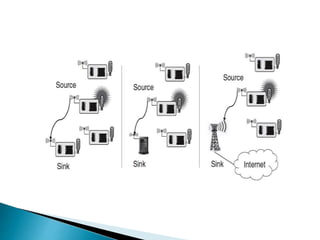
 Several typical interaction patterns found in WSNs – event
detection, periodic measurements, function approximation and
edge detection, or tracking.
 Sources: Any node that provides data / measurements or the
actual nodes that sense data.
 Nodes where information is generated.
 Sinks: Nodes where information is required.
 These sinks sometimes are part of the sensor network itself.
 Sometimes outside the network (Ex: The firefighter’s PDA
communicating with a WSN)
 Is part of an external network (Ex: Internet), somehow connected
to the WSN
 The sink is not interested in the detection of parameters like
source node; In sink data itself is much more important.
 The inherent power limitation of radio
communication follows a limitation on the feasible
distance between a sender and a receiver.
 Because of this limited distance, the direct
communication between source and sink is not
always possible, specifically in WSNs, which are
intended to cover a lot of area / ground (Ex: In
environmental or agriculture applications) or that
operate in difficult radio environments with strong
attenuation (Ex: In buildings).
 To overcome limited communication distances in
Wireless Sensor Networks (WSNs), relay stations can
be used
 In many cases, there are multiple sources
and/or multiple sinks present.
 In the most challenging case, multiple sources
should send information to multiple sinks,
where either all or some of the information has
to reach all or some of the sinks.
Node mobility
Sink mobility
Event mobility

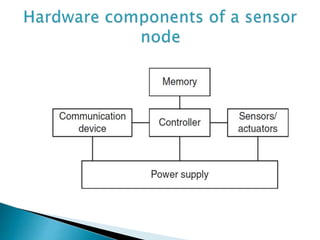
SINGLE NODE ARCHITECTURE Hardware components of a sensor node.pptx

  • 1.
  • 2.
     Embedded controllersare small, specialized computers that are integrated into sensor nodes.  They collect data from sensors, processing the data, and communicate with other nodes in the network. These controllers are designed to be very efficient to save energy.
  • 5.
     These scenariosvary widely based on the requirements of the application, the characteristics of the environment, and the objectives of the sensor network deployment. ◦ Types of sources and sinks ◦ Single-hop and multi-hop networks ◦ Multiple sinks and sources ◦ Three types of mobility
  • 6.
     Several typicalinteraction patterns found in WSNs – event detection, periodic measurements, function approximation and edge detection, or tracking.  Sources: Any node that provides data / measurements or the actual nodes that sense data.  Nodes where information is generated.  Sinks: Nodes where information is required.  These sinks sometimes are part of the sensor network itself.  Sometimes outside the network (Ex: The firefighter’s PDA communicating with a WSN)  Is part of an external network (Ex: Internet), somehow connected to the WSN  The sink is not interested in the detection of parameters like source node; In sink data itself is much more important.
  • 8.
     The inherentpower limitation of radio communication follows a limitation on the feasible distance between a sender and a receiver.  Because of this limited distance, the direct communication between source and sink is not always possible, specifically in WSNs, which are intended to cover a lot of area / ground (Ex: In environmental or agriculture applications) or that operate in difficult radio environments with strong attenuation (Ex: In buildings).  To overcome limited communication distances in Wireless Sensor Networks (WSNs), relay stations can be used
  • 9.
     In manycases, there are multiple sources and/or multiple sinks present.  In the most challenging case, multiple sources should send information to multiple sinks, where either all or some of the information has to reach all or some of the sinks.
  • 11.