The document discusses process stack management in real-time operating systems (RTOS), emphasizing its role in efficiently allocating and maintaining memory stacks for tasks to ensure predictable execution and adherence to deadlines. It outlines the advantages of strong task isolation and efficient memory usage, as well as the disadvantages including complexity in managing multiple stacks and potential stack overflows. Additionally, it explains memory management techniques such as contiguous and non-contiguous schemes, along with paging and segmentation as methods to optimize memory allocation.
Presented by D.S.MYDHEESWARAN; discusses the role of process stack management in RTOS for task reliability and deadline management.
Highlights advantages like predictable execution and task isolation, along with disadvantages such as stack overflows and complexity in managing multiple task stacks.
Focuses on the responsibilities of memory management in RTOS, including allocation and protection of resources.
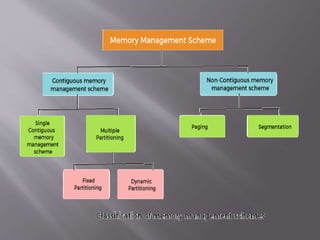
Introduces two main schemes: Contiguous and Non-Contiguous memory management.
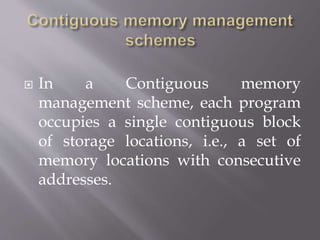
Explains the contiguous memory management scheme where each program occupies a single block of consecutive memory addresses.
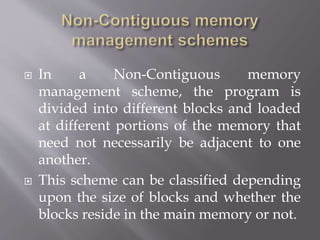
Describes non-contiguous memory management, where programs are divided into different blocks that may not be adjacent.
Discusses paging as a technique to avoid contiguous allocation by dividing memory into fixed-size frames.
Describes segmentation where memory is divided into variable-size segments based on program structure and modules.
Process stackmanagement in a real-time
operating system is responsible for efficiently
allocating, initializing, and maintaining
memory stacks for individual tasks or
processes.
It ensures that tasks can execute predictably,
meet real-time deadlines, and operate reliably
within the constraints of the system's memory
resources
3.
Advantages:
Ensure thattask execution is predictable and meets
deadlines
Provide strong isolation between tasks
Efficient Memory Usage
Disadvantages:
Stack overflows can lead to catastrophic failures
Managing multiple task stacks in an RTOS can be
complex
Potentially limiting the number of tasks the RTOS
can handle efficiently
4.
Memory managementin an RTOS is
responsible for allocating, managing,
and protecting memory resources to
ensure the predictable and reliable
behavior of real-time tasks and the
overall system
In aContiguous memory
management scheme, each program
occupies a single contiguous block
of storage locations, i.e., a set of
memory locations with consecutive
addresses.
8.
In aNon-Contiguous memory
management scheme, the program is
divided into different blocks and loaded
at different portions of the memory that
need not necessarily be adjacent to one
another.
This scheme can be classified depending
upon the size of blocks and whether the
blocks reside in the main memory or not.
9.
Paging isa technique that eliminates the
requirements of contiguous allocation of
main memory. In this, the main memory
is divided into fixed-size blocks of
physical memory called frames.
The size of a frame should be kept the
same as that of a page to maximize the
main memory and avoid external
fragmentation
10.
Segmentation isa technique that eliminates the
requirements of contiguous allocation of main
memory.
In this, the main memory is divided into variable-
size blocks of physical memory called segments.
It is based on the way the programmer follows to
structure their programs. With segmented memory
allocation, each job is divided into several
segments of different sizes, one for each module.
Functions, subroutines, stack, array, etc., are
examples of such modules.